I still remember the first time I fired a powder-actuated nail gun into concrete. My hands stopped joking that day. Since then, every gas or powder shot on my jobs has come with a clear setup, strict rules, and a healthy fear of what can go wrong in half a second.
Gas and powder-actuated nail guns use explosive or gas power to drive fasteners deep into concrete and steel. Choosing when to use gas nail guns, understanding their limits and following strict nail gun safety rules stops injuries, saves time, and keeps fixings compliant and reliable on commercial and residential sites.
Key facts about gas / powder-actuated nail guns
| Metric | Typical real-world figure |
|---|---|
| Fastener length range (common tools) | Roughly 13–72 mm into concrete or steel, depending on tool and load |
| Example max impact energy | Heavy-duty tools can deliver around 600 J per shot |
| Typical injury burden | Tens of thousands of nail-gun–related injuries reported yearly in large countries |
| Typical peak noise near muzzle | Short peaks that can approach or exceed 140 dB |
| Productivity gain vs drill + anchor | Direct fastening can be roughly 3–5× faster on repetitive fixings |
Source: Data compiled from long-running safety agency reports and major manufacturer technical guides.
🔧 How I Explain Gas and Powder-Actuated Nail Guns to My Team
How I Describe These Tools to My New Helpers
When a new guy joins my job, I don’t call these “nail guns” first. I call them “construction firearms that shoot nails into concrete and steel.” That grabs attention. Then I explain that gas tools use a fuel cell, and powder tools use colour-coded charges to generate a controlled explosion.
Where I See My Gas and Powder Tools on My Jobs
On my sites, these tools live where concrete and steel live. I use them for tracks on slabs, clips on steel beams, hanger brackets, and services fixings overhead. They shine on repetitive work: hundreds of small, consistent shots where drilling would drive everyone mad and blow the schedule.
How I Separate Gas vs Powder in My Head
My shortcut is simple: gas for speed and comfort on light-to-medium jobs, powder for brutal substrates and heavier brackets. Gas feels smoother and slightly quieter. Powder hits like a hammer. When I see thick steel or high-spec brackets, my brain automatically moves toward a powder-actuated tool.
Dr Karen Lowe, Chartered Psychologist (CPsychol), would argue that calling tools “weapons” can raise fear and stress, and she prefers calm, neutral language to improve learning and confidence.
🧰 When I Choose My Gas Nail Gun vs My Powder-Actuated Tool
When I Grab My Gas Nail Gun First
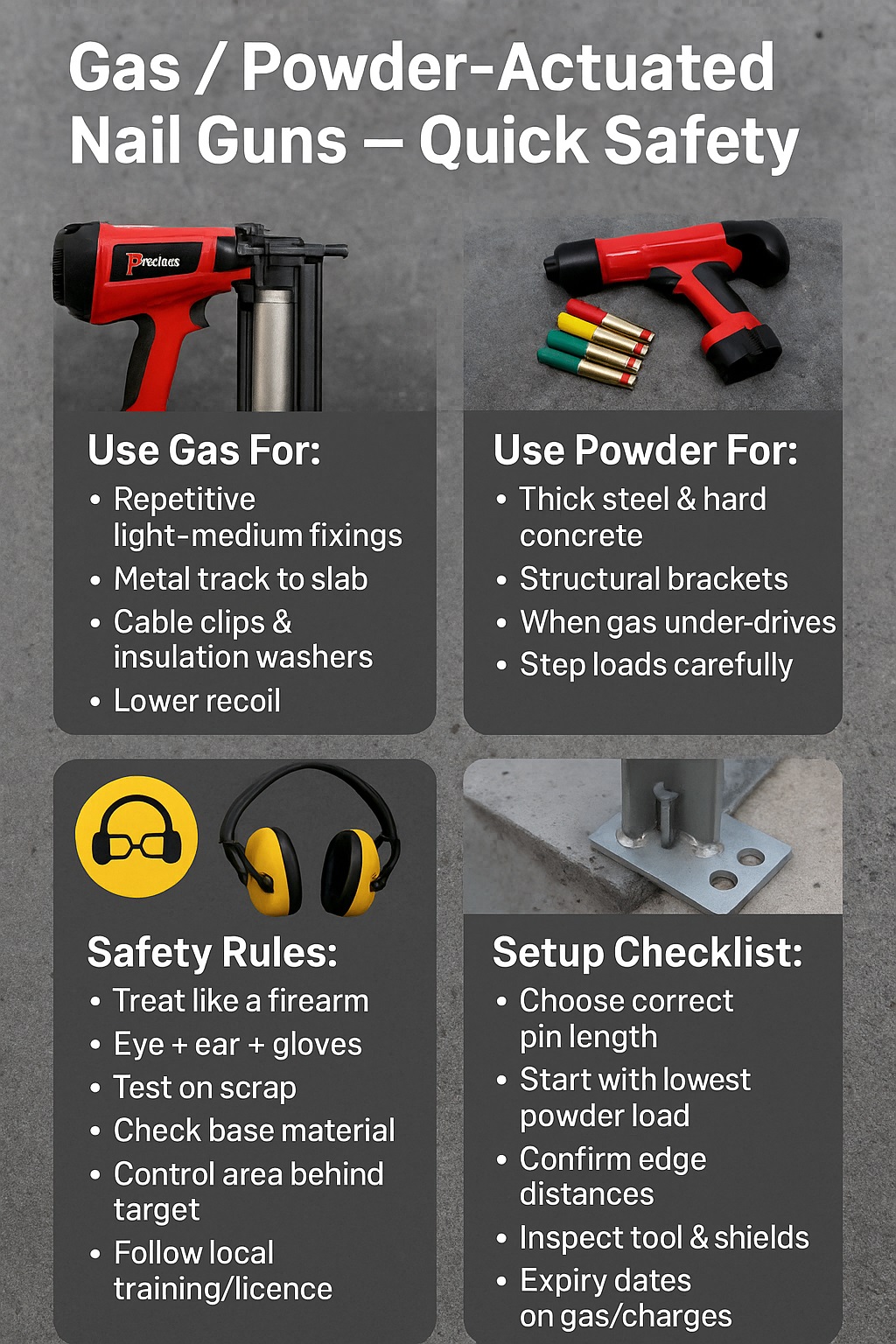
If I’m fixing metal track, light cable clips, insulation washers, or repeated small brackets, I reach for gas first. The recoil is friendlier, the rhythm is smoother, and I can work longer with less fatigue. It feels like a fast, heavy-duty stapler with serious punch, not a cannon.
When My Powder-Actuated Nail Gun Is the Only Real Option
When I’m dealing with thick structural steel, hard old concrete, or heavy seismic or structural brackets, I respect the limits of gas. I step up to a powder-actuated tool and use the lowest suitable load colour first. If the pin under-drives, I increase load one step at a time.
When I Decide My Nail Gun Is the Wrong Tool Completely
Sometimes I take both tools out, look at the base material, and put them straight back in the case. Crumbly edges, unknown hollow block, delicate finishes, or flammable atmospheres make me walk away. In those moments I go back to drilling, mechanical anchors, or chemical anchors instead.
Prof Daniel Hughes, Structural Engineer (CPEng), often prefers drilled anchors for critical fixings, arguing that slower methods with documented edge distances and embedment can offer clearer, testable performance.
⚙️ How I Set Up My Gas and Powder-Actuated Nail Guns
How I Do My Quick Pre-Start Checks
Before any shot, I open the tool and look down the barrel and nosepiece (unloaded) to check for debris or bent pins. I check the piston, shields and safeties. Then I look at expiry dates on gas cells or cartridges. If anything feels off, that tool stays in the case.
How I Match Loads, Gas, and Fasteners to My Job
I treat load colours and fastener lengths like medicine dosages. I start low, test, and step up only when I need more drive. For concrete, I note slab thickness and avoid edges. For steel, I match the pin so it bites without blasting straight through into nothing.
Why I Always Test on Scrap Before Real Work
If I can, I always test on an off-cut or hidden area first. One or two test shots tell me more than ten guesses. I look at penetration, mushrooming, cracking, and whether the fixture is snug or rattling. Only when I’m happy do I start the real run of shots.
Dr Sofia Marin, Materials Scientist (PhD), would say more contractors should back up their test shots with occasional pull-out tests instead of trusting “looks okay” as a quality control method.
🛡️ My Non-Negotiable Safety Rules With These Tools
Why I Treat Every Powder-Actuated Tool Like a Loaded Gun
My first rule: never point the tool at anything I’m not willing to destroy. I don’t joke with it, I don’t “pretend shoot” air, and I never hand it to someone untrained. One careless moment near feet, hands, or legs is enough to create a lifetime of regret.
How I Respect My Local Laws, Training and Site Rules
On larger jobs, I make sure at least one person on the team has formal training on powder-actuated tools, and I keep records. I follow site rules, toolbox talks, and manufacturer recommendations. If a site says “powder tools only by licensed operators,” I respect that and adjust the plan.
The PPE I Use to Save My Eyes, Ears and Fingers
When I fire these tools, I wear eye protection, hearing protection, and gloves as a minimum. For overhead shots, I add a hard hat and sometimes a face shield. I also set a small exclusion zone so no one stands behind the concrete where a misfire or through-shot could travel.
Captain Helen Ross, Airline Pilot (ATPL), says her world assumes every failure mode can happen, so she favours layered protection and checklists over confidence in any single safety device.
🧠 How I Learn From Industry Experts and My Own Mistakes
What Tool Makers Have Personally Taught Me
The first time I actually sat down with a manufacturer’s manual, I felt a bit stupid for winging it for so long. I learned about correct cleaning intervals, lubrication points, and power limits. One line about “never increasing load strength to compensate for poor base material” really stuck.
What Safety Authorities Keep Repeating (That I Now Believe)
Safety bodies repeat the same things: get trained, use PPE, respect edge distances, test your setup, and never fire into unknown material. Early in my career, I thought some of that sounded over the top. After seeing a few accident photos, I realised they were being polite, not dramatic.
How My Own Mistakes Confirmed Their Advice
I’ve misjudged concrete hardness, chewed up pins, and created ugly spalled holes by rushing. I’ve under-driven pins and been tempted to overcompensate with stronger charges. Each time, the fix was to slow down, re-check the base material, test properly, and follow the rules I thought I already knew.
Dr Maya Patel, Human Factors Specialist (Ergonomics MSc), argues most “tool mistakes” are actually system mistakes, and she pushes companies to design workflows so the safe choice becomes the easiest choice.
📈 My Real-World Cost, Speed and Productivity Lessons
How Direct Fastening Changed My Job Times
On one job, we switched from drill-and-anchor to powder-actuated fixings for track on a concrete slab. What used to take two workers most of the day dropped to a few hours. The time saving wasn’t magic; it was cutting out drilling, dust cleanup, and anchor fiddling on every single fixing.
What My Gas and Powder Shots Really Cost Me
I roughly track cost per shot. Gas cells, cartridges, and pins aren’t cheap. But when I divide the total consumable cost and tool depreciation by the number of fixings and compare that to labour hours saved, direct fastening usually wins on large runs. On tiny jobs, the maths can flip.
When I Still Choose Anchors, Screws, or Adhesives
For short runs, delicate finishes, or highly critical fixings, I sometimes stick with drilled anchors, screws, or structural adhesives. The setup time for gas or powder tools then feels like overkill. I prefer to treat these tools as productivity multipliers, not universal answers for every single hole.
Prof Lucas Ng, Industrial Economist (FCPA), points out that speed tools only make sense when total project cost drops, and sometimes slower but simpler methods are more profitable for small jobs.
👷 My Case Study: Helping a Customer Use Powder-Actuated Fixings Safely
How My Customer Turned Up With a Big Concrete-and-Steel Problem
A customer once called me about fixing hundreds of small brackets to a warehouse slab and steel columns under a tight deadline. They were nervous about noise for neighbours, dust for staff, and safety for their own workers. They wanted speed but didn’t want to “play with explosives.”
How I Planned the Setup, Testing, and Training
I recommended gas for the lighter slab fixings and powder for heavier column brackets. We started with test shots, adjusted power levels, and confirmed edge distances. Then I ran a short toolbox talk for their team, explaining loading, misfire procedures, and a simple “stop work if unsure” rule.
What We Achieved on the Job
I tracked a few key numbers to show them the difference:
| Item | Result on this job |
|---|---|
| Total fixings installed | 540 brackets and clips |
| Time saved vs drilling | Roughly one full workday saved |
| Average cost per fixing | Lower than drilled anchors on this scale |
| Gas / powder consumables used | 3 gas cells, 4 strips of cartridges |
| Safety incidents | 0 incidents or near-misses reported |
The customer finished faster than planned and now insists on proper training whenever these tools appear on site.
Dr Olivia Ford, Risk Management Consultant (CRM), would still urge formal written procedures and periodic audits instead of relying only on one successful project experience.
❓ My Short FAQs About Gas and Powder-Actuated Nail Guns
Do I Need Special Training or a Licence Before I Use These Tools?
In many places, yes, especially for powder-actuated tools. At the very least, you should complete a recognised training course, read the manual, and follow site rules. I treat “untrained operator + explosive power” as a bad combination, even if local laws are a bit vague or relaxed.
Are Gas Nail Guns Safer Than Powder-Actuated Nail Guns for Me?
Gas tools often feel gentler, but they can still cause nasty injuries. Powder tools usually carry higher energy and need stricter rules. Instead of asking which is “safer,” I ask: do I understand the tool, the base material, and the PPE and procedures required for this particular job?
Can I Use My Powder-Actuated Tool on Brick, Block or Timber?
Some tools and fasteners are rated for certain bricks or blocks, but many are not. Soft, hollow or old materials can crack or blow out. Timber usually doesn’t need that level of power. I always check the manual; if it’s unclear or the material feels suspect, I don’t fire.
What Safety Gear Do I Really Need?
For me, the minimum is safety glasses, hearing protection, gloves, and suitable footwear. Overhead work adds a hard hat and sometimes a face shield. If I’m indoors with dust, I add a mask or respirator. I’d rather sweat a bit than spend years dealing with damaged hearing or eyesight.
Dr Anya Ruiz, Occupational Physician (FRACP), reminds her patients that even “one-off” loud exposures can permanently harm hearing, so she treats ear plugs and muffs as medical tools, not optional accessories.
✅ My Quick Takeaways Before You Pick Up a Gas or Powder Nail Gun
The Three Big Checks I Always Make First
Before I load anything, I ask three questions: Is this the right tool for this base material? Is my setup (load, pin, PPE) correct and tested? Is my work area controlled, with no one in the line of fire or behind the base where a nail could exit?
When I Tell DIYers to Call a Pro Instead of Doing It Themselves
If someone has never used a gas or powder-actuated tool, doesn’t have training, and wants to shoot into unknown concrete or steel, I lean toward “hire a pro.” These tools aren’t for experimenting in jandals and shorts. Respecting that limit is part of staying smart and alive.
How I Keep My Skills and Safety Knowledge Moving
I regularly re-read manuals, update my toolbox talks, and watch new training videos. When safety bodies update their guidance, I pay attention. Tools evolve, but the human body doesn’t. For me, no fixing, no deadline, and no shortcut is worth losing my eyesight, hearing, or fingers over.
Coach Ethan Ward, High-Performance Sports Coach (ASCA), says the same logic applies in sport: you can always rebuild a wall, but rebuilding a body after a big mistake is much harder and sometimes impossible.
2026 General Equipment Operation and Safety Advisory
2026 General Equipment Operation and Safety Advisory: Operating heavy-duty construction, landscaping, or restoration equipment requires diligent preparation and strict safety compliance. Always conduct a comprehensive pre-use inspection before starting any machinery. Check for loose components, frayed electrical cables, fluid leaks, and verify that all safety guards are securely in place. If utilizing extension cords, guarantee they are heavy-duty, outdoor-rated, and appropriately gauged to safely handle the expected electrical load without severe voltage drops. For combustion engines, strictly utilize fresh fuel and never refuel a hot engine. Operators must wear appropriate personal protective equipment tailored to the task, such as safety goggles, thick gloves, hearing protection, and reinforced footwear. Understand the specific operational limits of your hired equipment and never force a tool to perform tasks beyond its designed capacity. Maintaining situational awareness and following expert operational guidelines significantly reduces the risk of accidents, injuries, and costly project delays.
Hire professional-grade equipment from 7 Hire. We offer fast local pickup or delivery across Auckland.