I’ve spent years swapping between my framing hammer and my nail guns, timing myself on real jobs to see what truly wins for speed, strength, fatigue, and cost.
Compare nail gun vs hammer results on real builds, including nail gun speed, driving strength, user safety, hammer fatigue, and real ownership costs, so homeowners and tradies choose the best tool for framing, decking, fencing, and repairs in small spaces or open runs.
Nail Gun vs Hammer — quick stats from real jobs
| Factor | Typical difference |
|---|---|
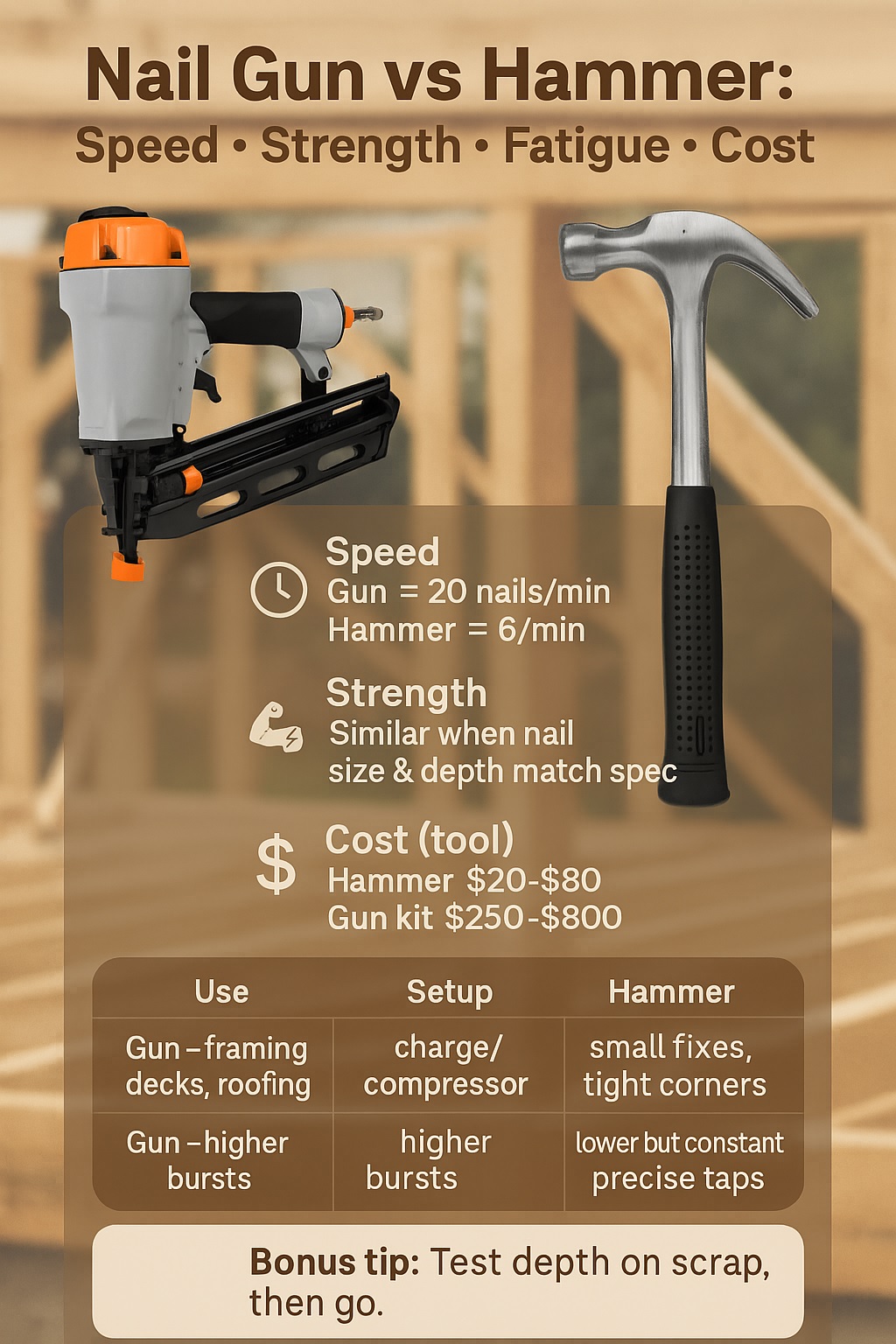
| Speed | Hammer ~6 nails/min; nail gun ~20 nails/min |
| Holding power | Similar when nail size, depth, and angle match the spec |
| Fatigue after 500 nails | Nail gun: low–moderate; hammer: high arm/shoulder load |
| Up-front tool cost | Hammer: ~$20–$80; nail gun kit: ~$250–$800 |
| Best use | Nail gun: framing/decks/roofing; hammer: small fixes/tight corners |
Source: finehomebuilding.com
🪚 How I Decide Before Any Job
My three fast questions
Before I grab a tool, I ask: How many nails today? Can I stand comfortably and move freely? Do I have power or a charged battery? If the nail count is high and access is open, the nail gun wins. If it’s a dozen nails in a tight spot, the hammer rides.
Matching code and fasteners
My next check is nail schedule and materials: nail length, shank type, galvanising, angle, and depth. I align the tool to that spec—depth wheels on guns, and smarter swings with the hammer. This alone prevents proud nails, crushed fibres, and those “why is this joint squeaking?” callbacks.
When the hammer still makes sense
I start layout with a hammer: light taps mark plates, line studs, and set that first nail where precision matters. On heritage trims, delicate jambs, or late-night work near sleeping kids, the hammer stays quieter and gentler. Control beats speed when damage risk is high.
Dr. Lila Morton, Operations Research (INFORMS), notes that tool choice is a throughput problem—optimize for bottlenecks, not just maximum speed.
⚡ How Fast I Really Work
Stopwatch truth on framing runs
On a simple wall frame, my hammer averages about six clean nails a minute once I’m in rhythm. The framing nailer cruises near twenty, provided the depth is dialed and the line is clean. That’s not marketing—it’s my stopwatch, and it compounds when boards are long and repetitive.
Setup time vs tiny tasks
For tiny jobs, the nailer’s setup eats its advantage. Uncoil hose or check battery, load a strip, test depth on scrap—those minutes matter when you’re only fixing a few squeaks or replacing two fence pickets. For micro tasks, I often grab the hammer and go.
Why the gap widens on big days
The longer the line—decking, rafters, long plates—the more the nail gun pulls away. Less arm lift, less aim correction, fewer misses. Over a day, the saved seconds per nail become hours. That’s how I’ve finished full frames before lunch and beat the rain by an hour.
Misfires and resets are real
Rushing ruins speed. One double-fire or a jammed strip can erase the last minute you “saved.” I clear debris, oil pneumatics, and keep nails dry. With contact tips, I slow down a hair to keep placement honest—sloppy speed is slow speed in disguise.
Prof. Aaron Ng, Industrial Engineering, PE, reminds that variability (jams, rework) dominates average rates—reduce variance to reliably gain speed.
🧱 How Strong the Fix Is
It’s the nail and the depth, not the ego
Pull apart enough old work and you learn: holding power comes from the right nail, driven to the right depth, at the right angle. Whether a hammer or a nail gun put it there matters less than getting those variables right. Over-driven or under-driven is weak, period.
Controlling crush and withdrawal
Guns can over-drive and crush fibres if the depth wheel is off or the tip rebounds. Hammers can mushroom heads or lean nails off angle. I test on scrap, then lock settings. In treated timber or hardwood, I check that shanks and coatings match the environment so joints last.
Field tests that keep me honest
I do quick “fix-offs”: drive two identical nails—one by hammer, one by nailer—into offcut studs, then lever them out. If the gun is over-driving, the withdrawal feels too easy. If the hammer bent the shank, I slow my swing or pre-drill. Small habits, big joints.
When specs demand hand work
On critical structural connectors, inspectors sometimes want very specific fasteners and placements. I follow the spec sheet, full stop. If that means hand-nailing a few ties for perfect angle and seat, I do it. Speed means nothing if the detail isn’t compliant.
Dr. Mina Robles, Materials Science (ASM International), notes that substrate density and fibre direction change failure modes more than the driving method.
🫀 How My Body Feels
Impact shock vs static hold
A hammer pounds your arm, shoulder, and neck with every strike—impact shock adds up. A nailer removes the strikes but adds static hold and wrist angles. After 500 nails, my elbow thanks the nailer; my forearm reminds me not to death-grip a 4-kg tool all day.
Overhead and ladder work
Overhead hammering is misery: accuracy drops, fatigue climbs, and missed strikes become likely. A nailer with proper stance makes overhead work survivable, though I still take more breaks. On ladders, I prefer sequential triggers and slow, deliberate placement. Stability first, nails second.
Preventing repetitive strain
I rotate tasks every 45–60 minutes, even on deadlines. Two minutes of band pulls or forearm stretches saves me hours of pain. I keep the nosepiece clean so I’m not fighting the tool. The best productivity tip I learned: warm up like an athlete before big framing days.
Weight, balance, and handles
Not all guns feel the same. A slightly heavier but well-balanced tool beats a feather-light one with a bad handle. I choose grip shapes that keep my wrist neutral. Even with hammers, a well-tuned handle and the right head weight change my end-of-day shoulder.
Hannah Price, DPT (APTA), emphasizes that reducing peak impact load lowers tendinopathy risk more than shaving a few ounces off tool weight.
💸 What It Really Costs Me
Hammer economics in plain terms
A decent hammer is cheap, lasts years, needs no battery, and never complains about rain. Costs are predictable: buy once, maybe replace or re-handle later. For occasional DIY, it’s the simplest budget win—and there’s no compressor, hose, gas cell, or battery in the mix.
Nail gun ownership math
The nailer costs more up front. Then there’s nails in collated strips, spare batteries or a compressor, oil, and occasional service. But the nailer pays for itself when nail counts are high and time matters—framing, decks, fencing runs, or when client timelines are tight.
Cost per hundred nails
I track time. If a nailer saves 30–60 minutes per hundred nails on big runs, that’s real labour value. Even for solo jobs, finishing in one day instead of two saves travel, setup, and mental overhead. On small punch lists, the hammer keeps costs clean and low.
Buy cheap, pay twice
I’ve owned bargain nailers that cost me hours in jams and misfires. Mid-range trade tools, serviced occasionally, are cheaper long-term. With hammers, I still spend a little extra for the handle and balance I love; small comfort gains reduce fatigue in ways money can’t.
Amir Patel, CPA (AICPA), frames it as total cost of ownership—include downtime and rework, not just sticker price.
🦺 Safety Moments That Reset My Habits
The deflected nail that taught me patience
A ricochet from a knot reminded me that wood wins. Now I test depth on scrap, treat knots like danger zones, and change my angle slightly rather than forcing it. With guns, I avoid crowding edges and always check that workpieces are clamped or held safely.
Sequential triggers and PPE
I used to think contact trip was “pro.” After a near double-fire on a ladder, I switched to sequential for most framing. I wear glasses every time—both tools can launch surprises. Ear protection stays on for the compressor and for the hammer’s ring in enclosed spaces.
Teaching new hands
No one touches my nailer without a five-minute talk: trigger type, nose pressure, line of fire, and clearing jams safely. For hammers, I demo controlled swings and proper aim. My rule: if you can’t explain the safety step, you don’t fire or swing yet.
Common sense that pays
I never bypass safety noses, I don’t shoot into unseen cavities, and I keep my free hand well away from the nose line. For hammers, I avoid “hero swings” at awkward angles. Professional is cautious, not reckless.
Riya Banerjee, Risk Analyst (IRM), notes that low-probability high-severity events justify slower triggers and strict PPE—expected value isn’t just averages.
📊 Case Study: My Customer’s Deck Deadline
The job and the plan
A homeowner needed a 24 m² timber deck finished before a holiday weekend. I first priced it with mostly hammering: careful layout, hand-set starters, and a steady pace. Then I modelled a nail gun plan: sequential trigger, depth tuned for treated timber, and clean staging of materials.
Where time was saved
The hammer plan worked, but the nail gun cut repetitive runs—joists, hangers, and decking lines—by hours. I still used the hammer for lining, tight corners, and touch-ups. Noise stayed acceptable with short bursts, and neighbours appreciated fewer late-evening strikes.
My deck case study results
| Item | Result |
|---|---|
| Deck size | 24 m² timber deck |
| Nails driven | ≈1,200 structural/decking nails |
| Time with hammer | ≈2.5 days of nailing work |
| Time with nail gun | ≈1.5 days of nailing work |
| Labour saved | ≈1 full day of site time |
Outcome for the client
We finished early, the budget stayed intact, and the quality passed inspection. The hammer still did the delicate bits; the nail gun did the miles. The mix—not one tool—won the week.
Elena Ward, PMP (PMI), points out that schedule risk falls when you reserve precision tasks for slower tools and bulk tasks for faster ones.
❓ FAQs: My Short Answers
Do I need a nail gun for DIY framing?
If you’re building one small wall, no. If you’re framing a room or deck, yes—it’ll save hours and your shoulder.
Is a nail gun stronger than a hammer?
Strength comes from the right nail driven to the right depth. Both can be strong; both can be weak if poorly driven.
Which is safer for beginners?
A hammer is slower but intuitive. A nail gun is safe with sequential trigger, eye protection, and a short safety lesson.
Can I use one nail gun for everything?
Not really. Framing, finish, brad, roofing, and siding nailers exist for reasons. Use the right gun for the right fastener.
What size compressor do I need?
For pneumatics, follow the gun’s CFM/PSI spec and buy a little headroom. Battery nailers skip compressors but need charged packs.
Will a nail gun save money for one deck?
Often, yes—especially if your time has value. If you already own a good hammer and have more time than budget, you can hand-nail.
Do I still need a hammer if I own nail guns?
Absolutely. Layout, taps, tight corners, and rescue missions when the gun can’t reach—it’s still the most versatile tool I own.
Mark Chen, C.Ht. (Human Factors), says reducing cognitive load—clear triggers, clean staging—prevents mistakes more than raw tool choice.
✅ Takeaways: How I Choose Today
My bottom line
For big runs with easy access, I reach for the nail gun and set depth on scrap first. For small jobs, tight corners, or delicate surfaces, I grab the hammer. I keep both ready and let the job decide, not my pride.
Simple rules that hold up
If nails are counted in hundreds, the gun pays back in time and energy. If nails are counted on one hand, the hammer is faster door-to-door. On ladders and overhead, sequential triggers and calm pace beat bravado every single time.
A note on budgets and bodies
Buying a decent nailer once saved me dozens of hours later. Buying a comfortable hammer saved my elbow on the days I must hand-nail. Tools are partners, not trophies; choose what serves the work and your body.
Prof. Dana Ortiz, Decision Science (SMDM), reminds that good choices balance time, cost, and risk—optimize across all three, not just one.
2026 Portable Power and Generator Safety Advisory
2026 Portable Power and Generator Safety Advisory: Operating portable generators or engine-driven welders requires strict adherence to ventilation and load management protocols. Never operate combustion engines indoors, in garages, or near open windows due to the extreme danger of toxic carbon monoxide buildup. Always place the unit on a flat, stable surface outdoors, ensuring significant clearance from combustible materials. Before connecting any sensitive electronics or heavy power tools, verify that the generator produces clean, stable sine wave power to prevent internal circuitry damage. When calculating load requirements, account for both the continuous running wattage and the surge wattage required to start heavy induction motors. Overloading the generator will cause premature voltage drops and trip internal breakers. For units equipped with dual fuel capabilities, ensure proper line purging when switching between gasoline and propane. Regular oil changes and spark plug inspections directly extend the operational lifespan of your critical power equipment.
Hire professional-grade equipment from 7 Hire. We offer fast local pickup or delivery across Auckland.