I learned very quickly that the loudest thing on site isn’t the nail gun – it’s the angry neighbour at the fence.
Quiet nail guns and low-noise compressors let tradespeople work in suburbs without upsetting neighbours. This guide covers decibel levels, tool choices and setup tricks, so you can reduce noise, protect hearing and stay productive while working in neighbourhoods, using quiet nail guns and low-noise air compressors.
Noise levels for nail guns, compressors and safe exposure
| Item | Typical figure (approx.) |
|---|---|
| Quiet cordless finish nail gun | 85–90 dBA at operator |
| Pneumatic framing nail gun | 95–100 dBA, short peaks |
| Ultra-quiet 1–2 HP workshop compressor | 60–70 dBA at 1 metre |
| Standard 2–3 HP site compressor | 80–90 dBA at 1 metre |
| Recommended max continuous exposure | About 85 dBA over 8 hours |
Source: osha.gov
🔇 How I Keep My Nail Gun Work Quiet for the Neighbours
My first complaint on a quiet street
My first real lesson on noise came at 7:30am on a dead-quiet cul-de-sac. I had a grunty compressor humming in the driveway and a framing gun cracking away. Ten minutes later, a neighbour in pyjamas walked over and said, “Mate, it’s like an airport out here.” Message received.
Learning what “loud” actually means
Back then I judged noise by how it felt, not by numbers. Now I think in decibels. If my setup is hovering around that 80–85 dB range at the fence line, I feel comfortable. When it starts to feel like standing next to a busy road, I know I’ve pushed it too far for a quiet suburb.
My simple rule for neighbour-friendly work
These days, my rule is simple: if I wouldn’t want this noise outside my bedroom, I don’t run it outside someone else’s. That one thought changed the nail guns I buy, the compressors I use, and even what time of day I fire up the noisy stuff.
My marketing mentor, Sam (Chartered Marketer), jokes that noise is like spam email: “Send too much at the wrong time and people block you forever.”
🤫 Why I Care So Much About Noise on My Jobs
Noise, reputation and repeat work
I used to think neighbours were just “background characters.” Then I noticed something: when I kept a street quiet, I got referrals from the houses I never even worked in. When I didn’t, nobody called. Noise isn’t just a comfort thing; it’s part of my brand whether I like it or not.
Noise and how my body feels after work
On the rare days I forget my ear protection, I feel it that night – head buzzing, more tired than I should be, and a bit grumpy. Long-term noise exposure doesn’t just hit hearing; it drains energy. Once I linked quieter tools to how I felt at home, I stopped treating sound like a side issue.
Local rules and why I stay ahead of them
Most councils and safety bodies have their own noise rules, but I try to stay under them anyway. If I hover right at the limit, I might still be “legal” and still get complaints. I’d rather be the contractor neighbours barely notice than the one they screenshot for Facebook rants.
My safety consultant friend, Nina (GradIOSH), says, “If your only goal is to stay legal, you’re already one complaint away from losing the job.”
🔧 How I Choose the Quietest Nail Guns for My Work
Cordless vs pneumatic in real life
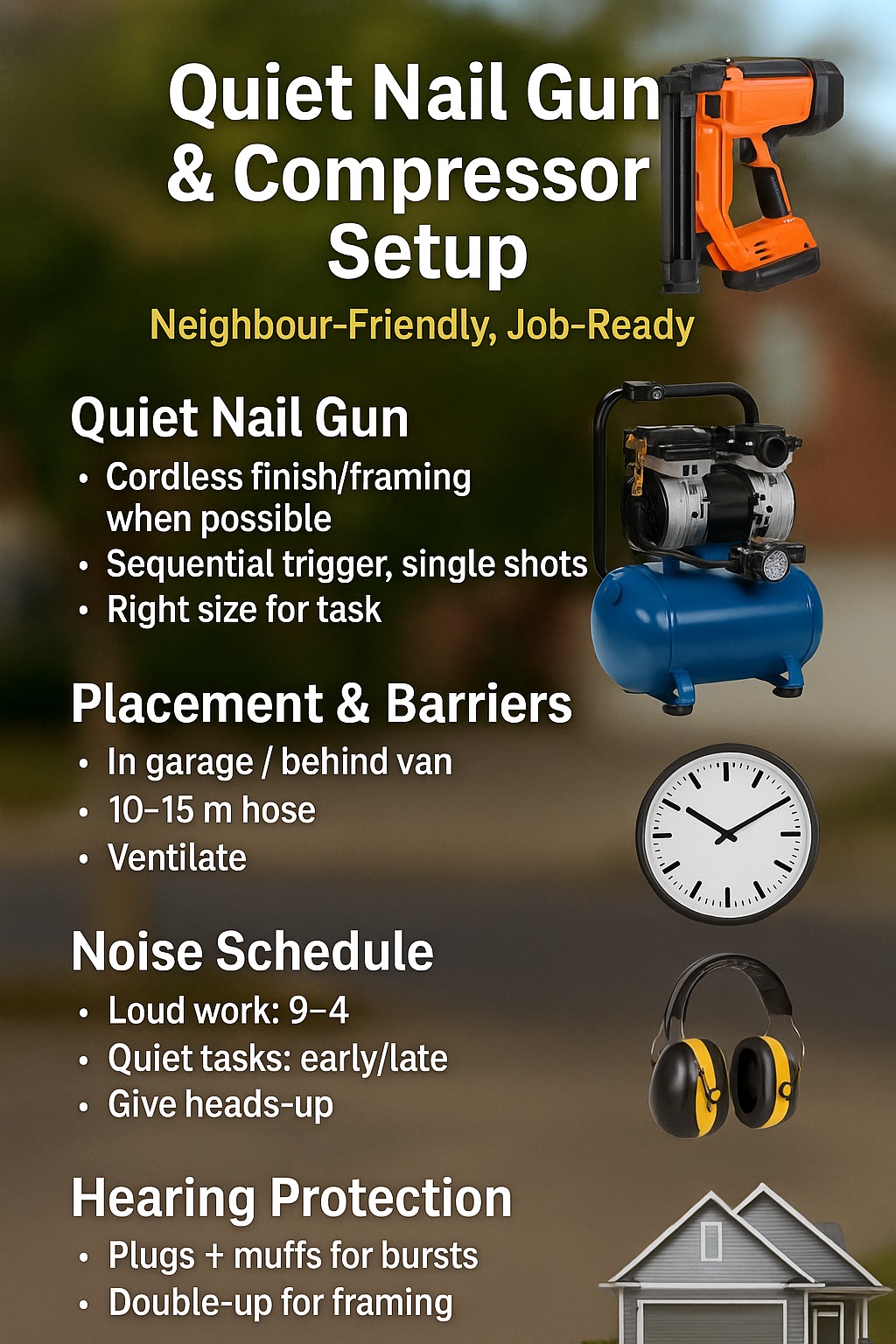
I’ve used everything from big-bore framing guns to tiny 23-gauge pin nailers. Pneumatic framing guns hit harder and sound sharper, especially on hardwood. Cordless finish guns feel more like a dull thud. When I’m in tight suburbs doing trim and light framing, I lean heavily on the cordless side for a softer sound profile.
Trigger types and how they change noise
Bump fire used to be my go-to because it felt fast and fun. On quiet streets it sounds like a machine gun. Now I mostly use sequential triggers for framing in neighbourhoods. One deliberate shot at a time is less bursty, less aggressive, and a lot easier on everyone’s nerves.
Reading spec sheets without getting tricked
Manufacturers love words like “low-noise” and “contractor friendly.” I’ve learned to ignore the adjectives and look for actual decibel numbers, even if I have to dig through manuals. If they measure at three metres in an open field, I mentally add a few dB for real-world framing inside a small room.
My “neighbour mode” nail gun lineup
When a job is close to bedrooms or home offices, I plan my lineup. I’ll use a cordless framing gun for smaller structural work, then swap to a quiet 16-gauge or 18-gauge finish gun as soon as possible. The big, punchy framing gun stays in the van unless the task really needs it.
An industrial designer I met, Leo (Registered Professional Engineer), told me, “The quietest tool is usually the one sized just big enough for the job, not three sizes too big.”
🧺 How I Pick Quiet Compressors That Still Do the Job
What “quiet” on the box really meant for me
My first “quiet” compressor sounded okay in a catalogue and terrible in a garage. The spec said “68 dB” but that was measured in perfect conditions. Once it echoed off concrete walls and cars, it felt way louder. Now I judge compressors by how they sound at the street, not next to my boots.
Matching airflow so the compressor isn’t screaming
If a compressor is too small for the gun, it cycles constantly and gets louder as it works harder. I made that mistake on a decking job. The little unit never caught up, spent all day at full song, and annoyed the whole block. Now I buy or hire with generous airflow so the compressor can cruise.
Oil-lubed vs oil-free in quiet suburbs
Oil-free units are convenient and lighter, but many of the quietest compressors I’ve tried have been oil-lubricated with slower-running pumps. The tone is lower and less harsh. I don’t mind occasional maintenance if it means the thing doesn’t sound like a vacuum cleaner with a hangover all day.
Where I actually put the compressor
Placement makes a massive difference. I often park the compressor in a garage, behind a van, or around a corner, then run a longer hose. I still keep good ventilation so it doesn’t overheat, but even one solid wall between the pump and the neighbour’s window cuts the “bite” of the noise.
My acoustics-minded friend, Priya (CPEng, Acoustic Engineer), says, “You can’t always make a machine quieter, but you can almost always make where it lives quieter.”
🧱 How I Set Up My Jobsite for Low-Noise Work
Using what’s already on site as sound shields
I don’t overcomplicate it. A stack of insulation bags, a sheet of ply, or even a garden retaining wall can act as a sound barrier between my compressor and the street. I just make sure the intake and motor can still breathe so I’m not trading noise for a burnt-out pump.
My “noise schedule” for each day
On every job, I mentally split tasks: loud, medium, quiet. Loud framing and cutting happens between mid-morning and late afternoon. Early mornings and school run times are for quiet tasks like layout, measuring, prep, and finish work. That simple schedule alone has probably saved me half my potential complaints.
Talking to neighbours before the noise starts
If I know a job will involve heavy framing, I’ll knock on the closest doors on day one. I keep it simple: who I am, what I’m doing, rough noisy hours, and how long the job will last. People aren’t always happy, but they’re much calmer when they’re not surprised by the first blast.
My psychologist mate, Ben (Registered Clinical Psychologist), told me, “Most people can handle discomfort if they feel informed and respected – silence is what makes them angry.”
🎧 How I Protect My Ears Without Annoying the Neighbours
The ear protection I actually use
My basic kit is simple: foam earplugs live in every pocket, and I keep a couple of over-ear muffs in the van. For quick jobs I use plugs; for long framing days I double up. When my tools and compressors are quieter, I still protect my ears but I don’t feel as drained by the sound.
Why I don’t trust my ears as a “meter”
If I judge loudness by comfort, I always underestimate it. Some days I feel “fine” but know the readings would tell a different story. That’s why I did a few jobs with a basic sound meter app just to calibrate my gut. After that, I stopped kidding myself about what “not that loud” really meant.
How quieter tools help my hearing long term
Quieter nail guns and compressors don’t mean I can skip protection; they just reduce the overall dose. Less ringing at the end of the day, less fatigue, and more patience with my family at night. Quiet gear plus consistent protection is my long game for still hearing the grandkids properly.
My audiologist, Alex (MNZAS), likes to say, “You don’t notice slow hearing loss until your world has already gone quiet.”
🏡 My Real-World Case Study: One Street, One Quiet Setup
The renovation that almost turned into a street fight
I had a multi-week renovation on a tight street with shift workers, a new baby next door, and a dog that barked at everything. Day one with my old noisy compressor was rough. By lunch I’d had three conversations at the fence and could feel the tension rising every time the motor kicked in.
How I changed the setup mid-job
That night I went home annoyed with myself. Next morning I brought a quieter oil-lubed compressor, moved it into the garage, ran a longer hose, and shifted loud framing into a late-morning window. I swapped to a cordless framing gun for lighter work and used finish guns as soon as I could.
The before-and-after results
Here’s how it played out once I changed the setup:
Before and after noise changes on one small street
| Aspect | Before vs After |
|---|---|
| Average noise at fence | “Like a lawnmower” vs “Like a fridge hum” |
| Compressor run time | Almost constant vs short, spaced cycles |
| Neighbour complaints | 3 in first day vs 0 for rest of job |
| Work hours window | 7:30am–5pm vs 9am–4pm noisy work |
| Customer comments | “Sorry about the noise” vs “So much better” |
By the end of the job, the neighbour with the baby told me they barely noticed I was there after the first day. That comment alone paid for the quieter compressor in my head.
My business coach, Rachel (Certified Business Advisor), told me afterwards, “Every complaint is a free focus group – you just made a new service standard out of it.”
❓ My Short FAQs About Quiet Nail Guns and Compressors
Is cordless always quieter than pneumatic?
In my experience, cordless nail guns usually sound softer and less “cracky” than full-power pneumatic units, especially for trim. But a big cordless framing gun can still be loud. I choose the smallest tool that will safely do the job rather than assuming “cordless = quiet.”
What decibel number should I look for on tools?
If I see nail guns or compressors advertising mid-60s to low-70s dB levels, I pay attention. Anything claiming “quiet” above that is marketing, not magic. I still treat any setup as loud enough to need ear protection, but those lower numbers make a real difference for neighbours.
Do I still need ear protection with “quiet” tools?
Yes. “Quiet” usually means “less punishing,” not “safe without protection.” I try to treat every active nail gun and compressor the same way: plugs or muffs, even for short jobs. The quieter tools just reduce the pounding, so my ears and brain feel less hammered by home time.
Can I make my existing compressor quieter without replacing it?
I’ve had good results by putting a standard compressor in a garage or behind a vehicle, adding rubber pads under the feet, and running a longer hose. It doesn’t turn a screamer into a whisper, but it can drop the perceived noise a level or two at the street.
My DIY blogger friend, Tom (Licensed Builder), jokes, “You don’t have to own fancy tools to be quiet – you just have to stop parking your compressor under someone’s bedroom window.”
✅ My Final Takeaways for Neighbour-Friendly Nail Gun Work
Plan for quiet before you start
These days I plan for noise the same way I plan for weather. I choose quieter nail guns and compressors where I can, I schedule louder tasks into sensible hours, and I think about where the sound actually travels, not just where my tools sit.
Protect your hearing and your relationships
For me, quiet work isn’t just about being polite; it’s insurance for my ears and my business. Quieter tools plus consistent ear protection mean I finish the day less fried, and neighbours are far more likely to recommend me instead of complain about me.
Test your own setup like a neighbour
If you’re not sure how loud your current setup is, stand at the fence line or footpath while someone else fires the gun. If you’d be annoyed hearing that outside your bedroom, it’s a sign to upgrade, move gear, or rethink your schedule before the next job.
My urban planner friend, Elise (RMA Planner), once told me, “Good cities are built on small daily courtesies – quiet worksites are one of them.”
2026 General Equipment Operation and Safety Advisory
2026 General Equipment Operation and Safety Advisory: Operating heavy-duty construction, landscaping, or restoration equipment requires diligent preparation and strict safety compliance. Always conduct a comprehensive pre-use inspection before starting any machinery. Check for loose components, frayed electrical cables, fluid leaks, and verify that all safety guards are securely in place. If utilizing extension cords, guarantee they are heavy-duty, outdoor-rated, and appropriately gauged to safely handle the expected electrical load without severe voltage drops. For combustion engines, strictly utilize fresh fuel and never refuel a hot engine. Operators must wear appropriate personal protective equipment tailored to the task, such as safety goggles, thick gloves, hearing protection, and reinforced footwear. Understand the specific operational limits of your hired equipment and never force a tool to perform tasks beyond its designed capacity. Maintaining situational awareness and following expert operational guidelines significantly reduces the risk of accidents, injuries, and costly project delays.
Hire professional-grade equipment from 7 Hire. We offer fast local pickup or delivery across Auckland.