When I first started framing, all those angles on nailers made me feel like I’d walked into a trigonometry exam. Here’s how I figured them out on real jobs—and how I choose the right angle today.
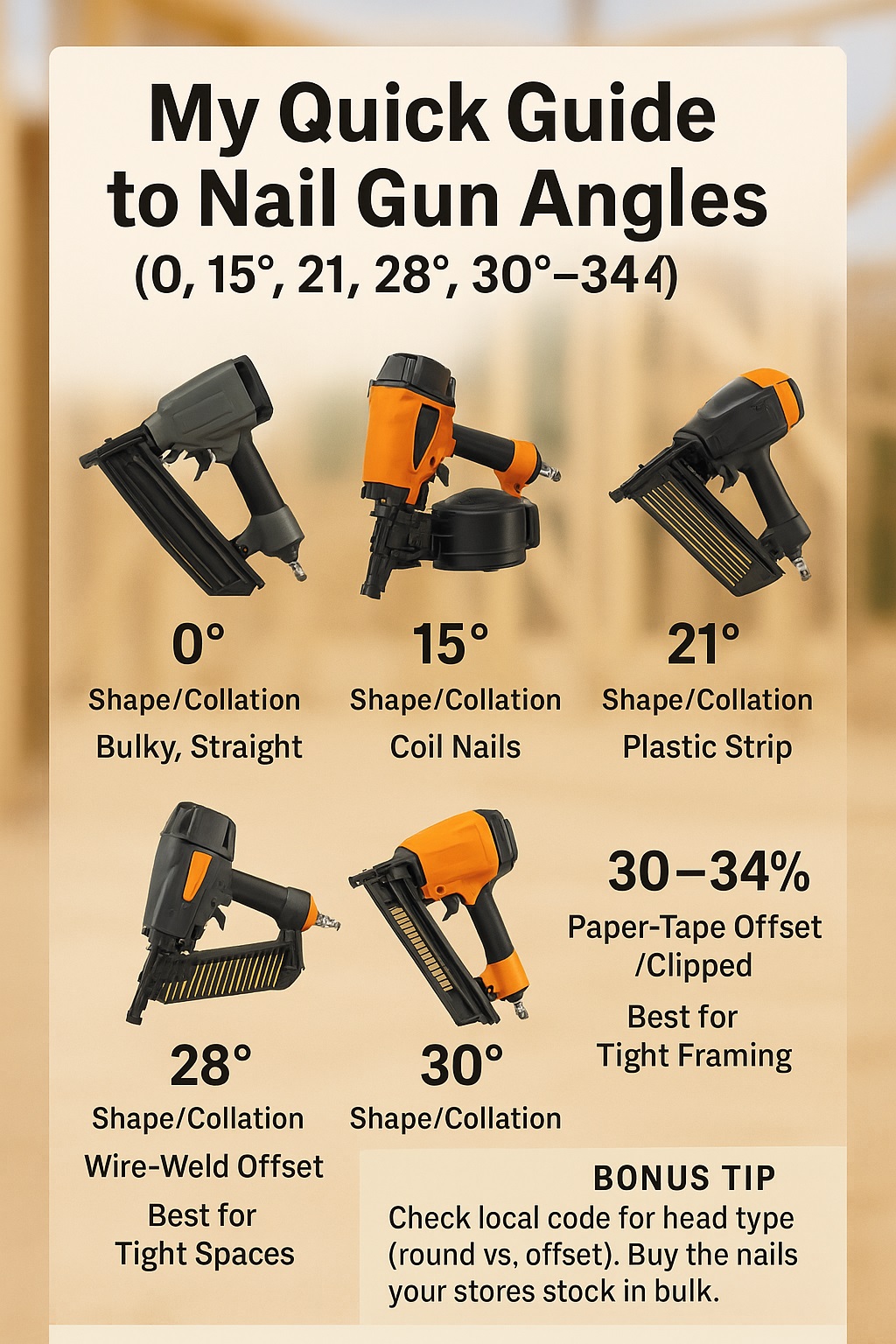
Nail gun angles like 0°, 15°, 21°, 28°, and 30°–34° describe the nail magazine angle, the nail collation type, and how well the tool squeezes into tight framing spaces. Understanding angles helps match the nailer to the task, improve access between studs, and avoid buying nails that don’t fit.
Quick facts about common nail gun angles
| Angle range | Simple real-world meaning |
|---|---|
| 0° (straight) | Bulky, very stable, often older or bench/fence oriented |
| 15° | Coil nails, great capacity, fits corners and roof/sheathing work |
| 21° | Popular framing angle with plastic strips, solid all-rounder |
| 28° | Offset nails, slimmer profile for remodels and tight spacing |
| 30°–34° | Slimmest bodies, clipped/offset heads, excellent in tight framing |
Reference: homedepot.com
🧭 My First Time Figuring Out Nail Gun Angles (Intro & Big Picture)
The moment it clicked
I was framing a small extension when my 21° nailer kept bumping the adjacent stud. A mate handed me a 30° nailer; suddenly the magazine cleared the stud and I could nail comfortably. That’s when I realised angle is really about body shape, nail strips, and access.
What an angle really is
Angle refers to the magazine orientation relative to the nose, not the angle the nail enters the timber. The nose still puts nails in straight. The magazine angle dictates nail collation type, tool footprint, and sometimes capacity. Once I separated “entry angle” from “magazine angle,” tool choices got much simpler.
Why angle changes the day
Angle affects sight-line, reach between studs, balance at arm’s length, and debris management. It also dictates which nails you can buy quickly at local merchants. On a tight renovation, a slimmer angle saves time. On open decks, a more common angle with easy nail supply is king.
*“Think like an ergonomist,” notes Dr. Lisa Grant, CPE; a few degrees that reduce awkward shoulder rotation can cut fatigue across a full shift.
🧠 How I Learned What Nail Gun Angles Really Mean
The “wrong angle” purchase
I once bought a bargain nailer without checking nail availability. It ran offset nails that only one supplier carried, and they were often out of stock. My lesson: nailers are married to their collation. If nails are scarce or pricey, that “deal” costs you in downtime.
Three big ideas
I now judge nailers by three basics: magazine angle, nail collation (plastic, wire, paper; full-head vs clipped/offset), and jobsite fit. If a nailer’s shape helps my wrist in cramped corners and the nails are easy to source, productivity goes up and jams go down. That’s the value trifecta.
What changes, what doesn’t
Angles change tool geometry, balance, sight-line, and access. What doesn’t change is the core fastening physics: length, shank, head style, and pattern drive holding power. I still choose nails based on timber, code, and structural loads—then pick the angle that lets me place them quickly.
*“Start with the fastener spec, then pick the tool,” says Maria Lopez, PE; reverse that and you’ll optimise for convenience, not capacity.
🏗️ Why My Nail Gun Angle Choice Depends on the Job Site
Tight remodels vs open frames
In cramped remodels, 28° or 30°–34° shine because the magazines slip between studs, around lintels, and near stair stringers. New builds with open space suit 21° because nails are everywhere and the bodies are nicely balanced. I match the angle to how likely I am to meet a corner.
Ergonomics all day long
Holding a nailer over your head while reaching into truss bays punishes shoulders. A slimmer angle reduces “tool collision,” and a lighter front end helps line-up. I’ve learned to test the balance at full reach, not just on the bench. Comfort means speed and fewer misfires.
Codes, inspectors, and nails
Local inspectors sometimes prefer full round-head nails. That leans me to 21° or to 30° paper-tape offset heads where allowed. I also map suppliers: if I can’t buy three boxes of the right strips today, I’ll choose a more common angle. Stock wins when deadlines loom.
*“Design for constraints,” advises Evan Brooks, PMP; your best tool is the one that is supported on site, not the one that’s perfect in theory.
📏 How I See 0° Nailers (Straight Nail Guns)
Where 0° helps
0° straight nailers feel stable and predictable on benches and fences where access isn’t tight. I’ve used them on jigged assemblies and long, clear runs. If I’m not weaving through studs, a straight body gives me a solid line and easy visual alignment to the nose.
Pros
They’re intuitive for beginners and can be rugged. The straight magazine is easy to rest against a surface, which steadies long shots. For shop-built frames or outdoor fencing lines, that stability matters. They can be workhorses in environments where bulk isn’t a penalty.
Cons
The bulk makes them clumsy in corners. Between studs, the magazine crashes into everything. Many pros have moved to angled bodies for framing and reserve 0° for specialties. If you’re starting out, consider how often you’ll be in tight spaces before committing to straight.
*“Form follows function,” says Noah Greene, Industrial Designer (IDSA); the geometry you carry dictates the geometry you can reach.
🔄 Why I Use 15° Coil-Angle Nailers for Specific Jobs
Where coil shines
15° coil nailers feed nails from a drum, which means big capacity and fewer reloads. On roof sheathing, wall sheathing, and repetitive cladding, continuous feed beats constant strip changes. The body often tucks into corners neatly because the drum sits close to the handle.
Benefits I notice
Capacity keeps momentum. Balance is surprisingly manageable once you adapt. Coil nails resist jobsite abuse because the coil housing protects them. For production sheathing days, avoiding the reload shuffle can save a surprising amount of time and focus, especially if you’re climbing scaffolds.
Trade-offs
Drums add weight, loading can be fiddly at first, and nails may be pricier or less common in some regions. If your work flips between tasks all day, a lighter strip nailer might be more flexible. I bring coil when I know it’s a “same-task, all-day” job.
*“Throughput beats sprint speed,” notes Grace Tan, Lean Six Sigma Black Belt; fewer changeovers often deliver the real productivity gain.
🧰 Why 21° Nail Guns Became My “Safe” Framing Choice
What I like about 21°
21° plastic-collated round-head nails are easy to find and keep passing inspections on my jobs. The nailers balance well, feel familiar, and clear jams without drama. For decks, sheds, and general framing, 21° has been my reliable “grab-and-go” setup for years.
When I pick 21°
If a job has decent space and I’m working with standard timber, I default to 21°. Nail boxes are available at big merchants and small ones. When time is tight, I won’t gamble on a rare collation and angle. Predictability wins bids and keeps clients happy.
Drawbacks to watch
Plastic collation leaves debris, and the magazine can feel chunky in stair framing or tight corners. In very cramped remodels, I sometimes switch to 28° or 30° to reduce magazine clashes. That said, for an all-rounder, 21° still earns its place in my van.
*“Standardisation reduces variance,” says Owen Clarke, CQE; consistent inputs make consistent outputs—and fewer surprises on site.
🪚 How I Use 28° Nailers When Space Starts Getting Tight
Why 28° works for me
28° nailers often use wire-weld collation with offset heads, making the body slimmer than many 21° tools. When I’m threading between studs or nailing near blocking, the smaller profile lets me place nails without awkward hand contortions. It’s a sweet spot for remodels.
Availability realities
Depending on your region, 28° nails can be less common than 21° or 30°. I check supplier inventory before committing the whole crew to 28°. If nails are reliably stocked, 28° gives me room to move without chasing special orders every week. Plan your supply chain.
Lessons learned
28° shines when the layout fights you—old houses, retrofits, and stair corners. It’s the angle I reach for when my 21° keeps bumping into something. But I won’t drag everyone to 28° unless I’m certain the nails will be there on a rainy Monday.
*“Supply chain is strategy,” reminds Priya Nair, CSCP; availability is a capability, not a coincidence.
🕳️ Why 30°–34° Nail Guns Feel Like My “Tight Space” Specialists
Slim shape, quick placement
30°–34° nailers typically have the slimmest magazines. In tight wall intersections, roof frames, and around services, that profile lets me steer the nose where it needs to go without wrestling the mag. Less contact with studs means cleaner line-ups and fewer “almost there” moments.
Pros that matter on site
The body shape fits tough angles, paper-tape strips carry well, and the sight-line feels natural across tricky moves. When I’m doing awkward overhead nailing, being able to angle the handle without the mag crashing into truss chords keeps my rhythm smooth and safe.
Code and nail types
Some regions favour full round-head nails; others allow clipped or offset heads. I check local preferences before buying thousands of fasteners. If inspectors want full heads, I align on that early. If offset heads are fine, 30°–34° is often my fastest path in tight spaces.
*“Context defines correctness,” says Tom Hughes, Licensed Building Inspector (NZIBI); passing inspection is part of doing the job right, not after.
✅ My Checklist for Choosing the Right Nail Gun Angle
Space & reach
If I’m mostly in open frames: 21°. If I’m weaving between studs and around stringers: 28° or 30°–34°. For repetitive sheathing with minimal space limits: 15° coil. I visualise the tightest corner first, then pick the angle that clears it without awkward posture.
Nail availability
I confirm nail types before I fall in love with a tool. I call suppliers and ask what they keep in bulk. If the nails aren’t on the shelf now, I re-consider the angle. I’d rather have a “pretty good” tool with easy nails than a “perfect” tool with none.
Codes & inspectors
I clarify head type (round vs clipped/offset) early. If there’s any doubt, I choose round-head with a common angle to avoid rework. Matching code preferences up front saves headaches later and earns trust during site visits and sign-off.
User profile
For a single “do-most” framing nailer, I often suggest 21°. For remodelers in old houses, 28° or 30°–34° might pay back faster. For roof and wall sheathing days, 15° coil can run laps on reloads. Choose based on the work you actually do most.
*“Decide like a pilot,” suggests Asha Verma, ATP; plan for worst-case manoeuvres, not best-case cruise.
🧱 How I Match Angles to Materials and Tasks
Framing stud walls
Stud walls with decent spacing behave nicely with 21°. If the layout is fussy, I’ll grab 28° or 30°–34° so the magazine doesn’t jam into the adjacent stud. For long, repetitive runs, the familiar balance of 21° reduces fatigue and keeps production steady.
Trusses, eaves, and corners
Roof trusses and eaves love slimmer bodies. I prefer 30°–34° to clear chords and webs. When working near soffits or intersections, that extra few degrees lets me find a clear path for the magazine, keep my wrists neutral, and set nails exactly where I want them.
Sheathing and cladding
Sheathing is where 15° coil earns its keep: big capacity and fewer reloads. If I’m on a scaffold, every avoided reload is a small safety win and a time saver. For cladding where access is fine, coil keeps me in rhythm; where tight, a slimmer strip nailer returns.
Strength myths I hear
Angle doesn’t make nails stronger. Holding power depends on nail length, shank, head, pattern, and substrate. I focus on nail specs and spacing, then pick the angle that lets me place those fasteners reliably where the plan calls. It’s physics, not folklore.
*“Separate variables,” counsels Dr. Ken Wallace, SE; test fastener capacity independently from tool geometry.
📊 Case Study: Helping a Customer Pick an Angle
Background
A homeowner was adding a living-room extension with a tight roof tie-in. They planned to DIY most framing but wanted to pass inspection with no fuss. Their store carried lots of 21° nails and some 30° paper-tape offset strips, but stocks fluctuated a bit.
Decision factors
We walked the space and checked inspector preferences. Tight rafters near an existing valley suggested a slimmer body would help. The inspector allowed offset heads. The homeowner also wanted a tool they could keep using for a future deck without hunting rare nails.
Outcome
They chose a 30° nailer with paper-tape offset heads for the extension and kept a small stash of extra strips. For the deck, they used the same tool with exterior-rated nails. They avoided rework, moved quickly in roof corners, and passed inspection on the first visit.
Customer’s angle decision summary
| Factor | Final choice |
|---|---|
| Space constraints | 30° for slimmer magazine in roof corners |
| Nail availability | Paper-tape strips stocked locally; bought extras |
| Inspector preference | Offset heads acceptable; confirmed before start |
| Budget | One tool for extension now and deck later |
| Comfort & speed | Better reach, fewer collisions, smoother workflow |
*“Design one solution for two projects,” adds Megan Cole, CMIT; reuse lowers cost and shortens the next learning curve.
❓ My Nail Gun Angle FAQs
Does a bigger angle mean stronger nails?
No. Angle affects the tool body and access, not nail strength. Holding power depends on the nail itself—length, shank, head—and the pattern and substrate. Choose nails for the job, then pick the angle that helps you place them accurately and safely.
Can one angle nailer use another angle’s nails?
Generally no. Nailers are designed for specific collations and angles. Some small variations exist within a family, but don’t bank on cross-compatibility. I buy nails that match the tool exactly and test a few strips before loading the crew with boxes.
Is 21° better than 30° for framing?
It depends on the space and supply. 21° wins on availability and all-round balance. 30°–34° wins in tight framing where the magazine can’t crash into studs. If you’re doing both new builds and remodels, you might even justify owning two angles.
Why do some inspectors dislike clipped-head nails?
Some jurisdictions prefer full round-head nails for withdrawal and head-pull-through concerns, especially in high-wind zones. Others accept offset or clipped heads. I ask early and align nail choice with the local standard so my schedule doesn’t hinge on a re-inspection.
Which angle is best if I only want one nail gun?
For most general framing, 21° is the safe bet because nails are everywhere. If you work mostly in cramped remodels, 30°–34° might be smarter. If you’re doing sheathing all day, 15° coil can sprint. Decide based on your most common task, not the rare one.
*“Policies differ by region,” notes Robert Kim, CBO; clarify expectations first and reduce downstream friction.
🧾 My Simple Takeaways on Nail Gun Angles
My defaults
For open frames and decks, I reach for 21° because nails are abundant and the balance feels right. For tight corners, roof frames, and awkward intersections, 30°–34° gets the nod. For long sheathing runs, 15° coil saves reloads and keeps production steady all day.
Final reminders
Start with nail requirements and local preferences, then pick the angle that clears your tightest corner. Test balance at full reach, not just at the bench. Check nail inventory before day one, and buy a cushion box so you don’t stall mid-shift. Build your system, not just your toolkit.
*“Systems beat heroics,” concludes Sarah Ahmed, MBA, CPIM; a planned setup outperforms improvisation when the clock is running.
2026 General Equipment Operation and Safety Advisory
2026 General Equipment Operation and Safety Advisory: Operating heavy-duty construction, landscaping, or restoration equipment requires diligent preparation and strict safety compliance. Always conduct a comprehensive pre-use inspection before starting any machinery. Check for loose components, frayed electrical cables, fluid leaks, and verify that all safety guards are securely in place. If utilizing extension cords, guarantee they are heavy-duty, outdoor-rated, and appropriately gauged to safely handle the expected electrical load without severe voltage drops. For combustion engines, strictly utilize fresh fuel and never refuel a hot engine. Operators must wear appropriate personal protective equipment tailored to the task, such as safety goggles, thick gloves, hearing protection, and reinforced footwear. Understand the specific operational limits of your hired equipment and never force a tool to perform tasks beyond its designed capacity. Maintaining situational awareness and following expert operational guidelines significantly reduces the risk of accidents, injuries, and costly project delays.
Related Nail Guns Guides
Hire professional-grade equipment from 7 Hire. We offer fast local pickup or delivery across Auckland.