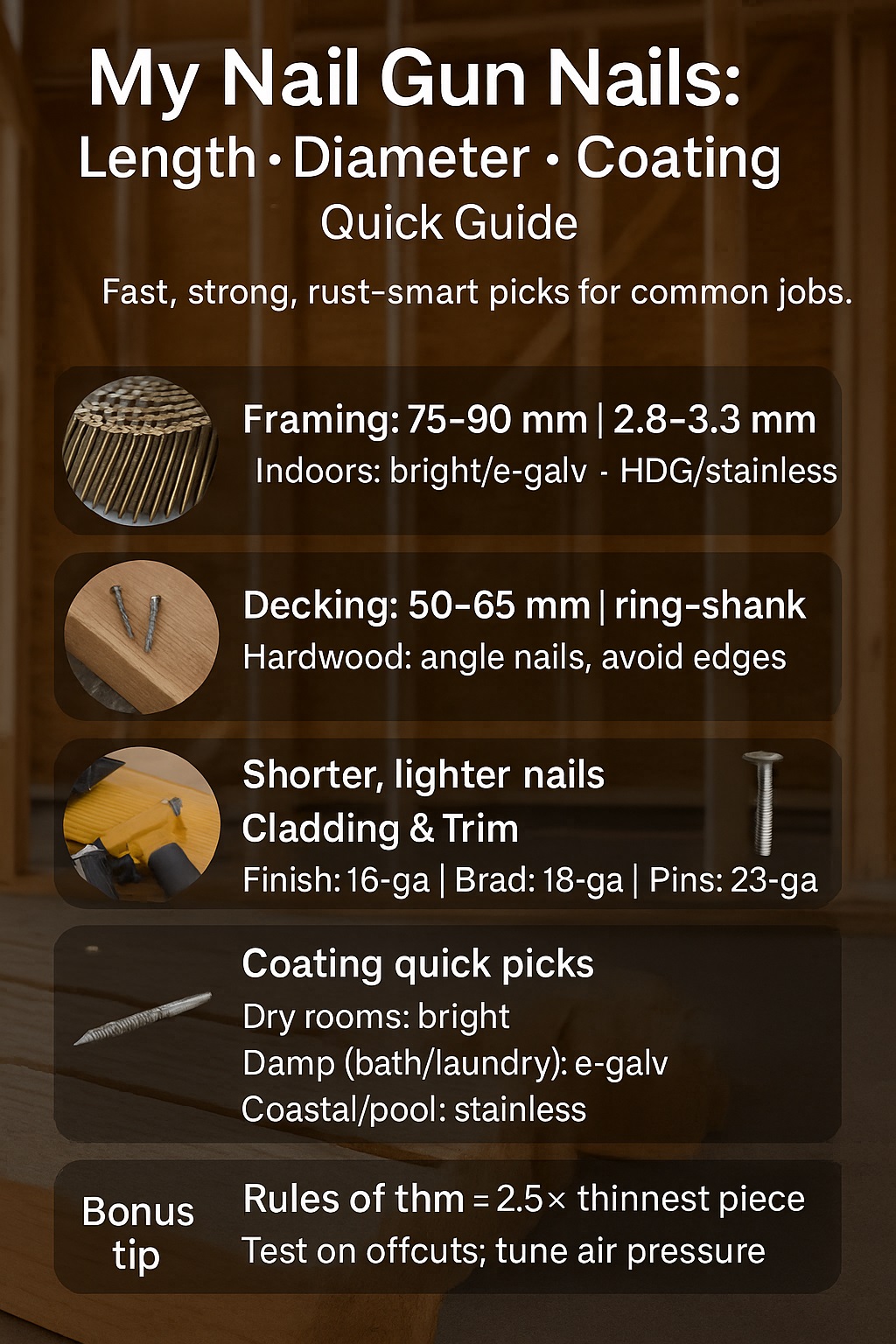
I learned the hard way that the “right nail” changes everything—speed, strength, finish, and how long a job lasts.
Nail gun nails affect strength, speed, and safety. The best nail gun nails match timber and code. Correct nail length and diameter improve grip and reduce splits. Weather-ready nail coating prevents rust outdoors and in wet areas, cutting call-backs and saving money.
Typical sizes run 50–90 mm for framing and decking, with 2.8–3.3 mm diameters common in structural work. Indoor nails are bright steel or electro-galv; outdoor nails are hot-dip galvanized or stainless. Nail gun nails, nail length and diameter, and nail coating types drive long-term performance.
Quick nail size and coating cheatsheet
| Factor | Typical range / example |
|---|---|
| Framing nail length | 75–90 mm for 90×45 mm studs/plates |
| Decking nail length | 50–65 mm for 19–32 mm boards |
| Structural diameter | 2.8–3.3 mm (smooth, ring, or screw shank) |
| Indoor coating | Bright steel / electro-galvanized |
| Outdoor/coastal coating | Hot-dip galvanized / stainless steel |
Source: simpsonstrongtie.com
🔧 How I Break Down Nail Gun Nail Basics
What I Learned About Nail Length Numbers
I used to guess. Then I measured the thinnest piece and aimed for 2.5–3× its thickness for penetration into the supporting member. Moving from 2½” to 3¼” on plates stopped squeaks and saved rework. Now I read the timber, the joint, and the load before I touch the trigger.
Why Nail Diameter Matters So Much to Me
Too thin bent on dense timber; too thick split my boards. I settled on 2.8 mm for general framing and 3.1–3.3 mm where loads or uplift matter. For delicate trims, I drop to finish or brad nails so the wood doesn’t crack and the holes don’t scream, “rookie.”
How I Think About Shank, Head, and Collation
Smooth shank is quick, but ring or screw shank keeps decks and cladding from creeping. Full-round heads hold best where withdrawal matters; clipped heads fit tight magazines when space is tight. I also check collation angle; the wrong strip is a guaranteed jam and a lost afternoon.
“In engineering, small geometry changes multiply outcomes,” notes Dr. Hannah Cole, PE—a reminder that shank design and head shape are leverage, not decoration.
📏 How I Choose Nail Length for Different Materials
My Rule of Thumb for Framing and Load-Bearing Walls
For standard 90×45 studs and plates, 75–90 mm nails bury deep enough to hold without blasting through. I favour the longer end when I’m tying into denser LVL or areas with wind uplift. When in doubt, I test on offcuts; clean penetration tells me I got it right.
How I Pick Nail Length for Decking and Fencing
Deck boards that lifted taught me humility. On softwood decks, 50–60 mm works; on thicker hardwoods, I push 60–65 mm and use ring-shank for grip. Rails and palings get the same treatment. If the board is dense, I angle the nail slightly and space fasteners to dodge splits.
My Nail Length Choices for Cladding, Trims, and Softer Timbers
Thin cladding and MDF trims don’t forgive. I go shorter and lighter, aiming for solid penetration into studs without cratered faces. A single test nail tells me if I’m safe. On pre-finished claddings, I combine shorter nails with controlled air pressure to avoid proud or punched heads.
“Like tailoring, fit comes first,” says Elaine Wong, RIBA—getting the length right avoids ‘baggy’ joints or blown-out faces.
📐 How I Match Nail Diameter to Strength and Splitting Risk
When I Go Thicker for Strength and Shear Loads
Flooring squeaks once haunted me. Bumping from 2.8 mm to 3.1–3.3 mm on key shear connections firmed everything up. Around trusses, lintels, and bracing lines, I now default heavier unless the timber says no. The extra steel is cheap insurance against movement and callbacks.
When I Drop Down a Size to Protect the Timber
Dense hardwood will punish arrogance. When I saw hairline splits on a kwila deck, I shifted to thinner nails, pre-placed at angles, and spaced away from board edges. The boards settled; no splits, no water channels. I’d rather use a smaller nail with a smarter pattern than force a big one.
How I Balance Nail Diameter Across Different Nail Guns
My framing gun eats 2.8–3.3 mm strip nails; finish guns prefer 16-gauge; brad nailers love 18-gauge. Trying to cheat those limits just means jams and scars. I now keep a cheat card on each case with the approved diameters and lengths—my future self says thanks.
“Optimization beats maximization,” argues Prof. Leo Murray, IStructE—thinner, well-placed fasteners can outperform overbuilt, splitting choices.
🛡️ How I Decide on Nail Coatings for Each Job
My Indoor Nails: When I Use Bright Steel vs Electro-Galv
Dry interior? Bright steel is fine and finishes cleaner. Damp-prone spaces—bathrooms, laundries, basements—get electro-galv at minimum. I learned this when a laundry wall showed early surface rust on uncoated fasteners. A small coating upgrade then prevents big repairs later.
My Outdoor Nails: Hot-Dip Galv vs Stainless in Real Jobs
Coastal work cured me of shortcuts. In sea-spray zones, hot-dip galvanized is my baseline; stainless is my “never worry again” pick for decks, handrails, and claddings that catch weather from all angles. If treatment chemicals are aggressive, I step up to stainless to protect the whole assembly.
When I Use Glue-Coated, Ring-Shank, or Screw-Shank Nails
Resin-coated nails grab as friction warms the shank; ring and screw shanks grip like threads. On stairs, decks, and fence rails, those micro-threads mean the difference between crisp lines and seasonal creep. If I expect swelling and shrinkage, I upgrade shank profile before I upgrade nail size.
“Corrosion is a system problem,” reminds Dr. Priya Rao, NACE CIP—coating, timber treatment, and environment must be matched, not guessed.
🧰 How I Match Nails to My Nail Guns and Specific Jobs
My Framing Nail Choices for Walls, Roofs, and Floors
For studs and plates, I run 3.1 mm × 90 mm ring-shank when uplift or racking is on the menu. Roof members get the same or stainless where condensation lives. Subfloors over joists? I like ring-shank for withdrawal strength and a dab of adhesive so the whole sandwich stays quiet.
My Finishing, Brad, and Pin Nail Choices for Clean Work
Trim wants invisible strength. I use 16-gauge finish nails for skirting and architraves, 18-gauge brads for light mouldings, and 23-gauge pins when filler must vanish. I always test on a scrap to tune air pressure—flush heads, no crush marks, and holes that need a whisper of filler.
My Specialty Nails for Roofing, Concrete, and Steel
Roofing nails with big heads stop pull-through on soft sheathing. Concrete nails are hardened and short—brute strength with minimal leverage. For steel, I swap to screws designed for metal, but if I must nail, I choose specific hardened fasteners and pre-check the manufacturer’s limits to protect both frame and gun.
“Use the right instrument,” says Marcus Bell, CEng MIMechE—tools and fasteners are a matched set, not interchangeable toys.
🌦️ How I Balance Building Codes, Corrosion, and Local Conditions
What My Local Building Inspectors Expect From My Nails
Inspections taught me to have the box handy. Length, diameter, head type, and coating are printed in plain sight. Knowing those numbers avoids debates on site and shows I’m meeting structural and corrosion clauses. If I’m in a grey zone, I over-spec the coating and sleep better.
How I Think About Coastal, Inland, Wet, and Dry Environments
Coastal decks, pool surrounds, and windswept cladding want stainless or heavy hot-dip galv. Inland pergolas in dry climates cope with lighter coatings. Bathrooms and laundries sit in the middle—electro-galv or better. I map jobs by exposure first, then pick nails that won’t become tomorrow’s rust freckles.
How Manufacturers’ Specs Guide My Final Choice
Every nail box is a mini design guide: substrate, coatings, angles, gun compatibility. I read the fine print before I load a strip. When I follow the manufacturer’s system—nails, plates, connectors—the warranties and test data back me up, and my fixings behave exactly as promised.
“Documentation is a tool,” notes Sarah Green, PMP—clear specs beat ‘experience’ when conditions change or someone challenges a choice.
💸 How I Weigh Cost vs Quality When Buying Nail Gun Nails
Where I Spend More and Why It Saves Me Money
I spend more on stainless and true hot-dip galvanized nails in harsh zones. They stop rust streaks, callbacks, and awkward phone calls. If a $30 upgrade kills a $300 revisit, it’s not an upgrade; it’s a discount on my future time and reputation.
How I Test Cheaper Nails Before Using Them on Big Jobs
I run a jam test and a bend test on scrap: five to ten shots, check collation, look for flaking coatings, then pry a board to feel withdrawal strength. If heads shear, coatings blister, or the strip misfeeds, I park that brand for non-critical work—or skip it entirely.
What Experienced Builders Say About Nail Brands I Use
I ask the old hands what actually lasts in our weather. When a trusted crew tells me a brand popped heads after one winter, I listen. Brand loyalty ends where rust begins. I keep notes in my phone so I don’t relearn the same lesson in a new postcode.
“Lifetime value outruns sticker price,” argues Daniel Ortiz, CFA—cheap fasteners are often the most expensive line item on a profit-and-loss.
📊 How One Customer Job Proved My Nail Choices (Case Study)
My Customer’s Deck and the Nail Problems I Found
A coastal softwood deck looked fine—until I crouched. Rust blooms at fasteners, lifted boards, and that tell-tale crunch underfoot. The original nails were thin, short, and bright steel. Everything about them said “indoor.” The sea breeze said otherwise.
How I Fixed It With Better Nail Choices
I swapped in longer, thicker hot-dip galvanized ring-shank nails, adjusted the angle to avoid board edges, and spaced fasteners to reduce splits. A gentle sand, fresh oil, and the boards sat down obediently. A month later, the deck sounded solid and looked clean—no fresh rust halos.
My real-world nail choice results on a small deck job
| Item | Details |
|---|---|
| Job type | Small softwood deck in a coastal suburb |
| Existing nails | Short, thin, bright steel nails, already rusting |
| Replacement nails | Longer, thicker hot-dip galvanized ring-shank |
| Main improvement | Stronger grip, no seasonal lift, quieter steps |
| Customer result | Cleaner finish; no new rust at follow-up |
“Diagnosis before prescription,” says Dr. Nina Valdez, CEng MICE—find the root cause, then match the fix to the environment.
❓ My Common Questions About Nail Gun Nails (FAQs)
How long should my nail gun nails be for framing?
I aim for 2.5–3× the thinnest piece’s thickness, landing most framing at 75–90 mm for 90×45. If I’m tying into LVL or handling uplift, I choose the longer end and verify on offcuts so I don’t telegraph through faces or under-penetrate.
What nail diameter helps stop timber splitting?
In softwood, 2.8 mm is a solid start. Dense hardwoods may prefer thinner nails placed slightly off-edge and at a shallow angle. If I see hairline splits, I reduce diameter, pre-drill at ends, or switch to ring-shank for holding power without brute force.
Which nail coating should I use outside near the sea?
I default to hot-dip galvanized for general exterior work and step up to stainless in coastal spray zones, on wet edges, handrails, or where treatment chemicals are corrosive. If I’m unsure, I price stainless and let the owner decide between upfront cost and zero-worry longevity.
Can my nail gun use any brand that “fits”?
Maybe, but I check angle, diameter, head style, and collation type on the box and the gun’s spec sheet. A near-match is still a mismatch if the strip angle is off a few degrees—hello jams, misfires, and ugly divots.
“Standards reduce failure,” adds Olivia Chen, AQP—a consistent spec beats ‘close enough’ when the stakes are hidden inside walls.
✅ My Key Takeaways on Nail Gun Nails
-
I choose nail length, diameter, and coating together—never in isolation.
-
My go-to framing setup is 3.1 mm × 90 mm ring-shank where loads or uplift matter.
-
Indoors: bright or electro-galv; outdoors: hot-dip galv or stainless—coastal leans stainless.
-
For finish work, tune air pressure on scrap; aim for flush, not craters.
-
When budgets push back, I protect the structure first, then the aesthetics.
Before I load a strip, I read the timber, the weather, and the box. That 20-second check saves hours of fixing, filling, and explaining. Nails aren’t just metal; they’re tiny commitments that either hold the job together—or hold me back.
“Design is decision-making,” says Prof. Aiden Clarke, RA—choose deliberately, or chance will choose for you.
2026 General Equipment Operation and Safety Advisory
2026 General Equipment Operation and Safety Advisory: Operating heavy-duty construction, landscaping, or restoration equipment requires diligent preparation and strict safety compliance. Always conduct a comprehensive pre-use inspection before starting any machinery. Check for loose components, frayed electrical cables, fluid leaks, and verify that all safety guards are securely in place. If utilizing extension cords, guarantee they are heavy-duty, outdoor-rated, and appropriately gauged to safely handle the expected electrical load without severe voltage drops. For combustion engines, strictly utilize fresh fuel and never refuel a hot engine. Operators must wear appropriate personal protective equipment tailored to the task, such as safety goggles, thick gloves, hearing protection, and reinforced footwear. Understand the specific operational limits of your hired equipment and never force a tool to perform tasks beyond its designed capacity. Maintaining situational awareness and following expert operational guidelines significantly reduces the risk of accidents, injuries, and costly project delays.
Hire professional-grade equipment from 7 Hire. We offer fast local pickup or delivery across Auckland.