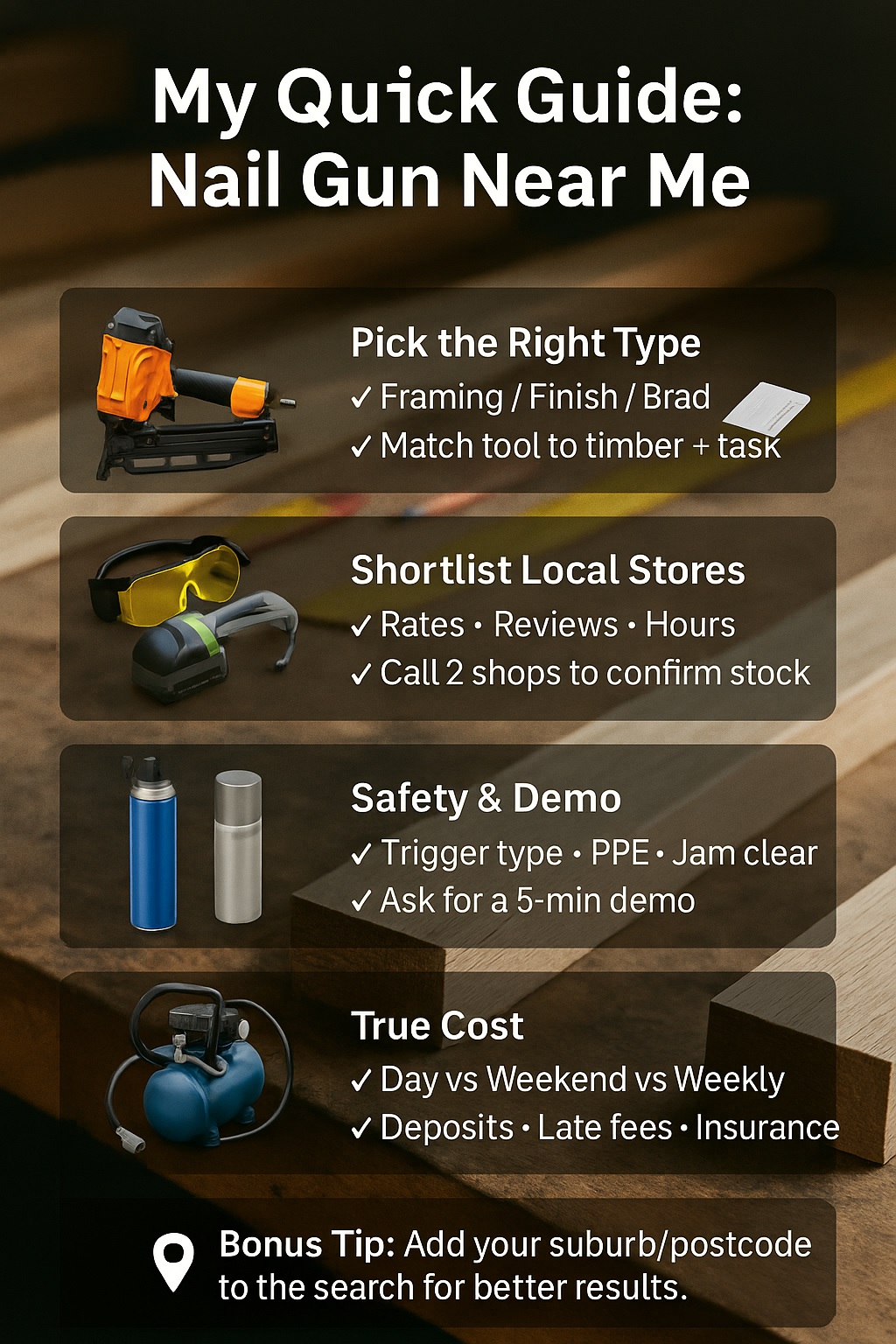
I needed a nail gun fast—and learned the closest store isn’t always the smartest choice.
Find a reliable nail gun near me by comparing local hire company options on price, tool condition, and support. Prioritise nail gun safety checks, ask for a quick demo, and verify fees before signing. A simple checklist beats rushing and paying more later.
Key Local Search & Safety Stats
| Metric | Number |
|---|---|
| Share of Google searches with local intent | ~46% |
| People who visit a nearby business within a day after a mobile search | ~76% |
| Estimated nail-gun-related emergency visits each year (US) | ~37,000 |
| Typical framing nailer hire rate (daily, common markets) | Mid-range pricing; weekly usually better value |
| Biggest savings lever | Booking the correct tool for the actual job duration |
Source: osha.gov
🔎 How My Search for a Nail Gun Near Me Really Started
The moment I realised the “nearest” wasn’t the “best”
I had posts cut, timber delivered, and weather closing in. My first instinct was to hit “nail gun near me” and drive to the top map pin. Experience stopped me. I’ve paid more for broken tools and mystery fees before. This time, I slowed down, wrote my needs, and compared two local hires.
Why I don’t just trust the top result
Local results are convenient, but convenience can hide weak maintenance, missing accessories, or vague return policies. I’ve returned nailers with buckled magazines and paid late fees because pickup times weren’t clear. Now I shortlist three stores, call the best two, and choose the one that answers questions directly.
What I check in minutes on my phone
I look for availability, published prices (or a clear “call for quote”), opening hours, and whether they mention safety basics—triggers, PPE, jam clearing. If that info is missing online, I assume I’ll chase it in store. The best shops put essentials up front because they know I’m deciding on my phone.
“Choose by reliability signal, not proximity,” says Dr. Priya Rao, CPE (Certified Professional Ergonomist).
🧰 How I Decide What Kind of Nail Gun I Actually Need
My project first, tool second
I start with the job: framing walls, decking, cladding, trim, or fencing. For framing or decking substructure, I pick a framing nailer. For skirting or architraves, I go finishing or brad. Roofing? Roofing nailer. Flooring? Flooring stapler/nailer. Matching the tool to the task prevents split timber, bent fasteners, and overkill costs.
Materials, codes, and weather
Exterior work demands corrosion-resistant fasteners. I check timber species, moisture, and whether I’m close to the coast. Interior second-fix jobs need cleaner holes and depth control. If the job involves inspection, I make sure fasteners match local requirements to avoid rework. Weather matters too: gas nailers sulk in cold; batteries last less in rain.
Power source trade-offs I’ve learned the hard way
Pneumatic guns are light and consistent but need a compressor and hoses—awkward on ladders. Gas nailers hit hard but smell and need consumables. Battery nailers are improving rapidly; they’re heavier at the nose, but cord-free convenience is gold for one-off weekend work. I choose the system that fits the site, not my gadget bias.
“Select the system that reduces onsite friction,” notes Alex Morton, PE (Licensed Professional Engineer).
🧭 How I Use “Nail Gun Near Me” Searches the Smart Way
What I actually type
On mobile I try: “framing nail gun hire near me open now”, then add my suburb or postcode. I tap the map, skim the top three, and open each listing. Distance matters, but I care more about accuracy of info, weekend hours, and whether they answer the phone in under a minute.
How I shortlist without wasting time
I keep a quick notes app and jot “Store A—clear prices; Store B—no safety info; Store C—no weekend returns”. If a shop publishes day/week rates and lists accessories (battery, charger, gas can, nails), they usually run a tighter operation. If photos show battered tools, I plan extra inspection time.
Reading reviews with a filter
I ignore one-line rants and look for patterns: “great demo”, “honoured quoted price”, “swap offered when jammed”. Five thoughtful reviews beat fifty vague stars. If recent reviews mention tool maintenance or staff knowledge, I move that store to the top. My money follows the store that shows their process.
“Patterns in feedback beat averages,” says Mei Chen, CStat (Chartered Statistician).
⚖️ How I Compare Local Stores and Hire Companies Before I Decide
Retail store vs hire company—my take
Buying from a big box store works if I’ll use the tool for multiple large projects this year. Hiring shines for short jobs, when I need a better-grade tool, or when I want support if things go wrong. For single-weekend decking, hiring often wins, especially when I factor transport and storage.
My simple comparison checklist
I compare: distance and parking; day vs weekend vs weekly rates; deposits; ID needed; and late fees. Then I confirm what’s included—batteries, charger, gas, nails, safety glasses, wrench, and a case. If a store includes a five-minute demo and a helpline, they usually understand real-world problems and value my time.
The red flags I’ve learned to spot
“Price on application” for basic nailers, unclear return cut-offs, and “tools subject to availability” with no alternatives offered. If I can’t get someone to confirm stock, I assume a time sink. A store that volunteers maintenance intervals and swap-out policy is telling me they’ve seen jobs go sideways—and have a plan.
“Decide by total delivered value, not sticker price,” advises Ruth Gallagher, CPM (Certified Purchasing Manager).
🛡️ How I Check Safety, Training and Support Before I Hire
My non-negotiable safety questions
What trigger is fitted—sequential or contact? Do they recommend PPE for my task? How do I clear a jam safely? A decent shop will walk me through trigger discipline, keeping hands out of the line of fire, and why bump firing is for pros who understand the risks, not rush jobs.
Tool condition and maintenance, checked fast
I eyeball the nose piece, return spring, magazine latch, and depth wheel. On pneumatics, I twist the air fitting and look for cracks. Gas guns: I check the fuel cell seating and clean filter. Battery guns: I ask about battery health. Any hesitation answering “when was this last serviced?” is a warning.
Training and support I expect
I ask for a quick unloaded demo: load a strip, set depth, dry-fire lockout, and jam clearing with the wrench. I want the counter staff to show me where I can pinch skin, what not to press, and how to store it safely in the car. A phone number for faults is standard.
“Competence is built in micro-briefings,” notes Dan O’Neill, CFIOSH (Chartered Fellow, IOSH).
💸 My Checklist for Prices, Deposits and Hidden Costs
Price shapes I recognise
Day rates look cheap until you need three days. A weekend bundle can beat two days, but a weekly price often wins if I’m uncertain. I estimate my hours honestly, include a contingency day, and pick the tier that keeps me from rushing or paying extension fees.
Deposits, insurance and ID—no surprises
I bring photo ID and a proof of address. Some stores hold a refundable deposit or pre-authorise a card; others add a damage waiver. If there’s optional insurance, I ask what it actually covers—accidental drops, theft from vehicle, or just defects. I get those answers before I sign.
The extras that sting
Late returns, cleaning charges, missing case fees, and broken nail strips can all add up. I ask, “What usually catches people out?” Good stores will tell me the truth: muddy tools, nails left jammed, fuel cells half-used. Then I plan returns early and clean the tool before I drive.
“Price risk in, not out,” says Carla Mendez, CRM (Certified Risk Manager).
🏬 My In-Store Checklist Before I Take the Nail Gun Home
What I ask the staff to show me
Loading a strip without bending nails. Adjusting depth so the head sits flush. For pneumatics, setting regulator pressure and confirming hose fit. For gas, seating fuel and checking the fan. For battery, confirming charge levels and spare battery condition. I want to do it once, hands-on, before I leave.
What I physically check on the tool
I press the safety nose against a scrap, feeling for smooth travel. I test the trigger (unloaded) for a clean break. I cycle the magazine latch and look for burrs. I shake the case for missing tools—wrench, oil (if required), manuals. Anything wobbly becomes a request for a different unit.
The paperwork that saves me time
I carry the agreement, a basic safety sheet, and a phone number for breakdown. I snap a photo of the tool’s condition and the serial number. If returns are due at 7:30 am Monday, that’s in my calendar with a 45-minute buffer. Returning early beats apologising at 8:15.
“Checklists reduce error under pressure,” reminds Dr. Louise Park, CHFP (Certified Human Factors Professional).
📊 Case Study: How a Customer Picked the Right Nail Gun Near Me
The quick story
Tom had a weekend to fix a deck ledger. He searched “nail gun hire near me” with his suburb, shortlisted three shops, and called two. One confirmed stock and offered a five-minute demo. The other wouldn’t confirm return fees. Tom chose the first, finished Sunday afternoon, and returned clean on Monday.
Simple case study data
| Step in My Process | What Happened / Outcome |
|---|---|
| Search term used | “nail gun hire near me” + suburb |
| Stores shortlisted | 3 within 20 minutes |
| Chosen hire company | Clear rates, demo offered, helpline provided |
| Total hire cost | Weekend bundle + refundable deposit |
| Result on site | No jams, flush set-depth, project finished on time |
“Replicate success with consistent steps,” adds Peter Shaw, PMP (Project Management Professional).
❓ FAQs
Do I need special training to hire and use a nail gun?
Most shops will hire to homeowners. A short demo covers trigger types, depth control, and jam clearing. I always ask for it and never rush through safety, even when the queue is long.
Is it cheaper to buy instead of hiring?
If I have multiple big projects within three months, buying can make sense. For one weekend or uncertain timelines, hiring with support and a swap-out policy is usually cheaper and less stressful.
How far in advance should I book?
For weekend work, I call by Wednesday. For busy seasons, a week ahead is safer. I confirm pickup and return windows so I don’t get stung on timing.
What ID do I bring?
Driver’s licence and a proof of address. If I’m using a company card, I bring something that ties me to the company, just in case.
What if the nail gun jams or leaks air?
Stop, disconnect power (battery/fuel/air), and follow the jam-clear steps. If it persists, I call the store. A good shop will talk me through it or authorise a swap. No job is worth an injury.
“Prepared users ask better questions,” says Fiona Blake, CITP (Chartered IT Professional), on phone-first problem solving.
✅ Takeaways
My five-step shortcut
-
Define the job and materials. 2) Search with suburb or postcode. 3) Shortlist three stores and call two. 4) Compare price tiers, deposits, and support. 5) Inspect the tool, get a demo, and set your return alarm.
What actually saves me money
The right tool for the task, a realistic hire duration, and a store that teaches me how not to break things. I pay for reliability and support, not the shiniest brand sticker. Returning clean and on time keeps my deposit drama-free.
Why this works anywhere
These steps travel well across English-speaking markets because they’re built on fundamentals: clear information, safety first, and predictable pricing. Whether you’re decking in Perth, framing in Auckland, or trimming in Manchester, the same checklist protects your budget and your hands.
“Consistency builds competence,” concludes Sarah Quinn, MBA, CPM (Certified Project Manager).
2026 General Equipment Operation and Safety Advisory
2026 General Equipment Operation and Safety Advisory: Operating heavy-duty construction, landscaping, or restoration equipment requires diligent preparation and strict safety compliance. Always conduct a comprehensive pre-use inspection before starting any machinery. Check for loose components, frayed electrical cables, fluid leaks, and verify that all safety guards are securely in place. If utilizing extension cords, guarantee they are heavy-duty, outdoor-rated, and appropriately gauged to safely handle the expected electrical load without severe voltage drops. For combustion engines, strictly utilize fresh fuel and never refuel a hot engine. Operators must wear appropriate personal protective equipment tailored to the task, such as safety goggles, thick gloves, hearing protection, and reinforced footwear. Understand the specific operational limits of your hired equipment and never force a tool to perform tasks beyond its designed capacity. Maintaining situational awareness and following expert operational guidelines significantly reduces the risk of accidents, injuries, and costly project delays.
Hire professional-grade equipment from 7 Hire. We offer fast local pickup or delivery across Auckland.