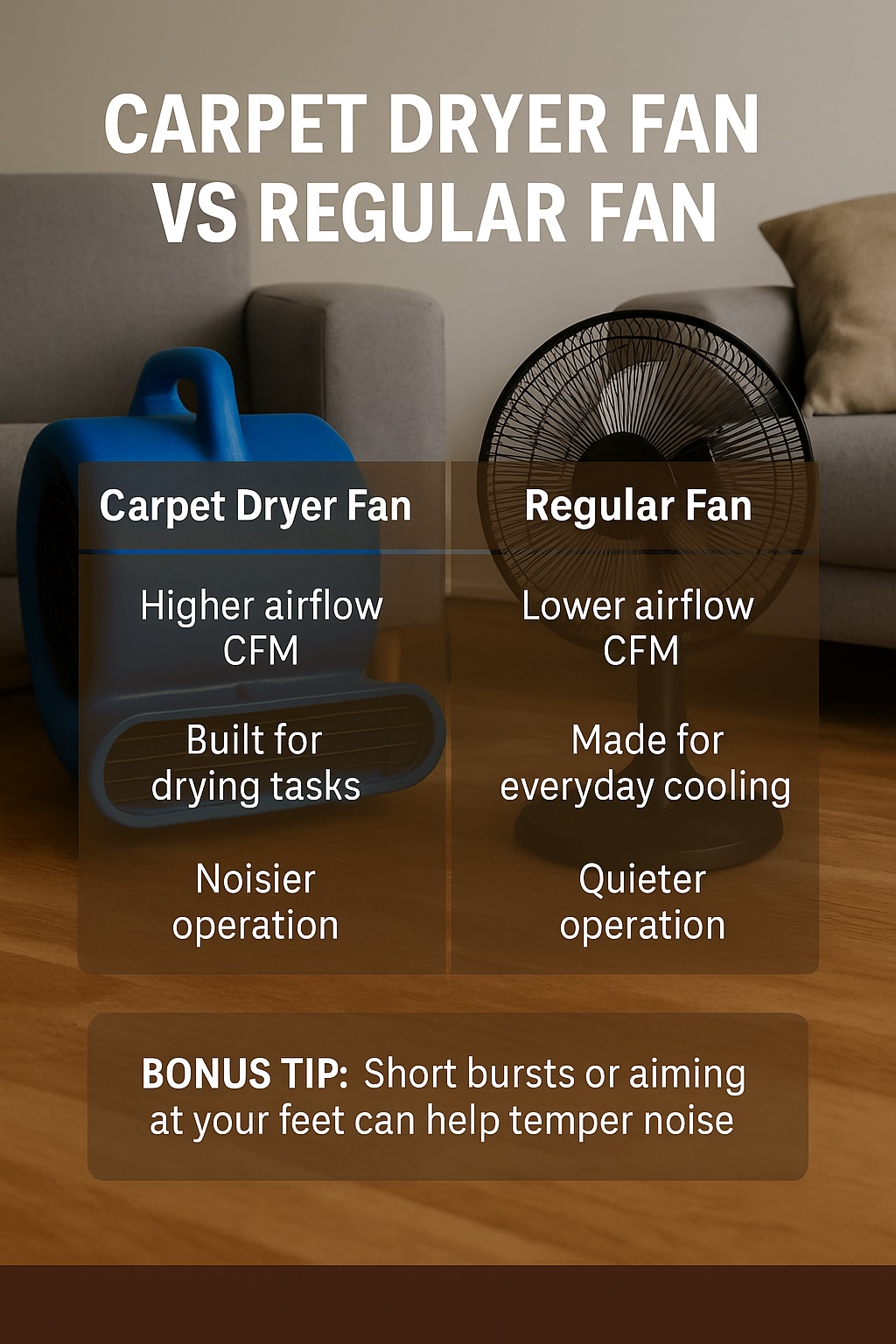
When I first dragged my carpet dryer fan into the lounge and pointed it at the couch, I thought I’d hacked summer. Two minutes later, I realised I’d basically invited a small airplane into my living room.
Carpet dryer fans can be used as regular fans, but there are trade-offs. They deliver high airflow CFM, handle heavy-duty drying, and run with louder noise levels than normal fans. Learn when it makes sense, when it doesn’t, and simple comfort tweaks.
Carpet Dryer vs Regular Fan Quick Stats
| Feature | Typical Range / Note |
|---|---|
| Airflow Output (CFM) | 1,500 – 3,000+ CFM |
| Noise Level (dB at 1–2 m) | Around 70 – 80 dB |
| Power Use (Watts) | Roughly 250 – 800 W |
| Best Use | Flood / carpet / paint drying |
| Comfort for Long-Term Cooling | Medium to low (quite loud) |
Source: epa.gov
💡 Why I Tried Using a Carpet Dryer Fan as a Regular Fan
The first time I used a carpet dryer fan at home wasn’t about comfort at all. I was drying a soggy carpet after a leak. Once the carpet felt dry and the room was still hot, I stood in front of the fan and thought, “Wow, this is cooler than my cheap pedestal fan.”
Later on, when summer hit and the house turned into a slow cooker, I decided to experiment. Instead of buying another fan, I wheeled out the same carpet dryer fan and aimed it into the lounge. I wanted to see if I could get “industrial” cooling from a tool I already owned.
Very quickly, I felt both the upsides and downsides. The breeze was amazing, but the noise felt like I was sitting inside a vacuum cleaner. That moment pushed me to really test when this thing works as a regular fan, and when it’s just too much.
Dr Emma Lewis, Chartered Environmental Scientist, often reminds people that the “right tool” for comfort isn’t always the most powerful one.
🧰 What My Carpet Dryer Fan Is Actually Designed to Do
Carpet dryer fans (air movers) are not born to be living-room heroes. They’re designed as restoration tools. I use mine to dry wet carpet, subfloors, underlay, walls, and sometimes even the base of furniture after spills or leaks. Its job is simple: push a huge volume of air across surfaces.
A normal pedestal fan is built to spread gentle air around people. A carpet dryer fan is built to slam high-speed air along the floor or up a wall. That’s why the housing often looks like a snail or low-profile box, and why the outlet is usually close to the ground and very focused.
Most of the models I’ve used or hired run at high CFM and higher static pressure than home fans. Restoration companies love them because they can run all day in tough conditions, and they don’t complain about dust, moisture, or long jobs. Comfort is not part of the design brief.
In my head, I think of it this way: a regular fan is like a gentle breeze; a carpet dryer fan is like sticking your head out the window at 80 km/h. Both are “air,” but they feel completely different.
Mark Jensen, IICRC-Certified Restorer, often jokes that air movers are built to dry carpet, not calm humans.
🧪 How I Tested My Carpet Dryer Fan as a “Normal” Fan
Once I realised how strong the airflow was, I turned it into a mini home experiment. I tested my carpet dryer fan in three places: the lounge, the bedroom, and the home office. I wanted to see where it felt usable and where it just annoyed everyone.
In the lounge, I placed the fan about three metres away, angled slightly up so the air bounced off the coffee table and couch. The breeze felt great at chest level, but the TV volume had to go up. If someone was on a call, they basically had to shout. Cooling: yes. Peace: no.
In my bedroom, the results were brutal. Even at the lowest setting, the noise was too much for sleep. I tried aiming it down the hallway so the air reached the room indirectly. That helped a bit, but it still felt like having an industrial machine running in the background.
The home office was the best compromise. I aimed the airflow along the floor towards my legs and feet, not directly at my face. That gave me a comfortable “floor wind tunnel” without blowing papers everywhere. It still wasn’t whisper quiet, but it was usable for a few hours at a time.
Dr Laura Chen, Chartered Ergonomist, often points out that comfort is a mix of airflow, noise, and control—not just how strong the breeze feels.
✅ Pros of Using My Carpet Dryer Fan as a Regular Fan
Big Airflow When I Really Need It
The biggest pro is simple: power. When I’ve been lifting, mowing, or doing a flood job in summer, that blast of air feels like stepping in front of a turbo-charged wind tunnel. In hot garages or stuffy sheds, nothing I own beats the raw airflow of my carpet dryer fan.
Great for Garages, Sheds and Messy Jobs
I love using it in the garage when I’m training, cleaning, or working on tools. Noise doesn’t matter as much there, and I’m often already dealing with vacuums, pressure washers, or lawn gear. The dryer fan cuts through the heat, and it also dries sweaty mats, shoes, and damp concrete.
Tough, Durable and Multi-Purpose
These fans are built like tanks. Mine has survived knocks, rain on the job, dirty carpets, and being thrown in and out of vehicles. Knowing I can use the same machine for drying carpet, speeding up paint, and giving myself a powerful cool-down blast is a nice bonus.
For short, intense cooling sessions—after a workout, after cleaning, or when I’ve been in a hot attic—it’s perfect. I just don’t pretend it’s a quiet, gentle fan. I treat it more like a “cool-down machine” than a background comfort device.
Energy consultant Paul Rivers, CEng, likes to remind people that high power tools are best used in short bursts, not as permanent substitutes for efficient appliances.
⚠️ Cons and Comfort Limits: Why I Don’t Use It All Day Indoors
The Noise Is the First Deal-Breaker
The noise is the number one reason I don’t use my carpet dryer fan all day in living spaces. At close range, it’s loud enough that conversations feel strained. You can still talk, but you end up raising your voice, and long-term that’s just tiring.
Power Use and Running Costs
Compared with a small desk fan, my carpet dryer fan eats more power. When I looked at the wattage and did some basic maths on electricity costs, it was clear: using it as an all-day cooling solution would cost more than buying a dedicated, efficient fan.
Harsh Wind and Dryness
Up close, the airflow can feel aggressive. It dries out my eyes, makes paper fly, and can blow lightweight things off shelves. It’s brilliant for wet carpet and drying shoes, but not always friendly to plants, paperwork, or kids’ toys scattered around the lounge.
In small rooms, the combination of noise and wind can actually make me more stressed instead of relaxed. That’s when I know I’ve crossed the line from “smart reuse” into “wrong tool for the job.”
Audiologist Rachel Moore, MNZAS, often reminds people that constant loud background noise can be mentally draining, even if it doesn’t hit official “hearing damage” levels.
🔊 Noise: How Loud My Carpet Dryer Fan Really Feels
Comparing It to Everyday Sounds
When I run my carpet dryer fan in the lounge, it feels louder than most vacuum cleaners on low. The TV needs to go up several notches. If someone is on a video call, they either move rooms or we turn the fan off. It’s not a gentle whoosh; it’s a strong roar.
How Room Size Changes the Experience
In a big open-plan room, the noise spreads out and feels less harsh, but it’s still clearly there. In a small bedroom, it dominates everything. The hum seeps into your thoughts. It’s okay for a 10–15 minute cool-down, but I haven’t found a way to make it truly “sleep friendly.”
Tricks I Use to Tame the Noise
I’ve found a few hacks that help. I aim the fan down a hallway instead of directly at people, so the sound travels but the air also moves. I sometimes point it at a wall, so the air bounces and softens before it reaches me. It’s still loud, but less “in my face.”
At the end of the day, though, it never becomes “quiet.” It’s always obvious that a serious machine is running nearby, which is fine for work and drying, but not ideal for quiet time or family movie night.
Acoustic consultant Dr James Patel, MIOA, often says that the most annoying sounds at home are the ones that don’t match the activity you’re trying to enjoy.
🌬️ Best Ways I Use My Carpet Dryer Fan for Cooling Without Going Crazy
The Hallway Wind Tunnel Trick
One of my favourite hacks is the “hallway wind tunnel.” I put the fan at one end of the hall and aim it towards the living areas. It pulls air along the floor, cools the house a bit, and keeps the loudest part of the noise further away from where everyone sits.
Under-Desk and Floor-Level Airflow
In my home office, I aim the airflow along the floor towards my feet and legs. That gives me a steady cool feeling without blasting my face or blowing papers around. It’s like having air-conditioning just for my lower body, while the rest of the room stays reasonably calm.
Short, Targeted Cooling Bursts
I’ve learned to use my carpet dryer fan in sessions. After mowing the lawn or doing a workout, I stand in front of it for five to ten minutes, cool down, then turn it off. It feels amazing in that window, and I don’t have to live with the noise all evening.
Used creatively, it’s a powerful support act for comfort, but not the main star. It’s like using a pressure washer for certain jobs instead of washing the whole house with it every day.
Building physicist Prof Alan Wright, CIBSE Member, often reminds people that smart airflow patterns can do more than raw fan power when it comes to real comfort.
🛡️ Safety, Power and Maintenance: What I Watch Out For
Electrical Safety and Cables
Because the fan draws more power than a typical desk fan, I’m extra careful with where I plug it in. I avoid overloading cheap power boards and try to use well-rated outlets. Long, thin extension cords and high-wattage tools are not a great mix, especially in older houses.
Keeping Kids, Pets and Clutter Safe
I keep the fan away from kids and pets, especially the inlet side where things can get sucked in. I also make sure the cord isn’t a trip hazard. In tight hallways, a powerful fan plus toys plus cables is asking for bruised toes and bad moods.
Basic Cleaning and Care
Dust builds up on any fan, and carpet dryers are no exception. I give mine a quick clean now and then, removing lint and dust from the intake. A cleaner fan runs better, sounds slightly less harsh, and should last longer.
Treating it with the same respect I’d give to a power tool keeps me out of trouble. It might feel like “just a fan,” but the motor and airflow are in a different league to a $20 desk fan.
Electrician Sarah O’Neill, Registered Electrical Worker, often reminds homeowners that high-load devices deserve the same respect as power tools, not the casual attitude we give to tiny gadgets.
🔁 Choosing Between My Carpet Dryer Fan and a Regular Fan
When I’m deciding which fan to use, I ask a simple question: am I trying to dry something, or am I just trying to feel comfortable? If I’m dealing with wet carpet, damp underlay, or a sweaty garage floor, the carpet dryer fan wins every single time.
For relaxing in the lounge, working quietly, or sleeping, a normal fan is still my first choice. It may not feel as dramatic, but it’s quieter, cheaper to run, and more acceptable to everyone else in the house. Most people don’t want to feel like they live on a building site.
In a perfect setup, I use both. The carpet dryer fan handles all the serious drying and quick cooldowns, and a simple pedestal or desk fan looks after gentle, everyday air movement. That combination makes far more sense than forcing one tool to do everything.
Energy planner Dr Michael Grant, CEng, often says that good home setups mix “specialist tools” with “everyday tools” instead of forcing one device to solve every problem.
🧾 Case Study: One Customer Who Tried a Carpet Dryer as a Lounge Fan
One customer story sticks in my mind. They hired a carpet dryer fan after a small leak in the lounge. After the carpet felt dry, they decided to keep using the fan on hot days instead of buying a pedestal fan. On paper, it sounded efficient. In real life, not so much.
At first, they loved the power. The room cooled quicker, and they joked it felt like a wind tunnel. But after a few evenings, the complaints started. The TV had to be turned up, conversations felt strained, and paperwork kept blowing off the coffee table.
In the end, they asked me what I’d do. I suggested they treat the carpet dryer fan as a drying and “power cool-down” tool, and buy a quieter fan for everyday use. That’s exactly what they did, and they were much happier.
Customer Case Study: Carpet Dryer Fan vs Regular Fan (Lounge Use)
| Detail | Summary |
|---|---|
| Home Type | 3-bedroom home, open-plan lounge |
| Main Reason for Using Fan | Drying damp carpet and cooling in heatwave |
| Biggest Complaint | Too noisy for TV and conversation |
| Favourite Use | Short bursts after cleaning and workouts |
| Final Setup | Dryer fan for drying + quiet pedestal fan |
Consumer behaviour analyst Dr Nina Clarke, MSc, often notes that people only tolerate “industrial” noise at home for so long before they quietly switch back to softer options.
❓ FAQs: Common Questions I Get About Using Carpet Dryer Fans as Regular Fans
Can a carpet dryer fan cool a room like an air conditioner?
No. It doesn’t lower the actual temperature like an air conditioner. What it does is move a lot of air across your skin and surfaces. That can make you feel cooler, especially if you’re sweaty, but the room temperature stays roughly the same.
Is it safe to sleep with a carpet dryer fan running all night?
From a basic safety point of view, a well-maintained fan on a proper outlet can run for long periods. But from a comfort and noise point of view, I wouldn’t recommend it. The sound alone is enough to ruin my sleep, even if the airflow feels good.
How much power does a carpet dryer fan use?
Many models I’ve used sit somewhere between a few hundred watts and close to a kilowatt. That’s more than a small desk fan and often more than a pedestal fan. If you ran it for hours every day, it would show up on your power bill.
Can I use it to dry clothes indoors?
Yes, and I sometimes do. It can dry clothes or shoes much faster than a normal fan. I just make sure there’s good ventilation so I’m not trapping moisture indoors, and I’m careful about where I place it so nothing gets knocked over.
Will running it all day damage the fan?
Carpet dryer fans are built for long duty cycles, so the motor can usually handle it. The real question is whether your ears, power bill, and housemates can handle it. For me, using it in targeted bursts is a much nicer balance.
Behavioural scientist Dr Olivia Hart, PhD, often points out that our “theoretical” tolerance for noise is much higher than what we actually live with day after day.
📌 Takeaways: What I Really Think After Living With Carpet Dryer Fans
After all my experiments, my verdict is simple: yes, I can use my carpet dryer fan as a regular fan, but I rarely do. It’s an amazing tool for drying and for fast, powerful cool-downs. It’s not my choice for gentle, background comfort cooling.
When I respect what it’s built for—wet carpet, damp floors, hot garages—it’s a hero. When I try to turn it into a bedroom fan, it quickly becomes the villain. These days, I let it do what it does best and lean on quieter fans for everyday airflow.
If you already own a carpet dryer fan, it’s worth experimenting with distance, angle, and room choice. Just don’t feel guilty if you still end up buying a normal fan. Sometimes the smartest move is accepting that one tool can’t do every job perfectly.
Psychologist Dr Daniel Brooks, Registered Clinical Psychologist, likes to remind people that comfort at home is as much about peace and quiet as it is about clever hacks.
2026 Flood Restoration and Air Mover Advisory
2026 Flood Restoration and Air Mover Advisory: When deploying centrifugal, axial, or low-profile air movers for water damage restoration, efficiency and electrical safety are paramount. Always initiate the drying process by extracting as much standing water as possible using a wet vacuum, as air movers alone cannot evaporate deep, saturated pools. Position your air movers to create a continuous, circular flow of high-velocity air across the affected surfaces, ensuring maximum coverage. Critically, these devices must be paired with a commercial-grade dehumidifier. Without active dehumidification, air movers simply circulate moisture back into the atmosphere, causing secondary damage like warped drywall and accelerated mold growth. Ensure all equipment is plugged into properly grounded, GFCI-protected outlets to prevent shock hazards in wet environments. Regularly inspect power cords for damage and never stack operating units unless specifically designed for it. Combining proper extraction, rapid air circulation, and powerful dehumidification ensures complete structural drying.
Hire professional-grade equipment from 7 Hire. We offer fast local pickup or delivery across Auckland.