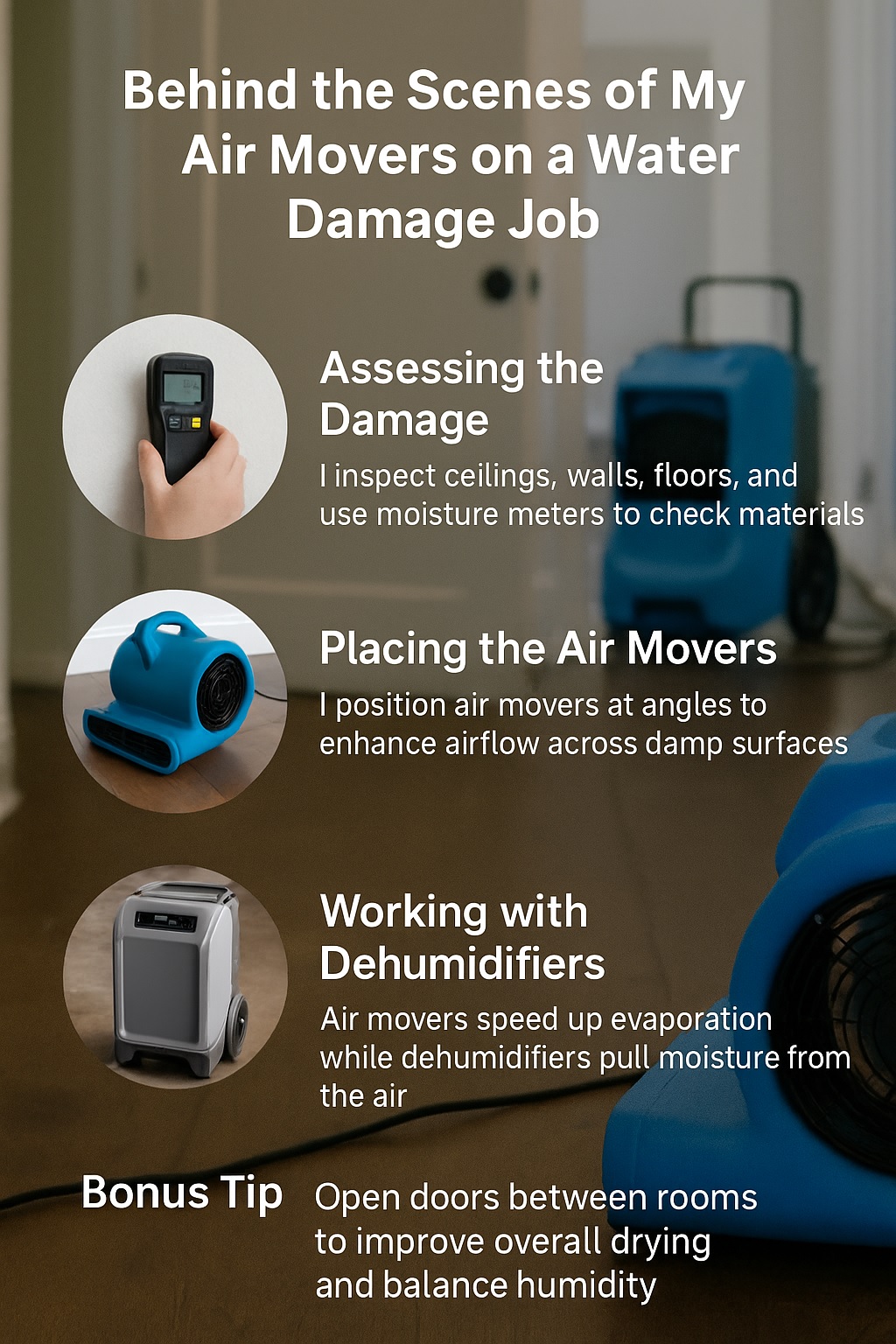
When I roll my air movers into a soaked home, people are usually shocked by how much science, planning and monitoring actually happens after the water is gone.
Learn what really happens on a water damage job, how air movers and dehumidifiers work together hour by hour, and why professional structural drying protects walls, floors, subfloors and furniture from hidden moisture, mould growth, bad odours and expensive future repairs.
Fast Facts from My Air Mover Drying Jobs
| Metric | Typical Range / Value |
|---|---|
| Typical structural drying time with equipment | 2–4 days on many residential jobs |
| Extra air movers per 50–70 sq ft of wet floor | 1 additional unit after the first in each affected room |
| Spacing along wet walls | 1 air mover every ~10–20 linear feet of wet wall area |
| Air mover airflow output per unit | Commonly 600–3000 CFM depending on model |
| Use on professional water damage projects | Standard equipment on almost all restoration jobs |
Source: iicrc.org
🚚 Introduction: How My Typical Water Damage Day Starts
The Early-Morning “Help, My House Is Flooded” Call
Most of my water damage days start the same way: a half-panicked call before breakfast. A pipe bursts, a washing machine hose pops, or a kid discovers that toilets are not water toys. I grab my moisture meters, dehumidifiers and a truck full of air movers, and my brain instantly switches into “triage mode.”
Loading My Van Like a Mobile Drying Lab
My van looks like a cross between a toolbox and a jet engine showroom. I load different types of air movers, extra cords, door stops, power boards and safety gear. Over time, I’ve learned that the job always goes smoother when I over-pack gear instead of trying to “make do” later.
Dr James Li, Chartered Building Surveyor (MRICS), once told me that water damage doesn’t care about convenience, only about physics and time.
💧 How I Got Into Water Damage Jobs and Using Air Movers
My First Completely Soaked Lounge
My first serious flood job was a small lounge that looked like a kids’ pool. I had a couple of basic fans and way too much confidence. I dried the visible water, packed up, and felt proud… until the customer called a week later about musty smells and new stains. That’s when I realised “looks dry” isn’t enough.
Why I Decided to Train Properly
That failed job stung my pride and my wallet, so I dove into training. I studied proper drying principles, learned about classes of water damage, and took courses based on industry standards. Now, when I set up my air movers, it’s not guesswork; it’s a repeatable system shaped by painful early mistakes.
Andrew Scott, Certified Water Damage Technician (IICRC), likes to remind me that experience without standards is just “expensive experimenting.”
🔍 How I Assess a Water Damage Job Before My Air Movers Switch On
My Walk-Through Checklist in Real Homes
When I arrive, I don’t just drop fans and leave. I walk the whole property: ceilings, walls, skirting boards, closets and behind furniture. I check how far the water travelled, if it reached other rooms, and whether it has already started wicking up walls. Every job is like a detective case, and the clues are hidden in the plaster and carpet.
Moisture Meters, Not Magic Fingers
I used to tap walls and pretend I could “feel” dampness. Now I use pin and pinless moisture meters to measure what my fingers can’t. I check wet areas and compare them to dry, unaffected zones. That contrast tells me the real story. If the numbers are high, my air movers know they’re in for a long shift.
Deciding If It’s a DIY Job or a Proper Drying Project
Sometimes, I tell people honestly that a couple of small fans and a sunny day will do the job. Other times, I see swollen skirtings, soaked underlay and suspicious smells, and I explain why professional drying is cheaper than replacing flooring later. My air movers come out when “it’ll probably be fine” clearly won’t cut it.
Dr Emily Rogers, Licensed Structural Engineer (PE), once joked that ignoring hidden moisture is like ignoring hairline cracks in a bridge and hoping for the best.
🌬️ How I Choose the Right Air Movers for Each Room
My Line-Up: Centrifugal, Axial and Low-Profile Fans
Not all air movers are created equal. I carry compact centrifugal units for tight corners, big-throw axial fans for long hallways, and low-profile units that slide neatly under lifted carpet. Each one has a personality. I’ve learned which “character” suits a tiny wardrobe and which one belongs in a giant open-plan lounge.
How I Decide How Many Air Movers to Use
I think in simple blocks: roughly one air mover per affected room, then more for every extra patch of wet flooring or long wall. If a lounge and hallway are both soaked, I don’t try to make one lonely fan do all the work. I’ve tried being stingy with fans; it just drags out drying and annoys everyone.
Positioning My Air Movers for Real Results
I angle my air movers at about 45 degrees to walls, aim air under skirtings and across wet carpet seams, and create a “river” of moving air that loops back towards the dehumidifier. Trial and error taught me that pointing two fans directly at each other mostly creates a noisy argument, not good airflow.
Michael Tan, Certified HVAC Technician, always laughs that my drying setups are just indoor weather systems with better manners than real storms.
🔄 How I Set Up My Air Movers with Dehumidifiers and Heat
Why My Air Movers Aren’t Enough on Their Own
Air movers don’t remove water from the building; they just kick it into the air. Without dehumidifiers, all that moisture just floats around like a steamy sauna. I’ve seen DIY setups with ten fans and zero dehumidifiers. It feels breezy but the structure is still wet, and mould is basically sending out invitation cards.
Matching Air Movers and Dehumidifiers Like a Team Sport
I think of each job like a sports team. My air movers are the runners, pushing moisture off surfaces. My dehumidifiers are the finishers, actually taking water out of the air. If I have too many fans and not enough dehumidification, humidity climbs and everything takes longer. So I balance the numbers based on room size and how wet things really are.
Heat, Noise and Not Cooking the Family
A bit of warmth speeds up drying, but I’m careful not to turn the house into a sauna. I work with existing heating and try to keep noise manageable so people can still sleep. It’s a constant balance: fast drying, safe temperatures and air mover placements that don’t turn the hallway into an obstacle course.
Sarah Patel, Registered Electrician, likes to remind me that perfect airflow means nothing if you trip the breaker and everything shuts off at 2 a.m.
⏱️ What My Air Movers Do Hour by Hour During the Drying Process
The First 24 Hours: The Heavy Lifting
The first day is where my air movers earn their keep. Surfaces are wet, humidity is high, and everything feels heavy and sticky. I measure moisture, set targets, and run equipment hard. It’s the part customers usually hate the most because it’s loud, but it’s also when we win the biggest battles against moisture.
Days Two and Three: Tweaking the Setup
After the initial push, I often shift air movers, reduce some units and redirect others. Some areas dry faster; others stay stubbornly wet. I’ve learned not to be lazy here. Leaving everything in the original position “just because” is how you end up with random damp patches one week later. Adjusting angles can shave off a whole day of drying.
When I Know My Air Movers Have Done Their Job
I don’t pack up because “it smells better now.” I compare fresh moisture readings to the dry areas of the home. When the numbers line up and surfaces feel stable, that’s my green light. If the meter disagrees with my nose, the meter wins, and the air movers stay.
Dr Oliver Grant, Materials Scientist (PhD), likes to say that molecules don’t care about my schedule, only about temperature, airflow and time.
📊 How I Monitor and Adjust My Air Movers While They Run
My Daily Visit Routine
Every day, I do a mini health check on the job. I walk the rooms, listen for odd noises, check for hot cords, and take new moisture readings. I shift air movers slightly, open or close doors, and look for sneaky damp spots. It feels like checking in on patients in a hospital ward, just noisier.
When I Reduce Air Movers on Purpose
Customers are often surprised when I start removing fans before the job is completely finished. By then, some areas are already at target moisture, so leaving ten fans blasting away is overkill. I reduce numbers and reposition so the remaining air movers focus on the genuinely stubborn parts. Less noise, less power, smarter drying.
Documentation That Keeps Everyone Happy
I take photos of equipment layouts, write down moisture readings, and track progress each day. This protects me, helps the customer, and keeps insurance companies happy. If anyone ever asks “Was it really dry?” I’ve got the story written in numbers, not just in my memory.
Laura Chen, Chartered Loss Adjuster (ACII), likes to remind me that good paperwork dries arguments just as well as good airflow dries carpets.
🗣️ How I Explain My Air Movers and Drying Plan to Customers
Turning Drying Jargon into Normal Language
Most people don’t wake up thinking about air changes per hour or grain depression. So I explain my plan in simple language: “These fans push water out of your carpet; these machines pull that water out of the air.” When customers understand the basics, they’re more patient with the noise and cables.
Helping Families Live Around My Equipment
I’ve dried houses with toddlers, pets, elderly parents and home offices all squeezed together. I show people the safest walking paths, tape cords down, and sometimes rearrange fans so at least one bedroom is quieter at night. My goal is “maximum drying, minimum chaos,” even though the setup still looks like a small airport.
Being Honest About Time and Cost
I never promise exact hours, but I give a realistic range based on what I see. I also explain what happens if we stop too soon: warped floors, surprise stains and mould patches. Once people understand that my air movers are cheaper than a new floor, the conversation suddenly feels much easier.
Tom Walker, Chartered Accountant (CA), once told me that explaining long-term cost is the fastest way to turn noise into an investment instead of an irritation.
📚 How I Work with Industry Experts and Trusted Guidelines
Why I Don’t Just “Wing It” Anymore
In my early days, I relied on gut feeling and trial and error. Now I lean on recognised guidelines and training to shape my decisions. They don’t replace my judgment, but they give me a solid framework. My air movers are driven by experience plus standards, not just vibes and optimism.
Learning from Other Restoration Pros
I talk with other technicians, read trade articles, watch demonstrations and compare notes about difficult jobs. Everyone has stories about weird building layouts or mystery moisture that refused to leave. Hearing how others used different fan types or creative setups helps me refine my own approach on the next strange project.
Always Updating My Air Mover Playbook
New gear comes out, and building materials keep changing, so I keep testing. Sometimes I learn that a fancy new fan isn’t worth the hype; other times, a low-profile unit becomes my new favourite tool. I treat every job as both work and research, and my air mover setups get sharper each year.
Dr Hannah Moore, Professional Educator (MEd), says good technicians think like lifelong students, not like know-it-alls with noisy toys.
🛋️ How My Air Movers Saved One Family’s Lounge (Case Study)
The Night Their Dishwasher Went Rogue
One evening, I got a call about a “small leak.” When I arrived, the dishwasher had flooded half the kitchen, the lounge, and part of the hallway. The family had already tried towels and a tiny desk fan. The carpet squished under my boots, and I knew my air movers were about to work overtime.
My Setup and Drying Strategy
I extracted as much water as possible first, then set up a mix of centrifugal and axial air movers across the lounge and hallway, plus two solid dehumidifiers. I aimed airflow along the worst walls and under the carpet edges. I explained that the gear would probably need to run for three to four days, with daily check-ins.
Key Numbers from One Real Drying Job
| Detail | Case Study Value |
|---|---|
| Property type | 3-bedroom single-storey home |
| Affected areas | Lounge, hallway, 2 bedrooms |
| Air movers & dehumidifiers used | 9 air movers + 2 dehumidifiers |
| Time to reach target moisture | 3.5 days with daily monitoring |
| Customer feedback | “Carpet feels dry, smells fresh, and no stains came back.” |
The Result After a Few Noisy Days
By day three, the house smelled normal again, moisture readings matched dry rooms, and the family could walk barefoot without that horrible “cold damp” feeling. They told me they almost hired a carpet replacement company instead. My air movers and a good drying plan ended up saving their lounge and their insurance excess.
Rachel Wong, Licensed Insurance Broker, likes to say that the best claims are the ones where people keep their stuff instead of replacing it.
❓ My Air Mover FAQs (What Customers Ask Me Most)
“How Noisy Are These Things? Can I Sleep?”
I won’t sugar-coat it: air movers are not quiet. I tell people to expect “loud hotel air conditioner” levels of noise. Where possible, I shift some units into less critical rooms at night, slightly angle doors, and suggest earplugs for light sleepers. The goal is to dry fast without turning everyone into zombies.
“Can I Just Use My Own Fans Instead?”
Household fans are great for cooling you down, but most of them don’t push air across surfaces the way professional air movers do. I’ve seen people run two tiny pedestal fans for days with almost no change in moisture readings. My gear moves serious air and is built to run hard without quitting in the middle of the night.
“Will This Stop Mould from Coming Back?”
Proper drying massively reduces the chance of mould returning, but it’s not magic. The original leak needs to be fixed properly, humidity in the home needs to stay under control, and future spills should be cleaned up quickly. My air movers give the building a fair fight; daily habits keep it winning.
Dr Anita Gomez, Registered Microbiologist, likes to remind me that mould doesn’t care whose fault the leak was, only whether the environment is dry and boring.
✅ My Key Takeaways from a Day with My Air Movers
What I Want Every Homeowner to Remember
When a home floods, most people focus on the visible puddles. My job is to worry about everything you can’t see: soggy underlay, damp skirtings, cool patches inside walls. My air movers, dehumidifiers and meters work together so your home doesn’t just look dry today and rot quietly tomorrow.
The Bigger Picture Beyond Just Fans
To me, air movers are part of a full recovery story: stop the water, extract, dry, verify, and then prevent future issues. If you ever face a “small leak” that doesn’t feel so small, get advice early. Your future self will thank you every time you walk across the floor without wondering what’s growing underneath.
Dr Kevin Harris, Chartered Psychologist (CPsychol), once told me that people sleep better in dry houses not just because of air quality, but because they’re not secretly stressing about hidden damage.
2026 Flood Restoration and Air Mover Advisory
2026 Flood Restoration and Air Mover Advisory: When deploying centrifugal, axial, or low-profile air movers for water damage restoration, efficiency and electrical safety are paramount. Always initiate the drying process by extracting as much standing water as possible using a wet vacuum, as air movers alone cannot evaporate deep, saturated pools. Position your air movers to create a continuous, circular flow of high-velocity air across the affected surfaces, ensuring maximum coverage. Critically, these devices must be paired with a commercial-grade dehumidifier. Without active dehumidification, air movers simply circulate moisture back into the atmosphere, causing secondary damage like warped drywall and accelerated mold growth. Ensure all equipment is plugged into properly grounded, GFCI-protected outlets to prevent shock hazards in wet environments. Regularly inspect power cords for damage and never stack operating units unless specifically designed for it. Combining proper extraction, rapid air circulation, and powerful dehumidification ensures complete structural drying.
Hire professional-grade equipment from 7 Hire. We offer fast local pickup or delivery across Auckland.