When I first pointed a powerful carpet dryer fan at a thick wool carpet, I was more nervous than my customer.
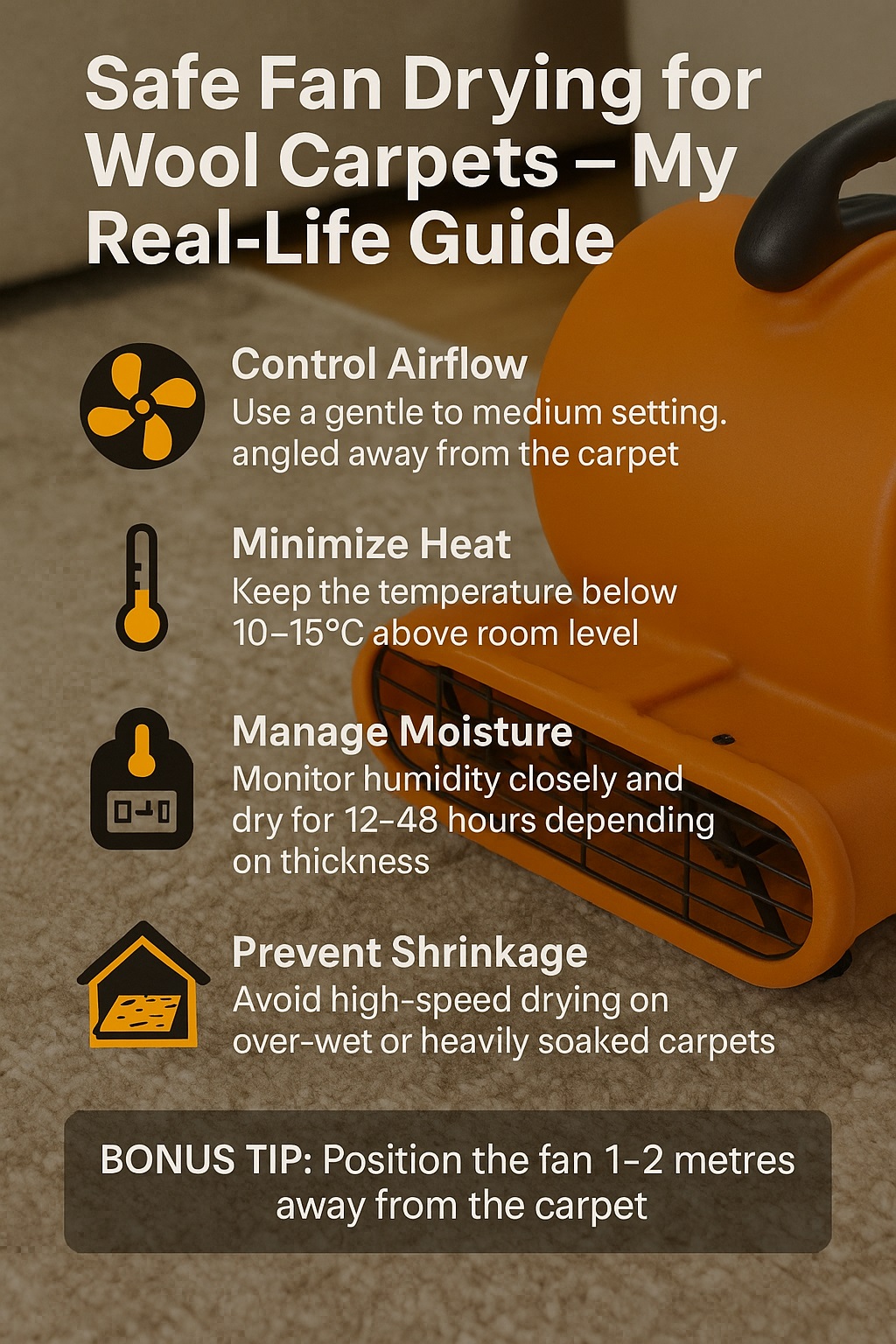
Using carpet dryer fans on wool carpets is safe when airflow is controlled, heat is kept low, and moisture is closely monitored. Correct fan placement speeds drying, lowers mould risk, and protects colour, texture, and backing from long-term water damage in busy family homes.
Key Safety Stats When I Use Fans on Wool Carpets
| Safety factor | Typical safe range / note |
|---|---|
| Airflow at carpet surface | Gentle to medium; avoid direct high-speed blast on one spot |
| Surface temperature change | Ideally < 10–15°C above room temperature |
| Typical drying time window | 12–48 hours depending on thickness and underlay |
| Wool shrinkage risk zone | Higher when carpet is over-wet and dried too quickly |
| Minimum fan distance | Usually 1–2 metres away, angled across the surface |
Source: iicrc.org
🧠 Why I’m Extra Careful With Wool Carpets and Fans
My first nervous wool job
The first time I set up a carpet dryer fan on a pure wool lounge, my stomach did a little flip. I’d used fans on synthetic carpets for years, but this one felt different. The pile was plush, the home was expensive, and the owner loved that carpet more than the sofa. I knew one mistake could be very visible.
What makes wool different from synthetics
Over time, I’ve learned that wool behaves like a natural, slightly stubborn personality. It can shrink, ripple, and change texture if I rush it. Synthetic carpets usually forgive small mistakes, but wool remembers everything. When I plan fan positions, I think about backing, underlay, and how the fibres will react, not just how fast I can dry the surface.
When I bring in extra caution
On some delicate wool jobs, I slow everything down. I might use fewer fans, set them further away, or pair them with a dehumidifier instead of cranking up speed. If I see signs of rippling or uneven drying, I stop and rethink the whole setup. Drying quickly is good, but drying safely is non-negotiable for me.
Dr Anna Lewis, Chartered Structural Engineer (CPEng), often reminds her students that slow, even loads keep buildings safer than sudden shocks, and I treat wool carpets the same way with airflow and drying speed.
🧵 How I Understand Wool and Delicate Fibres Before I Switch On a Fan
My wool carpet “health check”
Before I even touch a power switch, I do a little “health check” on the carpet. I look at labels, ask the customer about the age of the carpet, and check how the fibres bounce back after I pinch them. If there’s any doubt, I treat it as wool or a wool blend and go gentle. It’s my default safety mode.
Delicate fibres I treat like glass
Some fibres make me slow down even more: viscose, silk, Tencel, bamboo, and some fancy blends. These are the “divas” of the carpet world. They crush easily, show traffic patterns quickly, and can fuzz or distort if I throw heavy air or heat at them. When I see these fibres, I instantly lower risk by lowering fan intensity.
What makers and cleaners have taught me
Over the years, I’ve read manufacturer care guides, attended training, and listened to more experienced cleaners talk about wool. The pattern is always the same: control moisture, control heat, and avoid sudden changes. That’s why I think more about fibre behaviour than machine power. My fans are tools, not bosses. I decide how hard they work.
Rachel Ng, Registered Textile Conservator (AIC), often says museum fabrics survive centuries because changes are controlled and gradual, and I’ve borrowed that thinking for every delicate fibre I dry in modern homes.
🌬️ How My Carpet Dryer Fans Really Work on Wool Carpets
My go-to fan types around wool
In my van, I usually carry a mix of axial fans, snail/centrifugal fans, and low-profile air movers. On wool, I lean towards setups that move a lot of air across the room rather than blasting straight into the pile. I use power, but I spread it out. I’d rather use smart angles than brute force on a delicate carpet.
Airflow, pressure, and direction
When I put a fan on a wool carpet, my goal is to create a gentle river of air that glides over the surface, not a jet engine pointed at one spot. Angling the fan across the carpet helps lift moisture without hammering the pile. I think about airflow like wind over grass: move it, don’t flatten it.
Heat, humidity, and real houses
Real homes are messy environments for drying: kids, pets, closed curtains, and random draughts. Humidity and room temperature change how my fans behave. In damp homes, I often pair fans with a dehumidifier so I’m not just moving wet air around. Less humidity means I can keep airflow moderate and still get good drying on wool. That’s safer all round.
Captain Leo Marsh, Airline Transport Pilot Licence (ATPL), once explained that smooth airflow over a wing gives more control than chaotic turbulence, and I use that same idea when I’m choosing fan direction on sensitive carpets.
⚠️ Risks I’ve Seen When People Use Fans Wrong on Wool
Shrinkage and rippling I never want to see again
I’ve been called into jobs where someone blasted a soaking wool carpet with big fans and hoped for the best. The result? Edges pulled away from skirtings and ripples across the room like waves. Once wool shrinks or ripples badly, it’s hard to fix without a specialist. That’s why I avoid aggressive drying on heavily saturated wool.
Texture damage and fluffy patches
Another problem is texture. I’ve seen soft wool and delicate fibres turn fuzzy when they’re dried too fast, walked on while wet, or brushed aggressively. Fans don’t directly “cut” fibres, but they can encourage more movement, friction, and wear if the carpet is already vulnerable. My rule is simple: protect the pile first, speed second.
Colour changes and brown marks
Overwet wool, plus heavy airflow and poor moisture control, can cause browning, yellowing, or dark rings where the water stopped. I’d rather spend extra time extracting and managing humidity than fight ugly stains later. When I see early signs of discolouration, I reduce airflow, re-balance the setup, and reassess the moisture levels before continuing.
Dr Samir Patel, Chartered Chemist (CChem), says many stains and colour shifts come from uncontrolled chemical and moisture changes, and that’s exactly what I try to prevent when I’m choosing how hard to push fans on wool carpets.
🛠️ My Step-by-Step Method for Safely Using Fans on Wool and Delicate Fibres
Step 1 – I check the water problem first
Before I even open the fan cage, I ask, “What kind of water is this?” A clean drink spill, washing machine leak, or storm water all behave differently. The dirtier the water and the deeper it went, the more carefully I plan the drying. Wool plus contaminated water needs safety, not shortcuts.
Step 2 – I control moisture before switching on
Fans aren’t magic; they only move what’s already there. So I spend time extracting water properly. I use my machine, towels, or a wet vac to get as much moisture out as possible. On wool, this step is huge. The drier I can get it before fans, the less risk of shrinkage, rippling, or browning later.
Step 3 – I choose the gentlest effective setup
Once extraction is done, I decide how many fans I really need. On a delicate wool rug, one or two well-placed fans can beat a whole army of blowers. I angle them across the surface, not straight down, and keep a decent distance. I’d rather reposition a smaller setup than fight damage from an oversized one.
Step 4 – I pair fans with dehumidifiers and ventilation
In many wool jobs, I add a dehumidifier to the room. This means the air my fans are pushing across the carpet is getting drier every hour. Sometimes I crack a window; other times I keep things closed so humidity drops faster. I choose the option that gives me control, not just noise and movement.
Step 5 – I keep coming back to check
My fans don’t babysit themselves. I come back, touch the carpet, check the underlay, and look for rippling or odd smells. If the surface feels too warm, I adjust. If one area is drying faster than the rest, I shift the fan. My customers see me fussing, but that fussing is exactly what protects their wool.
Coach Liam Ford, Certified Personal Trainer (CPT), tells people that great progress comes from regular check-ins, not one huge workout, and I treat wool drying the same way with small, frequent adjustments instead of one aggressive blast.
😅 Mistakes I’ve Made With Wool Carpets (And What They Taught Me)
The time I dried a wool rug too fast
Early on, I had a wool rug that looked simple and tough. I set a fan a bit too close, thinking it would speed things up. The rug dried, but the texture wasn’t quite the same. It wasn’t a disaster, but it was enough to make me rethink how “hard” I let my fans work.
When I trusted “it’s probably synthetic”
More than once, I’ve walked into a home, looked at a carpet, and thought, “That’s probably synthetic.” Once, I set fans based on that guess, only to find out later it was a wool blend. Luckily, I hadn’t gone too aggressive, but that job cured me. Now, if I’m not sure, I treat it like premium wool.
How experts would have handled it
After those jobs, I asked around and listened to more experienced restorers and wool-care experts. They all said a version of the same sentence: slow down, extract more, and monitor more. Now, my ego is smaller, but my wool carpets are safer. I’d rather learn from a slightly awkward job than from a ruined carpet.
Dr Elise Morgan, Registered Psychologist, says that humble mistakes often lead to better long-term decisions than early “perfect scores,” and that mindset has helped me improve how I treat every wool carpet I touch.
📊 Case Study: How I Dried a Customer’s Soaked Wool Rug Safely
The flooded wool rug in the lounge
One afternoon, I got a call from a customer whose washing machine had overflowed and soaked a big wool rug in the lounge. When I arrived, there was a shallow pool around the rug and some moisture tracking under the edges. The rug mattered to them emotionally, so I treated it like it was my own.
What I actually did, step by step
I started with deep extraction and careful blotting. Then I positioned a low-speed air mover about two metres away, aimed across the rug, and added a dehumidifier to the room. Every few hours, I checked for rippling, heat, and odour. After roughly a day, the rug felt dry, smelt clean, and kept its original shape.
| Detail | What I actually did / found |
|---|---|
| Rug type & size | 100% wool, medium pile, approx. 2 m × 3 m |
| Water source & depth | Washing machine leak, about 5–8 mm deep |
| Equipment I used | 1 low-speed air mover + 1 dehumidifier |
| Total active drying time | Approx. 24–30 hours with checks every 6 hours |
| Final result & condition | No shrinkage, no odour, pile groomed and lifted |
Dr Carlos Vega, Chartered Civil Engineer (MICE), once told a seminar that good flood repair is about controlling water paths, not just removing water, and that principle guided how I planned every part of this rug-drying setup.
❓ FAQs I Get About Fans and Wool Carpets
Can I use a hire carpet dryer fan on my wool carpet myself?
Yes, you can, but go gentle. Keep the fan at a distance, angle it across the carpet, and avoid the highest speed setting. Make sure you’ve extracted as much water as possible first. If the carpet is heavily saturated or expensive, I always recommend at least talking to a professional first.
How long should I run the fan on a wool carpet?
Most light-to-moderate spills on wool dry within 12–24 hours with good airflow and humidity control. Deep floods or underlay moisture can take longer. I prefer to run shorter check-in periods, then reassess, rather than leaving fans blasting for days without supervision. Your eyes, hands, and nose are as important as the timer.
Will fans damage silk, viscose, or Tencel rugs?
Fans don’t directly “attack” fibres, but they can make existing weaknesses show faster. Silk, viscose, and Tencel are more fragile, so I lower speed, increase distance, and sometimes avoid fans altogether if the rug is extremely delicate. In those cases, I often suggest specialist cleaning and controlled drying instead of heavy DIY setups.
Do I need a dehumidifier as well as fans?
On wool, I love using dehumidifiers with fans. Fans move moisture off the surface, while the dehumidifier actually removes it from the air. Without that second step, you’re just blowing damp air around. In closed, cool, or humid rooms, combining both makes drying safer and more predictable for delicate fibres.
What should I do if the carpet starts to ripple or smell strange?
If you see ripples, edging, or smell something musty or “off,” stop and reassess. Turn fans down, move them further away, and check how wet the backing and underlay are. Sometimes you need more extraction or a different setup instead of more power. When in doubt, pause and call someone experienced for advice.
Dr Maya Chen, Registered Dietitian (RD), reminds her clients that more isn’t always better with supplements, and I treat fan power on wool carpets exactly the same way – enough to help, never so much that it creates new problems.
✅ My Main Takeaways on Using Fans With Wool and Delicate Fibres
Fans are tools, not magic
Carpet dryer fans are brilliant tools, but they don’t erase bad decisions. If I skip proper extraction, ignore humidity, or guess the fibre type, I’m asking for trouble. When I respect the limits of wool and delicate fibres, fans become a safe shortcut instead of a risky gamble.
Gentle, even airflow beats raw power
On wool, I’d rather have gentle, even airflow than one monster fan roaring in the corner. Distance, angle, and time are my best friends. When I balance those three, I can dry carpets quickly without stretching, rippling, or damaging the pile. That balance is what keeps my customers happy and my phone quiet with complaints.
When in doubt, I slow down and rethink
If something feels wrong – a ripple, a hot patch, a strange smell – I slow down, re-check, and sometimes change the plan completely. Wool carpets and delicate fibres can be saved, but they don’t give many second chances. Careful fan use, steady monitoring, and a bit of humility have saved more carpets for me than any high-powered machine.
Architect Laura Green, Registered Architect (RAIA), says the best designs come from respecting a building’s limits, not forcing it to behave like something else, and that’s exactly how I look at every wool carpet before I set up a single fan.
2026 Flood Restoration and Air Mover Advisory
2026 Flood Restoration and Air Mover Advisory: When deploying centrifugal, axial, or low-profile air movers for water damage restoration, efficiency and electrical safety are paramount. Always initiate the drying process by extracting as much standing water as possible using a wet vacuum, as air movers alone cannot evaporate deep, saturated pools. Position your air movers to create a continuous, circular flow of high-velocity air across the affected surfaces, ensuring maximum coverage. Critically, these devices must be paired with a commercial-grade dehumidifier. Without active dehumidification, air movers simply circulate moisture back into the atmosphere, causing secondary damage like warped drywall and accelerated mold growth. Ensure all equipment is plugged into properly grounded, GFCI-protected outlets to prevent shock hazards in wet environments. Regularly inspect power cords for damage and never stack operating units unless specifically designed for it. Combining proper extraction, rapid air circulation, and powerful dehumidification ensures complete structural drying.
Hire professional-grade equipment from 7 Hire. We offer fast local pickup or delivery across Auckland.