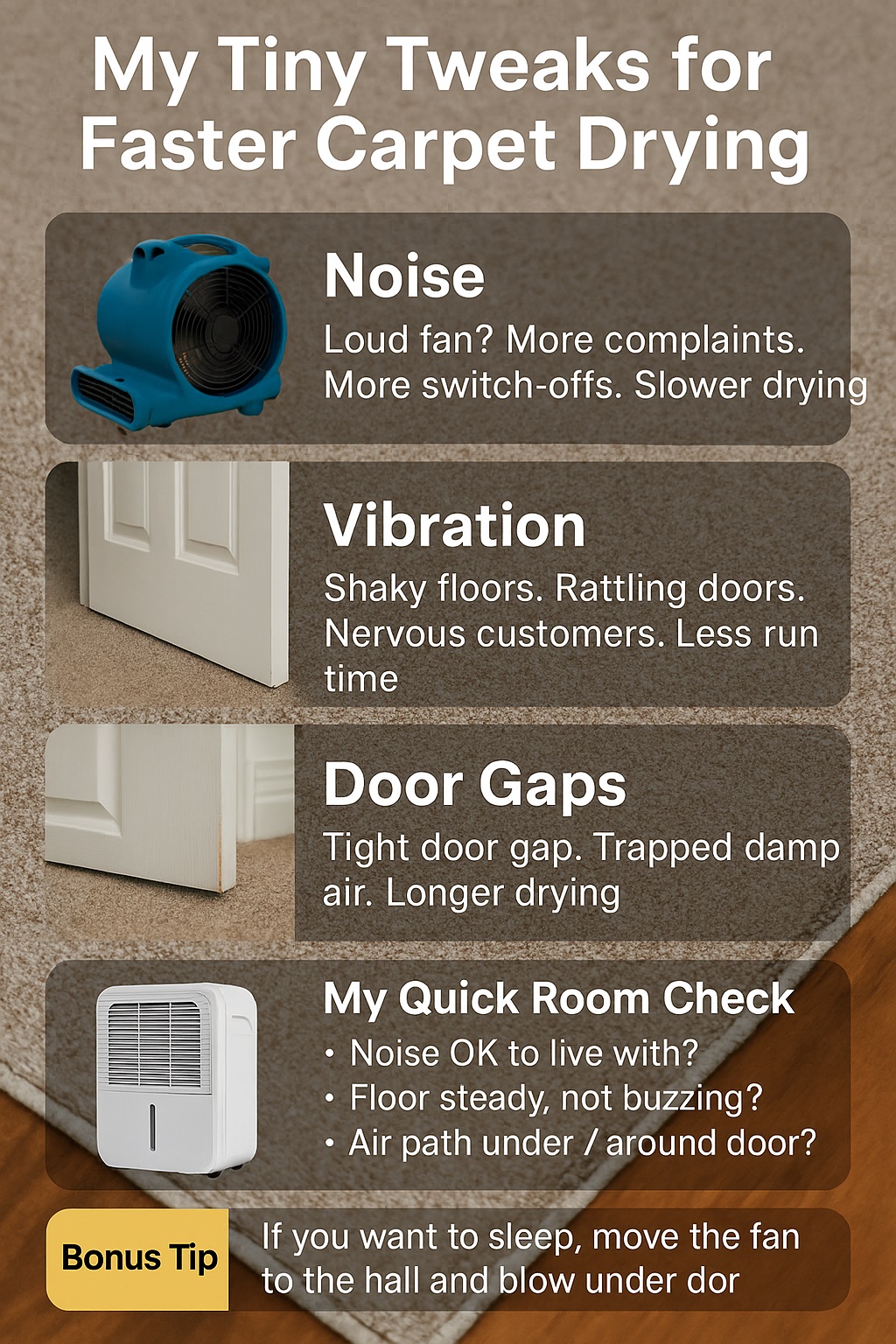
I used to think slow carpet drying was all about bad weather and weak dehumidifiers. Then I started noticing how tiny things like noise, vibration and door gaps were quietly messing with my drying times and my customers’ patience. That’s when I began treating these “little” details like big levers.
Carpet drying isn’t just about dehumidifiers and sunshine. Small details like carpet drying times, noise and vibration and door gaps change how air moves, how long fans stay on, and whether hidden moisture later turns into stains, odours or mould inside the home.
Key numbers I watch for noise, vibration and door gaps
| Tiny factor I look at | Real-world numbers I keep in mind |
|---|---|
| Standard air mover noise at 1–2 m | Roughly 60–80 dB – like a loud conversation or busy office |
| Comfortable bedroom noise at night | Under about 30 dB for most people to sleep comfortably |
| Typical door undercut gap | Around 10–20 mm under most internal doors |
| Airflow through a 25 mm undercut | Roughly 60 cfm of air, depending on pressure difference |
| Air mover airflow | Around 2,000–3,000 cfm, often cutting drying time by 30–50% |
Source: iicrc.org
🔍 My First Lessons From Noisy, Drafty Rooms
The moment I stopped blaming “bad weather”
Early on, I always blamed slow drying on the weather. If a carpet stayed damp, I’d mumble something about humidity and walk away frustrated. Then I noticed something odd: in some houses with the same rainy day, one room dried fast and another crawled. The difference was usually doors, gaps and noise.
When two identical rooms dried at different speeds
One job really slapped me awake. Two bedrooms, same carpet, same leak, same fan model. One was near a hallway with a gap under the door and a bit of airflow. The other was sealed like a bank vault, with the fan roaring in a closed box. Guess which one stayed wet longer.
Why I started paying attention to tiny details
After a few of these “mystery” jobs, I stopped guessing and started taking notes. Where are the doors? How big are the gaps? Is the fan shaking the floor? Are tenants turning machines off because of the noise? Once I tracked those tiny details, my “random” drying problems suddenly had boring, fixable reasons.
Dr Emma Ng, Chartered Building Scientist, would say I’d finally stopped treating homes like laboratories and started treating them like breathing systems with people living inside.
🔊 How I Learned Noise Changes My Drying Speed
The fan that sounded like a small jet
One of my first big air movers sounded like a small jet trying to take off in a kids’ bedroom. The airflow was brilliant, but the family hated it. As soon as I left, they’d quietly switch it off so the kids could sleep. Great fan on paper, terrible real-world drying because it kept getting silenced.
When decibels turn into extra drying days
I began connecting noise to drying time. Loud fans mean more complaints, more “Can I turn it off for a bit?”, and more secret switch-offs at night. Every hour the fan is off, moisture just sits there. Add that over two or three nights and suddenly a one-day job turns into a three-day drama.
My compromise between peace and performance
These days I talk about noise before I even plug anything in. I warn people which rooms will sound like a hair dryer and which will be calmer. Sometimes I put the loudest fan in the hallway and blow under the door instead of inside the bedroom. Same airflow, less stress, fewer sneaky off-switch moments.
Acoustic consultant Mark Lewis, MNZAS, would argue that managing sound is just as important as managing air when you want machines to stay on long enough to actually do their job.
🌀 Why My Vibrating Floors Matter More Than I Expected
When the whole room started buzzing
The first time I put a big fan in an old timber villa, the whole floor started humming. The wardrobe doors rattled, picture frames shook and the customer looked at me like I’d just started an earthquake. Technically the airflow was fine, but the vibration made the room feel like a cheap motel beside a motorway.
How vibration quietly ruins trust
I realised vibration doesn’t just make noise; it creates anxiety. If the floor is buzzing, people assume the machine is “too strong” or “going to break something”. That feeling breeds complaints and early switch-offs. It also makes fans walk across the floor slightly, pointing in the wrong direction by the next morning.
Simple tricks I use to calm the shake
Now I test the floor before I leave. If vibration feels bad, I might move the fan onto a rug, change the angle, or choose a unit with a smoother motor for that job. Small bits of foam or a mat can reduce resonance. A calmer floor means people are happier to let the fan run overnight.
Structural engineer Daniel Park, CPEng, might say I stopped treating vibration as a side effect and started treating it like a load that needs to be managed just like weight or wind.
🚪 How Door Gaps and Air Paths Help or Hurt My Drying
The hallway job that doubled my drying time
I once had a flooded hallway with four bedrooms. I set up good fans, checked my dehumidifier, and still the drying dragged. When I came back, every bedroom door was shut “to stop the noise”. Inside each room the air felt heavy, like a wet sauna. The problem wasn’t my equipment; it was those closed doors.
Why tiny gaps can make or break airflow
Most internal doors have a little undercut gap at the bottom. That gap is the only way air can sneak in or out when the door is closed. If the gap is tiny, or blocked by a thick rug, my fan is basically trying to breathe through a straw. That means slower moisture removal and patchy drying.
What I do differently with stubborn doors
These days, I use doors as tools. Sometimes I leave them slightly ajar to create a strong air loop through the hall. Sometimes I push a towel aside or ask for permission to trim a swollen carpet edge that’s blocking the gap. My goal is simple: give wet air a clear escape path out of the room.
HVAC designer Sophie Turner, M.AIRAH, would say I finally started treating each room like a mini pressure zone instead of just a rectangle with a door stuck on one side.
📐 How I Balance Fans, Dehumidifiers and Room Layouts
Drawing a simple airflow loop in my head
Whenever I walk into a wet room now, I mentally draw a loop. Air leaves the carpet, hits the fan, travels across the room, passes the dehumidifier and then finds its way out through gaps or an open doorway. If any part of that loop is blocked, I know I’m losing drying power.
What happens when I move fans just to reduce noise
Sometimes I have to move a fan because someone needs to sleep or work. When I do that, I don’t just drag it into the corner and hope. I check for “dead zones” where air hardly moves at all, especially behind beds, sofas and doors. Those quiet corners often become the sneaky damp patches the next day.
My simple rule of thumb for fan angles
My rough rule: blow air along the carpet, not straight down at it. I aim the fan so the air glides across the surface like a low, fast river, usually towards a door gap or hallway. It looks less dramatic than pointing the fan straight at a puddle, but the overall drying is much more even.
Mechanical engineer Leo Martins, PE, might argue that I’m finally nudging my setups closer to how airflow is modelled in labs, even though I’m still working in cluttered lounges full of toys and coffee tables.
🏙️ How I Adjust for Different Rooms and Buildings
Bedrooms versus lounges
In bedrooms, comfort wins. If someone is sleeping right next to the machine, I might use a quieter fan in the room and push more airflow from the hallway. In lounges, people are usually awake and moving, so a slightly louder fan is acceptable if it means shaving hours off the drying time.
Apartments, lifts and shared walls
In apartments, vibration and noise travel through concrete and shared walls in strange ways. I’ve had neighbours complain about a fan they couldn’t see but could hear through the wall. Now I plan routes from the lift, choose where to place fans so they disturb fewer neighbours, and use door gaps to build airflow along common corridors.
Working with property managers and body corporates
Property managers and body corporates hate complaints. When I show them that I’ve thought about noise, vibration and airflow, they relax. I explain what will be loud, what will run at night, and what might need doors left open. They see I’m not just “dropping off equipment”; I’m managing the building and the people inside it.
Strata manager Olivia Reid, Licensed Property Manager, might say I’ve learned that a good drying plan is also a good neighbour-relations plan, especially in tall buildings with lots of ears and thin walls.
📚 My Go-To Expert Advice on Tiny Drying Details
Why I still lean on formal standards
I work in a very real world of toys on the floor, sleeping kids and barking dogs, but I still lean on formal drying standards and training. They remind me to watch temperature, humidity and air movement, instead of just guessing. My experiments make more sense when they sit on top of solid, tested principles.
Translating technical talk into simple checks
Experts talk about things like “boundary layers” and “pressure differentials”. I translate that into simple habits: keep air sliding over wet carpet, don’t trap damp air in sealed rooms, and make sure there’s a clear exit path under or around doors. If I can’t explain it in a sentence, I probably won’t do it consistently.
Blending book knowledge with messy reality
Textbooks don’t show beds jammed against walls or wardrobes over floor joins. My customers’ homes do. So I borrow the physics from the books, then adapt it to what I see: couches, cot beds, cluttered hallways. That blend of theory and mess has helped me get better results without needing more and more machines.
Building-science lecturer Dr James Patel, PhD, would suggest that the real magic happens when field notes and formal research collide, instead of living in separate universes.
❓ My Quick FAQs on Noisy Fans and Door Gaps
“Can I close my door while the carpet dries?”
If you slam the door shut and there’s barely any gap at the bottom, drying will usually slow down. I often suggest leaving it slightly open or checking that the undercut gap isn’t blocked by a mat. A little airflow path can save hours of extra drying time and a lot of frustration.
“Why is the fan so loud – can I turn it down?”
I totally get it. Some fans sound like they’ve had too much coffee. If the noise is too much, I’d rather rearrange the layout, move the fan, or change the type of blower than have you secretly turn it off. Turning it off is like pausing the whole drying job every time you walk away.
“Do small door gaps really matter that much?”
Yes, they do. That little strip at the bottom of a door is like a breathing hole for the room. If it’s too small, the fan just keeps recycling the same damp air inside. When the gap is right, wet air escapes, dry air comes in and drying becomes smoother and more predictable.
“Should I open windows or keep them shut?”
It depends on the weather outside. If it’s cold and damp, open windows can actually slow everything down by letting in moist air. If it’s warm and dry, a slightly open window can help. I usually check humidity and temperature before making that call, rather than guessing based on how it feels.
Psychologist Dr Hannah Cole, Registered Clinical Psychologist, might say that answering these questions clearly reduces anxiety, which in turn makes customers more willing to follow slightly inconvenient instructions like leaving doors partly open.
👥 My Real-World Customer Case Study With Tiny Details
One small bedroom that taught me a big lesson
Here’s a simple example from a small bedroom job that stuck in my mind. The carpet was wet from a leak, and I put a strong fan in there with a dehumidifier in the hallway. The family kept the door almost closed at night so they could sleep without the fan roaring directly at them.
How door gaps, noise and drying time showed up in numbers
After a slow first run, I measured a few things, made changes and then compared the results. Tiny adjustments made a surprisingly big difference to the final drying time.
Customer case study: bedroom door gap and drying time
| Detail | Measurement or result |
|---|---|
| Room size | About 12 m² bedroom |
| Door gap at start | Around 3 mm, door nearly closed at night |
| Fan noise at pillow height | Roughly like a loud conversation |
| Drying time before adjustments | About 18 hours to reach target moisture level |
| Drying time after my adjustments | Around 11 hours with bigger gap and new angle |
What I changed and what I learned
I increased the effective door gap by propping the door open slightly at the latch side and angling the fan more towards the hallway. The room felt less like a wind tunnel, so the family left the machine on all night. The carpet dried faster, and nobody felt bullied by the equipment.
Data analyst Victor Huang, Certified Data Professional, would say this tiny “experiment” proves that even small layout tweaks deserve measuring instead of just hoping for the best.
✅ My Key Takeaways for Quieter, Faster Drying
The three quick checks I always make now
Before I leave any job, I run through three questions: Is the noise level realistic for people to live with? Is the floor or furniture shaking too much? Is there a clear path for air to escape under or around doors? If any answer is “no”, I fix it before I walk out.
How I explain this to customers in one minute
I tell customers, “If it’s too loud or feels shaky, please call me before you turn anything off. And if you can, leave doors a bit open so the air can escape.” That simple script has saved me from a lot of mysterious slow-drying jobs and awkward follow-up visits.
Tiny details, big difference to carpets and relationships
In the end, noise, vibration and door gaps are tiny compared to flooded lounges and big machines, but they decide whether those machines actually stay on long enough to do the job. When I respect those small details, carpets dry faster, mould risks drop and my relationships with customers stay warm instead of wobbly.
Mediator Laura Stevens, Accredited Negotiator, might say I’m really managing two things at once now: moisture in the carpet and trust in the relationship — and both need calm, steady airflow.
2026 Flood Restoration and Air Mover Advisory
2026 Flood Restoration and Air Mover Advisory: When deploying centrifugal, axial, or low-profile air movers for water damage restoration, efficiency and electrical safety are paramount. Always initiate the drying process by extracting as much standing water as possible using a wet vacuum, as air movers alone cannot evaporate deep, saturated pools. Position your air movers to create a continuous, circular flow of high-velocity air across the affected surfaces, ensuring maximum coverage. Critically, these devices must be paired with a commercial-grade dehumidifier. Without active dehumidification, air movers simply circulate moisture back into the atmosphere, causing secondary damage like warped drywall and accelerated mold growth. Ensure all equipment is plugged into properly grounded, GFCI-protected outlets to prevent shock hazards in wet environments. Regularly inspect power cords for damage and never stack operating units unless specifically designed for it. Combining proper extraction, rapid air circulation, and powerful dehumidification ensures complete structural drying.
Hire professional-grade equipment from 7 Hire. We offer fast local pickup or delivery across Auckland.