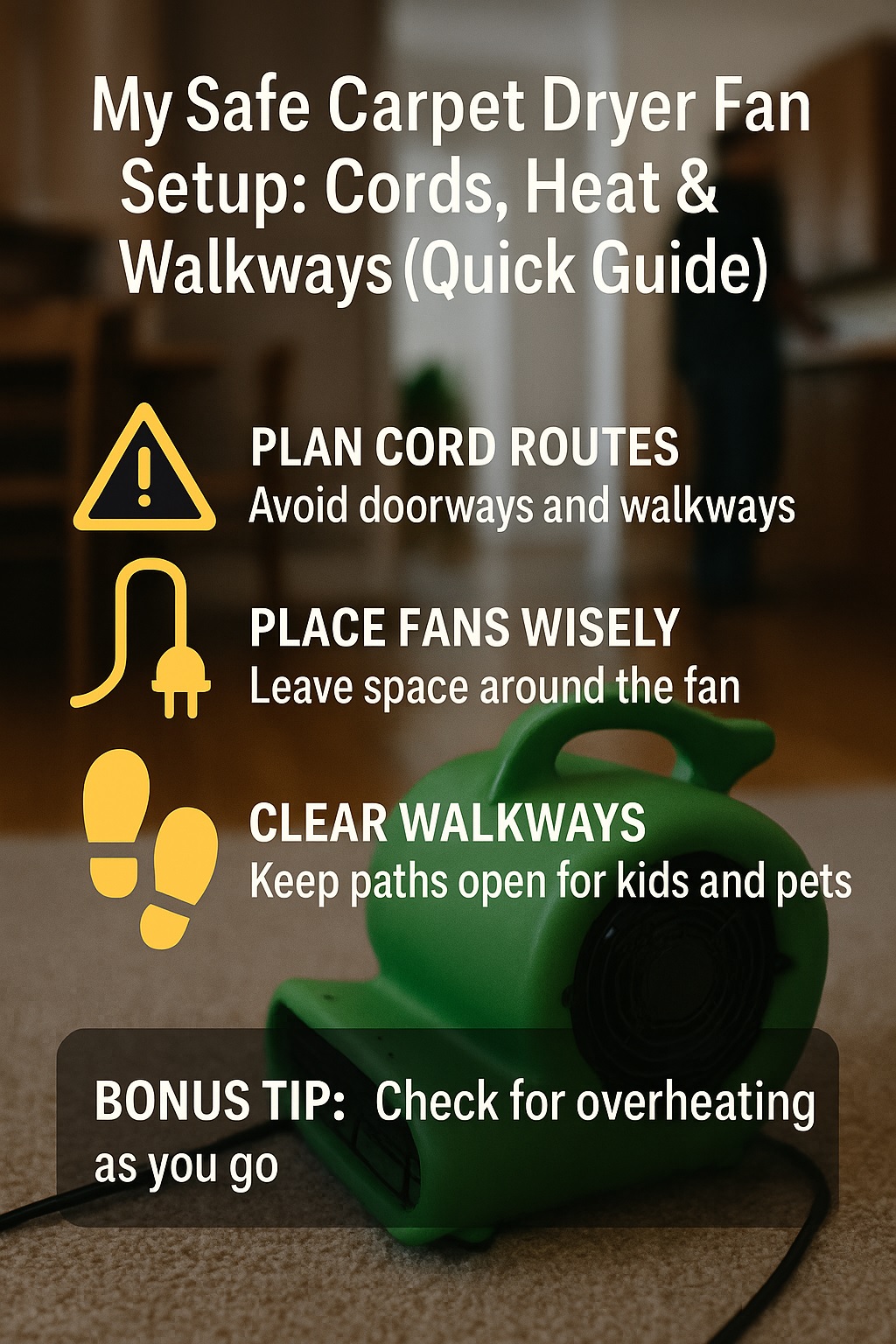
When I first started using carpet dryer fans in my busy home, I learned fast that speed means nothing if safety slips.
Good carpet dryer fan safety helps prevent house fires, painful falls, and repair bills. Busy homes face higher cord and tripping hazards and overheating risks when fans run for hours after leaks or cleaning. Small choices—outlet, placement, and cord path—decide whether drying stays safe or becomes dangerous.
Key Carpet Dryer Fan Safety Stats (US estimates)
| Safety risk focus | Estimated impact per year |
|---|---|
| Injuries linked to extension cords | ~4,000 ER-treated injuries |
| Trip injuries from cords and leads | About half of cord injuries involve tripping |
| Residential fires from extension cords | ~3,300 fires, ~50 deaths, ~270 injuries |
| Portable fan-related home fires | ≈560 per year (long-term average) |
| Electrical malfunction home fires | ~44,000+ annually |
Data source: cpsc.gov
🧭 How I Learned Carpet Dryer Fan Safety the Hard Way
A near-miss that changed how I work
My wake-up call came after I ran two fans through a narrow hallway. A midnight bathroom dash, a hidden cord loop, and one loud stumble later—luckily no broken bones. That mess taught me to plan cord routes like a flight path before I even plug in.
What I watch now—always
I focus on three risks: cords (where people walk), overheating (where the fan breathes), and visibility (what people can see in dim light). If a setup fails any one of those, I don’t start the fan. Dry carpet is never worth a fall or a fire.
“Safety is a system, not an accessory,” notes Ava Morton, CEng (Electrical)—design your layout so a mistake won’t cause harm.
🔌 How I Plan and Protect Power Cords
I map cord routes before power-on
I walk the rooms, look for natural “lanes,” and choose outlets that keep cords along walls, not through doorways. If a cord must cross a walkway, I reroute; if that’s impossible, I cover it or create a clear alternative path that everyone understands.
I prevent trips with bright cues and covers
Bright tape at edges, low-profile cord covers, and “step-free” zones make life easier for kids and sleepy adults. I explain in plain language: “This is the no-step zone.” When families buy in, compliance skyrockets, and accidents drop to zero.
I avoid overloads and daisy-chains
Big fans deserve their own quality outlets and RCD/ground-fault protection. I don’t stack power boards or run long, thin extension leads for high draw. Old outlets in old homes get a quick visual check: heat marks, looseness, crackling sounds—deal-breakers.
“Trip risk multiplies where attention is thin,” says Noah Ellis, OT, Fall-Prevention Clinician—make the safe choice the easy choice.
🌬️ How I Avoid Overheating and Motor Stress
I give fans room to breathe
Fans hate cramped corners. I leave space around inlets and outlets, keep soft items away, and never aim a fan into a closet or under bedding. If air can’t move, heat builds. I treat airflow like a highway: no traffic jams allowed.
I clean vents and listen for changes
Dust, pet hair, and fluff creep into grills. I brush them off between jobs and check daily on multi-day drying. A new rattle or hum means stop and inspect. I don’t bury fans in laundry, curtains, or under tables—it’s asking for heat trouble.
I balance runtime with checks
Long runs dry faster, but I do quick touch-and-smell checks during routine walkthroughs. If a unit feels unusually hot, smells like warm plastic, or sounds strained, I power down and investigate. I never rely solely on thermal cut-outs; they’re a seatbelt, not autopilot.
“Heat is feedback,” says Dr. Leo Park, PE (Mechanical)—manage heat and you manage lifespan, safety, and performance.
🐕 How I Make Busy Homes Safer for Kids and Pets
I build routes around routines
Kids need bathrooms at night; pets patrol everything. I place fans so normal life can continue without acrobatics. If I can’t avoid a crossing, I schedule fan-on times for when rush-hour traffic is lowest, like school drop-offs or late evenings.
I create no-touch zones
I use simple rules: no touching fans, no moving cords, no draping towels over grills. For toddlers, I increase distance and use furniture as a barrier. For curious pets, I secure cords along skirting boards and avoid dangling loops that look like toys.
I protect sleep and visibility
Night-time is when people trip. I keep paths wide, use low lighting or motion lights, and avoid dark cords across dark carpets. A safe layout is one you can navigate half-asleep without thinking.
“Design for low light,” advises Mila Chen, M.Arch (Human-Centered Design)—if it’s safe at 2 a.m., it’s safe at 2 p.m.
🧰 How I Check and Maintain My Fans
I run a fast pre-job checklist
Plug, cord, strain relief, switch, feet, housing, and sound—all get a quick look. I reject any fan with cracked insulation, wobbly feet, or burnt odor. If in doubt, I tag it and take a backup. Downtime is cheaper than damage.
I clean, coil, and store correctly
Dust traps heat. I vacuum grills, wipe housings, and coil cords loosely—no tight kinks. Fans sit upright, not buried in gear, so the next setup is clean and predictable. Good storage is free performance; bad storage is a slow, invisible failure.
I retire tired gear early
If a fan runs rough or makes new noises, I don’t argue—I replace or service it. Professional use ages equipment faster than home use. Reliability is part of safety, and safety is part of my brand.
“Maintenance is risk reduction in slow motion,” says Priya Rao, CMfgE—small habits prevent big incidents.
🧯 My Response Plan When Something Smells Hot
I treat smells and sounds as alarms
A burnt-plastic whiff, a high whine, or a sudden rattle means power off, cord out, and inspection. I give the unit time to cool, check for lint blockages, and verify the outlet. If there’s any doubt, that fan sits out the rest of the job.
I separate electricity and moisture
I lift all cord joins off damp carpet and keep them away from bathrooms and laundries. Towels and plastic trays keep moisture from creeping toward plugs. If water tracks toward a cord, I reroute immediately. Moisture plus electricity equals roulette.
I document and reset safely
If I pause drying to investigate, I note it. Photos help show insurers and owners why a delay happened. After fixes, I start low, monitor closely, and only return to normal when confident the issue’s gone.
“Incidents start as signals,” notes Elijah Brooks, IAAI-CFI (Fire Investigator)—honor weak signals before they become strong events.
🗺️ How I Map Safe Walkways and Airflow
I draw a simple floor map
A quick sketch helps everyone see the plan: fan arrows, cord paths, and “no-step” zones. Ten seconds with a pen can save ten days of regret. I tape the plan near the entry so visitors know the rules without me repeating myself.
I keep exits and smoke alarms clear
Fans and dehumidifiers never block exits or narrow the final meter to a door. I avoid pushing air directly at a smoke detector if it might trigger nuisance alarms; better to angle flow or move the unit than risk people disabling alarms.
I think like a tired guest
If a stranger arrived at midnight, could they reach a bathroom safely? If not, I redesign until they can. Accessibility isn’t a luxury; it’s survival during a leak week. Safe layouts respect real people doing real life.
“Wayfinding reduces cognitive load,” says Dr. Hannah Ortiz, EdD (Human Factors)—clear paths protect distracted minds.
⚡ How I Choose Outlets and Leads That Don’t Bite Back
I use quality, not mystery cords
Thick, grounded extension leads with intact strain reliefs are my baseline. I avoid bargain-bin cords with unknown ratings. I label the current draw of my fans so I pair them with the right lead without guessing.
I respect circuit limits
I spread loads across outlets and avoid running multiple high-draw tools on the same circuit as heaters or dryers. A tripping breaker is a message, not an inconvenience. I move loads, not blame, and keep drying steady.
I prefer RCD/GFCI protection
Where possible, I plug into protected circuits. If I have to use an outdoor lead, I keep all connections high and dry and check weather seals. Electricity is unforgiving; I act accordingly.
“Protection is layered,” says Samir Qadir, Master Electrician (NZ)—overbuild safety so single failures stay single.
🧑🏫 What I Learned from Fire, Electrical, and Rehab Experts
Fire service perspective changed my placements
I was told to avoid piling soft items near intakes and never to “tent” a fan under bedding. I now keep a clean ring around each unit, especially in kids’ rooms where toys migrate like ants.
Electricians taught me about hidden wear
They showed me how plug pins discolor from heat and how outlet plates can loosen over time. Now, any sign of heat or wobble means I move on. Outlets are not eternal; neither are cords.
Rehab pros reframed trip risk
They made me see how small lips, thresholds, and cord bumps become hazards for older knees and tired ankles. I design for shuffling feet, not superhero strides. It’s made my jobs safer and my clients happier.
“Design for the least steady person,” advises Olivia Tan, PT, Geriatric Specialist—their safety protects everyone else by default.
🧪 How I Test, Measure, and Improve My Setups
I do a “night walk” before I leave
Lights low, socks on, eyes half-closed—can I cross every path without glancing down? If not, I change it. This simple test catches all the silly little things that cause big accidents.
I time runs and cool-downs
On multi-day drying, I plan brief inspections around the longest runs. A two-minute hand check on housings and plugs tells me more than a thousand words. Heat patterns are stories if you learn to read them.
I gather feedback from families
I ask, “Where did you almost trip?” A near-miss today is an injury tomorrow. People remember what scared them. I make that spot safer, even if it adds five minutes to my day.
“User feedback is predictive data,” says Kara Singh, MSc (Ergonomics)—listen early to avoid learning late.
🧑🔧 Case Study: How I Stopped Repeat Tripping in a Small Hallway
The messy start
A tiny hallway, two bedroom doors, one bathroom, and a fresh leak. My first placement put a cord across the bathroom path. After two near-falls (kid at 10 p.m., dad at 5 a.m.), I tore it down and rebuilt the layout from scratch.
The fix that worked
I swapped outlets to the opposite wall, used a low-profile cord cover, widened the walking lane by 20 cm, and angled the fan to push air past the bathroom, not across it. I added bright edge tape and a simple “watch your step” note.
Results Before vs After (Phone-Friendly)
| Measure | Result |
|---|---|
| Trip incidents (24 hrs) | 2 → 0 |
| Night-time bathroom access | Interrupted → Clear |
| Fan runtime per day | 18 hrs → 16 hrs (with checks) |
| Total drying time | 48 hrs → 52 hrs (safer pace) |
| Family satisfaction (1–5) | 3 → 5 |
“A four-hour delay beats a four-week injury,” says Renee Doyle, RN (Community Care)—pace safety ahead of speed.
❓ FAQs
How long can I safely run my carpet dryer fan?
I often run fans continuously during the first phase but build in quick checks. If a unit feels unusually hot, smells odd, or sounds stressed, I power down and inspect. Safety beats speed, and short pauses rarely hurt real drying time.
Where should I never place a fan?
Avoid tight corners, closets, under bedding, or right against curtains. Give fans a clear intake and outlet path. Crowded spaces breed heat and dust buildup, and that’s how little problems become big ones.
Can I use an extension cord?
Yes—if it’s a heavy-duty, grounded lead in good condition. No daisy-chaining power boards. Keep all connections off damp carpet and away from bathrooms and laundries. If in doubt, shorten the run or pick a nearer outlet.
What are early signs of overheating?
Warm-plastic smell, unusually hot housing, new rattles or whines, and repeated breaker trips. Treat those as alarms, not curiosities. Power off, cool down, inspect, and fix before returning to full speed.
How do I make setups safer for older parents or toddlers?
Widen walkways, use low-profile cord covers, add night lights, and keep cords to the room edges. Explain the “no-touch” rule in simple words and place fans where curious hands and paws can’t reach.
✅ Takeaways
-
Plan cord paths like routes on a map; walls good, doorways bad.
-
Give every fan a breathing bubble—no curtains, bedding, or piles nearby.
-
Use quality, grounded leads; never daisy-chain boards for high-draw fans.
-
Do smell, heat, and sound checks; treat odd signals as alarms.
-
Keep exits and bathroom paths clear, especially overnight.
-
Clean grills, store cords loosely, and retire tired gear sooner than later.
-
Safety is speed: a safe layout prevents delays, injuries, and stress.
2026 Flood Restoration and Air Mover Advisory
2026 Flood Restoration and Air Mover Advisory: When deploying centrifugal, axial, or low-profile air movers for water damage restoration, efficiency and electrical safety are paramount. Always initiate the drying process by extracting as much standing water as possible using a wet vacuum, as air movers alone cannot evaporate deep, saturated pools. Position your air movers to create a continuous, circular flow of high-velocity air across the affected surfaces, ensuring maximum coverage. Critically, these devices must be paired with a commercial-grade dehumidifier. Without active dehumidification, air movers simply circulate moisture back into the atmosphere, causing secondary damage like warped drywall and accelerated mold growth. Ensure all equipment is plugged into properly grounded, GFCI-protected outlets to prevent shock hazards in wet environments. Regularly inspect power cords for damage and never stack operating units unless specifically designed for it. Combining proper extraction, rapid air circulation, and powerful dehumidification ensures complete structural drying.
Hire professional-grade equipment from 7 Hire. We offer fast local pickup or delivery across Auckland.