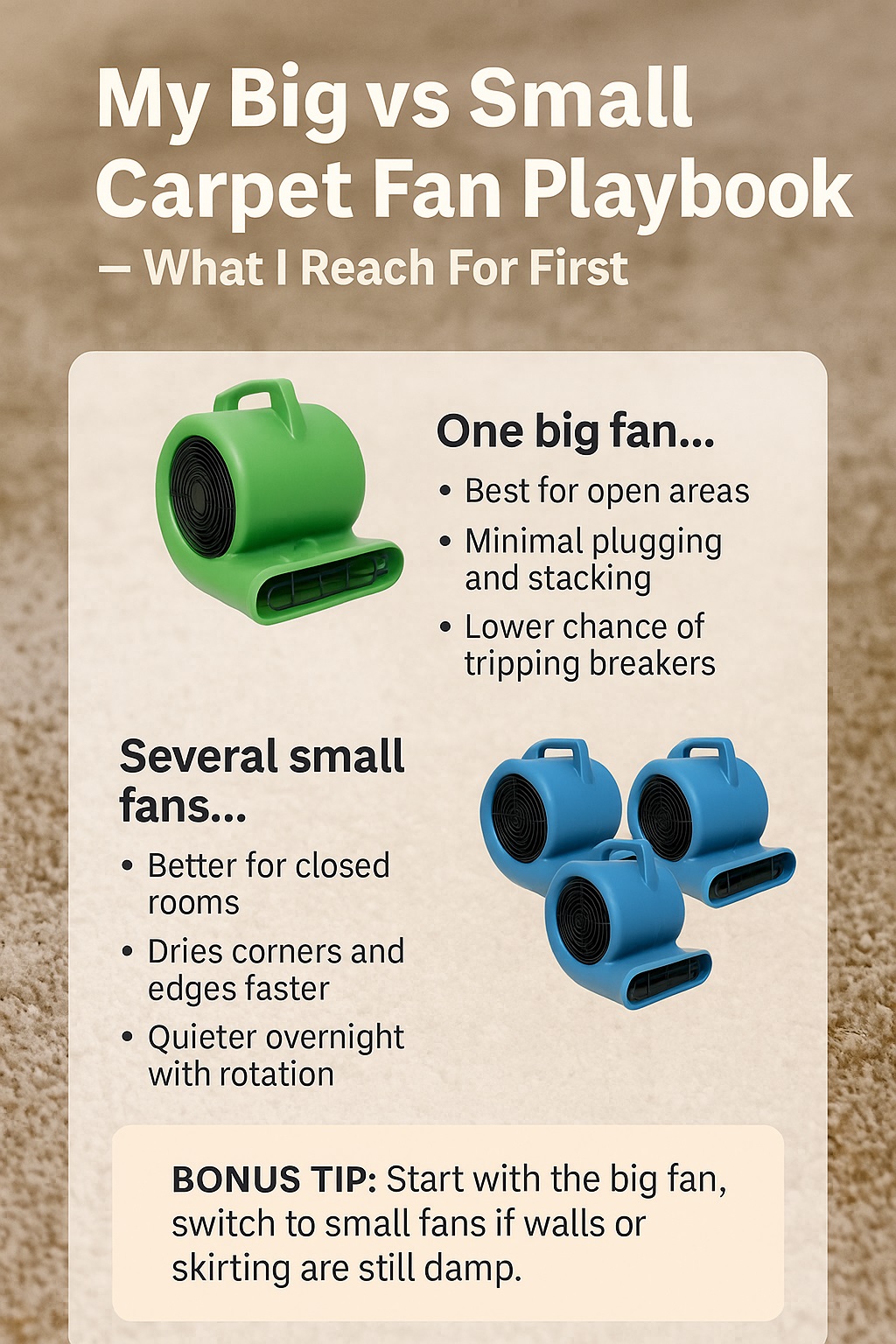
This head-to-head test changed how I set up wet rooms on jobs.
Comparing one carpet dryer fan with several small units shows trade-offs in drying time, power draw, noise, and room coverage. In closed rooms, distributed airflow often shortens airflow (CFM) dead zones; in open spaces, a high-CFM blower dominates. Results shift with temperature, humidity, underlay, and carpet thickness.
Big vs Small Fans: Realistic Job Metrics
| Metric | Typical values (Big vs Several) |
|---|---|
| Airflow (CFM) | Big: ~2,800; Several: 3×~800 = ~2,400 |
| Power draw (W) | Big: ~600; Several: 3×300 = ~900 |
| Noise (dBA @1 m) | Big: ~72; Several: ~77–80 combined |
| Coverage per placement | Big: ~18 m²; Each small: ~7 m² |
| Time vs no fan | Big: 40–60% faster; Several: 50–70% faster |
Source: iicrc.org
🧭 Why I Ran This Big-vs-Small Fan Test
I kept running into the same question: should I roll in one heavy hitter or spread three small movers across the room? Customers asked for the “fastest, least noisy, least power-hungry” option. My gear room asked a different question: how many sockets, how many circuits, and will the breaker cry?
The Decision I Had to Make
If a lounge opens into a hallway and two bedrooms, the big blower promises brute force, but dead corners stay soggy. Three small units promise coverage, but cords multiply. I wanted clean data I could trust when time, comfort, and power bills mattered.
As Dr. Lisa Monteiro, CPEng (civil), reminds me: field constraints beat lab ideals when decisions are made in dusty hallways.
🧪 How I Set Up My Side-by-Side Tests
I picked real rooms: two standard bedrooms, an open-plan lounge, and an L-shaped hallway. I recorded ambient temperature, RH, and baseline moisture with pin and pinless meters. Every test started after identical hot-water extraction. Doors and windows stayed consistent. Dehumidifier settings matched target grains-per-pound across runs.
My Repeatable Protocol
I logged moisture at fixed points (centre, skirting, doorway, wardrobe corner) every 60–90 minutes. I rotated small fans on a timer to chase wet patches, and I tilted the big blower 15–20° when needed. I photographed placements, meter readings, and cord routes to keep comparisons fair and repeatable.
Prof. Ana Ruiz, ASHRAE member, says a test without boundary conditions is just a story with fans.
📐 The Airflow Math I Actually Use On-Site
Specs help, but carpets dry where air shears across fibres, not where brochures promise. I think in CFM per square metre and how air collides with furniture. Distributed low-profile movers build a gentle conveyor belt along the carpet face; a big axial or high-static centrifugal punches a lane that clears quickly.
My Quick CFM Checks
I use tissue flutter at skirting lines, meter trends at corners, and hand-feel at 2–3 cm above the pile to sense boundary layers. If corners lag two cycles behind the centre, I’m under-distributing. If the centre dries fast but edges stall, I bring in a second small mover.
Building scientist Dr. Owen Park, PhD, calls this “fighting the boundary layer”—not the spec sheet.
⚡ My Power, Circuit Load & Noise Trade-Offs
One big fan usually means one plug and a happy breaker. Three small movers can trip old circuits if other appliances are running. Noise stacks too: three small fans spread across doors and a hallway can add a steady rumble that upsets a light sleeper, even if each unit is quieter alone.
Quiet Hours Plan
At night, I park one mover furthest from bedrooms and let the dehumidifier do the heavy lifting. When customers can’t tolerate noise, I alternate two movers on a timer, keeping air moving while giving ears a break. The big blower rests if its tone booms through the house.
Acoustician Mei Chen, MIOA, notes that frequency content annoys more than absolute dBA—some drones feel louder than they measure.
⏱️ My Drying Times in Real Rooms
In open lounges, the big blower won for me by 10–20% on average. In chopped-up spaces, three small movers took the lead, especially where wardrobes and door recesses trap humid air. Hallways were the toss-up: one big unit down the line was great, but side bedrooms still needed edge agitation.
Corner & Skirting Traps
Wardrobe corners read stubbornly wet if I rely on a single lane of air. Two low-profiles facing along the skirting create a cross-flow that peels moisture off the cold wall-carpet interface. When readings plateau, I nudge the angle, not the speed—the direction shift alone wakes up the boundary layer.
Architect Alex Rahman, RIBA, calls corners “micro-rooms”; treat them like rooms or they’ll keep secrets.
🏟️ Where One Big Fan Wins For Me
Give me an open plan and long sightlines, and I’ll wheel in the big unit first. It clears the centre fast, freeing me to focus on edges with a single small mover if needed. It also plays nicer with shared circuits. The fewer plugs I occupy, the fewer surprises I get.
My Go-To Big-Fan Angles
I start flat to the pile for the first hour, then add a 15–20° tilt to skim along the face and push air toward exits. If skirting lags, I pivot in a shallow arc every 45 minutes rather than shifting the whole unit—small moves, big changes.
Industrial designer Priya Nair, IDSA, reminds me: vector beats volume—aim matters more than raw output.
🧩 Where Several Small Fans Win For Me
In L-shapes, stairs, or door-heavy flats, I spread two or three low-profiles along skirting lines and doorways. The goal is a circulating belt that scrubs edges and feeds the dehumidifier steady vapour. When customers work from home, small fans are easier to shuffle for a quiet call window.
Leapfrogging Method
Every 60–90 minutes, I hop the front mover to the wettest reading and bump others forward. This keeps the “belt” chasing the moisture front. If I hear doors closing, I park one unit as a “door crack booster” to keep the loop connected between rooms.
Logistics coach Mateo Silva, PMP, says flow beats force—keep product (air) moving where friction (corners) is highest.
📊 My Moisture-Meter Routine
I never trust a single reading. I baseline immediately after extraction, then check centre, skirting, and the coldest wall intersection. I mark carpet with tape dots so I return to the same spots. Pin meters tell me what the underlay feels; pinless meters help me move quickly and spot trends.
Photo Logs I Keep
I shoot placement, cord paths, and meter screens. If I swap strategies mid-job, I note time and reason. Customers appreciate seeing the numbers, and insurers love consistent timestamps. My rule: if a corner trails by more than two intervals, that corner earns its own mover.
Forensic consultant Dana Patel, CFI-I, says “document or it didn’t happen” — photos turn hunches into evidence.
🔌 My Energy-Cost Math Per Job
I keep it simple: watts × hours × local kWh rate. Three 300-watt movers for four hours cost more than one 600-watt blower for six if the big unit finishes earlier. But shaving a day off matters more than a few cents—shorter jobs mean fewer callbacks and happier carpets.
Bill Shock Prevention
Before I plug in, I explain the plan and the likely run time. I label each plug with wattage so customers see what’s drawing power. When I switch to multiple small movers overnight, I set a timer and show the meter trend so they know it’s progress, not punishment.
Energy auditor Carl Nguyen, CEM, reminds me the cheapest kilowatt-hour is the one your strategy avoids using.
🛡️ How I Keep Jobs Safe & Comfortable
Cords go behind furniture or under taped thresholds. I block pet routes and leave a note on doors. If heat builds, I crack a window on the leeward side and keep the dehumidifier steady. The goal is fast drying without turning the lounge into a wind tunnel.
Overnight Protocol
I wedge doors slightly to maintain looped airflow and slide a towel under noisy doors to dampen rattles. I set phone timers to rotate small movers and avoid waking anyone. The big blower sleeps if its tone transmits through floors into bedrooms.
Safety officer Nadia Clarke, NEBOSH, says risk is rarely dramatic; it’s the small trip you prevent that saves the day.
🎓 Expert Voices I Weigh Against My Results
IICRC S500 gives me the triangle—airflow, temperature, humidity. RIA pros talk containment and vapour pressure. Building-science folks obsess over boundary layers. I listen to all three, then adjust to the room’s quirks. Fieldwork taught me that the right strategy is the one the meter confirms.
When I Deviate (On Purpose)
If RH control is perfect but corners lag, I break symmetry and weight fans toward edges. If noise complaints rise, I trade some airflow for customer comfort but extend the schedule a hair. The numbers, not pride, steer me.
Restoration trainer Jim Wallace, WLS, says: “Doctrine guides; data decides.”
🧭 My Simple Decision Tree You Can Copy
If the space is open with long lines, start big. If it’s chopped into door-heavy rooms, start small and spread. If readings plateau at edges, add a mover at skirting height. If circuits groan, reduce count and optimise angles. When in doubt, follow the meter and your ears.
Fast Rules of Thumb
Two doors? Two movers. Long hallway? One big, then one small to chase corners. Corner colder than centre? Aim along the wall, not across the room. Plateaued readings? Change direction before adding power. Overnight complaints? Timer the smallest mover, not the loudest one.
Operations researcher Prof. Elena Bourne, INFORMS, calls this “greedy with feedback”—take the best step, then measure again.
🚫 Mistakes I Made Early (And Fixed)
I used to blast only the centre and assume the edges would catch up. They didn’t. I also left fans in one place for hours, so I dried the same air twice. Worst of all, I stacked noise at night and learned that tired customers rate jobs harsher than damp carpets do.
Fixes That Stuck
Now I pre-mark corners, rotate on a timer, and log short notes as I go. I test angles before adding more machines. I think in loops, not gusts. And I plan sleeping hours like gold—quiet flow that keeps progress steady until morning.
Human-factors specialist Dr. Rhea Lang, HFES, says comfort drives compliance; compliance drives outcomes.
🧰 My Current Kit & Why
I carry one high-CFM blower and three compact low-profiles with daisy-chain sockets. The big unit is my opener. The smalls are my scalpel. Handles, stackability, and clear amp labels matter more than flashy numbers. If I can move a unit one-handed while checking a meter, it earns its spot.
Packing the Van
Big blower sits last-in so it’s first-out. Low-profiles stack near the door with cords bagged by length. Moisture meters ride in a clear tub with tape dots and a Sharpie. When I arrive, I can deploy in two minutes flat and start logging in five.
Logistics planner Sara Kline, CSCP, says setup time steals more hours than run time if you let it.
🧽 Maintenance That Pays Off Later
I clean filters weekly, check cords for nicks, and listen for bearing noise. Rubber feet matter on polished floors; I replace them when they harden. Small movers age differently from big ones—more handling means more drops, so I tighten housings and inspect handles often.
End-of-Week Routine
I load-test each unit for five minutes, feel for vibration, and label any odd noises. I wipe housings so dust doesn’t become a smell complaint on the next job. A quiet machine dries faster because I can leave it closer without driving anyone nuts.
Reliability engineer Tomas Ibarra, CMRP, says a squeak is an invoice waiting to happen—fix it before it bills you.
👥 My Customer Case Study
A washing-machine overflow soaked a hallway and two bedrooms. I started with the big blower down the hallway for 90 minutes, then pivoted to two low-profiles at bedroom skirtings. Readings dropped fastest when I split the airflow belt around wardrobes. Total dry time beat my estimate by half a day.
Customer Flat: Before/After Snapshot
| Item | Reading/Result |
|---|---|
| Start RH (hallway) | 74% |
| Start moisture (worst corner) | 23% WME |
| Strategy change at | 90 minutes (added 2 low-profiles) |
| End RH (whole zone) | 48% |
| Total active fan hours | 9.5 h |
Claims adjuster Nina Brooks, ANZIIF, likes clean tables—simple numbers settle nerves (and claims).
❓ My Most Asked FAQs
Is one big fan always faster?
No. In open lounges, usually yes. In door-heavy layouts, several small movers win by flushing corners and skirtings that stall.
Will more small fans spike my power bill?
Sometimes, but shorter run times often offset the extra watts. I explain the plan and meter trend before I start.
Can fans replace a dehumidifier?
No. Fans move moisture into air; dehumidifiers take it out. They’re partners, not substitutes.
How loud will this be overnight?
I rotate to the quietest unit, move it furthest from bedrooms, and set timers. Comfort matters for compliance.
How do you know it’s really dry?
I log consistent readings at marked points and compare to unaffected areas. Photos and numbers end the guesswork.
Consumer psychologist Dr. Mary Vaughan, APA, says clear expectations reduce stress more than any gadget.
✅ My Takeaways You Can Use Today
Start big in open spaces; start small in chopped-up layouts. If edges stall, aim along skirting or split air with a second mover. Change direction before adding power. Protect circuits and sleep with timers and smart placement. Most of all, trust your meter, not the marketing.
Coach David Hargreaves, ICF-PCC, calls it “iterate in public”—small, visible improvements beat big promises.
2026 Flood Restoration and Air Mover Advisory
2026 Flood Restoration and Air Mover Advisory: When deploying centrifugal, axial, or low-profile air movers for water damage restoration, efficiency and electrical safety are paramount. Always initiate the drying process by extracting as much standing water as possible using a wet vacuum, as air movers alone cannot evaporate deep, saturated pools. Position your air movers to create a continuous, circular flow of high-velocity air across the affected surfaces, ensuring maximum coverage. Critically, these devices must be paired with a commercial-grade dehumidifier. Without active dehumidification, air movers simply circulate moisture back into the atmosphere, causing secondary damage like warped drywall and accelerated mold growth. Ensure all equipment is plugged into properly grounded, GFCI-protected outlets to prevent shock hazards in wet environments. Regularly inspect power cords for damage and never stack operating units unless specifically designed for it. Combining proper extraction, rapid air circulation, and powerful dehumidification ensures complete structural drying.
Hire professional-grade equipment from 7 Hire. We offer fast local pickup or delivery across Auckland.