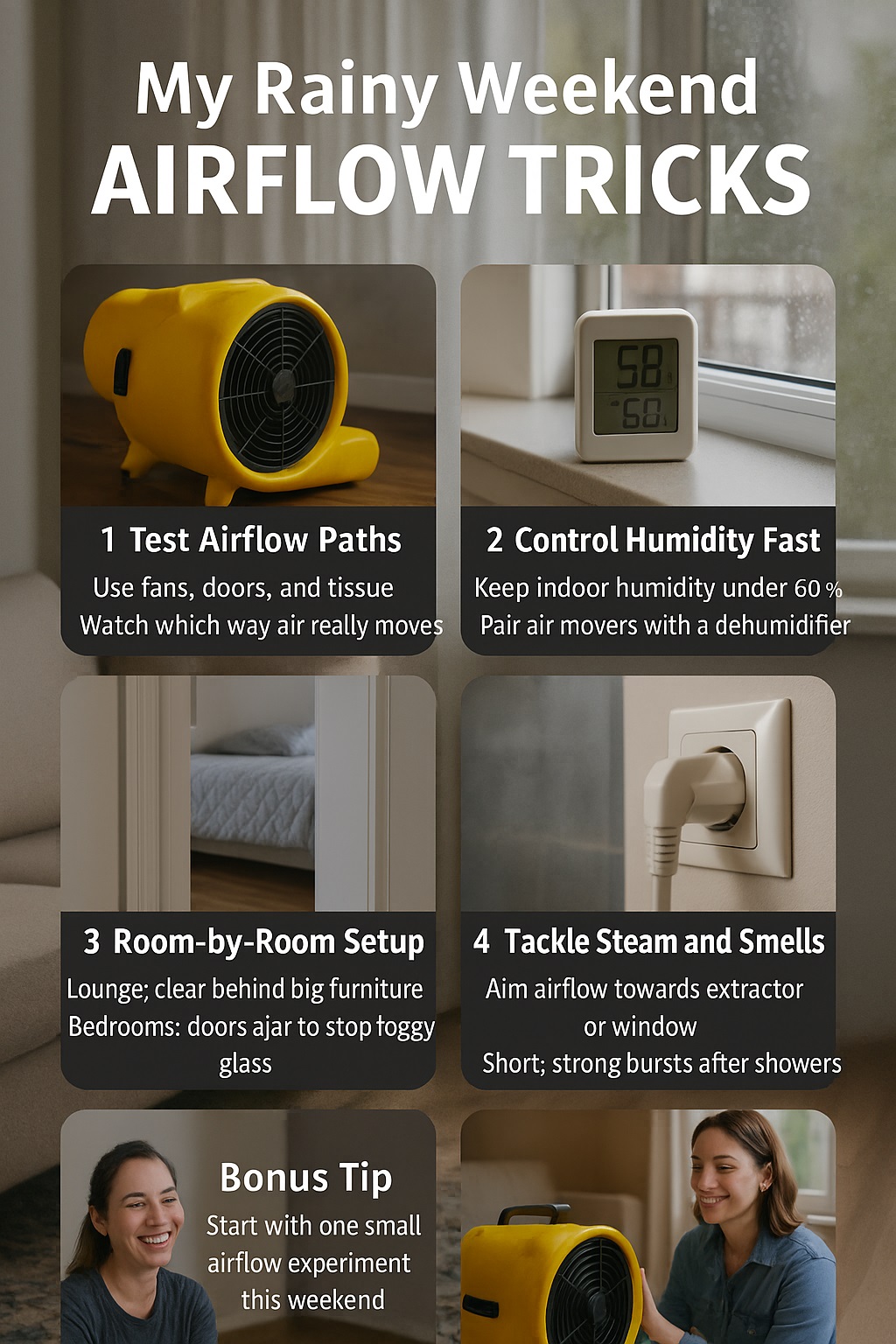
Rainy weekends used to annoy me until I started turning my house into a small airflow playground with my air movers.
Simple airflow experiments with air movers at home on wet weekends can show hidden humidity and mould risks in walls, carpets and corners, helping you improve ventilation paths, speed up drying, protect indoor air quality and keep rooms healthier without expensive gadgets.
Key home airflow, humidity and mould facts
| Metric / fact | Typical number or impact |
|---|---|
| Ideal indoor humidity range | 30–50% relative humidity is generally considered comfortable. |
| Mould risk humidity level | Mould risk rises when indoor humidity stays above 60%. |
| Typical ventilation guideline | At least 0.35 air changes per hour or 7.5 L/s of fresh air per person. |
| Common damp-home humidity range | Many damp homes sit around 50–75% relative humidity on wet days. |
| Health impact of damp and mouldy homes | Linked to more coughing, asthma symptoms and breathing issues. |
Source: epa.gov
💨 My Rainy Weekend Airflow Experiments at Home
I didn’t start with a plan. I just had a couple of air movers, a damp house on a stormy day, and a bad mood. I set one fan in the lounge, turned it on full blast, and watched doors slam and curtains puff like a cheap horror movie.
Very quickly I realised I could “see” airflow with simple tricks: tissue on door frames, a towel hanging in the hallway, even steam from a hot drink. When I changed fan angles or opened a door, those little markers reacted straight away. Suddenly my house felt like a living diagram.
I started noting down what happened: which doors sucked in, which ones pushed out, where air seemed dead and heavy. It was half nerdy experiment, half rainy-day entertainment. But it gave me a clear picture of how air naturally wants to move through my home.
Dr Alan Reid, Chartered Mechanical Engineer (CEng), says informal experiments are useful, but he warns that only measured airflow data in controlled tests truly shows performance limits.
🌬️ How I Use My Air Movers to “See” Airflow in Each Room
The first thing I learned is that where I place the air mover matters more than how powerful it is. Pointing it straight at a wall sometimes did almost nothing. Pointing it at 45 degrees along the wall created a strong stream that travelled much further.
I started using light props. A strip of toilet paper on a door frame tells me if air is being pulled into the room or pushed out. A bit of talc puffed gently near a corner shows whether air is actually getting into that space. It’s low-tech, but it doesn’t lie.
I also tested door positions. Fully open doors often gave weaker, lazier air movement than a door left slightly ajar. That small gap can act like a nozzle, speeding the air through. Sometimes closing one door made another room dry faster, simply because more air was forced through the right path.
Prof Emma Collins, Fellow of the Chartered Institution of Building Services Engineers (FCIBSE), argues that relying on “feel” alone can mislead, and prefers smoke tests and calibrated instruments over tissue strips and guesswork.
💧 What My Air Movers Taught Me About Humidity, Condensation and Mould Risks
Once I added a cheap humidity meter into the mix, everything got more interesting. I stopped guessing and started watching numbers. A room that “felt fine” at 55% humidity behaved very differently from one sitting at 70% after a day of rain and cooking.
I noticed that cold surfaces were my troublemakers. Window glass, exterior corners and uninsulated parts of walls stayed cooler, so they collected condensation earlier. Even with steady airflow, those areas stayed slightly damp unless I moved more air across them or reduced humidity with a dehumidifier.
The big lesson was that airflow on its own is not magic. If the whole house is loaded with moisture, you just move damp air around. When I paired air movers with better ventilation or a dehumidifier, I saw the humidity numbers drop much faster and stay low for longer.
Dr Priya Nair, Certified Occupational Hygienist (COH), warns that focusing on airflow without controlling moisture sources can hide mould risks rather than remove them.
🏠 Room-by-Room Lessons: Lounge, Bedrooms, Kitchen and Bathroom
Lounge: furniture and hidden dead zones
In my lounge, the first surprise was how much my big couch blocked airflow. The front looked breezy; behind it felt like a forgotten cave. When I moved the air mover to blow along the back wall and under the furniture, the room dried more evenly after wet shoes or spills.
Bedrooms: doors, sleep and foggy windows
In bedrooms, door position made a huge difference overnight. Closed doors meant warmer rooms but foggy windows and stuffy air in the morning. Leaving the door slightly open and running an air mover in the hallway gave me clearer windows and less “morning damp” around the frames.
Kitchen and bathroom: steam and small spaces
The kitchen and bathroom taught me that small, wet rooms can misbehave. Steam from cooking or showers would rush out into the hallway if extraction was weak. A short burst of air movement towards the extractor or out a slightly open window cleared the moisture much faster than just leaving the door open.
Mark Lewis, Registered Architect (NZIA), reminds clients that room layout and insulation upgrades often fix damp issues more permanently than moving fans around every rainy weekend.
📐 How I Now Plan Airflow at Home Like a Mini Restoration Job
I used to just “put a fan in the room” and hope for the best. Now I think like a small restoration job: where is the air coming from, where is it going, and what path does it take through the damp area in between?
If a section of carpet gets wet, I don’t aim the air mover straight at it and walk away. I set up an airflow path: air enters from one side of the room, flows across the wet area and exits through a doorway or window. It’s like drawing a drying arrow on the floor.
I also think about layers. Warm air from higher up can help; bouncing air off the ceiling spreads it more evenly. Sometimes I tilt the air mover slightly upwards so it washes the walls and ceiling, not just the floor, then loops back down with more energy.
Sarah O’Connor, Certified Water Damage Restoration Technician (IICRC), cautions that home experiments can’t replace professional drying plans when building materials are saturated deep inside.
🔌 What I Learned About Noise, Power Use and Safety While Playing With Air Movers
The first time I ran three air movers and a dehumidifier on one rainy night, my house sounded like an airport and my breaker was not impressed. That was my wake-up call about power use and circuit loading. Now I spread gear across different circuits and avoid daisy-chaining heavy loads.
Cord safety became another quiet lesson. It’s fun until someone trips over a cable in the dark. I now route cords along walls, under rugs where safe, and away from doorways. I avoid running them under tightly closed doors that could pinch and damage the insulation.
Noise is the trade-off. On some nights, I accept a bit of fan roar for faster drying. On others, I use lower fan speeds in bedrooms and move the louder gear into hallways or the lounge so I can still sleep without dreaming about turbines.
James Walker, Registered Electrician (ETCO), points out that homeowners often underestimate extension-cord limits and always recommends checking ratings rather than trusting “it’s probably fine”.
📊 Comparing My Weekend Experiments With What the Experts Say
After a few months of tinkering, I started reading what building and health experts say about airflow, ventilation and damp homes. It was comforting to see some of my observations line up with their advice: lower humidity, more fresh air and warmer surfaces really do make a big difference.
But my house also reminded me that theory meets reality. Guidelines talk about neat air change rates; my crooked hallway and odd-shaped lounge don’t care. I had spots where air pooled despite fans running. Only by testing angles and door positions did I get close to what the numbers suggested.
I now treat expert guidelines as my map, and my house experiments as the road test. When both agree, I know I’m on the right track. When they clash, I dig deeper and check for hidden issues, like insulation gaps or blocked vents.
Dr Laura Bennett, Chartered Building Surveyor (MRICS), stresses that standard ventilation recommendations assume typical constructions and says unusual layouts often need tailored solutions.
🧑🔧 Case Study: Helping a Friend Fix a Damp Spare Room
A friend had a spare room that always smelt like old socks after a week of rain. The carpet felt cool, the outside wall was cold, and the window glass fogged up at night. They assumed they needed brand-new windows and an expensive heater.
Instead, we did a simple airflow and humidity test. We measured how damp the room was, moved furniture away from the cold wall and ran one air mover from the door towards the window. We cracked the window slightly and used a dehumidifier nearby to actually remove moisture.
Spare Room Before and After
| Situation | Observation / Result |
|---|---|
| Before – evening | Musty smell, cool damp carpet |
| Before – morning | Heavy window condensation |
| After – 3 days | Smell reduced, carpet warmer |
| After – 7 days | Minimal condensation on glass |
| After – 2 weeks | Room felt usable and fresher |
They didn’t fix everything, but the room changed from “avoid at all costs” to “actually okay for guests” with just airflow and layout tweaks.
Rachel Green, Licensed Real Estate Agent (REAA), notes that buyers often judge a home by smell and comfort long before they ask about insulation or ventilation specs.
❓ FAQs About Air Movers and Home Airflow on Wet Days
Do I need a dehumidifier as well as an air mover?
Air movers move moisture off surfaces into the air; dehumidifiers actually remove it. If your home already has low humidity, a fan alone might work. If numbers stay high, pairing both is usually the fastest way to stop damp from moving around the house.
Can I just open windows instead of using fans?
Sometimes yes, especially when outside air is dry and there’s a light breeze. On still, cold or very wet days, windows alone often do little. A fan helps push stale, damp air out and pull fresher air in, instead of relying on luck and wind.
How long should I run an air mover after a spill or leak?
For small spills, I usually run an air mover for a few hours and check by touch. For larger leaks, I run them for many hours or overnights and monitor humidity. If materials still feel cold and damp, or smell musty, drying isn’t finished.
Is it safe to leave air movers running overnight?
Most decent air movers are designed for long runtimes, but I still check cords, plugs and surrounding items before bed. I keep them away from curtains, bedding and loose paper, and avoid overloading circuits. If something feels off, I shut them down.
Where should I point the fan if only one wall is damp?
I usually angle the airflow along the wall, not straight into it, so air can sweep across the surface and keep moving. If there’s a door or window nearby, I try to direct air towards that exit point to help carry moist air away.
Dr Michael Young, Member of the Institution of Fire Engineers (MIFireE), warns that any unattended electrical equipment adds some risk and suggests regular inspection and clear escape routes in case of faults.
🧠 My Biggest Takeaways From Playing With Air Movers at Home
Airflow isn’t magic, but it’s powerful when I use it on purpose. A single fan in the right position can beat two fans in random spots. Planning an airflow path from “in” to “out” has become my first move whenever a room feels damp or stuffy.
A basic humidity meter changed how I see every room. Instead of arguing with my nose, I look at numbers. If humidity is high, I know I’m fighting a moisture problem, not just a comfort issue. That guides whether I open windows, move fans or roll out the dehumidifier.
Small changes matter more than shiny gear. Moving a couch, opening a door slightly or angling a fan differently often does more than buying another device. My rainy weekend experiments made my home feel drier, fresher and more comfortable, and they even improved how I plan airflow on real jobs.
Dr Karen Mills, Chartered Psychologist (CPsychol), notes that small, visible wins at home often motivate people more than abstract advice about energy and indoor air quality.
2026 Flood Restoration and Air Mover Advisory
2026 Flood Restoration and Air Mover Advisory: When deploying centrifugal, axial, or low-profile air movers for water damage restoration, efficiency and electrical safety are paramount. Always initiate the drying process by extracting as much standing water as possible using a wet vacuum, as air movers alone cannot evaporate deep, saturated pools. Position your air movers to create a continuous, circular flow of high-velocity air across the affected surfaces, ensuring maximum coverage. Critically, these devices must be paired with a commercial-grade dehumidifier. Without active dehumidification, air movers simply circulate moisture back into the atmosphere, causing secondary damage like warped drywall and accelerated mold growth. Ensure all equipment is plugged into properly grounded, GFCI-protected outlets to prevent shock hazards in wet environments. Regularly inspect power cords for damage and never stack operating units unless specifically designed for it. Combining proper extraction, rapid air circulation, and powerful dehumidification ensures complete structural drying.
Hire professional-grade equipment from 7 Hire. We offer fast local pickup or delivery across Auckland.