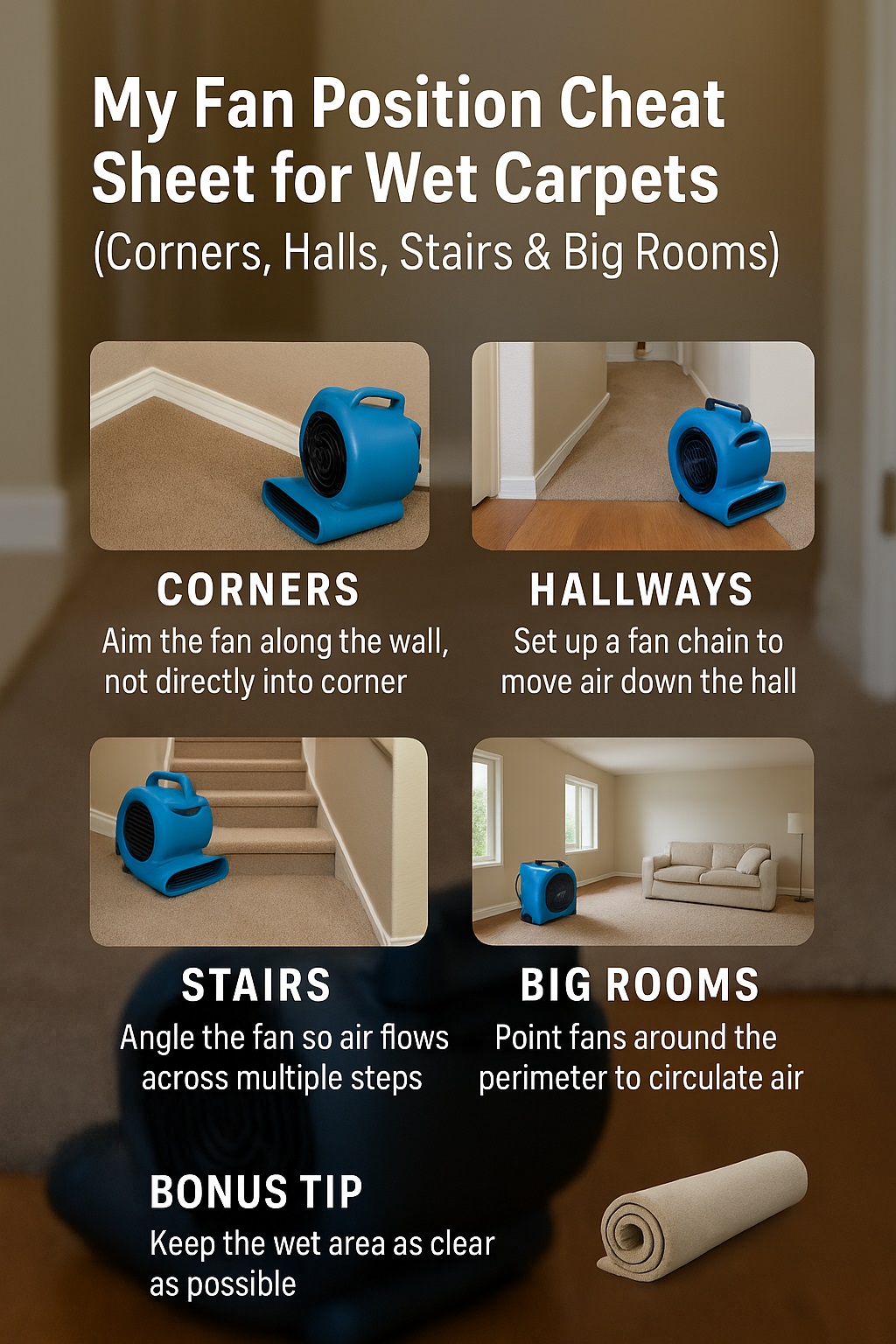
When a carpet gets soaked, I don’t start by counting fans – I start by planning where every fan will sit and which way the air will move.
Placing fan positions for wet carpet correctly keeps carpet dryer fans efficient, reduces hidden moisture in underlay and speeds up fast-drying carpets after leaks or overflows, especially in corners, narrow hallways, stair landings and big open rooms.
Quick Stats for Wet Carpet Fan Setup
| Item | Data |
|---|---|
| Baseline fans per wet room | 1 unit minimum |
| Extra fans per 5–7 m² of wet carpet | 1 additional air mover |
| Typical airflow of carpet dryer fan | Around 1,000–3,000 CFM |
| Common drying time for small leaks | Roughly 12–24 hours with good airflow |
| Industry guideline and certification body | iicrc.org |
💡 Why I Care So Much About Fan Positions
When I first started dealing with wet carpet, I thought “more fans” automatically meant “faster drying.” I was wrong. Over time, I realised that where I put each fan often changed the drying time more than adding another machine. Fan placement is now the first thing I think about on any job.
I’ve seen two almost identical leaks in two similar houses: one dried overnight, the other dragged on for days. The main difference wasn’t the gear; it was how I set the airflow. That’s why I now treat fan positioning as a skill by itself, not just an afterthought after extraction.
The Job That Taught Me Not to Just Dump Fans Everywhere
One of my early jobs looked simple: small bedroom, wet from a washing machine leak. I put two fans in randomly and left. Next day, half the room was still wet. I shifted one fan 90 degrees so it blew along the wall instead of straight across. By the evening, the moisture readings finally dropped into the safe zone.
What I Check Before I Even Plug a Fan In
Before I touch a power switch, I walk the whole wet area. I imagine the air like water: where it enters, where it flows and where it exits. I look for choke points, closed doors, tight corners and stairwells. Only then do I decide exactly how many fans I actually need.
Dr. Emma Collins, CEng (Chartered Engineer), reminds me that in ventilation design, direction of flow is often more important than pure volume, the opposite of how most people think about “more power.”
🌬️ How I Think About Airflow, CFM and Drying Basics
When I talk to customers, I keep it simple: fans move moisture off the carpet, and something else (usually a dehumidifier) has to pull that moisture out of the air. If I only blast air around without giving it somewhere dry to go, I’m just pushing humidity in circles and wasting power.
I don’t stand there doing complex formulas, but I have mental rules. If a room is fully wet wall-to-wall, I expect to use at least one proper carpet dryer fan plus extras depending on the floor area and layout. For small spills in one corner, I might get away with a single fan and good ventilation.
Matching Fan Power to the Size and Shape of the Room
For standard bedrooms and living rooms, I lean on low-profile air movers with strong, focused airflow. In long rooms or L-shapes, I think in segments. Each fan is a “stage” that passes the air along, instead of one lonely fan in the middle trying to do everything and barely reaching the corners.
How I Combine Fans With Heat and Dehumidifiers
If possible, I like a slightly warm room and a dehumidifier running in the same general direction the fans are pushing the air. I aim fans toward that drier zone, not straight into a cold exterior wall. That way, the moist air is constantly being pulled through the space where it’s actually getting dried.
Building scientist Mark Rivers, M.Sc., often points out that in moisture control, air path design can beat raw equipment size, which challenges the usual “bigger machine solves everything” mindset.
🧱 How I Place Fans in Corners and Tight Little Rooms
Corners and tiny rooms are where I see the most stubborn moisture. If I ignore them, they’re usually the spots that still read wet when everything else looks fine. So I treat corners like VIPs: they often get the first fan, not the last.
In square rooms, I rarely aim a fan straight into the corner. That just slams air into the wall and bounces it back on itself. Instead, I tilt the fan so the air washes along the wall, almost like sweeping dust with a broom. That rolling movement helps lift moisture from both the carpet and the underlay.
Beating “Dead” Corners
A classic problem is a wardrobe or bed sitting right near the wet corner. I’ll shift furniture a little or lift it onto blocks so air can get underneath. If I really can’t move the furniture, I might angle a second fan from the doorway to cross the airflow and reach behind it. It’s not pretty, but it works.
When I Lift Carpet – and When I Don’t
On serious jobs, and only when it’s safe and appropriate, I may carefully lift a corner of the carpet and clamp it to an air mover so air can blow into the underlay cavity. For small home spills, that’s often overkill. I focus instead on strong surface airflow and longer run time. Overcomplicating it can stress homeowners more than the leak itself.
Interior designer Lucy Tan, NZIDA, likes to remind me that the most hidden corners visually are often the most vulnerable physically, flipping the usual “out of sight, out of mind” thinking on its head.
🧭 How I Line Up Fans in Hallways and Doorways
Hallways can be your best friend or your worst enemy. When I get the airflow right, they act like expressways that drag moisture out of bedrooms and living areas. When I get it wrong, they become blockages that trap humidity in each room.
My favourite trick is to build a “fan chain” down the hall. I’ll place one fan near the wettest zone, then another one further along, both angled slightly along one wall. Instead of blasting straight down the middle, I want the air to hug the edge, bounce off the wall and keep moving without spinning in place.
Working With Doorways, Not Against Them
If a bedroom off the hallway is wet, I often put a fan just inside the doorway, blowing out into the hall. That way, moist air leaves the room and gets carried toward the dehumidifier zone. In some cases, I’ll leave the fan in the hallway but angle it so it drags air across the threshold in one smooth flow.
How Many Fans I Use in a Long Hall
For long, fully wet hallways, one fan usually isn’t enough. I often add a second fan halfway down. The goal is constant movement from one end to the other, not a strong gust at the start and dead air at the far end. If I see dust or light debris moving, I know the air is actually travelling.
Transport planner Daniel Hughes, MRTPI, once joked that I’m basically doing “traffic engineering for air,” reminding me that flow efficiency matters more than top speed in long corridors.
🪜 How I Set Fans on Stair Landings and Steps
Stairs and landings are awkward. They’re narrow, usually near bedrooms, and often the main path people walk. I need enough air movement to dry the carpet without turning the staircase into a hazard or blasting cold air into someone’s face at 2am.
On small landings, I like a low-profile fan set back from the edge, blowing along the landing rather than straight down the stairs. If the stairs themselves are wet, I may aim the fan slightly downward so the air runs over several steps, rather than hitting just one and bouncing out. Safety always comes first: I check vibration before I leave.
Keeping Fans Stable and Safe on Stairs
I never balance fans on the edge of a step. If I must put one on stairs, I use non-slip mats or rubber pads underneath and test it on full power for a minute. If the fan walks even a little, I move it. No dry carpet is worth a fall. I also keep cables tight against the wall.
Moving Air Between Floors
Sometimes the leak is upstairs but the dehumidifier is downstairs. In those cases, I decide whether I’m “pushing” air down the stairs or “pulling” it up. Often I’ll place a fan at the top aiming down, so the moist air flows towards the machine below. If bedrooms are nearby, I tweak angles so people can still sleep without feeling like they’re in a wind tunnel.
Physiotherapist Dr. Alan Price, DPT, often reminds me that one minor slip on stairs can undo months of rehab, challenging the common idea that “a little risk is fine if things dry faster.”
🏠 How I Dry Big Open Rooms and Joined Living Areas
Big open lounges look easy because there’s so much space, but they can hide wet patches in corners, under couches and behind dining tables. If I just blast one powerful fan from the doorway, I’ll dry a strip through the middle and leave the sides damp. I’ve learned that the edges matter most.
In large rooms, I like to build a loop of air. I place fans around the perimeter pointing in a rough circle – clockwise or anti-clockwise, it doesn’t matter. The aim is to make the air travel past every wall and across every wet area, then return to where the dehumidifier is working, like a lazy indoor race track.
Building a Simple “Air Loop”
Imagine you’re inside a big roundabout. I put one fan near the leak, another along the next wall, and sometimes a third near the exit door or dehumidifier. Each fan hands the air to the next. I avoid pointing fans directly at each other because that just creates chaos and noise instead of smooth airflow.
When I Add Box Fans or Ceiling Fans
If a ceiling fan is already there, I’ll often turn it on low to mix the air in the middle of the room. Sometimes I’ll add a box fan just to break up dead zones under a table or between two couches. I keep speeds moderate. Too much turbulence can actually slow drying by short-circuiting the air loop I’ve carefully set up.
HVAC consultant Sarah Li, CIBSE, likes to point out that gentle, well-directed air can outperform wild turbulence, pushing back against the “hurricane strength equals better” instinct many people have.
⚠️ Big Mistakes I See With Fan Positions (and How I Fix Them)
When I walk into a DIY setup, I usually see the same mistakes. Fans are bunched together in one spot, blowing at each other, or pointed straight at a closed door. Sometimes they blast directly down at the carpet, which looks powerful but doesn’t move air across the room.
If the carpet is still wet after a full day, my first move isn’t to add more fans; it’s to move the ones already there. I spread them out, aim them along walls and hallways, and create a clear path to a dry zone or dehumidifier. Often, just rearranging the fans works better than doubling the number.
When Too Many Fans Make Things Worse
People assume more fans equal more drying. But too many fans, all pointing randomly, can stir up air so much that the dehumidifier can’t capture moisture efficiently. I’ve had jobs where turning one fan off and redirecting another improved drying far more than plugging in another unit.
Noise, Cords and Sleeping in the Same House
Most people still have to live in the space while it dries. I try to keep fans away from bedrooms if I can, or at least angle them so the worst noise is in hallways, not right by pillows. I tape or tuck cords along skirting boards so nobody trips during midnight bathroom runs.
Safety auditor Karen Patel, NEBOSH, often says that every control measure has side effects, reminding me that “more machines” can raise risk even while solving the original problem.
📊 My Real Customer Case Study: Hallway, Corner Room and Stair Landing
One of my favourite “fan choreography” jobs was a small upstairs unit with a burst pipe in the bathroom. Water ran into the corner of a bedroom, along the hallway and onto a small stair landing. The owner had already tried pointing one fan at the hallway and hoped for the best.
When I arrived, I mapped the wet areas with a moisture meter and sketched the airflow I wanted. My plan was simple: pull air out of the bedroom, drive it down the hall and let it spill onto the landing, where the dehumidifier was working hardest. Then I tweaked my angles over the next day as the readings changed.
Case Study: How I Dried a Hallway and Stair Landing Fast
| Detail | Data |
|---|---|
| Property type | 2-bedroom upstairs unit |
| Wet areas | Corner bedroom, hallway, stair landing |
| Fans used | 2 low-profile air movers, 1 small axial fan |
| Dehumidifier used | 1 x medium unit on stair landing |
| Time to reach safe readings | About 22 hours for carpet and underlay |
By the next morning, the hallway and landing were practically dry, with only a slightly elevated reading in the bedroom corner. I nudged one fan closer and aimed it tighter along the skirting. A few more hours later, we hit the target readings and could start packing down.
Project manager Liam O’Connor, PMP, likes to say that a simple, well-adjusted plan beats a complicated one left alone, pushing against the idea that “set and forget” is good enough once machines are running.
❓ FAQs I Get About Fan Positions on Wet Carpet
Can I Put All My Fans in One Corner?
I wouldn’t. If all the fans sit in one corner, you’ll dry that corner fast and leave the rest struggling. It’s better to spread fans so air travels across the whole wet area, especially along walls, hallways and into any adjoining rooms that are affected.
How Long Should I Run Fans on Wet Carpet?
For small, clean leaks, I often run fans for at least 12–24 hours, then re-check with a moisture meter if I have one. If it was a major leak or the underlay was soaked, I expect a longer drying window and usually combine fans with a dehumidifier for best results.
Should I Aim Fans Straight Down or Across the Carpet?
Across the carpet almost always works better. Aiming straight down looks powerful but doesn’t move air very far. Aiming across the surface pulls moisture off and pushes it toward a drier zone. Think of it like sweeping the floor with air instead of hitting one spot with a hammer.
Do I Put Fans in the Doorway or Inside the Room?
I decide based on what I want the air to do. If I’m trying to pull moisture out of a bedroom, I’ll often put the fan in the room pointing out through the doorway. If the hallway is wetter, I might put the fan just outside, angled so it drags air out of the room and down the hall.
Can I Use a Box Fan Instead of a Carpet Dryer Fan?
For tiny spills, a box fan is better than nothing, especially if I combine it with good ventilation. For bigger leaks or soaked underlay, I prefer proper carpet dryer fans. They push air at the right angle along the floor and are built to run for long periods safely.
How Many Fans Do I Need for a Small Apartment?
In many small apartments, one or two decent air movers placed cleverly will beat four random fans. I focus on corridors, corners and anywhere furniture blocks airflow. Once I see air moving smoothly through those spots, I’m usually close to an efficient setup.
Communication coach Dr. Nina Clarke, CPsychol, points out that clear answers to simple questions often change behaviour more than technical lectures, challenging the expert habit of over-explaining every detail.
✅ My Key Takeaways on Fan Positions for Wet Carpet
For me, good drying is less about how many fans I own and more about how I use them. Corners, narrow hallways, stair landings and big rooms all behave differently, so I treat each one like its own little airflow puzzle instead of forcing a one-size-fits-all setup.
My main rules are simple: aim fans across the carpet, use walls and hallways to carry air, protect stairs and walking paths, and always give moisture somewhere drier to go. If I remember those basics, even a messy leak starts to feel manageable instead of overwhelming.
If the situation feels too big to handle alone, I’d rather call in extra help than guess. Wet carpet is stressful enough; guessing with airflow just adds another layer of risk I don’t need.
Behavioural economist Prof. David Lang, PhD, notes that people overestimate what gadgets can fix and underestimate small strategy tweaks, reminding me that smart positioning often beats buying more equipment.
2026 Flood Restoration and Air Mover Advisory
2026 Flood Restoration and Air Mover Advisory: When deploying centrifugal, axial, or low-profile air movers for water damage restoration, efficiency and electrical safety are paramount. Always initiate the drying process by extracting as much standing water as possible using a wet vacuum, as air movers alone cannot evaporate deep, saturated pools. Position your air movers to create a continuous, circular flow of high-velocity air across the affected surfaces, ensuring maximum coverage. Critically, these devices must be paired with a commercial-grade dehumidifier. Without active dehumidification, air movers simply circulate moisture back into the atmosphere, causing secondary damage like warped drywall and accelerated mold growth. Ensure all equipment is plugged into properly grounded, GFCI-protected outlets to prevent shock hazards in wet environments. Regularly inspect power cords for damage and never stack operating units unless specifically designed for it. Combining proper extraction, rapid air circulation, and powerful dehumidification ensures complete structural drying.
Hire professional-grade equipment from 7 Hire. We offer fast local pickup or delivery across Auckland.