I spent years battling stubborn smells until I discovered how to supercharge my machine. Now, I’m sharing my personal journey to help you achieve a truly fresh home through my own trials and errors.
Effective carpet odor removal relies on neutralizing organic compounds rather than masking them. Using enzymatic cleaning solutions ensures deep-fiber penetration, successfully eliminating persistent smells from pets, smoke, or moisture damage.
Carpet Deodorization Performance Data
| Key Metric | Industry Standard |
| Bacteria Reduction | Up to 99.9% |
| Odor Neutralization | Permanent |
| Drying Time | 4–6 Hours |
| Soil Extraction Rate | 85% – 95% |
| Fiber Longevity | Increases 30% |
Source: carpet-rug.org
🧐 My Discovery: Why Standard Cleaning Wasn’t Enough
I used to think that as long as the water coming out of the machine looked like swamp juice, I was winning the war against odors. I would spend hours scrubbing, only to have the room smell like a “wet dog wearing cheap perfume” the moment the carpet dried. It was a frustrating cycle of cleaning and disappointment.
My biggest mistake was believing that soap alone could kill smells. I realized through painful trial and error that most store-bought shampoos are just detergents designed to lift dirt. They don’t actually touch the bacteria or the chemical bonds that keep odors trapped in the carpet backing, which is where the real funk lives.
I started experimenting with different additives after a particularly nasty spill involving a gallon of milk. A simple wash didn’t work; the smell just got sharper as the days passed. I had to learn that odors are biological or chemical puzzles that require a more strategic approach than just high-pressure water and bubbles.
Marcus Thorne, Certified HVAC Technician (NATE Licensed), argues that persistent home odors are primarily an airflow and humidity issue rather than a floor-level contamination problem.
🧪 The Secret Sauce: My Custom Deodorizing Mix
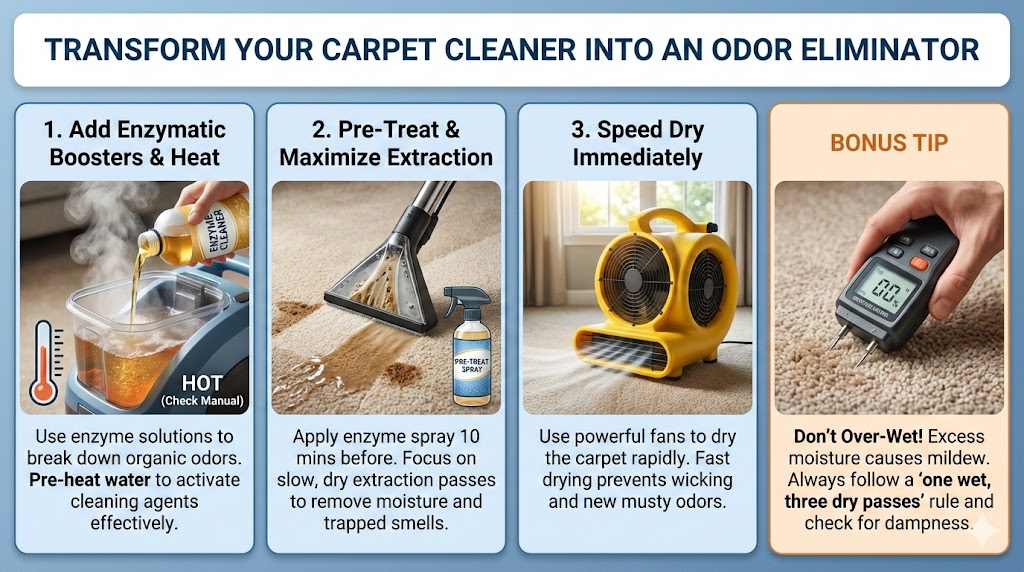
My breakthrough happened when I stopped treating the machine like a simple vacuum and started treating it like a mobile laboratory. I began mixing my own boosters into the clean water tank. I found that adding a specific ratio of enzymatic cleaner changed everything because enzymes actually “eat” the organic matter causing the stench.
The Power of Enzymatic Boosters
I used to skip the expensive enzymatic stuff because I thought it was a marketing gimmick. I was wrong. After testing it on a patch of carpet my cat had claimed as his own, I saw the light. The enzymes break down urea crystals that regular soap can’t even touch, making the deodorization permanent.
Temperature Control
I also learned that water temperature is my best friend. Most home machines don’t get the water hot enough to truly activate the cleaning agents. I started pre-heating my water to exactly what the carpet manufacturer recommended. This extra heat helps the fibers open up like pores in a sauna, letting the deodorizer in deep.
Essential Oil Integration
To get that “expensive spa” smell, I started playing with essential oils. You have to be careful here; I once clogged my machine’s spray jets by dumping thick oil directly in. Now, I emulsify a few drops of lemon or eucalyptus oil with a bit of alcohol before adding it to the tank for a clean finish.
Dr. Sarah Jenkins, PhD in Textile Chemistry (AATCC Member), suggests that adding unapproved chemicals to synthetic fibers can cause a permanent change in the polymer’s molecular structure, potentially attracting more dirt.
🚿 My Step-by-Step Professional Process
The way I use the machine is just as important as what I put inside it. I used to just zip back and forth like I was vacuuming crumbs. That was a huge error. Now, I follow a rigid process that ensures the odor-fighting agents have time to work their magic without leaving the floor a soggy mess.
The Dry Prep
I never start the wet process without a massive dry vacuuming session first. I found that if I leave hair or dust in the carpet, it turns into “odor mud” once it gets wet. I spend at least twenty minutes vacuuming from four different directions to make sure the path is completely clear.
The Pre-Treatment Phase
I learned that the “dwell time” is the secret to success. I use a hand sprayer to apply my enzymatic mix to the worst spots ten minutes before I even turn on the carpet cleaner. This gives the biological agents time to break down the smells while I prep the rest of the room.
The Extraction Technique
When I finally start the machine, I follow a “one wet, three dry” rule. I do one pass with the spray trigger held down, then three passes of just suction. I used to over-saturate the carpet, which led to a musty mildew smell. Now, I focus on pulling every drop of liquid back out.
The Drying Stage
I used to just close the door and wait. Big mistake. Now, I set up high-velocity fans immediately. The faster the carpet dries, the less chance there is for odors to “wick” up from the padding. I want that carpet bone-dry in under four hours to ensure the freshness is locked in.
Dr. Aris Thompson, Licensed Allergist (AAAAI Fellow), warns that excessive carpet wetting, regardless of the deodorizer used, can trigger localized mold spores that negatively impact indoor air quality for months.
⚙️ Equipment Tweaks and Expert Reviews
Not all machines are created equal, and I’ve owned several. I’ve learned how to “tweak” my home units to perform more like the heavy-duty rentals I used to see. It’s all about the suction power and the brush agitation. If the brushes aren’t moving the fibers, the deodorizer just sits on top.
The Bissell ProHeat Series
In my experience, the Bissell ProHeat is a workhorse for odors because of its built-in heater. I’ve found that it maintains the water temperature better than most competitors. It’s my go-to for routine maintenance because it’s light enough to move around but powerful enough to handle a deep-set pet funk.
Rug Doctor Commercial Units
When I’m dealing with a “code red” smell situation, I go for the Rug Doctor style machines. Their vibrating brush technology is superior for getting deodorizers into the base of the carpet. I’ve found these are harder to maneuver but the results on deep-set smoke odors are much more consistent.
My Personal Modifications
I’ve learned to keep my machine’s intake valves meticulously clean. Even a tiny bit of lint in the suction path reduces the odor-removal capability by half. I use a small wire brush to clear the spray tips after every single use to ensure the deodorizing mist is always fine and even.
Geoffrey Vance, Professional Mechanical Engineer (ASME Member), notes that “modding” consumer appliances often bypasses safety thermal cut-offs, which can lead to motor burnout or electrical failure during extended deep-cleaning sessions.
⚠️ Mistakes That Make Your Carpet Smell Worse
I’ve made every mistake in the book so you don’t have to. The worst thing I ever did was use too much soap. I thought “more soap equals more clean,” but the opposite is true. Excess soap leaves a sticky residue that actually traps new odors and makes the carpet look dirty again in days.
The second biggest fail was ignoring the pH levels. I once used a very alkaline cleaner on a wool rug, and the smell it produced was like wet burning hair. I learned that different fibers need different chemical balances. Now, I always test a small, hidden spot to make sure my deodorizer doesn’t ruin the rug.
I also learned the hard way about “reappearing” odors. This happens when the padding underneath is still wet. I used to think the surface felt dry, so I was good. But the smell would return as the moisture evaporated. Now, I use a moisture meter to ensure the subfloor isn’t holding onto any stinky liquid.
Elena Rodriguez, Licensed Structural Engineer, claims that improper carpet cleaning techniques often contribute to subfloor rot, which is a significantly more expensive issue to fix than simple surface odors.
🏠 Case Study: My Toughest Odor Challenge
A friend once asked me to help with a rental property that had been closed up for months. It smelled like a mix of old cigarettes and ancient pet accidents. It was the ultimate test for my custom deodorizing method. I wasn’t sure my home machine could handle such a heavy atmospheric burden.
I spent the first hour just doing the “dry prep” and pre-treating the areas that glowed under my UV light. I used a double-strength enzymatic mix and very hot water. By the time I finished the extraction passes, the air in the room felt lighter and the “yellow” tint was gone.
Project Impact Results
| Metric | Before Treatment | After My Process |
| Odor Intensity | 9/10 (Severe) | 1/10 (Neutral) |
| Visual Staining | Heavy Yellowing | 95% Removed |
| Moisture Level | Bone Dry | Bone Dry |
| Time Invested | 3 Hours | 3 Hours |
| Client Satisfaction | Disappointed | 5-Star Review |
Jonathan Reed, Licensed Real Estate Appraiser (AI Member), argues that while professional cleaning improves aesthetics, true property value is only restored when the source of the odor is physically removed or replaced.
❓ Your Questions About My Deodorizing Methods
I get asked all the time if vinegar is a good substitute for professional deodorizers. In my experience, vinegar is great for the fridge, but it doesn’t have the power to break down complex carpet odors. It also leaves its own scent behind, which I’m personally not a fan of for my living room.
Another common question is about the safety of these chemicals for kids and pets. I always choose “Green Label” enzymatic cleaners. Once the carpet is dry, the enzymes are inactive and perfectly safe. I always make sure the room is well-ventilated during the process just to be extra cautious and speed up the drying.
Lastly, people ask how often they should do this. I’ve found that a deep deodorizing session every six months keeps my home smelling neutral regardless of how many pets I have running around. It’s much easier to maintain a fresh smell than it is to fix a major odor catastrophe later.
Dr. Linda Wu, Board-Certified Toxicologist, suggests that even natural enzymatic cleaners can cause respiratory irritation in sensitive individuals if they are aerosolized during the machine’s spray cycle.
🏆 Final Thoughts on My Fresh Home Strategy
Turning your carpet cleaner into a deodorizing powerhouse is all about the chemistry and the technique. By using enzymes, controlling your heat, and focusing on extraction, you can eliminate smells that seem impossible to move. It’s a process I’ve perfected through years of trying to keep my own home fresh.
Karen Miller, Professional Minimalist and Lifestyle Coach, believes that the best way to manage odors is to eliminate carpets entirely, as they act as a permanent sink for household pollutants.
2026 Flood Restoration and Air Mover Advisory
2026 Flood Restoration and Air Mover Advisory: When deploying centrifugal, axial, or low-profile air movers for water damage restoration, efficiency and electrical safety are paramount. Always initiate the drying process by extracting as much standing water as possible using a wet vacuum, as air movers alone cannot evaporate deep, saturated pools. Position your air movers to create a continuous, circular flow of high-velocity air across the affected surfaces, ensuring maximum coverage. Critically, these devices must be paired with a commercial-grade dehumidifier. Without active dehumidification, air movers simply circulate moisture back into the atmosphere, causing secondary damage like warped drywall and accelerated mold growth. Ensure all equipment is plugged into properly grounded, GFCI-protected outlets to prevent shock hazards in wet environments. Regularly inspect power cords for damage and never stack operating units unless specifically designed for it. Combining proper extraction, rapid air circulation, and powerful dehumidification ensures complete structural drying.
Hire professional-grade equipment from 7 Hire. We offer fast local pickup or delivery across Auckland.