Bed bugs taught me very quickly that “clean” and “bug-free” are not the same thing, especially when carpets are involved.
A carpet cleaner for bed bugs supports whole-room bed bug treatment by flushing bugs, eggs, and droppings from fibres. It boosts deep carpet cleaning, reduces hiding spots, and works best alongside vacuuming, laundry, encasements, and professional pest control, not as a stand-alone magic fix.
Key facts about carpet cleaner for bed bugs
| What I look at | Typical figure / note |
|---|---|
| Adult bed bug size | About 1–7 mm long, flat, oval |
| Heat needed to kill on surfaces | Around 60–70°C contact temperature |
| Egg survival | Tougher; needs sustained heat and time |
| Survival without feeding | Can be several months in cool rooms |
| Typical treatment approach | Always part of a full room/whole-home plan |
Source: data adapted from epa.gov and cdc.gov guidance.
😱 My First Bed Bug Shock and Why My Carpet Matters
The bites that didn’t care how clean my room looked
My bed bug story started with itchy lines on my arms and a very smug-looking carpet. I vacuumed, washed my sheets, even sprayed random “bug killer” from the supermarket. The bites kept coming, and my perfectly vacuumed carpet just sat there quietly hiding the real problem.
When I realised the carpet wasn’t innocent
One night, I got down on my hands and knees with a torch and a loyalty card. I dragged the card along the carpet edge by the skirting board and saw tiny brown specks and a bug dash away. That was the moment I realised the carpet was part of the bed bug battlefield.
Why a carpet cleaner suddenly became part of my plan
I didn’t buy a carpet cleaner to “kill all bed bugs.” I bought it to flush out debris, bug droppings, shed skins, and the odd live bug from fibres and edges. Cleaner carpets meant fewer hiding crumbs and a better surface for any follow-up pest treatment to grab onto. Dr Laura Chen, Board-Certified Entomologist (BCE), reminds me that while my emotions shout “just wash everything,” bed bugs usually surrender to structured plans, not panic cleaning.
🧼 Why My Carpet Cleaner Was Only Part of My Bed Bug Plan
My first mistake: I thought “more cleaning = fewer bugs”
My first instinct was simple: clean more. I shampooed the carpet twice in one weekend, soaked it with solution, and proudly waited for bite-free sleep. Instead, the bugs kept feeding and I nearly created a musty smell because the carpet stayed damp too long. Over-cleaning became its own problem.
What my carpet cleaner actually does well
I learned to see my carpet cleaner as a support tool, not the hero. It helps me: remove dust and lint where bugs hide, wash away droppings and allergens, and occasionally dislodge live bugs near baseboards and under furniture edges. It makes the environment less friendly, but it doesn’t “cure” an infestation.
Where I draw the line between cleaning and treatment
Now my routine is simple: carpet cleaner for hygiene and support; proper bed bug products or professional treatment for the killing. I use encasements on the mattress and base, I vacuum, I declutter, and then I clean the carpet. Mark Davies, Licensed Pest Control Technician (NZPMA), often reminds me that while my carpet looks amazing after a deep clean, actual control comes from evidence-based treatments, not cosmetic improvements.
🔍 How I Check My Carpet for Bed Bugs Before I Even Plug In My Machine
My quick carpet inspection routine
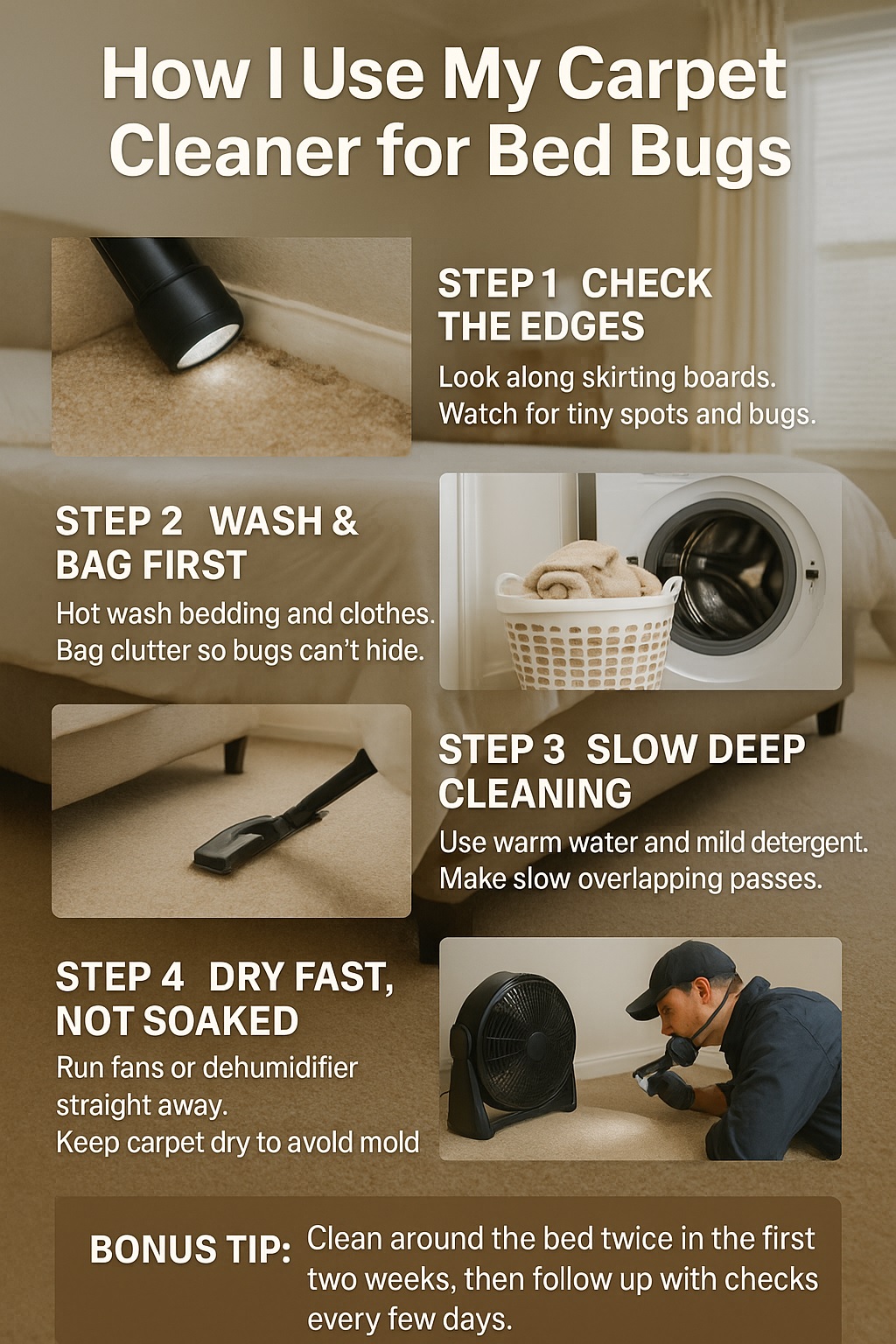
Before I even touch the carpet cleaner, I inspect. I grab a bright torch and a thin card and slowly work around skirting boards, bed legs, under the edge of rugs, and near electrical outlets. I’m hunting for small dark spots, shed skins, tiny eggs, or the bugs themselves scuttling away from the light.
How I tell bed bugs from “random little bugs”
My rule of thumb is: bed bugs look like flat apple seeds that don’t jump. Fleas jump. Ants race in lines. Carpet beetles have a different shape and hang out more in corners and wardrobes. When I’m unsure, I catch one in clear tape or a small jar so I can compare it later or show a pro.
When I pause and get medical or expert help
If bites are getting worse, if anyone has a big allergic reaction, or if bugs appear in multiple rooms, I slow down and consider professional help. My carpet cleaner waits until I know what I’m dealing with. Dr Emily Ross, Consultant Dermatologist (FRACP), often contrasts my “DIY first” instinct by pointing out that unexplained rashes need medical eyes, not just more cleaning passes.
🧺 How I Prep My Room Before I Use My Carpet Cleaner for Bed Bugs
Bagging and clearing so I don’t chase bugs around the room
Before I start cleaning, I remove easy hiding spots. I pick up clothes from the floor, soft toys, spare cushions, and random bags. Anything that can be washed goes into sealed bags or baskets so I don’t accidentally shake bugs from one corner of the room into another.
Laundry, heat, and the timing of carpet cleaning
I run hot washes or warm cycles where the fabric allows, then I use the dryer on a hotter setting for bedding and clothes. I like to time my carpet cleaning for after a big laundry session. That way, I’m not putting clean items back onto a dirty or freshly disturbed carpet.
Safety and drying come before “perfectly clean”
I always check my carpet cleaner’s manual, plug into safe outlets, and avoid soaking the underlay. More water is not more effective. Once I’m done, I use fans or a dehumidifier to get the carpet dry as fast as I can, especially around skirting boards and bed legs. Sarah Patel, Registered Building Scientist (BRANZ Network), points out that while my brain screams “more water, more clean,” building science sees lingering moisture as a mold risk, not an upgrade.
🧽 How I Actually Use My Carpet Cleaner for Bed Bugs Step by Step
My basic “bed bug zone” setup
I start by moving the bed slightly away from the wall if possible, so I can reach behind it. I focus on a strip around the bed, the walkway where I step out of bed, and the carpet edges along skirting boards. I don’t try to do the whole house in one frantic night.
My slow, overlapping passes
With warm water and a mild detergent in the machine, I use slow, overlapping strokes. I pull the carpet cleaner wand towards me rather than pushing it fast like a vacuum. I spend extra time along the edges and around the bed legs, sometimes doing a second pass with a slightly drier setting.
What I do differently now after over-wetting once
The first time, I held the trigger constantly and drenched the carpet. It took forever to dry. Now, I pulse the trigger: water on for the forward pass, suction only on the backward pass. That balance gives me a “wash then rinse” feeling without turning the underlay into a sponge.
Drying out the battlefield
As soon as I finish, fans and airflow become my best friends. I open windows when weather allows and aim a fan or air mover along the floor, not just at my face. Dry carpet makes it harder for bed bugs to enjoy cozy damp corners and keeps mold away. Dr Ivan Novak, Cleaning Chemist (IICRC Member), loves to remind me that my muscles want to “scrub harder,” but chemistry wins when I match the right temperature, solution, and drying time instead of flooding fibres.
🧴 Which Products I Trust (and Avoid) When Treating Bed Bugs in My Carpet
What I actually put in the carpet cleaner tank
Inside my carpet cleaner, I stick with mild, carpet-safe detergents and follow the dilution instructions. My goal is to lift dirt and bug residues, not to create a chemical soup. I avoid strong perfumes that just mask smells and can make it harder to notice new musty or “buggy” odours.
Why I don’t pour random insecticides into the machine
I never mix insecticide into the carpet cleaner tank. It’s not designed for that, it can damage the machine, and it can leave unsafe residues where kids or pets crawl. If I use any bed bug-specific product, I follow the label and keep it separate from the cleaning solution step.
Using carpet cleaning to support proper treatments
For me, carpet cleaning is “prepare and clear,” not “kill everything.” A cleaner surface makes it easier for targeted sprays, dusts, or professional heat treatments to work. I treat it like washing dishes before disinfecting, not as a substitute. Dr Hannah Lee, Environmental Toxicologist (DABT), contrasts my old “more chemicals must be better” mindset by reminding me that risk drops when products are used where they belong, not mixed on a whim.
👨🔧 When I Call the Pros Instead of Just Using My Carpet Cleaner
Red flags that tell me DIY isn’t enough
If I start seeing bed bugs in more than one room, or finding them on walls, curtains, or couch seams, my carpet cleaner goes from “hero” to “assistant.” Multiple rooms, heavy clutter, or recurring bites after several weeks are my signs to stop guessing and call a licensed pest control company.
What pros do that my carpet cleaner can’t
Professionals bring things I don’t have: specialised inspection tools, high-grade steam units, carefully selected insecticides, dusts for wall voids, and a proper follow-up schedule. They can also tell me when my cleaning is helping and when I’m just chasing bugs around with no overall plan.
How I mix professional help with my own cleaning
Even when I bring in a pro, I still vacuum, launder, and clean the carpet as instructed. I see it as teamwork: they handle the treatment, I handle the environment. That combo shortens the whole drama and gives me clearer progress to monitor over time. Jason Miller, Licensed Pest Manager (BPCA Member), often contrasts my “just one more DIY try” attitude by pointing out that each delay lets bed bug populations grow, while early professional intervention usually costs less in the long run.
📊 Case Study: How I Helped a Customer Use a Carpet Cleaner for Bed Bugs
A small bedroom with big problems
One customer called me about mysterious bites and little spots along the carpet edge. They had already tried spraying supermarket products and changing sheets daily. When I inspected, I found bed bugs mainly around the bed, skirting boards, and one fluffy rug by the window.
Customer carpet cleaning and bed bug follow-up
| Item | Detail |
|---|---|
| Home type | One-bedroom apartment with wall-to-wall carpet |
| Tools used | Mid-range carpet cleaner, vacuum, fan, mattress encasement |
| Cleaning frequency | Two deep carpet cleans in the first two weeks |
| Bed bug activity after 2 weeks | Reduced to rare sightings near skirting |
| Bed bug activity after 6 weeks | No new bites; monitoring and follow-up only |
What we changed and why it worked better
We stopped random spraying and focused on: decluttering under the bed, hot washing bedding, encasing the mattress, and targeted carpet cleaning around edges. A professional pest controller then added a proper treatment and a follow-up visit. My carpet work became the foundation, not the whole house.
What I learned from this case
This case reminded me that a carpet cleaner can dramatically improve hygiene and reduce harbourages, but the real win came when cleaning, laundry, and professional treatment lined up in sequence instead of fighting each other. Dr Miguel Santos, Data-Driven Public Health Researcher (MPH, PhD), likes to contrast my “single tool” thinking by showing that multi-step interventions consistently beat one-off fixes in infestation data.
❓ My Most Asked Questions About Carpet Cleaners and Bed Bugs (FAQs)
Can my carpet cleaner alone completely get rid of bed bugs?
In my experience, no. It helps, but it doesn’t replace a full plan. Bed bugs hide in mattresses, furniture, cracks, and even behind power points. A carpet cleaner can disturb and remove some, but you still need inspection, encasements, vacuuming, and often professional treatment for a true reset.
Is hot tap water enough, or do I need steam?
For light support cleaning, hot tap water with detergent is fine. For killing, sustained high temperatures on surfaces matter, and that’s closer to pro-level steam. I treat my home machine as a cleaning tool and leave true “heat treatment” to specialised equipment and licensed operators.
Will bed bugs run to my mattress if I only clean the carpet?
They’re already near your sleeping areas, so yes, disturbing just one zone can shift where they hide. That’s why I combine carpet cleaning with mattress encasements, bed isolation, and targeted treatment, not just one activity in isolation. Dr Olivia Grant, Sleep Medicine Physician (FRACP), gently contrasts my urge to “just blitz the floor” by reminding me that bed bugs target the sleeper, not the carpet, so the whole sleep zone must be addressed.
✅ My Key Takeaways About Using a Carpet Cleaner for Bed Bugs
When I think back over my own trial and error, I see my carpet cleaner as a strong supporting actor, never the main star. It’s brilliant for flushing out debris, droppings, and some bugs from fibres, but it works best when I pair it with inspection, laundry, encasements, and, when needed, professional treatment.
My simple rule now is: clean to support, treat to control, and call in licensed help before the infestation gets bigger than my sanity. Dr Robert Hayes, Risk Management Consultant (CIRM), contrasts my old “do everything myself” habit by noting that smart homeowners treat expert help as insurance against long, costly pest battles.
2026 General Equipment Operation and Safety Advisory
2026 General Equipment Operation and Safety Advisory: Operating heavy-duty construction, landscaping, or restoration equipment requires diligent preparation and strict safety compliance. Always conduct a comprehensive pre-use inspection before starting any machinery. Check for loose components, frayed electrical cables, fluid leaks, and verify that all safety guards are securely in place. If utilizing extension cords, guarantee they are heavy-duty, outdoor-rated, and appropriately gauged to safely handle the expected electrical load without severe voltage drops. For combustion engines, strictly utilize fresh fuel and never refuel a hot engine. Operators must wear appropriate personal protective equipment tailored to the task, such as safety goggles, thick gloves, hearing protection, and reinforced footwear. Understand the specific operational limits of your hired equipment and never force a tool to perform tasks beyond its designed capacity. Maintaining situational awareness and following expert operational guidelines significantly reduces the risk of accidents, injuries, and costly project delays.
Hire professional-grade equipment from 7 Hire. We offer fast local pickup or delivery across Auckland.