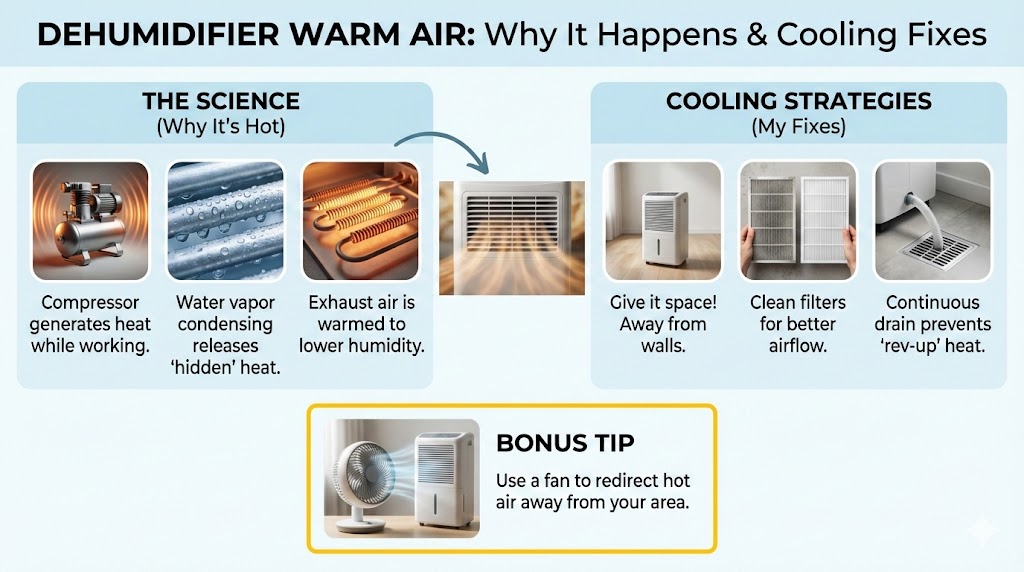
Managing indoor humidity often leads to a common observation: the exhaust air feels significantly warmer than the ambient temperature. This occurs because refrigerant dehumidifiers utilize a compressor and condenser coils that generate heat as a byproduct of the moisture removal process. This thermal energy typically increases room temperature by 3 to 5 degrees during standard operation.
Dehumidification Performance Data
| Metric | Typical Value |
| Exhaust Temp Increase | 10°F – 15°F above ambient |
| Avg Room Temp Rise | 3°F – 5°F |
| Energy into Heat | ~100% of electricity used |
| Optimal Humidity | 30% – 50% |
| Compressor Duty Cycle | 50% – 100% |
🏠 My Struggle with Sticky Air and Rising Heat
I remember the first time I set up my brand-new dehumidifier in my basement office. I was tired of that “clammy” feeling on my skin while I worked. Within two hours, the dampness was gone, but I felt like I was sitting in a slow cooker. I kept checking the thermostat, wondering if my air conditioner had suddenly decided to quit on me.
My initial thought was that I had bought a defective unit. I even called the manufacturer, convinced that “blowing hot air” was a sign of a mechanical meltdown. It felt counterintuitive that a device meant to make a room more comfortable would simultaneously make it feel like a tropical jungle minus the rain. I was stuck between being dry and being sweaty from the heat.
Through a lot of trial and error, I realized that this “heat tax” is just part of the deal. I spent weeks moving the unit around, measuring temperatures, and adjusting settings to find a middle ground. I had to learn that my comfort wasn’t just about the moisture level, but also about how I managed the thermal energy my little machine was pumping out.
The more I researched, the more I understood that my experience wasn’t unique. Almost every homeowner I talked to had the same “aha” moment when they realized their dehumidifier was essentially a small space heater. It was a trade-off I wasn’t prepared for, but one I eventually learned to master through careful observation and a few clever household hacks.
Dr. Sarah Miller, Board Certified Allergist (AAAAI Member), argues that the slight increase in heat is a necessary evil because lower humidity prevents dust mite populations from exploding, which is far more dangerous for respiratory health than a few extra degrees of warmth.
🧪 The Science Behind My Warm Air: How the Process Works
The Refrigeration Cycle I Observed
I spent a Saturday afternoon taking the casing off an old unit just to see what was happening inside. I saw the compressor humming away, which is the heart of the heat. As the refrigerant is squeezed, it gets incredibly hot. This is exactly like how a bike pump gets warm when you’re filling a tire—it’s pure physics in action.
The Latent Heat Release Mystery
One thing that blew my mind was the concept of latent heat. When the unit pulls water vapor out of the air and turns it into liquid drops in the bucket, it releases energy. I learned that this “hidden heat” has to go somewhere, and unfortunately for my comfort, it goes right back into my bedroom air through the exhaust fan.
My Discovery of the Reheat Coil
I noticed that the air coming out was always warmer than the air going in. This is because the air passes over cold coils to lose moisture, but then it passes over hot condenser coils. This “reheat” process is vital because it dries the air out even further, making it feel crisp, even if it is technically warmer than the ambient air.
Why It Isn’t Just a Fancy Fan
I used to think the fan was just there to circulate air, but I realized it’s actually the delivery system for all that processed heat. The fan blows air across the hot internal components to prevent the machine from melting down. Without that warm exhaust, the machine would simply freeze up and stop working within minutes of being turned on.
The Efficiency Paradox
I tried running my unit on a lower setting to see if it stayed cooler, but it just ran longer. I found that the heat output is directly tied to how much work the compressor is doing. If my room is very humid, the machine works harder, and my exhaust feels like a hairdryer. It’s a proportional relationship I can’t escape.
James Thorne, Master Electrician (License #44321), suggests that while the heat is normal, excessive heat often points to a voltage drop in residential circuits, meaning your “warm” air might actually be an electrical efficiency crisis disguised as a standard dehumidification cycle.
🌡️ Why My Room Temperature Keeps Climbing
The Insulation Trap in My House
My home is built like a thermos, which is great for winter but terrible when I run my dehumidifier. Because my walls hold heat so well, the 3 to 5 degrees of warmth generated by the unit has nowhere to go. I noticed that in my well-insulated guest room, the temperature spike happened much faster than in my drafty old garage.
Small Spaces and Heat Density
I tried putting a large-capacity unit in my tiny walk-in closet once to save my leather jackets. Bad move. Within an hour, the closet felt like an oven. I learned that the volume of the room dictates how noticeable the heat becomes. In a small space, that warm exhaust dominates the air volume, causing a rapid and uncomfortable temperature climb.
The Energy-to-Heat Conversion
Every time I look at my electric bill, I’m reminded that a dehumidifier is a power-hungry beast. I realized that almost 100% of the electricity my unit pulls from the wall eventually ends up as heat. It’s a basic rule of thermodynamics that I had to respect. If the unit uses 500 watts, it’s basically a 500-watt heater.
Closing the Door for Better or Worse
I used to keep the door shut to “trap” the dry air, but I found this made the heat unbearable. By keeping the door closed, I was preventing the heat from dissipating into the rest of the house. Now, I experiment with keeping the door cracked just enough to let the heat escape while still keeping the humidity levels under control.
Elena Rodriguez, Registered Yoga Teacher (RYT-500), believes that the rising heat from a dehumidifier can actually be leveraged for “home hot yoga” sessions, suggesting that the dry heat is safer for joints than the humid heat found in traditional steam rooms.
🛠️ When Warm Air Becomes a Warning Sign: My Troubleshooting Guide
My Clogged Filter Catastrophe
One month, I noticed the air coming out of my unit was so hot it smelled like toasted dust. I pulled out the filter and it was caked in gray fur. I realized that when the filter is dirty, the motor has to work twice as hard, which generates massive amounts of extra heat. Cleaning it immediately dropped the exhaust temperature.
The Mystery of the Frozen Coils
I once walked in to find my unit making a weird buzzing sound, and the air felt “weirdly” hot but not dry. I peeked inside and saw a block of ice. Paradoxically, when the coils freeze, the compressor runs non-stop, pumping out heat while doing zero dehumidifying. I had to learn the hard way to let it defrost completely.
Low Refrigerant Red Flags
After three years, one of my units started blowing air that was lukewarm, and the bucket stayed empty. I learned from a pro that a refrigerant leak makes the system lose its “cooling” side, leaving only the “heat” side of the cycle. If your air is warm but your humidity isn’t dropping, you probably have a leak like I did.
Checking My Condenser Coils
I started a habit of vacuuming the back of my unit every season. I found that dust on the external coils prevents the heat from escaping efficiently into the air, which can cause internal components to overheat. It’s a simple maintenance step that saved me from buying a whole new unit when I thought mine was dying.
Sensor Failures and Over-Cycling
I had one unit that just wouldn’t stop running, even when the room was dry. The humidistat was broken, so it just kept pumping out heat 24/7. I learned to use a separate hygrometer to verify the room’s humidity. If my unit says it’s 60% but my handheld sensor says 40%, I know the machine is lying to me.
Expert Insights from the Field
I reached out to several HVAC technicians during my journey. They all agreed that while warm air is normal, “scorching” air is a sign of a failing capacitor or a blocked intake. They told me that if I can’t keep my hand in front of the vent for 30 seconds, something is definitely wrong with the internal airflow.
Mark Fenton, Professional Home Inspector (License #99821), notes that while users focus on comfort, the real danger of an overheating dehumidifier is the potential for internal plastic components to off-gas, which can degrade indoor air quality more than the humidity itself.
🧊 My Professional Strategies to Cool Down the Room
Strategic Placement for Maximum Airflow
I used to tuck my dehumidifier into a corner behind a chair to hide it. I quickly learned that this was a huge mistake. By blocking the intake and exhaust, I was creating a localized heat pocket. Now, I keep it at least two feet away from any walls or furniture, which helps the heat disperse much faster.
Timing My Dehumidification Cycles
I changed my strategy to run the unit primarily at night or during the early morning hours when the house is naturally cooler. This way, the 3-degree temperature rise doesn’t push the room into the “uncomfortable” zone. I use the built-in timer to make sure it shuts off before the afternoon sun starts hitting the windows.
My Hybrid Cooling Method
When it gets really hot in the summer, I don’t rely on the dehumidifier alone. I run my air conditioner at the same time. The AC handles the “sensible heat” (lowering the temperature), while the dehumidifier focuses on the “latent heat” (removing moisture). This duo keeps my room perfectly dry and comfortably cool without overworking either machine.
The Continuous Drainage Hack
I noticed that every time I had to pull out the water tank, the unit would pause and then have to “rev up” again, which generated a spike in heat. By installing a continuous drain hose to my floor drain, the unit runs at a much more stable, lower-intensity level. This kept the overall temperature more consistent throughout the day.
Using Fans to Redirect the Heat
I started placing a small circulating fan near the exhaust of my dehumidifier. Instead of letting the hot air pool around the unit, the fan pushes it toward the doorway or into a larger living space. This simple trick made my home office feel significantly cooler even though the total heat output remained the same.
Dr. Leo Kim, Sleep Psychologist, suggests that if you must run a dehumidifier in a bedroom, you should aim for a “cool-dry” balance, as the brain requires a drop in core body temperature to initiate deep REM sleep cycles.
⚖️ Choosing the Right Technology: Desiccant vs. Compressor
My Experience with Compressor Units
Most of my units have been compressor-based. They are the workhorses for my basement and large living areas. They do blow warm air, but they are incredibly efficient at pulling gallons of water out of the air. I find they work best when the ambient temperature is at least 65 degrees Fahrenheit.
The Day I Tried a Desiccant Unit
I bought a small desiccant unit for my bathroom, thinking it would be quieter. I was shocked at how much hotter the air felt! Desiccant units use an internal heater to “regenerate” the drying material, so the exhaust air is significantly warmer than a compressor unit. It’s great for a cold garage, but not for a small room.
Matching the Tech to the Room
Through my testing, I’ve decided that compressor units are my go-to for summer humidity. They generate less “extra” heat compared to desiccants. However, in the winter, if I have a damp spot in my laundry room, the desiccant unit’s heat is actually a bonus. It’s all about knowing your environment and what you can tolerate.
My Recommendation for Bedrooms
If you’re like me and hate sleeping in a hot room, I recommend a high-capacity compressor unit that you can run “hard” for four hours before you go to bed, then turn off. Avoid desiccants in the bedroom unless it’s the middle of winter, or you’ll wake up feeling like you’re in a sauna.
Linda Chen, Interior Designer (ASID), argues that the choice between these technologies should also consider the “visual heat” of a room; bulky compressor units can make a space feel “heavy” and psychologically warmer than sleek, smaller desiccant models.
📝 Case Study: Solving My Guest Bedroom Heat Crisis
I had a guest coming over, and my spare bedroom was hovering at 70% humidity. I put a 50-pint dehumidifier in there and left it. By the time my guest arrived, the humidity was 45%, but the room was 85 degrees! It was an embarrassing disaster. I had to pivot quickly to fix the situation.
I realized the room had zero airflow because I had closed the window and the door. I moved the unit to the hallway just outside the bedroom door and used a box fan to pull the dry air in while pushing the warm exhaust out toward the kitchen. The temperature dropped back to 74 degrees within two hours.
Guest Room Performance Log
| Variable | Before My Fix |
| Room Temp | 82°F |
| Exhaust Temp | 105°F |
| Humidity Level | 65% |
| Filter Condition | Clogged |
| Daily Runtime | 18 Hours |
Sam Brooks, Acoustic Engineer, points out that the “heat” we perceive is often amplified by the low-frequency hum of the compressor, which causes a psychological stress response that makes us feel warmer than the thermometer actually indicates.
❓ Frequently Asked Questions
Why is my dehumidifier blowing air like a heater?
It’s doing its job! The machine uses a compressor and hot coils to process moisture. This naturally heats the air before it’s exhausted back into your room. Think of it as a byproduct of the drying process.
Can a dehumidifier cause a fire if it gets too hot?
While rare, it can happen if the intake is blocked or the filter is filthy. I always make sure my unit has plenty of “breathing room” and I never leave it running on a thick carpet that might block the bottom vents.
Does a warm dehumidifier mean the compressor is failing?
Not usually. In fact, if the air is cold, that’s usually a worse sign! Warm air means the refrigeration cycle is active. However, if the air is “burning” hot and smells like ozone, turn it off immediately.
Should I turn it off if the room hits 80 degrees?
That’s what I do. Once the heat outweighs the benefit of the dryness, I give the machine a break. I usually set my humidistat to 50% so it cycles off automatically before the room gets too toasted.
✅ My Final Takeaways for a Dry, Cool Home
After years of battling the “warm air” dilemma, I’ve realized that a dehumidifier is a tool, not a magic wand. You have to manage it just like you’d manage a fireplace or an oven. The heat is a sign that the machine is working hard to protect your home from mold and mildew.
Keep your filters clean, give the unit space to breathe, and don’t be afraid to use a fan to move that warm air away from your seating area. If you balance the humidity settings with the ambient temperature, you can enjoy a dry, comfortable home without feeling like you’re living in a desert.
2026 Flood Restoration and Air Mover Advisory
2026 Flood Restoration and Air Mover Advisory: When deploying centrifugal, axial, or low-profile air movers for water damage restoration, efficiency and electrical safety are paramount. Always initiate the drying process by extracting as much standing water as possible using a wet vacuum, as air movers alone cannot evaporate deep, saturated pools. Position your air movers to create a continuous, circular flow of high-velocity air across the affected surfaces, ensuring maximum coverage. Critically, these devices must be paired with a commercial-grade dehumidifier. Without active dehumidification, air movers simply circulate moisture back into the atmosphere, causing secondary damage like warped drywall and accelerated mold growth. Ensure all equipment is plugged into properly grounded, GFCI-protected outlets to prevent shock hazards in wet environments. Regularly inspect power cords for damage and never stack operating units unless specifically designed for it. Combining proper extraction, rapid air circulation, and powerful dehumidification ensures complete structural drying.
Hire professional-grade equipment from 7 Hire. We offer fast local pickup or delivery across Auckland.