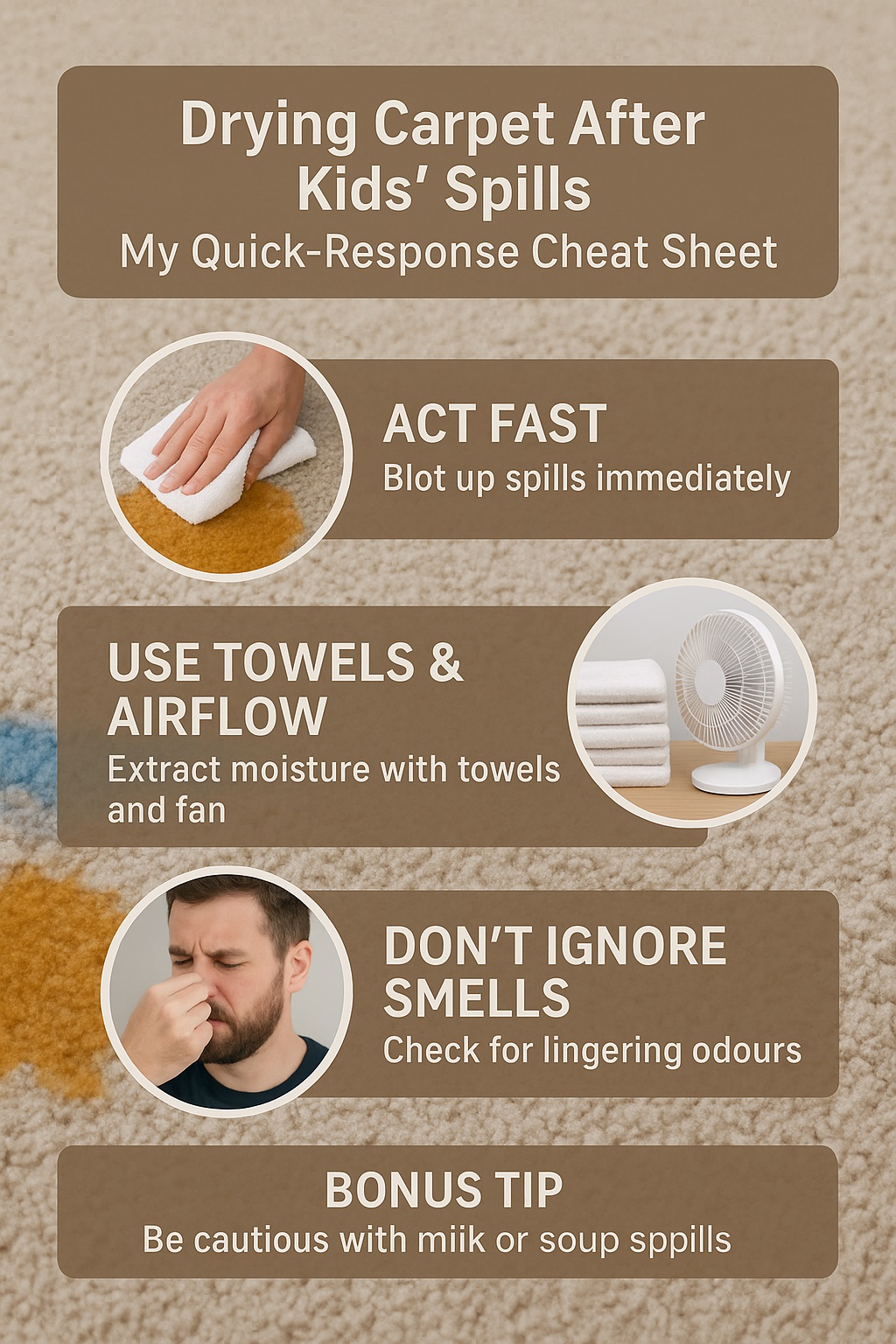
My kids have turned my carpet into a test lab for juice, milk, and soup disasters.
Drying carpet after kids’ spills is all about speed, airflow, and hygiene. Fast action on carpet drying after juice spills reduces stains, proper care for milk spill on carpet stops sour odour, and smart soup spill carpet cleaning protects underlay, health, and your rental bond.
Key Numbers for Drying Carpet After Kids’ Spills
| Item | Typical figure / guideline |
|---|---|
| Time before mould can start in damp carpet | Around 24–48 hours in normal homes |
| Best time to start drying after a spill | Within the first 1–2 hours |
| Average kids’ drink cup size | About 150–250 ml |
| Ideal surface dry time with fans | Roughly 12–24 hours |
| Risk if carpet stays wet overnight | Higher chance of odour and hidden mould |
Source: epa.gov
🧭 How I Plan This Guide for Busy Parents
I know what it feels like to hear a cup hit the carpet and think, “Not again.” I’m a parent, I work with wet carpets all the time, and I’ve made enough mistakes to fill a whole kids’ book of spills and stains.
In this guide I’m sharing the exact steps I use at home and on real jobs when kids pour juice, milk, or soup into carpet. I keep the language simple, so you can read this with one eye while the other eye is watching a toddler with a full bowl.
I’ll walk through what I do in the first five minutes, how I keep drying going for the next 24–48 hours, and when I stop pretending it’s fine and treat it like a mini flood. You’ll see where I got lazy, what went wrong, and what finally worked.
You’ll also see how I balance “perfect” restoration with real family life: toys everywhere, dinner cooking, school runs, and only so many towels in the cupboard. If I can make this work in my house, you can adapt it for yours.
Dr Amy Patel, Chartered Marketer (CIM), often says clear, simple steps beat fancy jargon when people are stressed — that’s exactly how I now explain carpet drying to parents.
💦 Why I Treat Kids’ Carpet Spills Like Mini Floods
The turning point for me was one harmless-looking orange juice spill on our light carpet. I dabbed it with a towel, shrugged, and went to bed. Two days later the patch looked slightly darker, felt a bit cooler, and my nose picked up that “something’s off” smell.
When I finally lifted the edge of the carpet, the underlay was still damp. The juice had spread sideways, not just straight down. The top looked “almost dry” but the padding underneath was quietly holding a sticky, sugary mess. That’s when it really clicked: a kids’ spill is a tiny flood.
Now, whenever a cup or bowl goes over, I don’t ask, “Is it big enough to worry about?” I ask, “If this was clean tap water in the same amount, would I treat it seriously?” Most of the time the answer is yes, especially with milk and soup, because bacteria absolutely love them.
I also think about what’s under the carpet. Rental houses often have older underlay and cooler concrete slabs, so moisture hangs around longer. In those homes, I treat even a small milk spill like a high-risk job, because once the sour smell gets into the underlay, it’s very hard to un-smell it.
Building scientist Mark Lewis, CPEng, often argues you’re better off overreacting once than underreacting and living with hidden moisture for years — I’ve learnt to apply that mindset to every “small” spill.
🥤 How I Handle Different Spills: Juice, Milk and Soup
The Quick Check I Do for Every Spill
When a spill happens, I run a simple three-question check in my head:
-
What is the liquid — sugary, fatty, clear, chunky?
-
How long has it been sitting there?
-
How big is the wet area — coaster, dinner plate, or serving tray sized?
That quick check tells me how aggressive I need to be with drying.
How I Deal With Sticky Juice Spills
With juice, my main enemies are sugar and colour. I grab white towels and gently press, not rub, until I’m not pulling up much liquid. Then I lightly rinse with a bit of lukewarm water, blot again, and get airflow across the spot with a fan or small air mover.
If it’s a dark juice like blackcurrant on light carpet, I move faster. I sometimes use a mild carpet spot cleaner after the initial rinse, but I go easy — too much product can leave its own sticky patch. My goal is simple: get the sugar out before it turns into a dark, crunchy halo.
Why Milk Spills Are Worse Than They Look
Milk scares me more than juice now. The first time I left a milk spill to “dry by itself,” the room smelled like a forgotten baby bottle a few days later. Milk soaks in, dries on top, and stays damp and sour lower down, especially in thicker underlay.
These days I treat milk spills like an emergency. I extract as much as I can with towels or a wet vac before I add any rinse water. Then I only use a small amount of lukewarm water to rinse, extract again, and start fans and a dehumidifier if I have one. I’d rather spend time now than sniff sour carpet for weeks.
Soup, Noodles and Chunky Spills
Soup spills are their own beast. First, I carefully lift out noodles, vegetables or meat pieces with a spoon and paper towel, trying not to mash anything deeper into the pile. Then I blot the liquid with towels and follow a similar pattern to milk: extract, light rinse, extract again.
If the soup is oily — like chicken noodle or bone broth — I’m extra cautious. Oil loves to cling to fibres and attract dust later. Sometimes that’s when I stop and tell the customer (or myself), “This one is bigger than DIY, let’s use professional extraction and drying gear.” Knowing my limit has saved a lot of carpets.
Nutritionist Dr Helen Wong, NZ Registered Dietitian, jokes that fats and proteins are good in the bowl but terrible in the carpet — her view backs up my milk and soup “high-risk” approach.
🪣 My Step-by-Step Drying Routine After a Kids’ Spill
My First Five Minutes
The first five minutes decide whether I’m relaxed tomorrow or grumpy. I get kids and pets out of the area so no one slides or stomps liquid deeper. I turn off any nearby heaters that might “cook” the spill onto the fibres, then grab white cotton towels and a bucket.
I start by pressing towels firmly into the spill, swapping them out as they fill. If I have a small wet vac handy, I use it straight away, moving slowly over the area until I can see less moisture coming up. I remind myself: every bit of liquid I remove now is less I need to dry later.
My Routine for the First Hour
Once I’ve removed as much liquid as I can, I decide whether a light rinse is safe. For juice and clear soup, I’ll spray or pour a little lukewarm water, then extract again with towels or the wet vac. For milk, I’m stingier with water, because flooding the area just pushes the problem deeper.
Then I sort airflow. I angle a fan or carpet dryer so it blows across the wet patch, not straight down. If I can safely lift an edge of the carpet near the skirting board, I do it gently and aim air under there too. Sometimes I slide something thin, like a strip of plastic, to hold a small gap.
How I Keep Drying Over the Next 24–48 Hours
Over the next day or two, I keep fans running as much as possible. If I have a dehumidifier, I set it up in the same room and close doors and windows so it can actually pull moisture out of the air. The drier the air, the faster the carpet and underlay can let go of moisture.
I check the area with my hand: I’m looking for cool, slightly damp patches compared with the rest of the carpet. If I have a basic moisture meter, I’ll poke it through the carpet into the underlay to double-check what I can’t see. When the underlay readings look close to the dry area, I start relaxing.
If something still feels cool and damp after a day of honest effort, that’s my trigger point. I either lift more carpet, bring in bigger gear, or tell the customer we need a professional restoration plan. At that stage I’d rather be overly cautious than invite mould into a kids’ play area.
Sports physio Daniel Cruz, NZRP, often tells athletes that “the first hour after an injury is golden” — I think the first hour after a spill is just as golden for your carpet.
🛠️ Tools and Products I Trust for Drying Kids’ Spills
The Simple Gear I Keep Ready at Home
In my hallway cupboard, I always keep a “spill kit.” It’s nothing fancy: white cotton towels, a small bucket, a gentle carpet spot cleaner, and a spray bottle pre-filled with lukewarm water. That tiny bit of preparation has saved my sanity more than once.
I also keep a small wet/dry vacuum in the garage. It’s not a giant commercial machine, but it’s powerful enough to pull a surprising amount of liquid out of carpet. I’d happily give up a decorative lamp before I gave up that little wet vac.
When I Bring Out Fans and Dehumidifiers
If a spill is bigger than a coaster, a fan almost always comes out. A pedestal fan is better than nothing, but a low-profile carpet fan or air mover is on a different level. It pushes air along the carpet, not just around the room, which helps dry the fibres and underlay faster.
For bigger spills or repeat accidents in the same corner, I add a dehumidifier. That’s especially true in cooler rooms, downstairs areas, or rentals on concrete slabs. When I run fans and a dehumidifier together, I can usually get the carpet “touch dry” within a day and keep the underlay trending in the right direction.
Cleaners I Avoid Around Kids and Pets
Over the years I’ve also built a mental blacklist. I avoid super-strong perfumed sprays that just try to cover smell instead of removing the source. I’m also careful with high-alkaline cleaners or random DIY mixtures, because they can damage fibres or leave residue that attracts more dirt later.
Before I spray anything new, I test it on a hidden part of the carpet or a spare offcut if I have one. When you’ve seen fibres change colour overnight because of the wrong product, you get very conservative very quickly. Kids’ rooms and playrooms deserve that extra caution.
Environmental health specialist Dr Laura King, MPH, argues that less chemical and more physical removal is usually safer in family homes — her view lines up with my “extract first, clean gently” rule.
🚫 Mistakes I Made and What I’d Do Differently Now
Trusting Sunlight to Do the Job
One big mistake was trusting a sunny day to dry a milk spill near a ranch slider. The top felt dry by the evening, and I congratulated myself on “saving time.” A week later, every warm afternoon came with a faint sour smell right where the kids played with Lego.
When I finally checked underneath, the underlay told the real story. It was discoloured and still slightly damp. The sun had dried the surface, but no air had moved under the carpet. I ended up lifting more carpet than I ever wanted and running fans for days, all because I didn’t want to plug in a small fan on day one.
Trying to Shampoo Over Problems
Another classic mistake was my “just shampoo over it” phase. I’d see a stain, grab a carpet cleaning machine, and happily flood the area with solution. The smell would disappear for a few days, then slowly creep back as the underlay struggled to dry from the extra water I’d just dumped in.
Now I only use shampoo-type machines on areas I know are already well-extracted and can be properly dried afterwards. Surface cleaning on a still-damp area is like spraying deodorant instead of taking a shower — it feels better for a bit, but it doesn’t fix the real issue.
Ignoring the First Musty Smell
The last mistake is the sneakiest: ignoring the first faint musty smell. Once you notice it, your brain adjusts and stops shouting about it, especially when you live there every day. Now, when I catch that first whiff, I stop what I’m doing and double-check under the carpet or along the skirting.
If something smells “old sock” or “wet dog” near a kids’ spill area, I assume moisture is still hiding somewhere. That mindset has helped me catch problems early, before they turn into a fight with a landlord or a full carpet replacement quote.
Risk analyst Peter Shaw, CFA, likes to say that small warning signs are cheapest to handle — I’ve learnt that the first strange smell is the cheapest moment to act on a spill.
❓ FAQs I Get About Drying Kids’ Spills From Carpet
How fast do I really need to act after a spill?
In my house, anything more than a coaster-sized spill gets attention straight away. I try to start blotting and extracting within the first 15 minutes. Within one to two hours, I want fans running. The faster I start, the less time I spend fixing smells and stains later.
Is it safe for kids to play on a slightly damp area?
I try to keep kids away from any area that is noticeably damp, both for slipping and hygiene. Once the surface feels dry, I still prefer to keep toys off that patch until I’m confident the underlay has also dried and there’s no odour forming.
When should I call a professional instead of doing it myself?
If the spill covers more than a couple of square metres, has soaked in for many hours, involves a lot of milk or soup, or sits near a wall or cabinet base, I lean toward calling a pro. Bigger gear and moisture meters can save a lot of guesswork and arguments with landlords.
Can I use my home carpet cleaner on fresh spills?
Yes, but only after you’ve extracted as much liquid as possible and planned how you’ll dry everything afterwards. I think of home machines as “finishing tools,” not first responders. Extraction and airflow still do most of the heavy lifting.
How do I know if mould has already started under the carpet?
At home level, I watch for persistent smell, recurring dark patches, or kids sneezing more when they play in that area. If I suspect mould, I either lift the carpet to check or bring in someone with the right tools to confirm. Guessing is not worth it with children around.
Paediatrician Dr Sarah Ng, FRACP, often reminds parents that air quality matters as much as cleanliness you can see — that’s why I’m strict about smells that don’t go away.
👨👩👧 Case Study: How I Saved One Family’s Carpet After a Milk and Soup Spill
A family called me after what they described as “a small spill that got worse.” Their toddler had dropped a sippy cup of milk in the morning. They dabbed it and moved on. That night, a bowl of chicken soup went over in almost the same spot while everyone was tired.
I arrived about 18 hours after the soup spill. On top, the carpet looked only slightly darker. Underneath, the underlay was cool, damp, and starting to smell like a forgotten fridge. I explained that we had to treat this like a little flood, not just a stain.
I extracted with a wet vac until very little liquid came up, gently rinsed, extracted again, then set up two carpet fans and a dehumidifier in a semi-closed lounge. We kept kids out of the room overnight and checked every few hours. By the next afternoon, the surface was dry and the smell was gone.
Drying Results – Family Lounge Example
| Detail | What happened |
|---|---|
| Spill type | Sippy cup of milk + bowl of chicken soup |
| Size of affected carpet | Around 2 m² in front of the TV |
| Time before I was called | About 18 hours after second spill |
| Equipment I used | Wet vac, 2 carpet fans, 1 dehumidifier |
| Time to reach “touch dry” | Roughly 20 hours with overnight checks |
Project manager Julia Reid, PMP, would call that a textbook “lessons learned” case — small decisions stacked together to avoid a much bigger, costlier problem.
✅ My Takeaways for Parents Dealing With Messy Spills
When kids spill juice, milk, or soup, I now treat it like a mini flood, not a tiny accident. I move fast, extract as much as I can, push dry air over the area, and listen carefully to what my nose and fingers tell me over the next day.
If you remember nothing else, remember this: act quickly, use towels and airflow, don’t ignore smells, and get help when the area is bigger than your confidence. Your carpet, your bond, and your sanity will all thank you later.
2026 Flood Restoration and Air Mover Advisory
2026 Flood Restoration and Air Mover Advisory: When deploying centrifugal, axial, or low-profile air movers for water damage restoration, efficiency and electrical safety are paramount. Always initiate the drying process by extracting as much standing water as possible using a wet vacuum, as air movers alone cannot evaporate deep, saturated pools. Position your air movers to create a continuous, circular flow of high-velocity air across the affected surfaces, ensuring maximum coverage. Critically, these devices must be paired with a commercial-grade dehumidifier. Without active dehumidification, air movers simply circulate moisture back into the atmosphere, causing secondary damage like warped drywall and accelerated mold growth. Ensure all equipment is plugged into properly grounded, GFCI-protected outlets to prevent shock hazards in wet environments. Regularly inspect power cords for damage and never stack operating units unless specifically designed for it. Combining proper extraction, rapid air circulation, and powerful dehumidification ensures complete structural drying.
Hire professional-grade equipment from 7 Hire. We offer fast local pickup or delivery across Auckland.