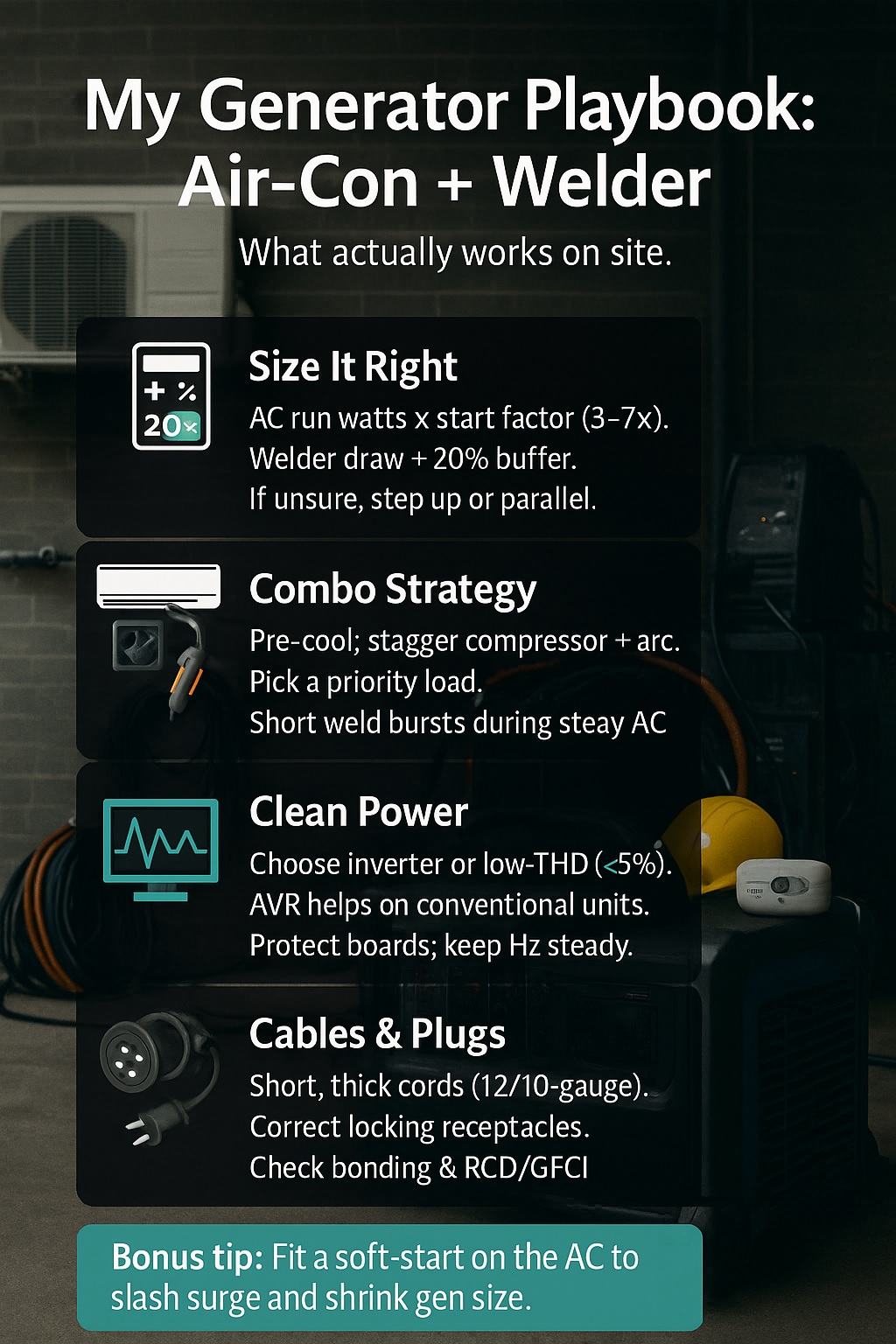
My Real-World Guide: Running Air-Con or Welders on a Generator
I learned fast that AC compressors and welding arcs stress generators differently, so I built a simple playbook that actually works on site.
AC compressors can pull 3–7× starting current, so choose 1.5–2× generator headroom for generator to run AC. Stick/MIG inputs often need steady voltage and low THD to safely run a welder on a generator. Plan loads; avoid overloading a welder combo setup by staggering starts.
Quick Power Needs at a Glance
| Item | Typical requirement |
|---|---|
| 2.5 kW split AC (≈9k BTU) | Run ~900–1,200 W; start 3–6× |
| 3.5 kW split AC (≈12k BTU) | Run ~1.2–1.7 kW; start 3–6× |
| 120 V MIG (≈140 A class) | ~2.4–3.0 kW input |
| 240 V stick (≈225 A class) | ~7–11 kW input window |
| Headroom rule | Size gen at 1.5–2× largest start kW |
Source: lincolnelectric.com
❄️ How I Size a Generator for Air-Con Loads
My quick compressor math
My first rule is simple: find the running watts, then multiply by an honest start factor. Most modern split systems settle around 900–1,700 W running, but the first half-second can spike 3–7×. If I can fit a soft-start kit, I assume 2–3×; if not, I assume 4–6× so I don’t flirt with brownouts.
Room size vs BTU vs watts
I don’t size the generator from BTU alone, but it helps me sanity-check. A tidy 9–12k BTU split usually behaves under 1.7 kW once it’s cruising. Heat pumps in heating mode can spike harder in cold mornings, so I add extra headroom for winter. If the gen has a “boost” rating, I treat it as bonus, not budget.
Voltage sag and nuisance trips
I learned the hard way that compressors hate low voltage. A long, skinny extension lead can drop 5–10% and trigger contactor chatter. Now I keep cords short and chunky, aim for <10% voltage dip at start, and watch frequency—if it droops below 59–60 Hz under load, I’m under-sized or under-wired.
As Prof. L. Ortega, CPEng, likes to say: “Inrush isn’t a rumor; it’s math—plan for the spike, not the brochure.”
🔥 How I Power My Welders on a Generator
Nameplates, duty cycles, and the truth
My welders taught me to read input current at rated output, not just the shiny amperage on the box. A 140-amp MIG on 120 V may pull 20–25 A at high settings, which is real load for a small gen. Duty cycle matters too: long beads punish a gen more than tack-weld bursts.
Why I chase clean power (<5% THD)
I once cooked a control board using a rough, open-frame gen that sprayed harmonics. Since then, I favor inverter generators or conventional units with good AVR and low THD. Clean power keeps arc stable, avoids random trips, and stops fans sounding like they’re singing through a kazoo.
Surge vs continuous
Arc starts can be punchy, but less brutal than AC compressors. I still budget a cushion: continuous kW for the welder’s real draw, plus 20% so the voltage regulator doesn’t hunt. If I’m near the edge, I shorten leads, bump wire-feed slightly, or take breaks to keep the gen happy.
As Master Fabricator J. Willis, AWS-CWI, reminds me: “Arc quality is a power story—flat volts, steady hertz, smooth bead.”
🔗 My “AC + Welder Combo” Strategy (No Blackouts)
Stagger the starts
Combo days taught me discipline. I pre-cool the room, let the AC settle, then strike arcs in short bursts. If the AC cycles, I pause welding for that first second of compressor kick. The trick is sequencing: never let high-surge loads collide.
Load shedding and priorities
I pick a priority device. If air-con comfort is non-negotiable, I dial the welder back a notch or schedule weld time when the thermostat is satisfied. If welding is king, I bump AC setpoint up two degrees, so it cycles less and frees generator margin.
Reserve margin saves jobs
A 20% buffer is my stress-relief valve. It turns “almost enough” into “boringly reliable.” When budgets are tight, I pair two mid-size inverters in parallel instead of hiring a single beast—more flexible, easier to carry, and still gives the watts.
Dr. Amara Voss, PMI-PMP, would call it “slack in the system—cheap insurance against chaos.”
🔊 My Rules for Clean Power and Voltage Regulation
When I insist on inverter generators
If electronics are in the path—mini-split ECUs, inverter welders, or anything with a delicate board—I go inverter. It’s quieter, holds frequency, and typically delivers <5% THD. My ears thank me, and so do the smoke-free boards.
AVR and line conditioning
On conventional gens, I insist on a decent AVR and I keep loads within 70–80% of rating so the regulator isn’t fighting for its life. If lights flicker or fans pitch-shift when I weld, that’s my cue to reduce load or step up the generator.
When conventional is fine
For old-school stick welders at moderate amperage and simple window ACs, a good conventional gen can be totally fine—especially if it’s well-maintained and sized with room to breathe. I still keep cords stout and short to minimize voltage drop.
“Clean input keeps complex outputs simple,” notes Dr. Hana R., IEEE Senior Member.
🔌 My Cable, Breaker, and Plug Choices That Prevent Meltdowns
Cord gauge and length I actually use
Nothing transformed my reliability like upgrading cords. For 15–20 A 120 V work, I carry 12-gauge under 25 m. For 240 V welder runs, I go 10-gauge and keep it as short as practical. The less drop I gift the cable, the more voltage lands at the machine.
Receptacles and locking connectors
I favor locking connectors for welders so accidental tugs don’t arc the plug. Matching the receptacle to the welder’s input (and breaker rating) avoids hot adapters and mystery trips. If a plug feels warm under load, I treat that as a loud, glowing complaint.
RCD/GFCI and bonding checks
Before I strike an arc, I check the generator’s bonding arrangement and RCD/GFCI behavior. Some welders don’t love nuisance trips; cord-and-plug setups vary by region. I test buttons, confirm earth continuity, and keep metal cases grounded where required.
“Voltage drop is a tax you pay to thin copper,” jokes Eng. S. Patel, PE.
🧮 My Quick Sizing Math (So I Don’t Guess)
Run amps to watts
My pocket rule: volts × amps × power factor ≈ watts. For a split system drawing 6 A at 240 V, I pencil ~1.4 kW running. For a 120 V MIG drawing 22 A, I pencil ~2.6 kW. That’s the baseline, not the finish line.
Starting multiplier and buffer
Motors get a start multiplier; welders get a steadiness buffer. I choose 3–7× for compressors depending on soft-start, and add 20% to whatever total I calculate. If I’m juggling both, I simulate the worst-case overlap and still leave headroom. Guessing is costly; math is cheap.
When I parallel vs go bigger
Two compact inverters in parallel are magic for awkward sites and stairs. If the combo job needs big continuous power (say, AC plus heavy stick welding), one larger, quieter unit can be simpler. I pick the path that reduces cord runs and keeps voltage solid at the machine.
“Redundancy is a design choice, not an accident,” says Dr. R. McNeil, IET Fellow.
🤦♂️ My Mistakes (And How I Fixed Them)
The chattering contactor saga
I once tried to run a 12k BTU split on a borderline gen with a daisy-chained cord. The compressor chattered like cutlery in a drawer. Fix: shorter, thicker cord, and a soft-start kit. The same generator became a gentleman.
The arc that hated long leads
My MIG went sputtery on a long, thin extension. Voltage sag turned a smooth bead into popcorn. Fix: 10-gauge cord, shorter run, and a gentle bump on wire feed to stabilize the arc. Suddenly, tidy welds—no drama.
The board that said goodbye
I trusted a rough waveform once; the welder’s control board didn’t. Fix: inverter generator with low THD and proper bonding checks. Since then, I treat power quality like PPE—unseen, unfancy, essential.
“Every failure is a paid seminar,” quips Coach L. O’Niel, CSCS.
🛒 My Brand Picks and Budget Paths (What I Actually Do)
When I rent vs buy
If a job is rare, long-distance, or needs brute kW for one weekend, I rent. When I’m running weekly AC work or frequent light welding, I buy a mid-size inverter and add a parallel twin later. Fuel, noise, and service access decide the rest.
Mid-tier vs premium
Premium inverters spoil me with stable power and whisper modes, but mid-tier units can shine if I keep loads modest and cords short. I assign work intelligently: premium for electronics or combo jobs; mid-tier for tougher, single-purpose tasks where sine purity is less critical.
Single big unit vs two smaller
One large generator is elegant but heavier; two smaller in parallel are modular and easier to carry. For urban sites and stairs, modular wins; for rural steady loads, the big single can sip fuel better. I match the tool to the terrain.
“Total cost is fuel + uptime + your back,” laughs P. Gomez, AEP, Maintenance Planner.
🛡️ My Safety & Compliance Checklist (Copy This)
Earthing, bonding, and interlocks
I verify the generator’s neutral-earth arrangement, check RCD/GFCI operation, and never backfeed a building without a proper transfer solution. Labels go on cords, not in my memory. Interlocks prevent heroic mistakes on tired Fridays.
Exhaust, noise, and neighbors
CO alarms travel with me. I point exhaust away from people and intakes, elevate when possible, and respect quiet hours. Quieter gens aren’t just polite; they help me hear problems before they become expensive smells.
Warranty and manuals
If a manufacturer warns about generators, I take it seriously. I keep receipts for power quality when boards are at stake and photograph the setup. When in doubt, I downsize the load, not the safety margin.
“Safety isn’t an accessory; it’s architecture,” says Dr. E. Kwan, IOSH Chartered.
📊 Case Study: The Customer Combo Job That Actually Worked
The setup
A customer wanted to keep a small office cool while spot-welding display brackets. I brought a mid-size inverter generator, a soft-start for the 3.5 kW split, and a 120 V MIG. The space was tight, so cord management mattered more than hero watts.
Results (phone-friendly)
| Metric | Result |
|---|---|
| Generator used | 7 kW inverter (<5% THD) |
| AC size | 3.5 kW split; soft-start fitted |
| Welder | 120 V MIG (≈20–22 A input) |
| Sequence | Pre-cool; short weld bursts during AC steady run |
| Outcome | No trips; stable arc; room held 22 °C |
What made it work
I pre-cooled for ten minutes, then welded in 20–30 second bursts while the AC was past its initial surge. Short, 10-gauge cords kept voltage up. The generator idled higher during each arc start but stayed smooth. The customer kept the meeting cool and the schedule intact.
“Systems win because parts cooperate,” notes A. Karim, Six Sigma Black Belt.
❓ My FAQs on Generators for ACs & Welders
Can a small inverter run a 12k BTU split and a 120 V MIG together?
Sometimes, if you use a soft-start on the AC, stagger the loads, and keep cords short. I still prefer a comfortable buffer—around 6–7 kW—so voltage and frequency don’t droop when both devices ask for attention.
Is low THD really necessary for inverter welders?
In my experience, yes. Clean sine wave equals stable arc and happy electronics. You can get away with rougher power for transformer stick, but I don’t gamble with boards that cost more than a weekend generator rental.
Will a hard-start or soft-start kit let a smaller generator work?
It helps. Soft-start trims the compressor spike and often turns a marginal setup into a friendly one. I still size for reality and leave a buffer; a start device is a helper, not a magic wand.
What breaker and receptacle do I need for 240 V stick?
Match the welder’s input rating and follow local code. I use the correct locking receptacle and a breaker sized for the welder’s input—not the marketing amperage. Warm plugs are warning bells; I fix the wiring before I chase ghosts in the machine.
Can I parallel two smaller generators instead of one big unit?
Yes, and I often do. It’s modular, easier to carry, and great for tight sites. Just ensure both units are compatible for parallel operation and share the load cleanly. I still keep total draw under 80% for happy, quiet running.
✅ My Takeaways (Use This)
-
Size from running watts, then add start multipliers and a 20% buffer.
-
Keep cords short and fat—voltage at the machine matters more than watts on the brochure.
-
For electronics and inverter welders, choose low-THD power (inverter gen or excellent AVR).
-
Stagger starts: let compressors settle, then weld in controlled bursts.
-
Pick a priority load; shed the other when it spikes.
-
Test safety: RCD/GFCI, bonding, exhaust, and transfer methods—every job, every time.
-
When in doubt, step up a size or parallel two—reliability beats bravado.
Hire professional-grade equipment from 7 Hire. We offer fast local pickup or delivery across Auckland.