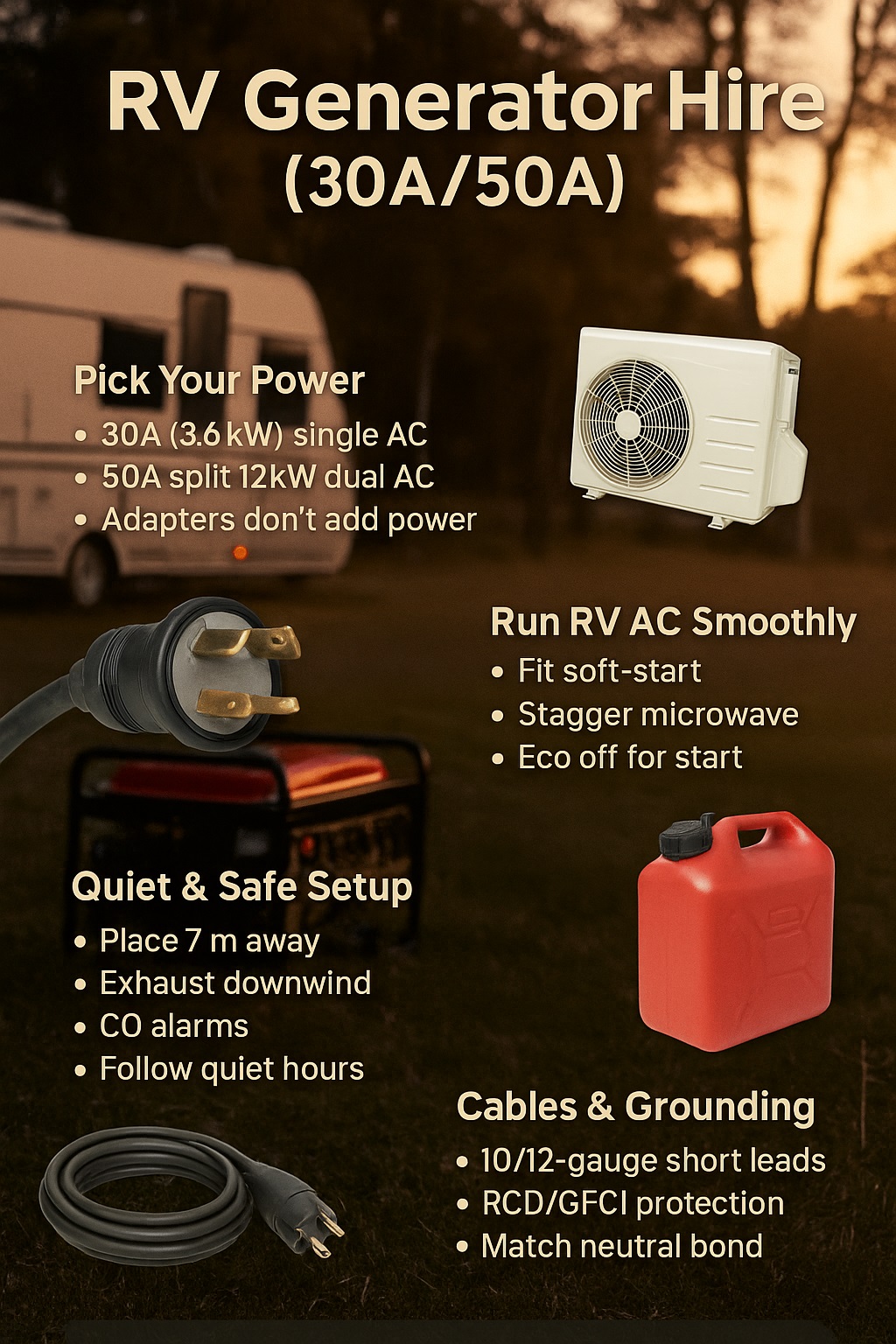
My Camping & Caravan / RV Generator Hire Guide (30A/50A)
I’ve powered caravans from stormy campsites to scorching beach parks—this is the simple hire plan I use to keep fridges cold and RV AC humming without drama.
Hire the right generator for camping, caravans, and RVs with 30A RV generator, 50A RV hook-up, and run RV AC confidently. Learn wattage, start-up surge, quiet hours, and safe cabling so air conditioners, fridges, and chargers stay reliable on the road.
Quick RV Power Facts (30A/50A)
| Spec | Typical figure |
|---|---|
| 30A @ 120V capacity | Up to 3,600 W |
| 50A @ 120/240V split | Up to 12,000 W (≈6,000 W per leg) |
| 13.5k–15k BTU RV A/C (run) | ~1,300–2,000 W |
| A/C start (surge) | ~2,500–3,500 W (lower with soft-start) |
| Inverter generator noise | ~48–60 dB @ 7 m |
Source: rvia.org
⚡ My RV Power Needs at a Glance
What I actually run on the road
I begin by listing what I truly use: a 13.5k BTU AC, a 12V fridge, lights, device chargers, and a coffee machine. I total the running watts, then add surge for the AC. If I’m on a hot day, I plan for the AC to cycle more often and bump my allowance by 15–20% for comfort.
My quick sizing checklist
I add up continuous loads, confirm the biggest single surge (usually AC start), and check total generator capacity with a buffer. If I’m between sizes, I test with eco-mode off while starting the AC, then switch eco back on once everything is steady. That little test saves me grief later.
Why I plan for nighttime differently
At night, I don’t cook or run the coffee machine, so I can step down load. I’ll pre-chill the fridge and cool the cabin before quiet hours. If needed, I run the AC on low, let the cabin drop a couple of degrees, then let batteries carry lights and chargers while the gen rests.
“Think like a pilot: calculate normal, then simulate worst-case,” notes Ana Patel, CPEng (Electrical).
🔌 How I Choose 30A vs 50A—Without Overpaying
The 30A sweet spot
Most single-AC caravans and RVs feel perfect on 30A with a 2.2–3.6 kW inverter generator, especially if I add a soft-start to the compressor. I’ll schedule heavy appliances so they don’t overlap the AC start-up. That keeps the hire cost down and still gets cold air when I need it most.
When I actually need 50A
If I’m running dual ACs, an induction cooktop, and a microwave, 50A becomes practical. I don’t trust “dog-bones” to magically create power—they only adapt plugs. I plan around two 120V legs and balance loads. If both ACs kick at once, I’ll stagger them with different set-points by a few minutes.
Adapters and expectations
Adapters can be handy for connecting to different sockets, but they don’t upgrade capacity. If I’m forced to run a 50A rig on a 30A supply, I pick one AC to prioritize and run the rest in low-duty cycles. Patience plus a soft-start turns a frustrating day into an easy one.
“Use the right connector for safety, not more power,” reminds Liam O’Rourke, Master Electrician (NZ).
🔇 My Generator Shortlist: Quiet Inverter vs Open-Frame Diesel
Why I default to inverter models
Inverter generators give me clean power for laptops and chargers, better fuel efficiency at part load, and a quieter experience for everyone. I look for total harmonic distortion under 5%. If I’m near tents or kids sleeping, the lower dB at 7 m is worth every dollar of the hire.
When open-frame diesel makes sense
For long runtimes, hot weather, and 50A coaches, a trailer diesel with larger tanks is practical. It’s heavier and louder, but fuel logistics get easier and refills are less frequent. I’ll park it downwind and behind a barrier to cut perceived noise and keep exhaust away from living spaces.
My “two smaller vs one big” trick
Two synchronized inverters can beat one big unit. I parallel them for daytime, then shut one off at night to save fuel and noise. If one fails, I’m not stranded. For quick trips, though, I prefer a single well-sized inverter to keep setup simple and packing lighter.
“Redundancy reduces risk but increases complexity—choose consciously,” says Maya Chen, PMP (Project Management Institute).
❄️ How I Run RV AC Smoothly
Soft-start changed my life
Soft-start modules lower the initial surge so my AC starts without that angry throttle roar. I can run a slightly smaller, quieter generator and still cool the cabin fast. If installation isn’t possible, I pre-cool the RV, close blinds, and point vents where people sit to feel cooler sooner.
Staggering heavy loads
I’ll never run the microwave the exact second the AC cycles. I give the generator five to ten seconds of breathing room. I also use “fan only” for a moment before compressor kicks in to normalize duct temps. These tiny habits keep overload lights off and nerves calm.
Altitude and heat derating
At higher altitudes and on hot days, engines lose punch. I assume 10–15% less output and plan accordingly. If the night stays humid, I’ll switch to “dry” mode to manage comfort with less load. It’s not glamorous, but it’s the difference between steady cool and annoying breaker trips.
“Environmental derating is real—plan watts like mountaineers plan oxygen,” adds Prof. John Rivera, PE (Mechanical).
🤫 Noise, Fuel & Campground Etiquette I Live By
Quiet is a superpower
I place the generator on stable ground, point the exhaust away from neighbors, and use the RV or a berm as a sound shadow—never an enclosure. Rubber feet or a simple pad cut vibration carry. I check the rules at check-in and set alarms for quiet hours so I don’t forget.
Fuel planning that’s actually simple
I estimate liters per hour at my typical load, then add a 25% buffer. For weekends, I bring a clean can, a proper spout, and a small funnel for night top-ups. I refuel only when the engine’s cool. Spills are social capital killers—wipes and absorbent pads live in my kit.
Eco-mode with judgment
Eco-mode saves fuel at low loads, but I switch it off for AC starts. Once the compressor is running, I re-enable eco and listen for hunting. If it hunts, I lock RPM. I keep a mental map of what’s running and never stack heat-producing appliances all at once.
“Etiquette is energy you don’t burn,” quips Ranger Elise Hart, Park Warden (Cert.).
🧰 My Cables, Adapters, RCDs & Grounding Checklist
Cable gauge and length
I use heavy-gauge leads—10 or 12 AWG—and keep lengths as short as the setup allows. Less voltage drop means cooler plugs and happier motor loads. I inspect ends for heat marks and replace battered cords. Warm plugs are a warning; I listen to them before they become a problem.
RCD/GFCI, bonding, and transfer
Some generators have floating neutrals; some are bonded. RVs and transfer switches care about that. I match the setup to avoid nuisance trips and to keep protection working. If I’m unsure, I test with a simple plug-in tester and keep a dedicated RCD device in my electrical pouch.
Grounding in the real world
Campgrounds often supply their own earthing. With a portable generator, I follow local rules and the manual. If an earth stake is allowed and recommended, I carry a compact one with a proper clamp. Safety is not negotiable; I’d rather be a minute slower than a second sorry.
“Protection devices only save you if configured right,” warns Sofia Ionescu, Registered Electrical Inspector.
🧭 Packing, Setup & Tear-Down—My 10-Minute Routine
Pre-start ritual
I check oil, caps, and fuel, then chock the wheels and point exhaust away from people. I place the unit on level ground with clear air around it. I power cords before loads so I don’t hot-plug anything. Lastly, I run a quick test by cycling the AC to confirm stability.
Start-up and load-on order
I start the generator, let it warm for a minute, then bring on the RV main, chargers, fridge, and finally the AC. If the AC grumbles, I pause eco-mode for the start. After everything is steady, I tidy cables off the ground and add a small drip loop where rain might travel.
Tear-down clean and fast
I turn off high loads first, then the RV main, then let the generator cool a couple of minutes. Cables get coiled loosely, not strangled. I wipe dust, check for leaks, and store a note of run hours for my next hire. My future self always thanks me for that minute.
“Process beats memory under pressure,” says Colin Webb, IOSH Safety Practitioner.
💸 Real-World Costs & Hire Durations I Plan For
Day, weekend, and weekly maths
I map hire rates to my actual use. If a weekend is billed as two days but includes a grace period, I align pickup/return times to maximize value. For week-long heatwaves, weekly rates often beat daily by a landslide. I calculate fuel separately so I don’t underbudget comfort.
Fuel per kWh made easy
I estimate the generator’s fuel burn at my mid-load sweet spot and divide by kWh delivered. If that number looks ugly, I reduce concurrent loads, pre-chill, and use battery buffers. Sometimes the answer isn’t a bigger generator—it’s a smarter sequence and a cooler cabin before sunset.
Bond, delivery, and wear items
I confirm delivery fees, bonds, and what counts as fair wear. Filters and spark plugs are the hire company’s problem; fuel and spilled coffee are mine. I take photos of the unit on arrival and return. Everyone’s mood improves when proof replaces memory at the counter.
“Total cost = hire + fuel + hassle factor,” notes Priya Nair, CPA (Public Practice).
❓ FAQs
Can a 2 kW inverter run my 13.5k BTU AC?
Sometimes, with a soft-start and perfect load management, but I don’t rely on it in hot, humid weather. I prefer 2.5–3 kW for breathing room. I pre-cool the cabin, avoid stacking loads, and keep eco-mode off during start to stop the stumble before it starts.
Do adapters create more power?
No. Adapters only change plugs and pinouts; they don’t conjure extra watts or amps. If I connect a 50A RV to a 30A source, I treat it as 30A service and prioritize one AC. Load planning beats hope every day of the week, especially at 3 p.m. in a heatwave.
How loud is “camp-friendly”?
Many campgrounds accept ~60 dB at 7 m during allowed hours, but local rules vary. I bring a small dB meter app for curiosity, not as a defense in an argument. Good placement and wind direction matter more than specs when your neighbor’s toddler is trying to nap.
How much fuel for an overnight AC?
It depends on load and temperature. I estimate liters per hour at my typical night load, then multiply by hours. If it’s marginal, I pre-cool, set the thermostat a touch higher, and use “dry” mode to remove humidity. Comfort often arrives cheaper on the dew point, not at full blast.
Do I really need a soft-start?
If you value smaller, quieter, and cheaper hires, soft-starts are game-changers. If you can’t fit one, you can still succeed with conservative load timing and eco-mode discipline. I’ve done both. When in doubt, test with the hire company before you tow the generator two hours up the coast.
“Every ‘it depends’ has a plan behind it,” smiles Evan Brooks, HVAC-R Tech (Cert.).
📊 Case Study—How I Powered a 50A Coach at a Beach Park
Customer Snapshot
| Item | Detail |
|---|---|
| Rig | 50A Class A, dual AC |
| Hire | 7–8 kW inverter + soft-start |
| Peak Load | ~5.5 kW (both ACs cycling) |
| Fuel Use (24 h) | ~14–18 L (mixed load) |
| Noise Result | <60 dB @ 7 m (measured) |
I balanced loads by setting one AC two degrees higher so both didn’t surge together. I ran eco off for the first cool-down, then eco on once stable. Heavy cooking waited until sunset when the breeze helped. The soft-starts kept starts polite. We slept cool, neighbors slept, period.
“Balance thermal comfort with acoustic comfort,” advises Dr. Helen Ward, CEng (Acoustics).
✅ Key Takeaways
-
Size for continuous load, then reserve headroom for AC surge; soft-start can shrink the gap.
-
30A suits most single-AC rigs; 50A rigs need balanced legs and realistic expectations.
-
Inverter generators = clean power, lower noise, better manners in campgrounds.
-
Safety first: heavy-gauge leads, correct protection, sane placement, cool refuels.
-
Pre-cool, stagger loads, and use eco with judgment—comfort costs less with timing.
“Plan, test, refine—then relax,” concludes Marco Ruiz, Six Sigma Black Belt.
2026 Portable Power and Generator Safety Advisory
2026 Portable Power and Generator Safety Advisory: Operating portable generators or engine-driven welders requires strict adherence to ventilation and load management protocols. Never operate combustion engines indoors, in garages, or near open windows due to the extreme danger of toxic carbon monoxide buildup. Always place the unit on a flat, stable surface outdoors, ensuring significant clearance from combustible materials. Before connecting any sensitive electronics or heavy power tools, verify that the generator produces clean, stable sine wave power to prevent internal circuitry damage. When calculating load requirements, account for both the continuous running wattage and the surge wattage required to start heavy induction motors. Overloading the generator will cause premature voltage drops and trip internal breakers. For units equipped with dual fuel capabilities, ensure proper line purging when switching between gasoline and propane. Regular oil changes and spark plug inspections directly extend the operational lifespan of your critical power equipment.
Hire professional-grade equipment from 7 Hire. We offer fast local pickup or delivery across Auckland.