I used to think nails stop a few metres out. One loud “thwack,” a clean miss, and I watched a bright sliver keep flying—far past where I thought it could. That moment changed how I plan jobs, set up safety zones, and talk to anyone near my work.
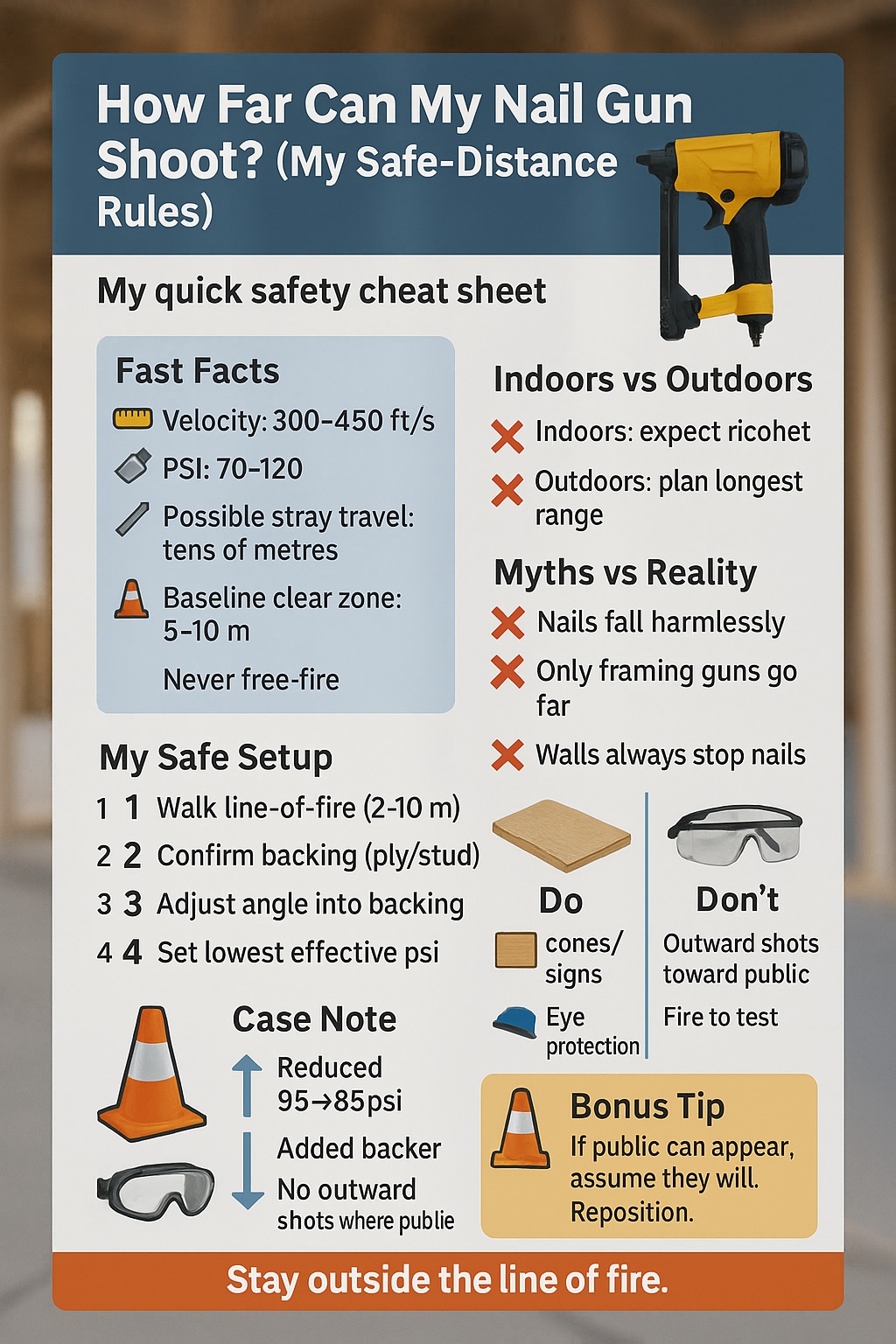
Nail gun distance depends on nail type, velocity, angle, and what it hits. Learn how far can a nail gun shoot, the nail gun safe distance I now use, and why nail gun range myths are dangerous. Typical figures: 300–450 ft/s velocity, 70–120 psi pressure, and strict clear-zone planning.
Typical Nail Gun Distance & Safety Numbers
| Stat | Typical figure (approx.) |
|---|---|
| Framing nailer muzzle velocity | 300–450 ft/s (90–135 m/s) |
| Operating pressure (pneumatic) | 70–120 psi |
| Practical fastening distance | Nose nearly touching work |
| Potential travel of a stray nail | Tens of metres; rare cases farther |
| Clear zone I enforce ahead of muzzle | Minimum 5–10 m, no people |
🧠 Why I Started Wondering How Far My Nail Gun Can Shoot
When I First Saw a Nail Go Too Far
I was firing off a ladder into a stubborn length of framing. The nail clipped a metal edge and went sideways, not in. I saw it zip past an empty driveway and vanish. That one miss forced me to rethink distance, angles, and who might be downrange.
What My Early Assumptions Got Wrong
I thought timber always swallows nails and walls block everything else. Not true. Knots, straps, and hidden fasteners act like launch pads. I also assumed smaller gauges meant smaller risk. Wrong again—light nails can travel surprisingly far and fast when they deflect or miss.
How Seasoned Pros Reset My Thinking
A safety trainer asked me to imagine every miss as a “line of fire” cone. That visual changed me. Instead of two metres in front, I started planning ten. I also began tracing secondary paths—through sheet goods, cavities, and out external cladding or soffits.
As Chris Morgan, CPEng (Chartered Professional Engineer) reminds builders, “Energy doesn’t know intention—only direction, mass, and angle.”
⚙️ What I Learned About Power, Velocity, and Range
How My Guns Turn Air or Gas Into Speed
Pneumatic guns shove a piston with compressed air; gas guns ignite a small fuel charge; many cordless models store spring energy in a flywheel or nitrogen chamber. Different systems, same outcome: a nail accelerated fast enough to enter wood—and keep going if it misses.
The Numbers I Watch Before I Fire
I match fastener length and gauge to timber density, then confirm pressure. Running a framing gun at the high end of psi gives clean sinks, but it also extends the distance a stray nail can travel. Lower settings reduce bounce and over-penetration when the work allows.
What Tool Engineers and Trainers Emphasise
Engineers talk in joules; trainers talk in consequences. Both say the same thing: it only takes one bad shot with enough energy and the right angle. I treat exterior shots, elevated shots, and open-air firing as “maximum-range scenarios” and stretch my exclusion zones accordingly.
“Treat every fastener like a projectile,” says Dana Li, PE (Mechanical)—“range comes from speed, not job intent.”
🧪 Myths I Believed About Nail Gun Distance (and What Actually Happens)
Myth: “Nails Drop Harmlessly After a Few Metres”
Gravity works, but not on your schedule. At typical nail speeds, a slight upward angle can carry a nail far beyond “a few metres.” Timber edges, metal, or masonry can add unpredictable spin. I’ve seen nails fade out of sight in bright daylight—never again assumed safe.
Myth: “Only Big Framing Guns Travel Far”
My brad nailer taught me humility. Miss light trim and a 18-gauge can skate off hard surfaces. It may not punch through studs like a 3¼″ framing nail, but it can still travel—especially outdoors with no backing. Small gun ≠ small risk. I plan zones the same.
Myth: “Walls Always Stop Nails”
Hollow cavities, thin claddings, and old linings can surprise you. I’ve seen nails pass through ply, lose a bit of energy, then keep moving. When I can’t confirm backing (stud, block, steel plate), I assume the wall is a tunnel, not a shield, and reposition.
“Risk hides in assumptions,” notes Rita Shah, CSP (Certified Safety Professional)—“verification beats confidence every time.”
📏 How I Work Out a Safe Nail Gun Distance on Each Job
My Line-of-Fire Checks
Before I squeeze, I walk the path—two metres, five metres, ten metres. Inside, that means checking who’s on the other side of a wall or above a ceiling. Outside, I look for driveways, windows, and footpaths. If I can’t guarantee clear air, I change the angle.
Indoors vs Outdoors: How I Adjust
Indoors, I assume ricochet off concrete, steel, or packed knots. Outdoors, I assume range: nothing to stop a miss. Elevated shots get extra caution—downhill means longer travel. I add temporary backers (scrap ply) behind delicate work and switch to shorter, blunter nails when possible.
What Inspectors and Safety Pros Recommend
Inspectors pushed me to mark exclusion zones, not just shout “heads up.” I now use cones, signs, or a helper to hold space. I also stagger tasks so no one is opposite my line of fire. If that delays me, good—delays are cheaper than accidents.
“Space is PPE for everyone,” says Leo Gardner, CHST (Construction Health & Safety Technician)—“distance beats luck.”
🛡️ How I Protect People and Property Around My Work
Keeping Others Out of the Firing Line
I talk plain: “Stay ten metres in front, please.” Clients and kids don’t know what a “cone of fire” is, so I use tape, cones, and simple words. If there’s any doubt, I stop and look together. Everyone understands a pointed finger and a clear boundary.
Planning for Ricochets, Misses, and Deflections
I expect surprises—knots, straps, hidden screws. I angle slightly into backing when possible and avoid fully perpendicular shots on suspect surfaces. I keep my off-hand and body outside likely rebound paths. Hard hats and safety glasses aren’t optional, even for “one quick shot.”
Small Habits That Made a Big Difference
Short nails in thin materials, test shots into scrap, and never free-firing to “check power.” I use anti-dry-fire features and keep contact tips clean so the gun sits flat. A dirty shoe or bent contact trip can tilt the muzzle and change everything.
“Safety is layers, not a hero cape,” adds Maya Cho, CIH (Certified Industrial Hygienist)—“engineering, admin, then PPE.”
🔧 What Different Nail Gun Types Mean for Range in My Hands
Framing vs Brad vs Finish
My framing nailer carries heavy nails with momentum; misses can do real damage. Brad and finish nailers feel gentler, but their small nails can glance and travel. I don’t rank them by “danger.” Instead, I rank by backing certainty and set my zones the same way.
Cordless Gas vs Pneumatic
Gas guns hit hard and consistently in dense timber—great for productivity, not forgiving for misses. Pneumatics are predictable if pressure is set correctly; over-pressure pushes range and bounce. With compact cordless models, I still avoid free-space firing and assume the worst-case line of travel.
Why I Read Every Manual (Now)
Manuals aren’t bedtime stories. They tell me fastener length limits, minimum material thickness, and angles to avoid. I follow them and then add my own margin. If a manual says “no free-fire,” I don’t free-fire—even for “just one quick test.” There are safer tests.
“Tools have design envelopes,” notes Harold Kim, SME (Society of Manufacturing Engineers)—“stay inside or expect surprises.”
📊 Case Study: The Day a Customer Saved Me From a Bad Angle
The Job and the Near-Miss
I was fixing fascia with a clear lawn in front. The client waved and pointed to a footpath I hadn’t noticed—kids on scooters, unseen from my angle. I stopped, moved my platform, and shot inward into a sacrificial backer instead of outward into open space.
Quick Data From That Day
Fascia Safety Reset — What I Changed
| Item | My field note |
|---|---|
| Nail & gauge | 2″, 16-gauge finish |
| Pressure setting | 95 psi (reduced to 85) |
| Original firing direction | Outward toward open footpath |
| New setup | Inward with scrap-ply backer |
| New rule adopted | No outward shots where public can pass |
That tiny change—plus a ten-metre public exclusion—became my standard for exposed edges.
“If the public can appear, assume they will,” says Olivia Reed, CMIOSH (Chartered Safety Professional)—“design your process around them.”
❓ FAQs I Get About Nail Gun Distance
Can my nail gun shoot through a wall?
Sometimes. Hollow cavities, thin linings, or old claddings may not stop a miss. If I can’t confirm backing, I act as if the wall is a tunnel. I reposition, add a backer, or change fasteners rather than betting on unknown layers.
How far can a nail travel if I fire into open air?
It depends on speed, angle, and wind. I’ve seen nails vanish outdoors, so I treat open-air shots as a worst-case. I never free-fire, and I plan a long, empty exclusion zone in front of the muzzle for any exterior work.
Is it safe to use a nail gun in a small room?
Only with control. I confirm what’s behind the target, avoid hard rebounds, and keep bystanders out. I lower pressure, shorten nails when possible, and set a strict no-entry zone. Small spaces make ricochets faster to reach you, so I stand out of likely rebound paths.
“Risk grows as space shrinks,” observes Ben Carter, CRSP (Canadian Registered Safety Professional)—“geometry is part of safety.”
✅ Takeaways I Keep in My Pocket Every Time I Nail
-
Range is real: assume a miss will travel farther than you think.
-
Plan zones: ten clear metres in front of the muzzle is my baseline outside.
-
Control angles: shoot into backing; avoid outward, open-space shots.
-
Set power to need, not habit: lower psi where the work allows.
-
People first: stop and reset if anyone can enter the line of fire.
“Good work is safe work,” says Ava Singh, PMP (Project Management Professional)—“schedule safety like a task, not a wish.”
Final Word From My Bench
I still love the speed a nail gun brings. I just love certainty more. If I can’t guarantee where a miss will go, I pause, reposition, or add a backer. That habit has saved me time, saved me material, and—most importantly—protected people I care about.
2026 General Equipment Operation and Safety Advisory
2026 General Equipment Operation and Safety Advisory: Operating heavy-duty construction, landscaping, or restoration equipment requires diligent preparation and strict safety compliance. Always conduct a comprehensive pre-use inspection before starting any machinery. Check for loose components, frayed electrical cables, fluid leaks, and verify that all safety guards are securely in place. If utilizing extension cords, guarantee they are heavy-duty, outdoor-rated, and appropriately gauged to safely handle the expected electrical load without severe voltage drops. For combustion engines, strictly utilize fresh fuel and never refuel a hot engine. Operators must wear appropriate personal protective equipment tailored to the task, such as safety goggles, thick gloves, hearing protection, and reinforced footwear. Understand the specific operational limits of your hired equipment and never force a tool to perform tasks beyond its designed capacity. Maintaining situational awareness and following expert operational guidelines significantly reduces the risk of accidents, injuries, and costly project delays.
Hire professional-grade equipment from 7 Hire. We offer fast local pickup or delivery across Auckland.