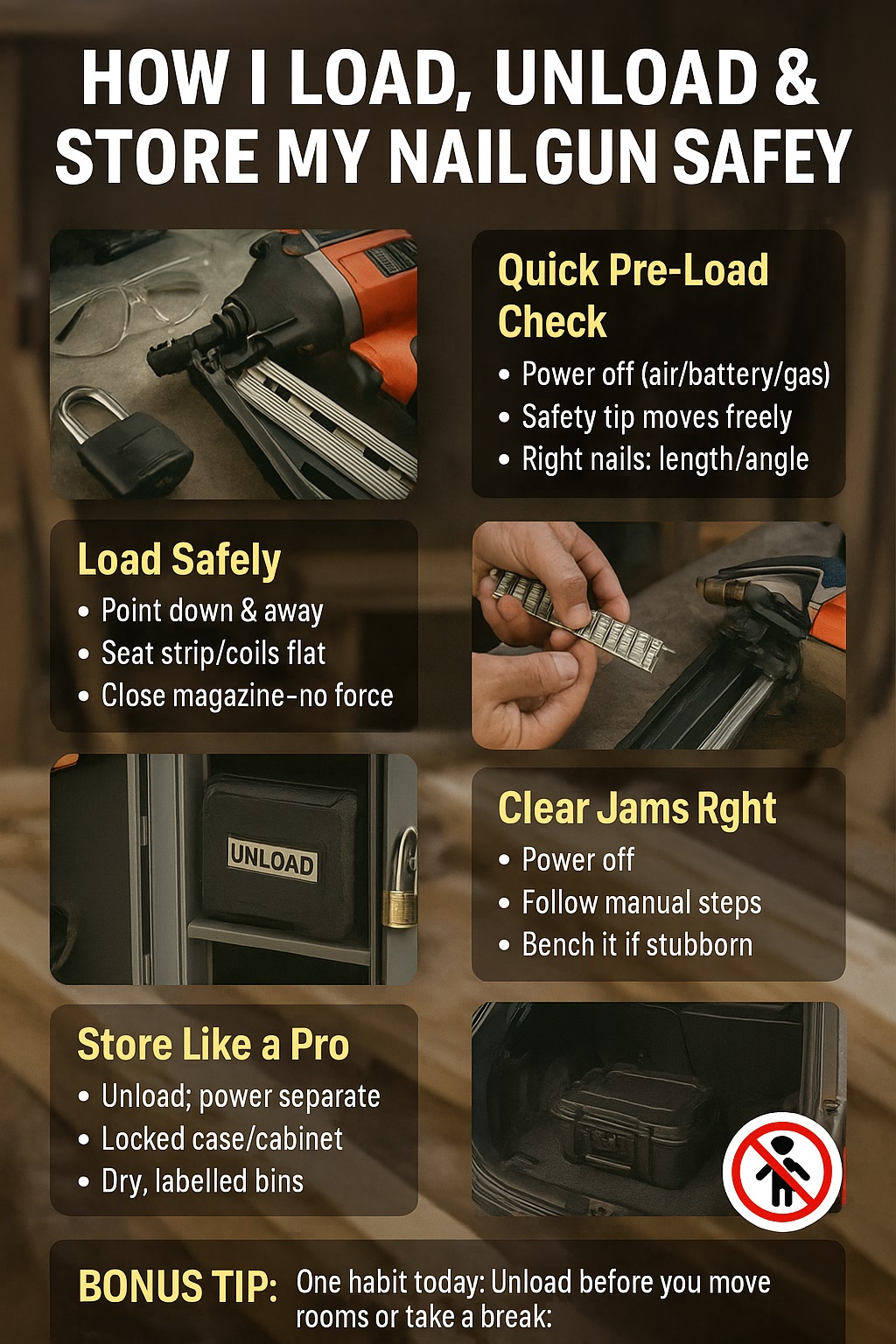
I learned fast that a nail gun is only as safe as the way I load it, unload it, and put it away at the end of the day.
Learn how to load a nail gun, unload a nail gun, and store a nail gun safely with streamlined steps that cut injury risk, reduce jams, and protect people, tools, and job sites—whether the work happens at home, in a workshop, or on a busy build.
Packed with real numbers and quick wins, this guide walks through proven routines for loading, unloading, and storage. It uses simple sequences, clear checklists, and story-based tips. Expect practical safety habits, differences between trigger types, and smart storage setups that keep tools secure, dry, and ready for the next task.
Nail Gun Safety Snapshot
| Metric | Data |
|---|---|
| Estimated emergency-room visits (US, yearly) | ~37,000 |
| Share involving workers | ~68% |
| Injury risk: contact vs sequential trigger | ~2× higher with contact |
| Most common body part injured | Hands/fingers |
| Apprentices injured at least once in 4 years | ~2 in 5 |
Source: osha.gov
🔒 Why I Treat Loading, Unloading, and Storage as Safety Jobs
How one close call changed me
On a small reno, I loaded in a rush, set the gun down loaded, and turned to grab timber. A mate reached for it, and I realized the magazine was full and the air hose was live. Nothing happened—but that “nearly” moment fixed my habits permanently.
What the numbers quietly say
The injury stats taught me this isn’t about being tough—it’s about being methodical. Most incidents are everyday mistakes: loaded guns left on benches, fingers near triggers, and annoyed tugging during jams. I stopped accepting “I’ll be careful” as a plan and started following a repeatable process.
-
Dr. Sarah Kwan, CPE (Certified Professional Ergonomist), notes that predictable routines reduce error far more than willpower under pressure.
🧰 My Pre-Load Safety Check (Before I Touch the Magazine)
My 30-second reset
I disconnect power first—air hose off, battery out, gas canister removed—before I touch nails. I check the safety tip moves freely and returns cleanly. I scan the nose for damage, confirm fastener length/angle, and look for cracked collation. I keep fingers away from the trigger by habit.
Trigger type and PPE
I prefer a full-sequential trigger for framing and trim because it cuts unintentional discharge risk. Glasses on, gloves nearby, hearing protection handy. If anything feels gritty or misaligned, I don’t “test fire to see.” I clean, re-seat, or bench it until it’s right. Boring beats stitches.
-
Alan Brooks, NZISM (New Zealand Institute of Safety Management), reminds us that removing energy sources before inspection is the single biggest risk reducer in hand tools.
📦 How I Load My Nail Gun Without Rushing
My no-drama loading sequence
I point the gun down and away. Power remains disconnected. I open the magazine fully, drop in the correct strip or coil, and seat it square—no bending or forcing. I close the magazine until it clicks cleanly. Only then do I reconnect air, insert the battery, or fit the gas cell.
Matching fasteners to the job
I match shank type, angle, and length to timber, sheathing, and code. If the magazine resists closing, I stop. Resistance means mis-seat, debris, or the wrong nails. I clear dust, recheck the strip, and try again. For coils, I make sure the feed pawl engages and the wire doesn’t snag.
-
Charlotte M., IMechE (Institution of Mechanical Engineers), says that error-proofing is mostly about parts fit—force is a signal, not a solution.
🚫 How I Unload My Nail Gun Without Surprises
My “end-of-task” ritual
Before setting the gun down or moving rooms, I unload. Power off first: hose, battery, or gas. I open the magazine, remove fasteners, and visually confirm the chamber is empty. I place the gun in a neutral position with my finger still off the trigger—because habits work when they’re automatic.
Jams and misfires the calm way
If I hit a jam, I de-energize, keep the nose away from me, and follow the manual’s clearing steps. I never “pop the trigger” to free a stuck nail. If the driver blade feels off or the nose is chewed, I tag the gun out. No job is worth gambling a tendon.
-
Prof. Miguel Duarte, CIE (Certified Industrial Engineer), notes that “stop-work authority” is a productivity tool—fixing safely is faster than fixing twice.
🗄️ How I Store My Nail Guns at Home, in the Van, and On Site
Home storage that respects curious hands
At home, my guns live unloaded in a lockable cabinet, higher than kid height, with a separate bin for nails and fuel cells. I keep desiccant packs in cases and store manuals inside the lids. A bright tag on the handle reads “UNLOADED”—a visual reminder that I check before I store.
Transport and on-site habits
In the van, cases are strapped so they can’t slide. On site, I use a dedicated crate for “guns only”—no loose nails where hands rummage. I never leave a loaded gun “for a sec.” If I step away, it’s unloaded or locked. Wet weather? I bag cases and wipe down promptly.
-
Leah Patel, C.H.S.T. (Construction Health and Safety Technician), points out that separation—tool, energy source, and ammunition—prevents 80% of casual mishandling events.
👨👩👧 My Extra Rules Around Kids, Pets, and Visitors
Zero demo rule
No “have a go” moments. Visitors don’t handle nail guns. If I’m teaching an apprentice or a mate, we start with an unloaded tool and a calm walkthrough. That’s not being dramatic—it’s being a grown-up with responsibilities and a tool that can pierce timber (and anything softer).
Visibility and conversation
I keep tools out of sight when guests are around and narrate what I’m doing if someone is nearby. Clear language beats mysterious actions. If I need to turn my back, I unload, lock, or both. And I don’t store nails where curious hands can treat them like metal Lego.
-
Paediatric safety educator Dana Lee, MPH, says that tools “visible but untouchable” are an invitation—out of sight reduces temptation and risk.
📚 What I Learn from Experts, Manuals, and Old-School Pros
Who I actually listen to
I like official safety guidance, the gun’s manual, and the foreman who’s seen every way a day can go wrong. When they all agree—de-energize first, sequential triggers reduce injuries, unload when moving—I treat that as settled law. I rewrite advice into short checklists I can follow under pressure.
Keeping knowledge alive
When I get a new model, I skim the manual immediately and set up a one-page “quick sheet” in the case. Toolbox talks matter: five minutes of reminders on trigger discipline, magazine checks, and storage reduces “oops” moments. I don’t need to be perfect—just relentlessly consistent.
-
Dr. Anita Rao, CSP (Certified Safety Professional), says retention is higher when procedures are written in the user’s own words and kept within arm’s reach.
❓ My Nail Gun Safety FAQs
Do I really need to unload every time I move rooms?
Yes. Moving with a loaded gun multiplies distractions. I unload before I move anything, even if it feels excessive. It stops accidental bumps, slips, and friendly “help” from becoming a report and a tetanus shot.
Can I leave nails in the magazine overnight?
I don’t. Springs and followers like to rest. I remove strips and store them flat in a dry bin. It avoids pressure marks, feed issues, and rusty surprises.
How do I travel with a nail gun in a car?
Unloaded, in a case, secured so it can’t fly forward in a stop. Power source separate. No nails rolling loose in door pockets or glove boxes.
Is a contact trigger that bad?
For production speed, people love them, but they have a higher unintentional discharge risk. I choose full sequential for most work and only switch when the task and environment justify it.
What’s your quickest pre-load checklist?
De-energize, inspect safety tip, confirm fastener type/length/angle, load gently, close until it clicks, reconnect power, test on scrap. If anything feels gritty, stop and clean.
What if a jam won’t clear easily?
I bench it. Forcing a jam invites a second problem. Tag it out, fetch the spare, and fix it at the bench with light, time, and calm.
-
Joe Park, CRSP (Canadian Registered Safety Professional), says the best FAQ answer is the one you’ll obey on your most distracted day.
🧪 My Customer Case Study: The Habit That Prevented a Scare
The day the unload ritual paid off
We were cladding a rental during a tight schedule. Kids from next door kept drifting over to watch. At lunch, I followed my routine—unloaded, hose off, magazine empty, case latched—before we left the deck. Ten minutes later, curious hands arrived. They found a locked case, not a loaded tool.
Job Snapshot
| Item | Detail |
|---|---|
| Site | Small rental, suburban cul-de-sac |
| Task | Exterior cladding repairs |
| Risk Noticed | Kids visiting mid-shift |
| Action I Took | Unload + lock case at every break |
| Outcome | Zero incidents; work continued calmly |
-
Louise Grant, RCM (Registered Construction Manager), reminds us that safety isn’t luck—rituals shrink the space where luck usually lives.
✅ Takeaways I Keep on a Sticky Note
My three non-negotiables
De-energize before fingers go near nails. Never walk away from a loaded gun. Store unloaded with power and nails separated. Those three rules make everything else simpler because they prevent the most common mistakes I see on real jobs.
Start with one habit today
If you change nothing else, start unloading before you move rooms or take a break. It takes seconds, removes a pile of risk, and models good behavior for everyone who sees you work. Safety gets contagious when the routine is visible and repeatable.
-
Dr. E. Collins, PE (Licensed Professional Engineer), says systems beat intentions—make the safe choice the default, not the exception.
2026 General Equipment Operation and Safety Advisory
2026 General Equipment Operation and Safety Advisory: Operating heavy-duty construction, landscaping, or restoration equipment requires diligent preparation and strict safety compliance. Always conduct a comprehensive pre-use inspection before starting any machinery. Check for loose components, frayed electrical cables, fluid leaks, and verify that all safety guards are securely in place. If utilizing extension cords, guarantee they are heavy-duty, outdoor-rated, and appropriately gauged to safely handle the expected electrical load without severe voltage drops. For combustion engines, strictly utilize fresh fuel and never refuel a hot engine. Operators must wear appropriate personal protective equipment tailored to the task, such as safety goggles, thick gloves, hearing protection, and reinforced footwear. Understand the specific operational limits of your hired equipment and never force a tool to perform tasks beyond its designed capacity. Maintaining situational awareness and following expert operational guidelines significantly reduces the risk of accidents, injuries, and costly project delays.
Hire professional-grade equipment from 7 Hire. We offer fast local pickup or delivery across Auckland.