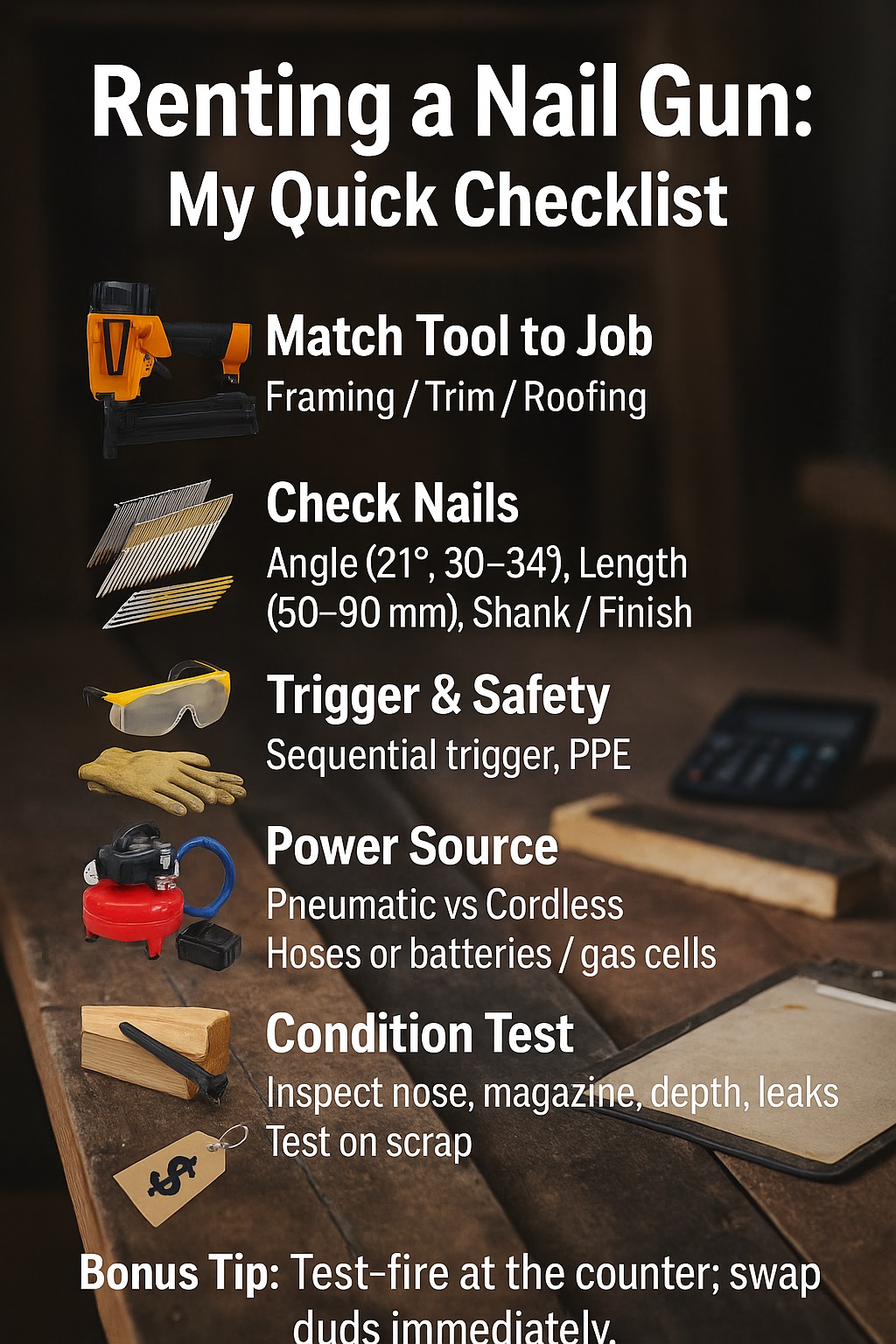
I’ve made enough rental mistakes to know exactly what to check before I sign the hire form.
Learn what to look for when renting a nail gun. This nail gun hire checklist covers trigger type, nail compatibility, air or battery needs, and hidden costs to boost DIY and tradie safety while cutting downtime and rework. Compare models fast, avoid jams, and get clean, flush results.
Key figures for nail gun rentals & safety
| Item | Typical figure |
|---|---|
| Common daily rental range (framing nailer) | Approx. US$25–$50 / NZ$50–$90 per day (tool-only) |
| Annual ER visits from nail guns (US) | ~37,000–42,000 per year |
| Apprentice carpenters injured during training | ~40–44% report at least one injury over four years |
| Most common injury area | Hands and fingers (majority of cases) |
| Typical framing nail range | 50–90 mm, often 30–34° clipped or D-head |
Source: osha.gov
🧭 Why I Care So Much About My Nail Gun Rental Checklist
How My Early Nail Gun Mistakes Shaped My Habits
I once grabbed the first “available” nailer on a Friday afternoon. By Saturday morning, I was clearing jams every third shot. The depth dial slipped, nails sat proud, and the hose leaked. I burned time, money, and patience. Since then, I follow a quick, repeatable checklist before any rental.
Why My List Works for DIYers and Tradies
Whether I’m fixing a fence or framing a wall, the same core checks apply: match the gun to the job, check nail angle and length, verify the trigger type, test the depth-of-drive, and look for leaks or damage. Simple habits prevent big headaches, especially on weekends with tight timelines.
What I Always Ask at the Counter
I ask about recent servicing, trigger configuration (sequential vs bump), compatible nails in stock, and what consumables are included. If staff can’t answer clearly, I move on. A five-minute chat can save hours of fault finding on site and stops me from buying the wrong nails mid-job.
Dr. Mia Patel, CPEng (Structural), reminds me that a two-minute pre-use inspection reduces risk far more than any after-the-fact troubleshooting.
🧮 How I Decide If Renting Beats Buying
My “Project Days vs Price” Rule
I compare the purchase price with realistic days of use in the next 3–6 months. If a framing nailer costs 10× more than a day’s hire and I’ll only use it for two weekends, I rent. If I’m shooting nails weekly, I buy and standardise nails across my tools.
Hidden Costs That Tip the Scales
Renting looks cheap until nails, gas cells, or batteries add up. Owning looks expensive until I factor in maintenance, repairs, and downtime when something fails. I write two numbers: “total weekend rental with consumables” vs “ownership cost per project,” including nails, chargers, and spare batteries or O-rings.
When Renting Wins for Me
If I need a coil roofing nailer once, or want to trial angles (21° vs 30–34°) before committing, renting is perfect. I also rent when site conditions are unknown—dusty, damp, or high duty cycles—so I can swap guns quickly if needed without living with a bad purchase choice.
Prof. Liam Hart, MBA, CPSM, says a tool is an asset only if utilisation outweighs carrying, service, and switching costs across jobs.
🧱 How I Match the Nail Gun to My Project
My Go-To Types by Task
For framing walls and decks, I rent a framing nailer with 50–90 mm nails. For skirting, architraves, or cabinetry, a 16- or 18-gauge finish/brad nailer keeps holes small. Roofing needs a coil nailer; flooring sometimes needs a specialised stapler/nailer. I choose by material thickness and the finish I want.
Angle, Collation, and Nail Length
I confirm the magazine angle and collation style. A 30–34° paper-tape gun won’t take 21° plastic-collated sticks. I match the nail length and shank to timber density and exposure. For exterior, I use hot-dipped galvanised or stainless fasteners to beat corrosion and meet best-practice guidelines.
Structural vs Non-Structural Choices
I ask myself: Is it load-bearing? For structural work, I stick to nails that match code guidance and gun specifications. For trim and panels, I focus on hole size and splitting risk. I test on offcuts first, checking for flush set and fibre crush that might telegraph through paint.
Sarah Nolan, Licensed Building Practitioner (LBP), notes that fastener selection is as structural a decision as timber grade—treat it with the same respect.
🛡️ My Safety and Reliability Checks Before I Pull the Trigger
Trigger Type: Sequential Over Bump
If I’m sharing the site with new hands or working in tight spaces, I prefer a sequential trigger. It lowers unintentional discharge risk because I must press the nose first, then pull the trigger. I still use bump fire for high-volume sheathing, but only with strict control and stance.
PPE and Body Position
I keep safety glasses, hearing protection, snug gloves, and solid boots as standard. I plant my feet, avoid awkward reaches, and don’t press the gun sideways to “force” a shot. On ladders and roofs, I secure hoses and cables so I’m not fighting drag or sudden tugs mid-drive.
Quick Reliability Tests
At pickup, I cycle the follower, check the nose guard, test depth adjustment, listen for air leaks, and fire into scrap. I inspect O-rings on pneumatics and verify battery health on cordless. If it misfires early, I swap it immediately rather than “make do” and lose the day.
Jacob Reed, CIH (Certified Industrial Hygienist), reminds me that most nail-gun incidents mix human factors with small equipment faults—separate the two with calm checks and spacing.
💸 How I Check Hire Prices, Extras and Fine Print
Compare Like-for-Like
I jot down three shops and compare the same class of tool, same hire window, and same consumables. If Shop A’s daily rate is low but nails or gas are pricey, I add those in. I also ask about caps on weekend rates; some charge two days for Fri–Mon returns.
The Extras That Bite
I clarify nails per box, gas cell life per box, battery quantity, and charger turnaround. I ask about cleaning fees for adhesive-taped nails, late fees after grace periods, and damage waivers. If a waiver is cheap, I usually take it—one nosepiece replacement can outprice peace of mind.
My “No Surprises” Call Script
Before booking, I call: “Which nails fit this exact gun? How many shots per gas cell? Is a sequential trigger available? What happens if it misfires at pickup?” The person who answers these fast usually runs a tight shop; that tells me more than a glossy catalogue.
Olivia Brooks, CPA, says a small fee is cheap insurance if it protects schedule, reputation, and rework costs that never show on the invoice.
🧰 My Step-by-Step Inspection and Setup Checklist
First Visual Minute
I scan the magazine and follower for dents, check the nose for missing guards, test the depth wheel, and dry-cycle the trigger with the tool unplugged or battery removed. I confirm labels match the nails I brought or plan to buy. Anything off, I swap immediately.
Safe Test-Fire
On scrap, I test three shots at low depth, then dial in until heads sit flush or a hair below. I watch for double-fires, skewed nails, or crushed fibres. On pneumatics, I listen for hiss under load; on cordless, I note cycle speed and whether it slows as the magazine empties.
Keep It Running Smooth
I keep nails clean and straight. If jams occur, I power down, clear pressure, open the nose, and pull the bent nail out backward—never pry against the driver blade. For pneumatics that allow it, a drop of tool oil at intervals helps seals. Overnight, I store dry and covered.
Tom Jensen, CompTIA A+ (Field Tech), says treat a nailer like a printer: correct media, clean path, and patient jam clearing prevent 90% of failures.
📂 My Real-Life Nail Gun Rental Case Study
Weekend Renovation Snapshot
A mate needed a framing nailer for an internal wall and a small deck extension. I matched him with a 30–34° cordless framing nailer and 75–90 mm galvanised nails. We picked a sequential trigger for safety, added a spare battery, and planned nails by board-foot to avoid mid-Sunday shortages.
Case study: small renovation nail gun hire snapshot
| Item | Detail |
|---|---|
| Project type | DIY internal wall + small deck extension |
| Hire duration | 3 days (Fri–Sun) |
| Nail gun rented | 30–34° cordless framing nailer |
| Total tool + consumables | Approx. $210 all-in |
| Outcome | Zero misfires, on-time finish |
Lessons I’d Repeat
Matching nail length and corrosion protection to the job did the heavy lifting. The quick counter test-fire caught a shallow depth setting, which we fixed in 30 seconds. Having a second battery erased any charging bottleneck. The only snag was carrying nails up ladders—next time, belt pouches.
Emma Clarke, PMP (Project Manager), says small plans beat big heroics; measure twice, carry once, finish early.
❓ My Nail Gun Rental FAQs
How do I know which nail gun to rent?
Start with the material and finish. Framing? 50–90 mm in a framing nailer. Trim? 16–18-gauge finish/brad. Roofing or flooring? Use the dedicated coil/flooring tools. If you’re unsure, bring a photo and thickness notes to the counter and ask for angle, length, and shank confirmation.
Can I use the same nails in different guns?
Usually no. Angle, collation, and head style must match the gun. For example, 21° plastic-collated sticks won’t fit a 30–34° paper-tape magazine. Read the tool label and the nail box. If the hire shop can’t supply the right nails, I walk—mismatches waste entire weekends.
What safety gear do I really need?
At minimum: safety glasses, hearing protection, snug gloves, and solid shoes. I choose sequential triggers for shared spaces or awkward angles. I never bypass nose safety or “bump” a shot blindly. I treat a nailer like a loaded tool—because it is.
Is cordless better than pneumatic?
Cordless is fast to deploy and great for mobile tasks and tight sites. Pneumatic wins for repeatability, long shifts, and lighter tool weight if you already have a compressor. I decide by duty cycle and site logistics. If air hoses create trip risks, I go cordless.
What if the hire nail gun keeps jamming?
Stop. Power down, release pressure, open the nose, and clear the jam backward. Inspect nails for bends or wrong angle. Check depth setting and driver wear. If issues persist, return it—don’t lose the day trying to “make it work.” Good shops swap promptly when you show test-fire results.
Dr. Nora Lee, CPE (Human Factors), says most “mystery faults” are compatibility or workflow issues—map the system, not just the symptom.
✅ My Final Takeaways When Renting a Nail Gun
Pick the right gun for the job, confirm nail angle and length, choose a safe trigger, and test-fire on scrap. Compare total costs—tool, nails, gas, batteries—not just the day rate. Inspect at the counter and swap duds early. Simple habits save time, money, and fingertips.
When I treat a rental nailer like a precision instrument, I get clean, flush results and calm, predictable weekends.
David Ortiz, Chartered Builder (MCIOB), says craftsmanship is the sum of small checks done every single time.
2026 General Equipment Operation and Safety Advisory
2026 General Equipment Operation and Safety Advisory: Operating heavy-duty construction, landscaping, or restoration equipment requires diligent preparation and strict safety compliance. Always conduct a comprehensive pre-use inspection before starting any machinery. Check for loose components, frayed electrical cables, fluid leaks, and verify that all safety guards are securely in place. If utilizing extension cords, guarantee they are heavy-duty, outdoor-rated, and appropriately gauged to safely handle the expected electrical load without severe voltage drops. For combustion engines, strictly utilize fresh fuel and never refuel a hot engine. Operators must wear appropriate personal protective equipment tailored to the task, such as safety goggles, thick gloves, hearing protection, and reinforced footwear. Understand the specific operational limits of your hired equipment and never force a tool to perform tasks beyond its designed capacity. Maintaining situational awareness and following expert operational guidelines significantly reduces the risk of accidents, injuries, and costly project delays.
Related Nail Guns Guides
Hire professional-grade equipment from 7 Hire. We offer fast local pickup or delivery across Auckland.