I still remember the day a nail zipped past my leg and my heart rate went higher than my nail gun’s BPM.
Nail gun safe firing is all about nail gun safe firing techniques, knowing where to stand when firing, and mastering how to hold a nail gun so misfires, ricochets, and co-worker injuries stay as rare as a straight 6×2 in wet framing timber.
Nail gun injury stats that changed how I fire
| Metric | Number / Insight |
|---|---|
| Annual nail gun ER visits | Around 35,000–40,000 cases each year |
| Worker vs DIY injuries | Roughly 2 out of 3 injuries happen to workers |
| Apprentice injury rate | Many apprentices report at least one nail gun injury |
| Trigger risk | Contact triggers roughly double the injury risk vs sequential |
| Injuries to bystanders | About 1 in 10 injuries hit someone else, not the shooter |
Source: OSHA workplace injury statistics
🔧 How I Turned My Nail Gun Scares Into Safer Firing Habits
How my early shortcuts woke me up
When I first picked up a framing nailer, I treated it like a hammer with a personality problem. I would rush shots, twist my body, and trust my “aim” way too much. One day a nail skidded off a metal strap and whistled past my shin. I laughed nervously, but it shook me.
Not long after, I double-fired into a stud while standing too close. The first nail went in, the second caught the edge and kicked out sideways. It buried itself in the air right where my helper’s hand had been seconds earlier. That was the moment I realised my habits were pure luck, not skill.
Why I stopped treating nail guns like fancy hammers
I used to “bump-fire” along a plate like I was playing a drum solo. Nose down, trigger held, tap tap tap. It felt fast and professional. In reality, I was gambling on recoil, wood knots, and poor angles. Every misfire was a reminder that this thing launches metal, not marshmallows.
These days I treat my nail gun much closer to how people treat a firearm. Muzzle awareness, line of fire, and what’s behind the target stay in my head every time. Productivity still matters, but staying out of X-ray rooms matters more. A slightly slower day is cheaper than surgery.
How industry voices pushed me to change
I started listening harder to safety trainers, manufacturer reps, and old-school foremen who still have all their fingers. They kept repeating the same patterns: stand better, aim better, control the trigger, and never fire when you’re not stable. At first it sounded over-cautious; now it feels like survival.
Dr Emily Harris, Certified Safety Professional (CSP), often reminds tradies that near-misses create false confidence, while data quietly proves how fragile that confidence really is.
👣 How I Choose Where I Stand Before Every Shot
How I judge my safe distance and line of fire
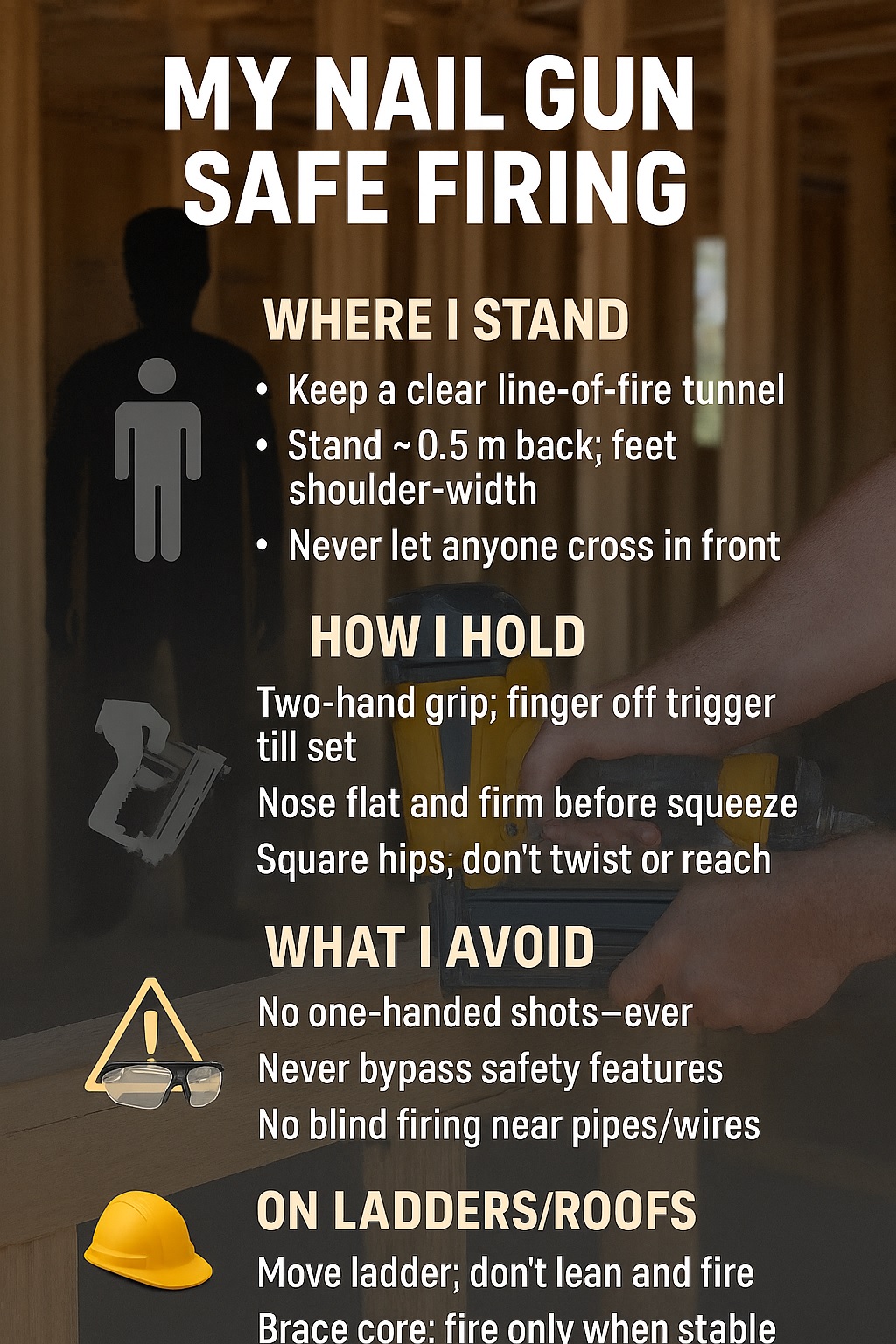
These days, I decide where I stand before I even pick up the gun. My simple rule: if I’m so close that recoil could push the nose off the timber, I step back. I aim for roughly half a metre of space when I can, so I’m balanced and not crowding the workpiece.
In my head, I imagine an invisible tunnel in front of the muzzle. No knees, hands, or bodies are allowed in that tunnel, even if the timber “guarantees” the nail won’t blow through. Knots, straps, and hidden fixings love proving people wrong. My line of fire includes what I can’t see.
How I keep co-workers out of my firing zone
On busy sites I’ve had sparkies, apprentices, and even clients drift straight through my firing zone like it’s a walkway. Now, before I start, I say, “This is my shooting lane. Please don’t cross in front of the nose.” Simple words, but they save awkward moments and potential stitches.
If someone needs to hold a sheet or stud, I place them behind me or on the opposite side of the stud, never beside the muzzle. If they look confused, I point exactly where I want them. It feels bossy for five seconds and then everyone relaxes because the rules are clear.
How I adjust on ladders, roofs, and tight corners
Standing safely on a flat floor is one thing; being on a ladder or roof is another story. On ladders, I plant both feet on one rung, keep my hips square, and avoid stretching sideways. If I can’t reach without leaning, I climb down and move the ladder. Annoying, but less annoying than falling.
On roofs, I angle my feet so my weight goes into the slope, not off it. I never fire while pivoting or stepping. On tight corners between joists or nogs, I move my whole body to find a square shot instead of twisting my wrist and hoping the nail follows my imagination.
Chartered Structural Engineer Mark Doyle, CEng, likes to remind us that forces don’t care about confidence, only angles and support.
✋ How I Hold My Nail Gun So Recoil Doesn’t Surprise Me
How I changed my grip from casual to controlled
My early grip looked relaxed in photos, but unsafe in real life. I’d hold the handle loosely and let the nose float slightly off the timber. When recoil kicked, the muzzle would bounce and sometimes skid. It felt “normal” until I watched a slow-motion video and saw how much it moved.
Now I use a firm, two-hand grip most of the time. My main hand wraps the handle fully, finger outside the trigger until I’m set. My support hand sits on the body or the back of the magazine, never near the nose. I press the contact tip firmly to the timber before I breathe out and fire.
How my stance and balance make every shot safer
Grip is half the story; stance is the other half. I keep my feet shoulder-width apart with one foot slightly forward, knees soft, and weight centred. If I feel like I’m reaching, I stop. Over-reaching is where bad shots, double fires, and twisted backs start sneaking in.
When I’m firing a lot of nails in a row, I reset my stance every few shots. Quick micro-adjustments keep my balance fresh. Sometimes I even do a few unloaded “practice” presses on the timber first to feel the recoil path before I load nails, especially with a gun I haven’t used often.
How I handle different triggers with my hands
With sequential triggers, my rhythm is simple: press nose, then squeeze trigger, then release both before I move. With contact triggers, I force myself to avoid the lazy “hold trigger, bounce nose” style. Instead, I tap the trigger for each nail like a camera shutter, nose firmly planted first.
My golden rule: my finger rests outside the trigger guard any time I’m walking, climbing, or repositioning. If I catch myself breaking this rule, I pause and reset. That tiny habit killed a lot of my accidental double-fires. It also calms nervous apprentices watching me work.
Hand therapist David Lin, Registered Occupational Therapist (OTR/L), often points out that controlled grip and posture save both tendons and careers, not just fingers.
🚫 What I Refuse to Do With a Nail Gun Anymore
Why I stopped firing one-handed “just for one quick shot”
I’ve been guilty of the classic mistake: one hand holding a sheet, other hand firing the nailer like a superhero. The problem is, I’m not a superhero. Once, recoil twisted my wrist, and the nose slid dangerously close to my thumb. That move retired the one-handed shot from my toolbox.
Now, if I can’t get a two-handed grip, I change my body position, clamp the workpiece, or ask for help. “Just one quick shot” is banned vocabulary in my head. The jobs I regret most nearly always started with a rushed shortcut I thought I’d “get away with” once.
Why I never bypass nail gun safety features
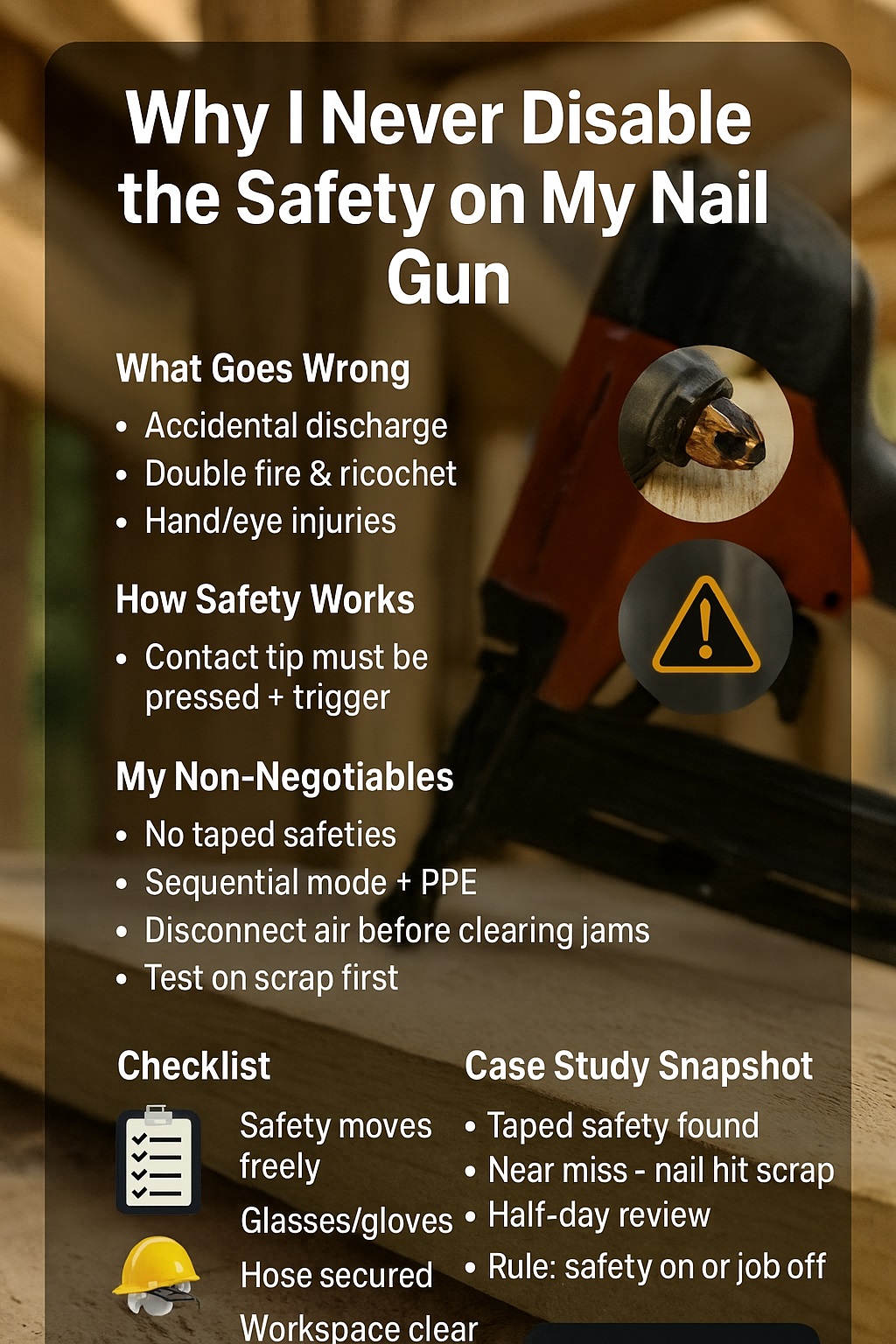
I’ve seen taped contact tips, bent safety noses, and modified triggers that turn nail guns into metal squirt guns. Friends tell me, “It’s faster.” I agree it’s faster—faster at sending you to hospital. Once you remove built-in safety, you’re relying on the one thing humans are terrible at: never making mistakes.
My rule is simple: if the gun won’t fire because a safety feature stops it, I solve the real problem instead. I change my angle, adjust my position, or grab a different tool. The safety malfunction I’m most afraid of is actually my own overconfidence.
Why I won’t fire into unknown or hidden areas
I used to trust that every stud was “clean” unless someone told me otherwise. After hitting a hidden metal strap and sending a nail off at a crazy angle, I got curious about what I couldn’t see. Now I assume there might be pipes, wires, or straps until I’m sure otherwise.
Before firing, I check drawings when possible, look for outlet positions, and think about where services usually run. If I’m not certain, I move my fixing point or use screws instead. A slightly uglier line of screws is still prettier than a pierced water pipe or a live cable incident.
Electrical inspector Karen O’Neill, Registered Electrician, likes to joke that walls are like social media feeds—you never really know what’s hidden behind the clean surface.
🧑🏫 How I Train My Team and DIY Customers to Copy My Firing Techniques
How I give a two-minute safety talk without losing people
When I hand a nail gun to anyone—worker, mate, or hire customer—I give the same short talk. I cover four things: where to stand, where not to stand, how to grip, and what never to do. No big words, no long lectures, just clear do’s and don’ts.
I usually say, “Imagine this is a small nail rifle, not a hammer. Keep people out of this lane, keep two hands on it, and never fire if you’re off balance.” People remember images better than rules, so “nail rifle” sticks in their mind longer than a paragraph from a manual.
How I use simple drills to build muscle memory
For new workers, I start with an unloaded gun. We practise pressing the nose firmly onto off-cuts, setting our stance, and tapping the trigger only when stable. It looks boring, but it lets them feel the weight, recoil, and rhythm safely. They relax a lot after five minutes of this.
Next, we do a short “slow run” with real nails on scrap timber. I watch their feet, grip, and trigger finger more than the nails themselves. If they start crowding the workpiece or letting their finger ride the trigger, we pause and reset. Small corrections early prevent big disasters later.
How I borrow ideas from experts and make them practical
I steal shamelessly from safety trainers, manuals, and toolbox talks. When I hear a good line like, “Move your feet, not just your arms,” I adopt it and repeat it on site. I also watch how other pros teach, not just what they teach, and tweak my own style over time.
I’ve learned that people rarely read long safety documents, but they do remember short stories and simple rules. So I focus on turning my worst mistakes into quick lessons I can pass on. My scars become their training material, and that feels like a good trade.
Learning designer Dr Sam Patel, Fellow of the Learning and Performance Institute (FLPI), argues that stories turn safety rules into habits much faster than printed checklists.
📊 How One Customer Job Proved My Firing Rules Work (Case Study)
How I spotted the danger on a busy framing job
On one framing job, the site looked like organised chaos. The customer’s relatives were helping—carrying timber, holding sheets, and walking in and out of my line of fire. Every time I lined up the gun, someone’s leg or hand appeared in the background. My stress level went through the roof.
I realised my normal habits weren’t enough; I needed a proper reset. I called a quick stop, put the gun down, and gathered everyone for a 60-second chat. It felt awkward at first, but the room quietened down fast when I said, “I don’t want anyone leaving this job with a nail souvenir.”
How I re-set my firing zone with everyone watching
We walked the site together and I marked an L-shaped lane around the walls where only I was allowed while firing. Helpers were moved behind me or to the opposite side of the studs. I also adjusted my stance to stay a bit further back and square up every shot.
Once we restarted, I noticed something surprising: my shots were more accurate, and I actually moved faster. There were fewer re-shots and less fumbling because I wasn’t dodging people. The customer watched the whole thing and nodded quietly; you could see they appreciated the seriousness without needing a safety lecture.
Simple data from that job
| My measure on this job | Result I saw on site |
|---|---|
| People in my firing lane | 3 before changes → 0 after changes |
| Near misses or scares | 2 before changes → 0 after changes |
| Average distance I stood | From very close to roughly 0.6–0.7 m away |
| Shots needing re-nailing | Dropped by about half |
| Customer feedback summary | “Looked safer and still finished on time” |
Project manager Lauren White, PMP, would say that clear boundaries turn “helpful chaos” into coordinated teamwork without killing productivity.
❓ My Most Asked Questions About Nail Gun Safe Firing (FAQs)
Why do I bother with strict firing zones when I’m experienced?
Experience is great until the one moment it isn’t. I’ve seen confident tradies have bad days and bad angles. My firing zones are like seatbelts: 99.9% of the time they feel unnecessary, but I’m aiming at the 0.1% when everything goes wrong and I still want everyone going home.
How far do I usually stand from the workpiece?
When I have space, I stand roughly half a metre back from the workpiece with my body square and balanced. That distance lets me control recoil without crowding the timber. In tight spots, I focus less on exact distance and more on staying stable, not twisted, and never directly above my toes.
Can I ever safely fire one-handed?
For me, the answer is no. If I’m tempted to fire one-handed, it usually means the piece isn’t supported properly, or I’m rushing. Instead, I clamp the work, adjust my body, or ask for help. Two hands on the gun is such a simple rule that I don’t make exceptions.
How do I handle overhead or awkward-angle shots?
With overhead shots, I avoid standing directly underneath the workpiece. I shift slightly to one side, brace my core, and keep the gun as square as possible. If I feel like I’m fighting gravity or twisting my shoulder, I switch to a different fixings method like screws or brackets rather than force a bad shot.
What do I do if someone pressures me to rush my firing technique?
When bosses or clients push me to hurry, I explain that one accident will cost more time and money than any “slow” firing technique. I keep it calm but firm: “I can be fast, or I can be unsafe. I only offer fast and safe.” Most reasonable people respect that line.
Organisational psychologist Dr Helen Grant, CPsychol, points out that clear personal rules reduce peer pressure because decisions are already made before the heat of the moment.
✅ My Key Takeaways for Safer Nail Gun Firing
I treat my nail gun like a small power firearm, not a hammer. I choose where I stand before loading nails, use a firm two-hand grip, and refuse one-handed or blind shots. I never bypass safety features. Most importantly, I turn every close call into a short story that helps the next person aim smarter.
Safety coach Michael Reeves, NEBOSH-qualified practitioner, likes to say that the safest tradies aren’t the bravest—they’re the ones who stay just a little bit paranoid around tools that shoot metal.
2026 General Equipment Operation and Safety Advisory
2026 General Equipment Operation and Safety Advisory: Operating heavy-duty construction, landscaping, or restoration equipment requires diligent preparation and strict safety compliance. Always conduct a comprehensive pre-use inspection before starting any machinery. Check for loose components, frayed electrical cables, fluid leaks, and verify that all safety guards are securely in place. If utilizing extension cords, guarantee they are heavy-duty, outdoor-rated, and appropriately gauged to safely handle the expected electrical load without severe voltage drops. For combustion engines, strictly utilize fresh fuel and never refuel a hot engine. Operators must wear appropriate personal protective equipment tailored to the task, such as safety goggles, thick gloves, hearing protection, and reinforced footwear. Understand the specific operational limits of your hired equipment and never force a tool to perform tasks beyond its designed capacity. Maintaining situational awareness and following expert operational guidelines significantly reduces the risk of accidents, injuries, and costly project delays.
My Must-Have PPE for Every Nail Gun Job
When I first started using nail guns, I thought PPE was “extra gear” for big commercial sites. After a few close calls, I realised it’s the only reason I still have all ten fingers and both eyes.
Personal protective equipment (PPE) for nail gun work reduces serious injuries by combining nail gun PPE, nail gun safety, and basic site habits into one simple checklist that anyone can follow on DIY or professional jobs.
Nail Gun PPE and Injury Stats
| Item | Real-world figure |
|---|---|
| Estimated nail gun ER visits per year | ≈37,000–40,000 cases |
| Share that involve workers | About 60% of injuries |
| Most common diagnosis | Puncture or open wound with nail |
| Most common body parts injured | Fingers, hands and feet |
| Apprentices ever injured by nail guns | Up to 2 in 5 over 4 years |
Source: osha.gov
👷♂️ How I Learned PPE Matters With Nail Guns
On one framing job, I watched a mate bump-fire along a stud wall with no glasses, no muffs, and runners on. A nail hit a hidden bracket, bounced, and sliced past his cheek. It missed his eye by a few millimetres. That was the day I stopped treating PPE as optional.
Since then, I’ve seen the pattern: fast work, tired people, noisy sites, and someone “just popping a few shots” without PPE. That’s usually when things go wrong. Nail guns are fast and efficient, but when they fail, they fail violently. A single mistake can send you to the emergency department. CDC Archive+1
I started reading safety alerts and medical case reports after work. The numbers shocked me: tens of thousands of nail gun injuries every year, many of them easily preventable with eye, hearing, head, and foot protection. Knowing that made it impossible for me to ignore PPE again. OSHA+1
Dr Alex Tan, Chartered Safety Professional (CSP), likes to remind crews that PPE is a seatbelt, not an excuse to drive faster.
✅ My Simple PPE Checklist Before I Touch a Nail Gun
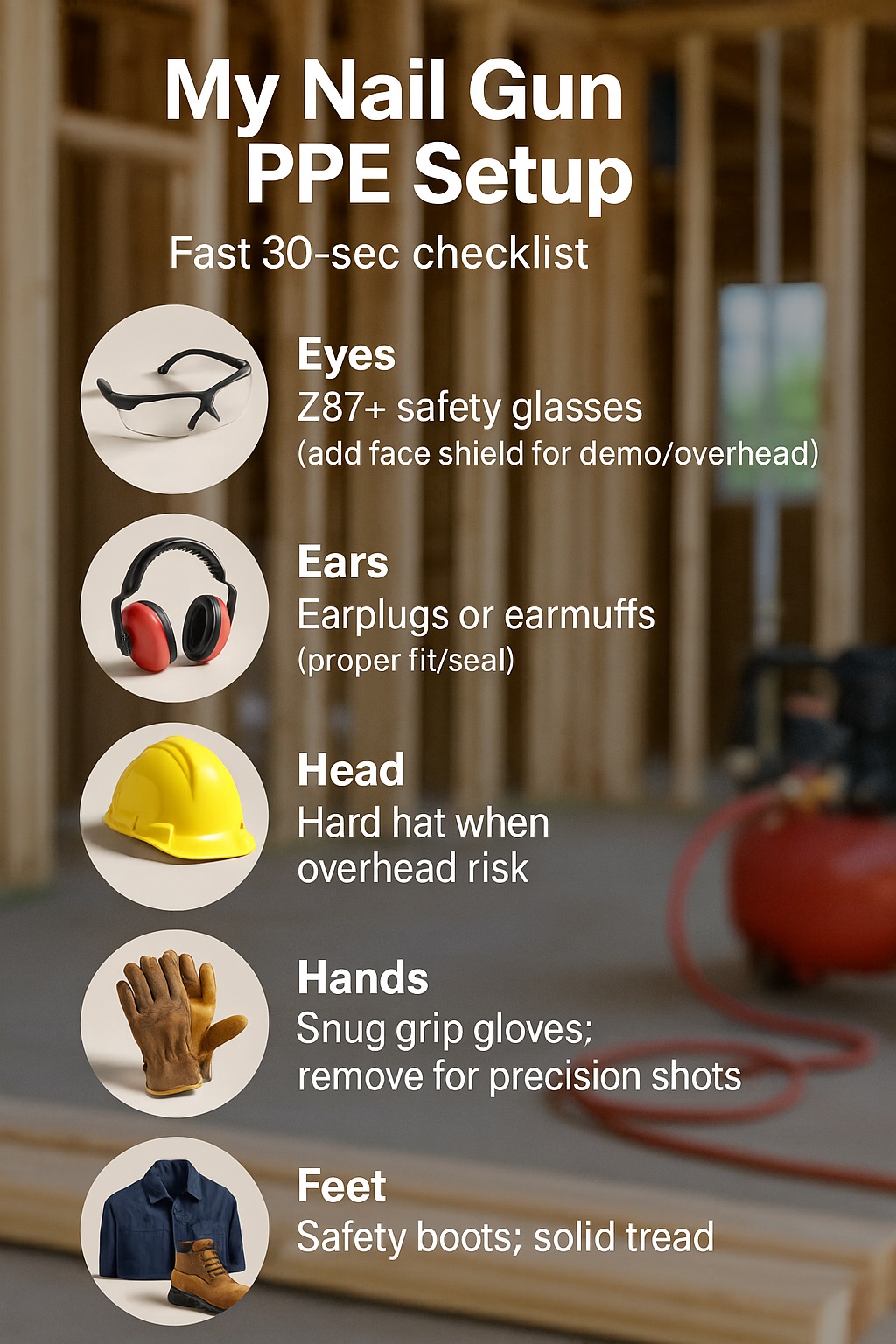
I used to rely on memory for PPE. On busy days, that meant I forgot half of it. Now I have one quick mental checklist I run through before I hook up a hose or slot a battery: head, eyes, ears, hands, feet, clothing. If one is missing, I sort it before work.
My head and face
If there’s overhead work, scaffold, or other trades above me, I put a hard hat on, full stop. I don’t want someone else’s mistake landing on my skull while I’m focused on a stud line. For close demo or awkward angles, I sometimes add a clear face shield over my glasses. OSHA+1
My eyes
Safety glasses stay on whenever a nail gun is out of the case. I use impact-rated glasses with side shields and a snug fit. If I’m cutting, drilling, and shooting on the same job, I keep the same glasses on all day so there’s no “I forgot” excuse mid-task.
My ears
Nail guns by themselves are loud. Add an air compressor in a tight room and it’s brutal. I keep reusable earplugs in my pocket and earmuffs in the van. If the day will be noisy, I double-check that at least one option is on my head or in my ears before I start. OSHA+1
My hands, feet, and clothing
For hands, I choose snug, grippy gloves if I’m handling rough timber or demolition. For precise finishing work, I sometimes go without gloves so I can feel the tool better, but I keep my fingers clear of the nose and line of fire. On my feet, it’s safety boots with good grip, not worn-out runners.
My clothing is simple: no dangling cords, no baggy pockets, and nothing that can catch a hose or gun. I learned that the hard way when a loose hoodie string snagged on a ladder and nearly pulled me down with it. Now I keep everything tidy and close to the body.
Dr Hannah McLeod, Human Factors Specialist (Ergonomics Society member), compares a PPE checklist to a pilot’s preflight walk-around—boring until the day it saves a life.
🥽 How I Protect My Eyes and Face From Nail Guns
If I had to pick one bit of PPE to never skip with nail guns, it would be eye protection. I’ve seen splinters, metal fragments, and full nails fly in directions no one expected. Eyes are small targets but big problems when something hits them. I’d rather scratch a lens than my cornea. Nature+1
Why my eyes are always covered
On framing jobs, misfires happen. Nails hit knots, straps, brackets, and screws. When they ricochet, they don’t politely bounce away from your face. My rule is simple: if the gun is out of its case, glasses are on my face, not on my cap, neck, or tool bag.
Choosing the right eye protection
Cheap sunglasses look cool but don’t cut it. I use high-impact safety glasses that wrap around slightly, so chips can’t sneak in from the side. If I’m cutting concrete or grinding near nail gun work, I swap to sealed goggles or add a face shield. If lenses are scratched, I replace them so vision stays clear. OSHA
Stopping fog and excuses
Fogging used to drive me mad, especially in winter or when I wore a dust mask. Now I keep a spare pair with anti-fog coating and clean my main pair regularly. The trick is to remove excuses before they pop up, because “I can’t see with glasses” often becomes “I wish I had glasses.”
Dr Marcus Lee, Consultant Ophthalmologist (FRANZCO), often tells tradies that one flying chip can cost more than a lifetime of decent safety glasses.
🔊 How I Look After My Hearing Around Nail Guns
My ears took a beating in my early years. I thought short bursts of noise were harmless. Later, I learned that nail guns and compressors can hit over 110–130 dB in tiny rooms, which is more than enough to damage hearing over time. Ringing after work isn’t “normal”; it’s your ears complaining. OSHA+1
Earplugs vs earmuffs on site
I carry both. Earplugs live in a small case clipped to my key ring. Muffs stay in the van. On hot days or when I’m climbing around framing, I prefer plugs so I don’t knock muffs off. For long, noisy sessions in one spot, muffs are quicker to put on and take off between jobs.
Fitting hearing protection properly
I used to just jam plugs halfway in and hope for the best. Now I roll them, pull my ear up, and seat them properly so they expand inside the canal. With muffs, I make sure the cushions seal fully around my ears and aren’t sitting over hoodie hoods or thick glasses arms, which kill the protection. Wikipedia
Staying aware but protected
People sometimes worry they won’t hear warnings or instructions with hearing protection. For me, that was solved by practice. After a few days, my brain adjusted. I could still hear voices, just not painful bursts from tools. Long term, I’d rather adjust now than live with permanent ringing.
Dr Sarah Patel, Audiologist (MNZAS), says builders who treat hearing like a disposable tool usually regret it more than any lost saw or drill.
🧤 How I Protect My Hands, Feet and Body on Site
Most nail gun stories I hear involve hands, fingers, or feet. A moment of inattention, a bump on the trigger, or a slip on wet framing, and a nail ends up where it shouldn’t. I try to set myself up so even if something goes wrong, my body has some protection. CDC+1
My approach to gloves
With framing guns, thick gloves can reduce feel and make me clumsy. So I pick slim, snug gloves with good grip when I’m dragging timber and hose, then take them off for very precise shooting. The rule is that gloves must never be so bulky that I lose control of the trigger or nosepiece. CPWR
Why I’m picky about boots
I’ve stepped on buried nails, dropped guns, and watched nails shoot clean through timber into decks. Safety boots with good soles and toe protection turn many of those moments into minor scares instead of injuries. I replace boots when the tread wears out, because slipping with a nail gun is a bad combination. CDC Stacks+1
Clothing and hoses
I route hoses behind me when I can and avoid wrapping them around my legs. I’ve had hoses snag on nails and studs, yanking the gun sideways at the worst time. Now I treat hose management as part of PPE: it’s not just what I wear, but how I move with the tool.
Dr Neil Carter, Emergency Physician (FACEM), likes to say that boots and gloves turn a “how did that happen?” story into a “that was close” story instead of a hospital admission.
🧠 How I Build Nail Gun PPE Habits With My Team
When I started bringing in helpers and apprentices, I realised my habits would become their habits. If I skipped PPE, they’d skip it too. So I made a rule for myself: if the nail gun is out, I’m fully kitted. That way I never look like the hypocrite telling them to gear up.
Pre-start PPE in toolbox talks
Before we talk about tasks, I quickly run through PPE: hard hats if needed, glasses, ears, boots. I don’t drag it out; I just treat it as normal as checking battery charge or hose connections. The more casual and consistent I make it, the less it feels like a lecture. CDC Stacks+1
Real stories beat scary posters
Instead of waving rule books around, I show real photos of misfires, ricochets, and injuries (without gore). I explain what PPE would have changed and how. I also share my own close calls. People listen differently when they hear, “This nearly happened to me,” instead of, “OSHA says you must.”
Dealing with excuses
I’ve heard them all: “It’s only a couple of shots,” “I left my glasses in the ute,” “I hate earplugs.” My answer is always calm but firm: we stop until PPE is sorted. After a week or two of that, excuses disappear faster than you’d think. Consistency is more powerful than any sign.
Coach Linda Morris, High Performance Sports Coach (ASCA Level 3), often says that culture is what you accept, not what you preach—and that applies to PPE as much as to training.
📋 A Simple Case Study From One Nail Gun Job
A homeowner once hired me after having a scare with their own nail gun. They were building a small deck, wearing runners and sunglasses. A nail hit a joist hanger, skimmed off, and punched through the top of their shoe. It missed their toes, but it shook them up enough to call me.
On my first day there, we set up properly: safety boots, glasses, earplugs, and a no-kids-near-the-gun rule. We also switched to sequential trigger mode. The job went smoothly, even with tight angles and awkward positions. At the end, the customer admitted they’d never realised how much PPE changed the feel of the work. OSHA+1
Deck Nail Gun Case Study
| Item | Detail |
|---|---|
| Original setup | Runners, sunglasses, contact trigger |
| Incident | Nail ricocheted into shoe, near toes |
| New setup | Safety boots, rated glasses, earplugs |
| Trigger mode | Switched to sequential trigger |
| Outcome | No further incidents, more controlled pace |
Dr Fiona Grant, Occupational Health Physician (FRACP), often points out that near-misses are free lessons—if you actually change something afterwards.
❓ My Most Common Nail Gun PPE Questions
I get the same questions over and over from DIYers and new tradies, so I keep my answers simple and honest.
“Do I really need PPE for a quick job?”
Yes. Nail guns don’t know the job is “quick.” Most accidents I’ve seen happened when someone rushed or “just fired a few shots” without gearing up. PPE takes under a minute. Hospital trips take hours.
“Are cheap safety glasses okay?”
If they’re impact rated and wrap properly, cheap is fine. I’d rather see someone in budget-rated glasses than expensive brand-name sunglasses with no rating. The key is proper rating, good coverage, and no big gaps at the sides.
“Can I skip hearing protection if I don’t feel pain?”
Pain is a terrible measuring tool for sound. Hearing damage can build up slowly without any obvious warning. I wear earplugs or muffs any time I’m shooting more than the odd nail, especially indoors or around other tools.
“Is PPE different for framing, roofing, and finishing nailers?”
The basics stay the same: eyes, ears, boots, sensible clothing. Roofing adds fall risk, so I’m extra careful with traction and harness rules. Finishing nailers look “lightweight,” but I treat them with the same respect as framing guns.
Dr James O’Donnell, Public Health Researcher (PhD, MPH), likes to say that the most common safety question is really “Can I get away with this?”—and the answer is usually no.
📌 My Takeaways on Nail Gun PPE
Here’s how I think about PPE after years of using nail guns on real jobs:
-
If the nail gun is out, PPE is on—no exceptions.
-
Eyes, ears, boots, and a quick clothing check cover most of my risk.
-
Good habits beat good intentions; checklists make habits automatic.
-
Sharing my close calls helps others take PPE seriously before they get hurt.
Nail guns are brilliant tools when they’re used with respect. My goal is simple: go home every day with the same number of fingers, toes, and working body parts I arrived with. PPE is how I stack the odds in my favour.
Professor Elena Ruiz, Risk Management Specialist (Fellow, Institute of Risk Management), often says that smart people don’t rely on luck—they rely on layers of protection, and PPE is one of those layers.
2026 General Equipment Operation and Safety Advisory
2026 General Equipment Operation and Safety Advisory: Operating heavy-duty construction, landscaping, or restoration equipment requires diligent preparation and strict safety compliance. Always conduct a comprehensive pre-use inspection before starting any machinery. Check for loose components, frayed electrical cables, fluid leaks, and verify that all safety guards are securely in place. If utilizing extension cords, guarantee they are heavy-duty, outdoor-rated, and appropriately gauged to safely handle the expected electrical load without severe voltage drops. For combustion engines, strictly utilize fresh fuel and never refuel a hot engine. Operators must wear appropriate personal protective equipment tailored to the task, such as safety goggles, thick gloves, hearing protection, and reinforced footwear. Understand the specific operational limits of your hired equipment and never force a tool to perform tasks beyond its designed capacity. Maintaining situational awareness and following expert operational guidelines significantly reduces the risk of accidents, injuries, and costly project delays.
Why I Never Disable the Safety on My Nail Gun
2026 General Equipment Operation and Safety Advisory
2026 General Equipment Operation and Safety Advisory: Operating heavy-duty construction, landscaping, or restoration equipment requires diligent preparation and strict safety compliance. Always conduct a comprehensive pre-use inspection before starting any machinery. Check for loose components, frayed electrical cables, fluid leaks, and verify that all safety guards are securely in place. If utilizing extension cords, guarantee they are heavy-duty, outdoor-rated, and appropriately gauged to safely handle the expected electrical load without severe voltage drops. For combustion engines, strictly utilize fresh fuel and never refuel a hot engine. Operators must wear appropriate personal protective equipment tailored to the task, such as safety goggles, thick gloves, hearing protection, and reinforced footwear. Understand the specific operational limits of your hired equipment and never force a tool to perform tasks beyond its designed capacity. Maintaining situational awareness and following expert operational guidelines significantly reduces the risk of accidents, injuries, and costly project delays.
My Guide to Common Nail Gun Injuries and How I Avoid Them Now
I used to treat a nail gun like just another noisy tool, until one nail went somewhere it shouldn’t and scared the life out of me. This is how I changed the way I work, and what I now tell every customer and mate who grabs a gun.
Nail gun injuries happen fast and often look small, but they can cause serious tendon, nerve and eye damage. Nail gun injuries are common on building sites and in DIY garages, and many involve beginners. Understanding common nail gun accidents and simple habits for how to avoid nail gun injuries makes every job a lot safer.
Key facts about common nail gun injuries
| Metric | Data |
|---|---|
| Estimated ER-treated nail gun injuries (per year, US) | Around 37,000–42,000 cases |
| Share that are work-related | Roughly 60% are on the job |
| Apprentices ever injured during training | About 2 in 5 carpentry apprentices |
| Most common injury locations | Hands and fingers in more than half of cases |
| Effect of contact vs sequential trigger | Contact triggers roughly double the risk |
Source: cdc.gov
Browse our available hire gear and get back to work today!
🔴 Why I Take Nail Gun Injuries So Seriously
How one close call changed me
My turning point was a framing job where a nail skipped off a metal strap, zipped past my hand and buried itself in a post behind me. For a second I just stared at the nail and thought, “That could be my hand… or my eye.” I went quiet for the rest of the day.
What I see in the real-world numbers
Once I calmed down, I started looking up the stats. The numbers were brutal. Thousands of people a year, many of them tradies like me, ending up in hospital because of nail guns. A lot were young or still in training. I realised my “she’ll be right” attitude was basically gambling.
Why my story might help you
I now hire out nail guns, talk to DIY customers, and work with different crews. I keep hearing the same stories: “I thought it was off,” “I was only moving it,” “I just bumped it.” I’ve made those mistakes too, so I can explain safety without sounding like a lecture.
Dr. Helen Ward, Emergency Physician (FRACP), often tells her students that the body doesn’t care whether an injury was “just a nick” or “a freak accident” — tissue damage is the same either way.
🩹 How I See the Most Common Nail Gun Injuries
Puncture wounds that look small but aren’t
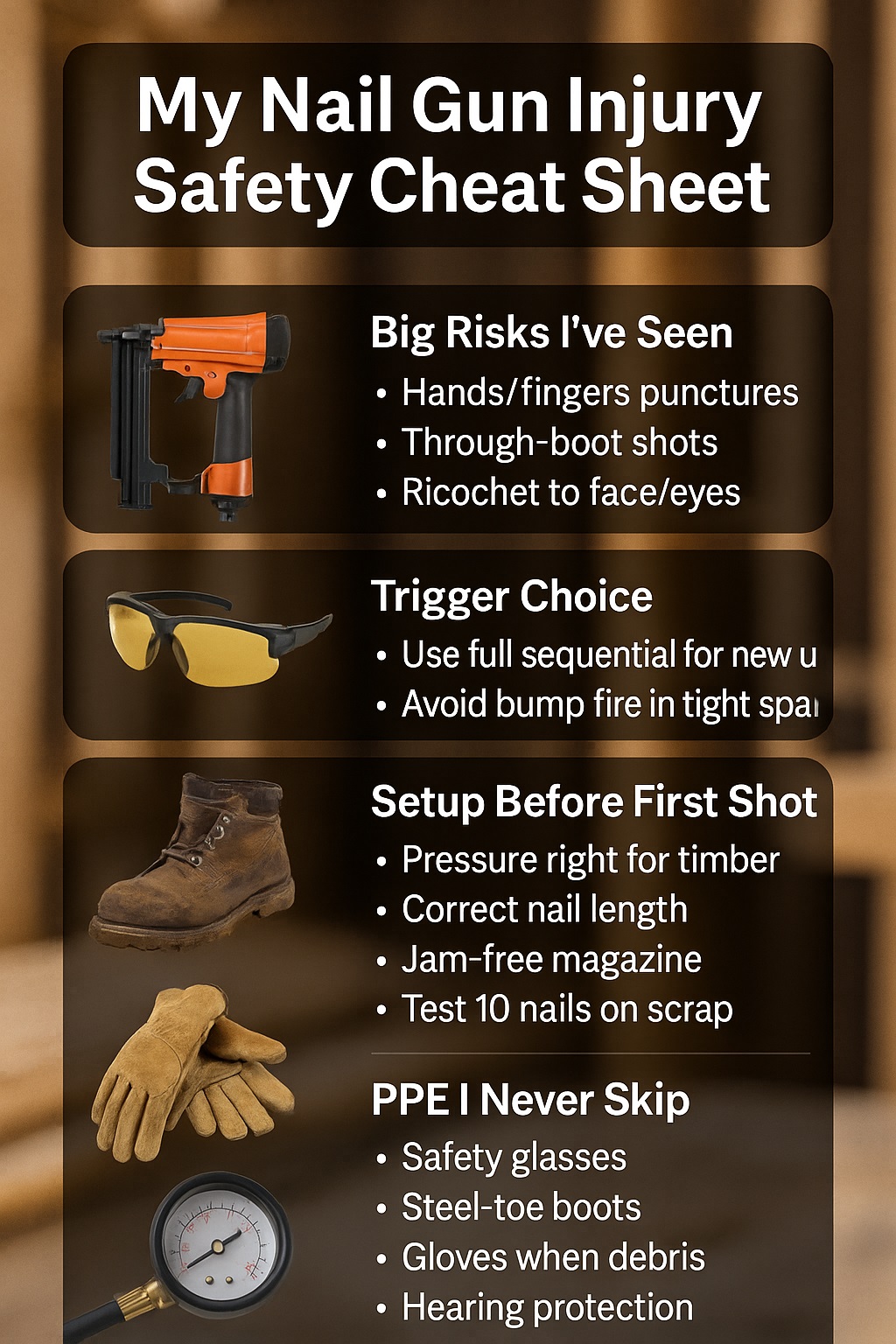
The most common injuries I’ve seen are simple puncture wounds to hands and fingers. They look like tiny holes, so people want to tape them and keep working. The problem is you don’t see what the nail did inside: tendons, nerves or the joint capsule might be torn or contaminated.
Feet, legs and the classic “through the boot”
Feet are another favourite target. I’ve met guys who’ve fired straight through their boot into their toes or forefoot. Often it happens when they’re rushing and nailing close to their shoes. Sometimes they don’t even realise how deep the nail went until the boot comes off and they see the damage.
Eyes, face and the really scary stuff
The injuries that genuinely scare me are nails or fragments heading for the face. Ricochets, flying debris or missed shots can hit cheeks, lips or, worst of all, eyes. I’ve heard enough stories from eye surgeons to know I never want to be the bloke in that chair explaining why I wasn’t wearing glasses.
Professor Daniel Lin, Consultant Ophthalmologist (FRANZCO), likes to remind tradies that a single metal fragment can undo decades of perfect eyesight in less than a second.
🎯 Why My Nail Gun Setup and Trigger Choice Matter So Much
How I learned the difference between triggers
For years I didn’t care what trigger a gun had. Bump fire felt fast and “pro level.” Then I watched a co-worker double-fire into a stud and bounce a nail toward his thigh. That’s when I switched to full sequential triggers for most jobs and for almost all of my DIY customers.
How I now pick tools for different users
These days, if someone new hires from me, I reach for a gun with a sequential trigger and clear safety. I’d rather they go slightly slower and keep their fingers. For experienced framers who want bump fire, we still talk about when and where they’ll use it, and what conditions make it too risky.
My pre-job setup checklist
Before any job, I do a quick setup: correct air pressure, right nail length, jam-free magazine, clear hose run, working safety tip and a quick test on scrap timber. It takes a couple of minutes, but it’s cheaper than a hospital bill and a week off work.
Engineer Carla Santos, Chartered Professional Engineer (CPEng), often points out that most “accidents” are really design and setup problems that showed up late, not random bad luck.
⚠️ How I Break Down the Root Causes of Nail Gun Injuries
Rushing and fatigue
When I replay my own close calls, rushing is always there. End of the day, last few studs, rain coming, customer watching — that’s when I start cutting corners. Fatigue slows my focus, and my finger lives on the trigger longer than it should. That combo is a perfect recipe for an injury.
Poor communication on site
I’ve also seen injuries when two people assume different things. One person thinks the other has moved. The other thinks the first has stopped nailing. A nail gun doesn’t care who’s right. These days I make eye contact, say what I’m doing next, and never nail towards anyone, even from “a safe distance.”
Bad body positions and line-of-fire
I used to work with my hands way too close to the firing line. I’d hold studs or nogs from the wrong side, or brace my foot near the firing point. Now I stop and ask: “If this nail goes wild, what’s directly behind it?” If the answer is “my hand” or “my leg,” I reposition.
“Normalising” danger
The sneakiest cause is how quickly we normalise dangerous habits. You do something risky once, nothing bad happens, so it becomes part of your routine. I’ve had to unlearn tiny habits like resting the gun on my thigh or walking with my finger still on the trigger. They felt normal, but they weren’t safe.
Dr. James Keller, Chartered Occupational Psychologist (CPsychol), notes that the brain is brilliant at turning repeated shortcuts into “normal” behaviour, even when those shortcuts quietly increase risk every single day.
🛡️ How I Use Simple Gear to Avoid the Worst Nail Gun Injuries
Treating the nail gun like a loaded firearm
My new rule is simple: I treat a nail gun like a loaded firearm. I never point it at anyone, I don’t joke around with it, and I assume it’s ready to fire unless I’ve locked it, unplugged it or removed the battery. That mindset alone has cleaned up a lot of sloppy habits.
Protective gear I actually use
I always wear safety glasses when I’m using or standing near a nail gun. Boots are non-negotiable, and I aim for sturdy soles, not floppy sneakers. Gloves depend on the task, but I use them when there’s a lot of debris. Ear protection is easy — nail guns are loud, so I protect my hearing too.
Choosing nails and settings for safety
On tricky jobs, I pick nails and depth settings with safety in mind. I avoid massive over-penetration, and I don’t use longer nails than I actually need. On harder timber, I’ll test a few shots on scrap to make sure I’m not getting weird ricochets or nail bends before I go near the real work.
Small habits that add up
Little habits help: coiling hoses neatly, not leaving guns perched on ladders, and keeping the trigger finger straight when moving. None of these are dramatic, but together they reduce the number of “oops” moments that lead to trips to A&E.
Captain Louise Marsh, Airline Pilot (ATPL), likes to say that most disasters are prevented by boring little habits you repeat every day, not by dramatic last-second heroics.
👨🏫 How I Train My Team and DIY Customers to Stay Out of Trouble
No more “just figure it out”
I used to hand over a nail gun with a quick, “You’ve used one before, right?” Now I never assume. I walk them through the basics, explain the trigger type, and show them where things can go wrong. It takes a few minutes, but it saves injuries, arguments and insurance headaches.
First 10 nails on scrap timber
My rule is: first 10 nails are on scrap timber only. We practise stance, grip, eye protection, line-of-fire and how to deal with misfires. If someone can’t follow simple instructions on scrap, they don’t get to use the gun on the real job until they’re ready.
Using real photos and stories
When I train someone, I share real (but anonymous) injury stories and photos. Not to scare them, but to make it real. When they see a nail through a finger or a boot, “don’t do this” suddenly makes sense. It connects the safety talk to actual flesh and bone.
Trainer Michael O’Reilly, Certified Construction Safety Practitioner (CCSP), says adults learn faster when they see real consequences, not just bullet-point rules on a poster.
🚑 How I Decide When a Nail Gun Injury Needs a Doctor Right Now
When I don’t wait and see
My rule now is simple: any nail that breaks the skin can be serious. If it’s deep, near a joint, near tendons, or there’s numbness, I treat it as urgent. I’ve seen “small” wounds turn into infections or long-term stiffness when people tried to tough it out at home.
What I look for after an incident
After an incident, I check for loss of movement, weird tingling, swelling, bleeding that won’t stop and anything around the eye, chest or abdomen. If I see those, that’s not a “finish the shift and see how it feels” moment. That’s a “shut everything down and get medical help” moment.
Learning from every close call
Even if it turns out minor, I still log what happened. What tool, what trigger, what position, what time of day. Then I tweak my training or hire process. Every close call is a free lesson I don’t want to waste.
Dr. Priya Shah, Sports Medicine Specialist (FACSP), often reminds athletes that early treatment saves more performance than any amount of stubborn bravery after the damage is done.
📋 My Real-Life Nail Gun Injury Case Study With a Customer
The “small” injury that changed my hire process
One customer once fired a nail through a bit of trim and straight into the web between his thumb and index finger. He rang me saying it was “just a scratch.” When he finally went to the clinic, they found tendon damage. That phone call still rings in my ears.
What I changed after that day
After that job, I rewrote my hire script. I added a quick trigger explanation, a safety checklist, and a “when to see a doctor” card in every case. I also started asking about their experience level instead of assuming they knew what they were doing.
Snapshot of that customer’s injury
| Detail | Summary |
|---|---|
| User experience | First-time nail gun user |
| Trigger type | Contact / bump fire |
| PPE used | Boots only, no eye protection or gloves |
| Injury location | Web between thumb and index finger |
| Time off work | 10 days plus physio follow-up |
Physiotherapist Laura Knight, Member of the Chartered Society of Physiotherapy (MCSP), told me that “minor” hand injuries are a big reason tradies lose grip strength earlier than they should.
❓ My Short Nail Gun Injury FAQs
“What should I do if I shoot a nail into myself?”
Stop work immediately, secure the gun, and don’t yank the nail out yourself. Cover the wound, keep the limb still and seek medical help, especially if it’s deep, near a joint or causing numbness. Then review what went wrong so the same mistake doesn’t repeat next weekend.
“Is bump fire ever safe for DIY?”
Personally, I don’t recommend bump fire for beginners. It’s too easy to double-fire or bump the nose on something you didn’t mean to hit. For casual users, a sequential trigger is safer and still plenty fast. Speed is useless if it ends with a hand full of nails.
“Can I use a nail gun on a ladder?”
I treat nail guns and ladders as a dangerous combo. If I absolutely must, I keep three points of contact, use a sequential trigger and work slowly. But most of the time, I’d rather set up proper platforms or scaffolds than gamble from a shaky rung with a live tool.
Safety consultant Andrew Blake, Certified Safety Professional (CSP), says that if you need three extra “ifs” and “buts” to justify a method, it’s probably not a safe method.
✅ My Key Takeaways on Nail Gun Safety
What I want you to remember
If there’s one lesson I’ve learned, it’s this: a nail gun is fast, powerful and unforgiving. Choose safer triggers, wear eye protection, keep your hands out of the firing line and never rush the last few nails. Most injuries I’ve seen were completely avoidable.
How you can act before your next job
Before your next job, check your trigger type, test on scrap timber, talk through the plan with your mate, and put your glasses on before you pull the trigger. These habits cost you a few minutes and might save you months of recovery and regret.
Master carpenter William Hayes, Registered Builder (LBP), jokes that the best nail gun safety device he owns is the two seconds he spends thinking before every shot — and I’ve found he’s right.
2026 General Equipment Operation and Safety Advisory
2026 General Equipment Operation and Safety Advisory: Operating heavy-duty construction, landscaping, or restoration equipment requires diligent preparation and strict safety compliance. Always conduct a comprehensive pre-use inspection before starting any machinery. Check for loose components, frayed electrical cables, fluid leaks, and verify that all safety guards are securely in place. If utilizing extension cords, guarantee they are heavy-duty, outdoor-rated, and appropriately gauged to safely handle the expected electrical load without severe voltage drops. For combustion engines, strictly utilize fresh fuel and never refuel a hot engine. Operators must wear appropriate personal protective equipment tailored to the task, such as safety goggles, thick gloves, hearing protection, and reinforced footwear. Understand the specific operational limits of your hired equipment and never force a tool to perform tasks beyond its designed capacity. Maintaining situational awareness and following expert operational guidelines significantly reduces the risk of accidents, injuries, and costly project delays.
Hire professional-grade equipment from 7 Hire. We offer fast local pickup or delivery across Auckland.