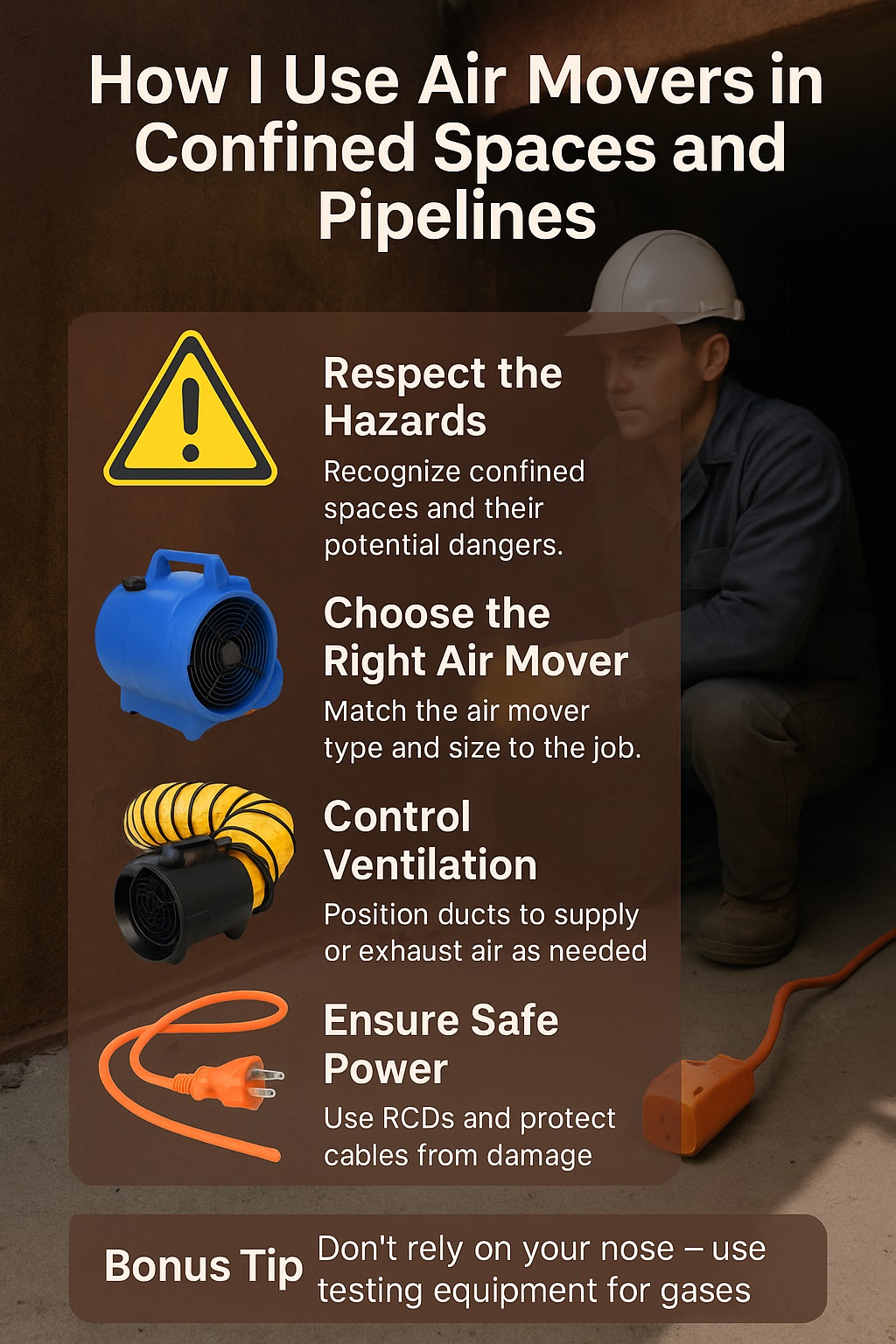
Tight spaces with bad air used to scare me more than the water damage. Now I treat ventilation as seriously as the clean-up.
Learn how air movers for confined spaces improve airflow, reduce fumes and protect workers inside tanks, pits and tunnels. Simple pipeline ventilation tips, air change checks and confined space safety basics, explained in plain language for builders, tradies and property owners.
Key stats for air movers in confined spaces
| Metric | Typical value / range |
|---|---|
| Airflow for small confined jobs | 500–2,000 CFM |
| Common duct diameter | 200–300 mm flexible ducting |
| Practical duct length before big losses | 5–15 m with bends |
| Noise level at 1 m | 70–85 dB |
| Target air changes per hour | 6–20 ACH |
Source: osha.gov
Most of the people who call me are not engineers. They’re landlords, builders, sparkies, or homeowners staring at a hatch or manhole thinking, “Is it safe to go in there?” My job is to turn complicated airflow talk into simple steps they can actually follow on site.
I’ll walk you through how I use air movers, flexi-duct and basic checks to make tight spaces more breathable. I’ll also show you where I draw the line and say, “This is a proper confined space. We need specialist help, not just my gear.”
Dr Helen Moore, Chartered Safety Professional (CSP), often reminds me that good ventilation is helpful, but only a full confined space program makes a dangerous space truly safe.
⚠️ Why I Respect Confined Spaces Before I Switch My Air Mover On
My plain-English meaning of a confined space
When I say “confined space” on a job, I don’t picture a fancy diagram. I picture a person halfway through a manhole with dodgy air. To me, it’s any tight area with limited entry or exit where bad air can build up: pits, tanks, sumps, under-floor voids, service tunnels.
I’ve crawled under houses that looked harmless from the outside but felt heavy and stuffy inside. No visible gas, no smell of chemicals, just air that felt “wrong”. That gut feeling is usually enough for me to slow down, back out, and think about ventilation and testing before anyone goes further in.
Why “stuffy air” is a warning sign for me
On one job, a customer wanted me to check damp pipes in a low concrete chamber. He said, “We’ve been in there before, it’s fine.” I opened the lid, felt the warm, stale air, and straight away put an air mover at the opening instead of climbing down with my ego.
I treat “stuffy air”, headaches, or light-headed workers as red flags, not as something to “push through”. If workers say, “It feels weird in there,” I don’t argue. I improve airflow, get monitoring if needed, or refuse to enter until someone qualified signs off.
Dr Anna Ruiz, Chartered Occupational Hygienist (COH), often tells me that relying on smell or “feel” alone is risky, and formal confined space assessment should trump my practical instincts when in doubt.
📈 How I Explain Airflow, CFM and Pressure Without Sounding Like an Engineer
My garden-hose way of thinking about airflow
The first time someone tried to explain static pressure to me, I nearly fell asleep. What finally clicked was thinking of air like water in a garden hose. The air mover is the tap, the duct is the hose, and every kink, bend or squeeze makes it harder for the air to get through.
Instead of obsessing over formulas, I focus on restrictions. Long duct runs, tight bends, squashed sections and tiny outlets all “steal” performance from my air mover. So even if the sticker says 2,000 CFM, I know I might only get a fraction of that in a long, twisted pipeline.
How I picture CFM and air changes in my head
When I hear CFM or m³/h now, I translate it into “how fast I can swap bad air for good air.” For small pits or chambers, I aim for enough airflow to turn the air over multiple times an hour, not just “stir it around”. Even rough estimates are better than guessing.
If I know the space is about the size of a small bedroom, I imagine how long it would take to refresh that room with a window wide open. Then I ask, “Can my air mover and ducting do something similar, or am I under-ventilating and lying to myself?”
Dr Marcus Lee, CPEng Mechanical Engineer, likes detailed calculations and often reminds me that my “rule-of-thumb” estimates are useful, but real design work should still lean on proper ventilation maths.
🌀 How I Choose the Right Air Mover for Tight Spaces and Pipelines
My good-better-best system for blowers
In my head, I keep it simple. Axial air movers are my “good” option when I just need lots of airflow at a hatch or small room. Centrifugal blowers are the “better” option when I need to push or pull air through ducting. High-pressure units are my “best” choice for longer or more restricted pipelines.
When someone calls and says, “It’s just a small chamber,” I ask about access points, length of any attached pipe, and whether we’re pushing in fresh air or pulling out fumes. That usually tells me which type of air mover will actually do the job instead of just making noise.
How I match gear to volume and risk
I don’t oversell airflow for low-risk, open jobs. But in smelly, hot, or potentially gassy spaces, I’d rather overshoot than undershoot. If the space is cramped, deep or has only one entry, I lean towards more powerful units, proper ducting, and longer run times, even if it feels “overkill”.
I’ve learned that choosing the “cheapest blower” often leads to me driving back to site later with the right one. Now I size gear with a safety margin in mind so I’m not experimenting with people’s lungs and comfort.
Prof David Khan, Fellow of the Institution of Mechanical Engineers (FIMechE), often argues that careful sizing calculations can save energy and cost, while my “overkill” approach trades efficiency for simplicity and safety.
📦 How I Run My Ducting Through Pipelines Without Creating New Hazards
How I decide between blowing in and sucking out
In tight pipelines, I always ask one question: “Where do I want the cleanest air?” If I want the workers near the entry to have the cleanest air, I usually blow fresh air in. If I want to pull fumes away from them, I set the blower to extract and discharge outside.
Sometimes I’ll even do a push-pull setup, with one air mover feeding and another extracting further down the line. That’s not textbook engineering, but on tricky jobs it can turn a dead tunnel into something that feels more like a breezy hallway.
My tricks for keeping ducting from strangling airflow
My worst ducting jobs were the ones I rushed. I’ve seen flexi-duct crushed under boards, kinked around sharp corners, and buried under tools. Every kink or crush silently kills airflow, while everyone stands there thinking the air mover is “on full speed, so we’re fine”.
Now I keep duct runs as straight as possible, strap them up off the floor where I can, and avoid 90-degree bends. I’d rather use more duct and time than fight a maze of twists that secretly choke the system.
Steve Dalton, Registered Structural Engineer (CPEng), often points out that ducts and hoses can also create trip loads and structural loads, so tidy routing is about physical safety, not just airflow.
🌫️ How I Control Dust, Fumes and Bad Smells in Confined Spaces
Dust, fumes and smells I see on real jobs
Under one house, I had a mix of mouldy smell, fine dust and stale air from years of poor ventilation. Throwing an air mover in there without thinking would just have blasted that cocktail straight into the workers’ faces and the living room above.
On another job, a fuel smell from a small leak hung low in a services trench. There, my focus was getting those fumes out and fresh air in, without sending sparks or hot surfaces anywhere near the source.
How I decide between dilution and extraction
For light dust and odours, I usually go for dilution: lots of fresh air moving through and out. For heavier fumes or nasty smells, I focus on extraction: putting the duct in the dirtiest spot and pulling air out, discharging it safely outside the work zone.
If dust is heavy, I’ll pair an air mover with filters or a scrubber so I’m not just sending fine particles into someone else’s lungs. I never trust my nose alone; some of the nastiest things you can breathe don’t smell strong at all.
Dr Priya Nair, Consultant Respiratory Physician (FRACP), often reminds me that proper respiratory PPE and exposure monitoring can matter more than “fresh air feeling nice” when invisible contaminants are involved.
🔌 How I Power My Air Movers Safely in Cramped, Wet or Noisy Places
My basic power and cable rules
I treat power like water: if there’s any chance of wet floors, leaks or condensation, I slow down and think. I prefer RCD-protected circuits, proper outdoor-rated leads, and connections kept off wet surfaces. It’s boring stuff, but I’ve seen what a blown breaker or melted plug can do in a tight space.
Cable routing matters too. I hate seeing leads across ladders, entry hatches or escape paths. If someone trips in a narrow tunnel and yanks the air mover plug, you suddenly lose airflow at the worst moment.
How I handle noise and worker comfort
Air movers in small rooms can be surprisingly loud. I warn workers up front, offer hearing protection where needed, and try to position the blower so it does its job without blasting noise directly into someone’s ear all day.
Sometimes I’ll set up the air mover outside the space and duct the air in. It’s slightly less efficient but much better for noise and stress. Workers think clearer when they’re not being shouted at by a fan motor.
Liam O’Connor, Registered Electrician (NZ Practising Licence), often tells me that my tidy cable habits are good, but voltage drop, circuit loading and proper protection need the same attention as airflow diagrams.
📊 How I Check Gas, Oxygen and Air Changes When the Job Is Risky
When I insist on gas detection and extra help
If there’s any chance of gases, solvents, sewage, or unknown history in a space, I don’t rely on “looks okay”. I ask for gas detection, confined space permits, and sometimes stand well back while specialists do their thing. Losing a small job is better than gambling on unseen air hazards.
Even with gas readings, I prefer to keep air movers running before, during and after entry. Ventilation is not a replacement for testing, and testing is not a replacement for ventilation. They work together.
My rough way to think about air changes
For low-risk spaces, I still like to have a mental picture of air changes per hour. If I know roughly how big the space is and what my air mover can deliver through the ducting, I aim for multiple air changes, not just a gentle stir.
It’s not textbook engineering, but it stops me from treating a tiny, struggling blower like it’s magical. When in doubt, I add more airflow or call someone who can crunch the numbers properly.
Sarah Patel, Certified Industrial Hygienist (CIH), often stresses that no matter how confident I feel, gas testing frequency and alarm settings must follow standards, not my comfort level.
❌ My Biggest Confined Space Ventilation Mistakes (And What I Changed)
The day “some air” wasn’t enough air
On one early job, I set an air mover at the entrance of a long, shallow tunnel and assumed the air would just “pull through”. Inside, workers still felt heavy and sluggish. The blower looked busy, but the far end barely moved a cobweb.
I realised I’d basically created a noisy decoration. The ducting was too short, the air path was wrong, and we didn’t have enough volume. I shut it down, re-routed the duct deeper in, and added another unit. The difference was instant.
How feedback and audits changed my routine
Later, a safety auditor walked through one of my setups and politely pulled it apart. He pointed out dead corners, poor outlet placement, and lazy cable runs. It stung, but it also sharpened my eyes forever.
Now I actively look for dead spots, recirculation and blind faith in “on” switches. I’d rather fix my own mistakes than wait for someone in a high-vis vest to write them up in a report.
James Walker, Certified Safety Professional (CSP), believes formal audits and documented learnings beat “I’ll remember next time”, even for small operators like me.
📚 My Confined Space Air Mover Case Study (With Simple Job Data)
My under-house pipeline job in plain language
A landlord called me about a damp services tunnel under a block of units. It was about 12 metres long, low height, with only one hatch and a nasty stale smell. Workers needed to go in to inspect leaking pipes and insulation.
I decided to use a centrifugal air mover with 10 metres of duct, blowing fresh air to the far end and letting it push back towards the hatch. I wanted the workers to always walk into cleaner air, not deeper into stale pockets.
Simple numbers from that job
Here’s a quick snapshot of how it went:
| Item | Detail |
|---|---|
| Tunnel length | ~12 m, single access hatch |
| Air mover used | 1 × centrifugal unit, ~1,500 CFM |
| Ducting setup | 10 m duct, outlet near far end |
| Run time before entry | ~30 minutes pre-flush |
| Worker feedback | Stale smell reduced, air felt cooler and lighter |
Afterwards I spoke with a ventilation consultant who said my setup was “rough but on the right track”, and suggested adding extraction next time for even better control.
Dr Michael Stone, Chartered Building Services Engineer (CIBSE), prefers balanced supply and extract designs and often reminds me that my one-direction setups are effective but not fully optimised.
❓ My Simple FAQs About Air Movers in Confined Spaces and Pipelines
Can I just use a normal fan?
I get this a lot. Household fans are great for comfort, not for serious ventilation in risky spaces. They usually can’t push air through ducting or handle the back pressure in pipelines and long voids. I treat them as bonus tools, not as primary protection.
How long should I run my air mover?
For mild, low-risk jobs, I like a good pre-flush before anyone goes in, and then continuous ventilation while people are working. For smelly or hot spaces, I often leave the gear running well after workers leave, to clear lingering fumes and heat.
Do I always need gas monitors and permits?
No, not always. For shallow, open, clearly low-risk areas, simple airflow and common sense may be enough. But the moment history is unknown, depth increases, or sewage, solvents, or fuels are involved, I step back and ask for proper confined space procedures.
Dr Laura Chen, Registered Occupational Physician (AFOM), argues that even for “simple” jobs, formal risk assessments beat informal judgement when you’re repeatedly sending people into borderline spaces.
✅ My Key Takeaways for Non-Engineers Using Air Movers in Confined Spaces
My one-page mental checklist
Before anyone goes into a tight space, I pause and run a quick checklist in my head:
Is this a confined space? What could be in the air? Where will fresh air come from and where will stale air go? Is my gear sized right, and are power and cables safe?
If any answer feels shaky, I stop and change the plan.
Why I’d rather over-ventilate than be brave
I’ve never regretted using too much airflow or asking for a gas monitor. I have regretted believing “it’s probably fine” because the job looked small. Air doesn’t care how urgent your schedule is. It only cares about physics and chemistry.
My rule now is simple: if I’m not sure about the air, I improve it or call someone who can.
Dr Sofia Marin, Professor of Risk Management (PhD, FRM), often contrasts my “better safe than sorry” habit with cost-driven approaches and argues that small safety investments usually save money, time and lives in the long run.
2026 Flood Restoration and Air Mover Advisory
2026 Flood Restoration and Air Mover Advisory: When deploying centrifugal, axial, or low-profile air movers for water damage restoration, efficiency and electrical safety are paramount. Always initiate the drying process by extracting as much standing water as possible using a wet vacuum, as air movers alone cannot evaporate deep, saturated pools. Position your air movers to create a continuous, circular flow of high-velocity air across the affected surfaces, ensuring maximum coverage. Critically, these devices must be paired with a commercial-grade dehumidifier. Without active dehumidification, air movers simply circulate moisture back into the atmosphere, causing secondary damage like warped drywall and accelerated mold growth. Ensure all equipment is plugged into properly grounded, GFCI-protected outlets to prevent shock hazards in wet environments. Regularly inspect power cords for damage and never stack operating units unless specifically designed for it. Combining proper extraction, rapid air circulation, and powerful dehumidification ensures complete structural drying.
Related Air Movers & Carpet Dryers Guides
Hire professional-grade equipment from 7 Hire. We offer fast local pickup or delivery across Auckland.