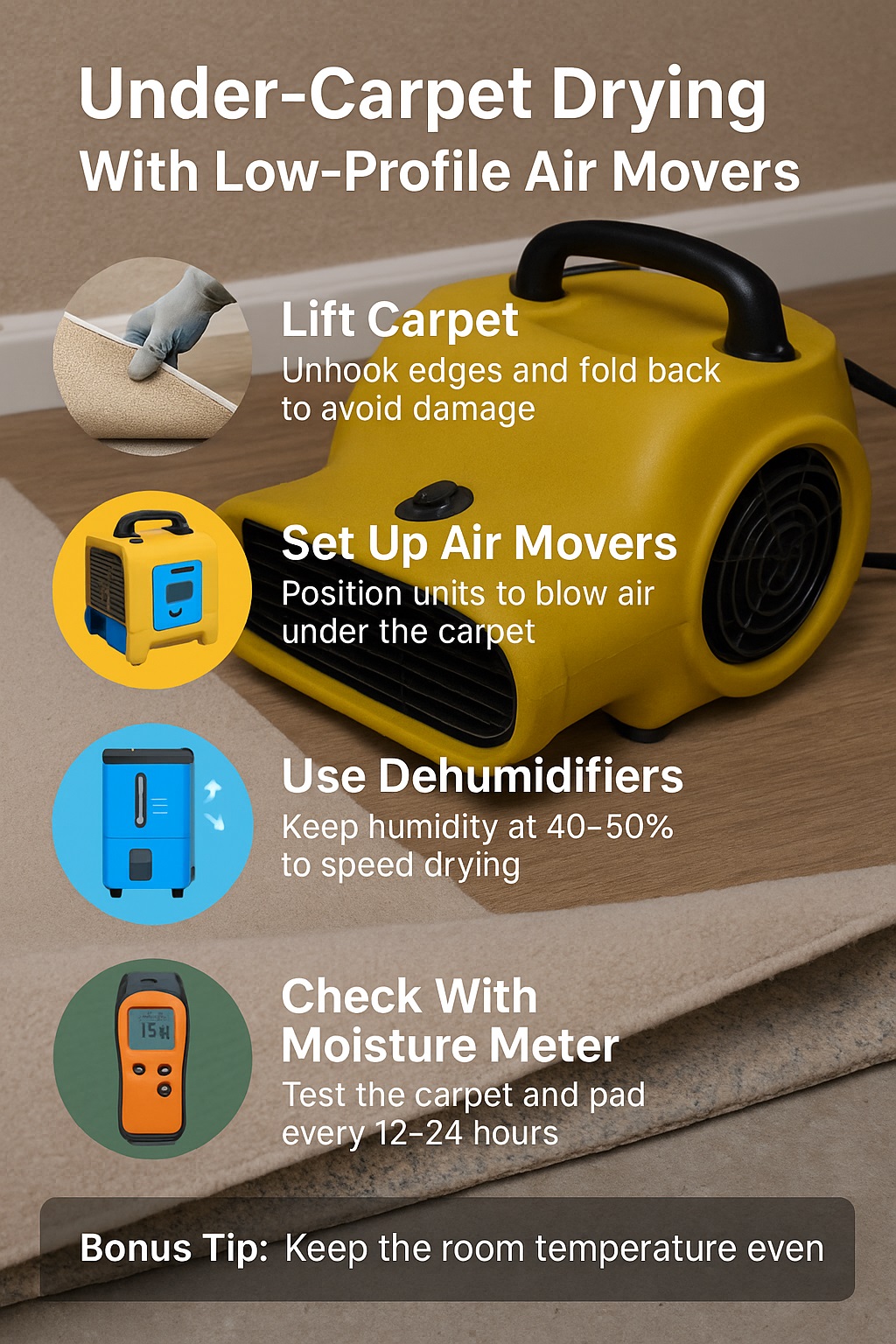
I never planned to become “that guy” crawling under loose carpet with air movers, but a few nasty floods forced me to learn under-carpet drying the hard way.
Fast under-carpet drying with low-profile air movers prevents mould, saves pads, and cuts repair costs. A clear step-by-step process checks wet carpet edges, underlay and subfloor moisture, trimming smell, ripples, and hidden damage within a tight 24–48 hour window.
Key Numbers I Watch for Under-Carpet Drying
| Metric I track | Typical target or value |
|---|---|
| Mold-growth risk on damp carpet | 24–48 hours if left wet |
| Clean-water drying window | 12–48 hours to reach “dry standard” |
| Indoor RH target while drying | 40–50% relative humidity |
| Air mover spacing | ~1 unit per 28 m² (300 sq ft) |
| Dehumidifier to air mover ratio | ~1 dehumidifier per 4–5 air movers |
Source: iicrc.org
🧠 Why I Started Drying Under the Carpet Instead of Ripping It Up
The Old “Rip It All Out” Mindset
When I first started, my answer to a soaked carpet was simple: “We’ll rip it out.” It felt safe, it looked decisive, and no one could blame me for mould later. But customers hated the cost, the mess, and the time without flooring. I realised I needed smarter options, not just safer excuses.
The Job That Changed My Mind
One clean-water burst pipe flooded a lounge, hall, and part of a bedroom. The carpet was good quality, fairly new, and the owner nearly cried when I said “replace everything.” That moment pushed me to research under-carpet drying, low-profile air movers, and in-place restoration so I could at least offer a second option.
From Guessing to Measuring
Back then, I relied on touch and “looks dry.” Now I use moisture meters, relative humidity targets, and clear dry standards. Under-carpet drying became less of a gamble and more of a controlled experiment. I still sometimes recommend replacement, but these days it’s an informed decision, not a default panic move.
Prof. Laura Chen, Chartered Building Surveyor (MRICS), would say that replacing materials without measuring moisture is like demolishing a house just because one window sticks.
🛡️ How I Decide When Under-Carpet Drying Is Safe (and When My Answer Is No)
My Basic Safety Checklist
Before I touch a corner of carpet, I run through a simple checklist in my head:
-
What type of water is this? (clean, grey, or sewage)
-
How long has it been wet?
-
Any visible contamination, silt, or smells?
-
Any vulnerable people living here – kids, elderly, asthma?
If those answers feel wrong, my answer is “no, we replace.”
Water Category and Time Window
If the water is clean and the leak is caught fast, under-carpet drying can work well. If we’re hitting the 24–48 hour mark with warm temps and no airflow, I assume mould is already thinking about moving in. At that point, I’m much stricter and often steer the customer toward more aggressive removal.
Moisture Meters, Not Magic Fingers
I used to “feel” the carpet and guess. Now I check:
-
Carpet surface moisture.
-
Underlay moisture.
-
Subfloor or slab moisture.
If the subfloor is still soaked, I know the job is bigger than it looks from above. Under-carpet drying is great, but it’s not magic. If I can’t get safe readings, I don’t pretend I can.
Dr Michael Grant, Occupational Hygienist (COH), would argue that trusting fingers instead of instruments is like doing air quality checks by sniffing the wind.
🧰 How I Lift Carpet and Place Low-Profile Air Movers Without Wrecking It
The First Time I Mangled a Carpet
The first time I tried to lift a carpet corner, I went in like I was opening a paint tin. I creased the backing, bent the tack strip, and created a ripple that refused to flatten. The carpet survived, but my confidence didn’t. That mistake forced me to slow down and respect the materials.
My Step-by-Step Carpet Lifting Routine
Now my routine is boring but safe:
-
Pick a corner or doorway with easy access.
-
Use the right tool to ease the carpet off the tack strip, not rip it.
-
Gently fold or tent the carpet so it doesn’t crease.
-
Slide the low-profile air mover nozzle under the edge and check it’s not rubbing.
This way I protect both the carpet and my relationship with the customer.
Working With Different Carpet Types
Loop pile, plush, and older carpets all behave differently. Some forgive a bit of rough handling, some do not. I’ve learnt to spend 30 seconds testing how the carpet lifts before I commit. Those 30 seconds often save an hour of trying to fix ripples later.
Alex Rivera, Master Tailor (Guild Member), would say that rushing fabric work is the fastest way to turn a clean line into a permanent crease.
🌬️ How I Set Up Airflow, Dehumidifiers, and Temperature Under the Carpet
Airflow Alone Is Not Enough
I once set up four low-profile air movers in a room, felt very proud of the wind tunnel, and then wondered why it still smelt damp two days later. Humidity was sky high, and I hadn’t added a dehumidifier. I’d basically built a giant hairdryer in a steam room. Lesson learned.
My Simple Drying “Recipe”
These days my under-carpet drying setup usually looks like this:
-
Enough low-profile air movers to push air under the whole wet area.
-
At least one properly sized dehumidifier running continuously.
-
Doors mostly closed to control the environment, with controlled exhaust if needed.
-
Room temperature kept in a comfortable range so evaporation isn’t slowed by cold.
I’m not chasing perfection; I’m chasing predictable, repeatable results.
Moving Dry Air Where I Need It
Sometimes I use ducts or hose to move dry air from one room into another, especially if one area gets too warm or crowded with equipment. This lets me keep air moving under the carpet without roasting the occupants. It’s not fancy engineering; it’s just practical airflow management.
Sarah O’Neill, Commercial Pilot (ATPL), would say that airflow with no plan is like turbulence without a flight path – lots of motion, not much progress.
🚫 Mistakes I Made With Under-Carpet Drying (So You Don’t Have to Repeat Them)
Over-Drying and Carpet Ripples
One time I left air movers on an older carpet for too long without adjusting placement. The backing relaxed, the carpet shrank slightly, and ripples popped up everywhere. The carpet was dry, but I had to organise re-stretching. Technically the job was “finished,” but it didn’t feel like a win.
Forgetting Hidden Corners
Another classic mistake: drying the main area beautifully and forgetting behind doors, wardrobes, and little alcoves. A week later, the customer called about a strange smell in a tiny corner. Now I deliberately hunt for those spots, even if it means crawling around like a lost lizard with a moisture meter.
Not Documenting the Journey
In the early days, I never recorded readings. When an insurer or landlord asked, “How do you know it’s dry?” I had nothing except “trust me.” Now I log start readings, mid readings, and final readings with dates and photos. It protects the customer, and it quietly protects me too.
Emma Blake, Chartered Accountant (CA), would say that a drying job without records is like a business without books – you only know the truth when something goes wrong.
🗣️ How I Explain Under-Carpet Drying Risks to My Customers
Setting Realistic Expectations
When I talk to customers, I don’t promise miracles. I explain that under-carpet drying is a way to save materials and money, but it’s not always guaranteed. I walk them through best-case and worst-case outcomes so they feel involved, not ambushed later if we still find damage.
Simple Language, No Jargon
I avoid words like “psychrometrics” and “vapour pressure.” Instead I say things like, “We’re trying to get the room dry enough so mould doesn’t want to live here.” People don’t need a science lecture; they need to understand the decisions we’re making with their home and their wallet.
Showing, Not Just Telling
I show readings on the moisture meter, let them feel the difference between a wet patch and a dry one, and explain why I still want another 12–24 hours of drying even when the carpet “feels fine.” When they see the numbers, my recommendation stops sounding like guesswork.
Dr Priya Nair, Clinical Psychologist (Registered), would say that clear explanations reduce anxiety the same way good ventilation reduces damp – both keep problems from growing quietly in the dark.
📊 My Real-World Under-Carpet Drying Case Study (With Job Data)
The Lounge That Looked Worse Than It Was
A customer called me after a burst pipe soaked their 4 m × 5 m lounge. Water had run for about six hours. The carpet was modern nylon, and they really wanted to save it. I saw a chance to try careful under-carpet drying with low-profile air movers instead of ripping everything out.
What I Measured and What Happened
Here’s the simple snapshot I recorded for that job:
My Under-Carpet Drying Job Snapshot
| What I measured | Result on this job |
|---|---|
| Room size | 4 m × 5 m lounge, nylon carpet |
| Water source & category | Burst pipe, clean Category 1, ~6 hours |
| Starting pad moisture (average) | Around 40–45% WME |
| After 36 hours of under-carpet drying | Around 12–14% WME, no odour |
| Setup used | 2 low-profile movers + 1 dehumidifier, RH from ~75% to ~45% |
The carpet relaxed slightly but settled back after furniture was re-set. No smell, no staining, and no call-back. That job gave me confidence to offer under-carpet drying as a serious option, not an experimental extra.
Tom Walker, Structural Engineer (CPEng), might argue that one good case study doesn’t prove a rule – but it does prove a method can work when applied with care.
❓ My Quick FAQs About Under-Carpet Drying With Low-Profile Air Movers
Can I Always Save the Underlay Too?
No. If the underlay is crumbling, heavily stained, or has been soaked with dirty or sewage-contaminated water, I usually recommend replacement. When it’s clean water and caught early, I’ll try to dry both carpet and underlay, but I still rely on readings, not hope.
How Long Does Under-Carpet Drying Usually Take?
Most of my clean-water jobs dry within 24–72 hours, depending on how long the leak ran, how thick the underlay is, and how big the room is. I keep equipment running until moisture readings match normal dry areas of the house, not just until it “feels OK.”
When Do I Refuse Under-Carpet Drying Completely?
If I see sewage, heavy contamination, long-standing moisture, or clear mould growth, I don’t bother trying under-carpet drying. I explain why, show the customer what I’m seeing, and recommend safe removal. It’s not fun, but it’s more honest than pretending an air mover can fix everything.
Are Low-Profile Air Movers Very Noisy?
They do make a consistent hum, like a strong fan. I try to position them so bedrooms are less affected at night, and sometimes I shift equipment around between day and night. I warn customers before we start so there are no surprises once everything is running.
Can Homeowners DIY This?
You can try small DIY setups, but if there’s a lot of water, a vulnerable family member, or any doubt about contamination, I always recommend calling someone with proper equipment and meters. Guessing with your family’s health on the line is not a good DIY experiment.
Dr Henry Lopez, Emergency Physician (FACEM), would say that asking the internet to clear a sewage-soaked carpet is like asking it to stitch a cut – sometimes professional help isn’t optional.
✅ My Key Takeaways for Safer Under-Carpet Drying
The Rules I Now Live By
These days I keep a few firm rules:
-
Only try under-carpet drying for the right water and time frame.
-
Always measure, never guess.
-
Balance airflow with dehumidification, temperature, and time.
-
Tell customers the truth, even when the truth is “we need to replace this.”
Knowing When “No” Is More Professional Than “Yes”
Saying “yes” to every job used to tempt me. Now I know that a firm “no” or “this needs replacing” can be the most professional answer. My reputation is worth more than squeezing one extra job out of a carpet that should have been removed on day one.
Adapting My Method to Different Homes
Climate, building style, and budget all change how I set up under-carpet drying. My method is a framework, not a script. If you’re in a different country or climate, take my experiences as a starting point and tweak them to your conditions, not a one-size-fits-all solution.
Dr Sofia Marin, Systems Engineer (PE), would say that copying someone else’s settings without context is like copying their passwords – it might work briefly, but it’s not a long-term strategy.
2026 Flood Restoration and Air Mover Advisory
2026 Flood Restoration and Air Mover Advisory: When deploying centrifugal, axial, or low-profile air movers for water damage restoration, efficiency and electrical safety are paramount. Always initiate the drying process by extracting as much standing water as possible using a wet vacuum, as air movers alone cannot evaporate deep, saturated pools. Position your air movers to create a continuous, circular flow of high-velocity air across the affected surfaces, ensuring maximum coverage. Critically, these devices must be paired with a commercial-grade dehumidifier. Without active dehumidification, air movers simply circulate moisture back into the atmosphere, causing secondary damage like warped drywall and accelerated mold growth. Ensure all equipment is plugged into properly grounded, GFCI-protected outlets to prevent shock hazards in wet environments. Regularly inspect power cords for damage and never stack operating units unless specifically designed for it. Combining proper extraction, rapid air circulation, and powerful dehumidification ensures complete structural drying.
Hire professional-grade equipment from 7 Hire. We offer fast local pickup or delivery across Auckland.