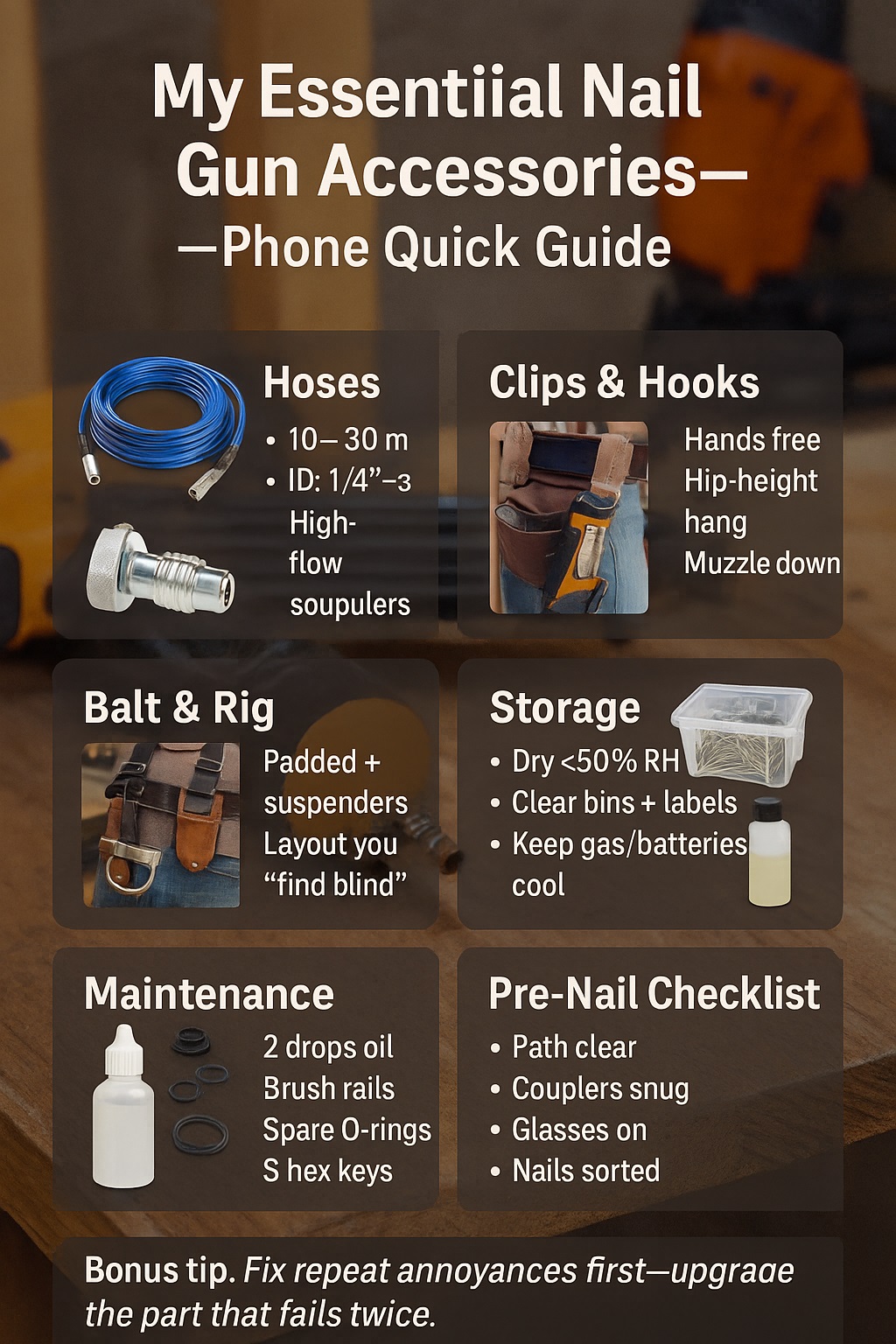
On every build, I learned the right hoses, clips, belts and storage turn a basic nail gun into a smooth, safe work partner.
Essential accessories reduce trips, jams and mess. Quality nail gun accessories, flexible nail gun hoses, secure clips, padded tool belts, and weather-proof storage keep jobs fast, tidy and consistent on busy sites and weekend projects.
Core Nail Gun Accessory Metrics (Quick View)
| Metric | Typical Range / Note |
|---|---|
| Hose length | 10–30 m depending on house size |
| Hose inside diameter | 1/4″–3/8″ for most air nailers |
| Working pressure rating | 90–120 PSI typical; check gun spec |
| Belt load comfort zone | 3–6 kg with suspenders |
| Dry storage humidity | <50% RH; use desiccants in damp garages |
Source: cpwr.com
🔧 My Real-World Introduction to Nail Gun Accessories
How I learned the hard way
My first months with a nail gun were chaos. A stiff hose coiled at my feet. Nails lived in random boxes. I kept one hand full, one hand frustrated. After two close calls and a sore back, I realised accessories aren’t “extras.” They’re the system that makes the gun safe.
The weekend that changed my setup
I borrowed a padded belt, added a swivel clip, bought decent quick-connects, and tossed my cracked hose. Suddenly I stopped walking back to the toolbox every ten minutes. My rhythm improved. The job finished cleaner, faster, and without the end-of-day aches that used to feel “normal.”
What I focus on now
Today I treat hoses, clips, belts and storage as one package. I choose them for flexibility, layout, and weather. I keep spares for couplers and O-rings. I label everything. The result is fewer surprises and a crew that can jump in without asking where anything lives.
Dr. Tessa Moore, CPE (Certified Professional Ergonomist), notes that reducing micro-interruptions with better layout can lower fatigue more than adding raw tool power.
🌀 How I Choose and Set Up My Nail Gun Hoses
Length I can trust—room to move, not to trip
I pick hose length by footprint. Small rooms: 10–15 m. Full frames: 20–30 m with tidy routing. Too short forces tugging. Too long becomes a snake. I avoid sharp bends near fittings, and I protect the first metre with a sleeve so it doesn’t kink against scaffolds.
Getting the size and feel right
For air nailers, 1/4″ ID covers most tasks; 3/8″ helps on long runs to keep pressure steady. I ditch stiff PVC when it’s cold and go for hybrid or rubber hoses that relax and uncoil smoothly. Swivel ends at the tool keep twists down and wrists neutral.
Quick-connects that don’t leak
Cheap couplers whistled away pressure and made the gun misbehave. I changed to high-flow couplers and matched plugs across the fleet. I keep thread sealant in my pouch and re-seat any fitting that weeps. A drop of oil on the plug occasionally keeps connections snappy.
Alex Grant, MEchE, compares flow losses to traffic: small “roads” jam. Larger ID and consistent couplers keep “traffic” moving and the tool predictable.
🪝 How My Clips, Hooks and Swivels Keep Me Moving
Freeing both hands safely
Carrying timber with a gun dangling from my fingers was an accident waiting to happen. A belt hook and a locking carabiner changed that. I hang the gun, climb safely, then re-draw without fiddling. When I set it down, I disconnect air or remove the battery—habit, not heroics.
Hanging height that saves my shoulders
Too low drags my belt. Too high jabs ribs. I hang the hook roughly at my hip hinge. A short lanyard keeps the muzzle down and away when I bend. Swivel mounts stop the body from twisting my belt every time I pick the gun back up.
Dr. Lina Park, PT, DPT, says aligning load near the body’s centre reduces shoulder elevation moments, cutting fatigue and poor lifting mechanics over long shifts.
🧰 How My Tool Belts and Rigs Save My Back and Time
From “brick on my hips” to balanced carry
My first belt had skinny webbing and big ambition. It dug into my hips by lunch. I moved to a wider, padded belt with suspenders. Weight spread across my shoulders and pelvis. I could carry nails, square, tape, and driver bits without feeling like a pack mule.
Layout I can work blind
Framing days: nails on dominant side, square and knife opposite, pencil high and centre, tape measure forward. Finishing days: small pouches, brads, and a trim hammer replace the heavy load. I don’t rearrange mid-day. I set the layout once so my hands find tools without looking.
Upgrade path that won’t break the bank
Start with comfort: belt pad and suspenders. Add pouches with rigid mouths so they don’t collapse. Choose riveted seams, not only stitching. I swap in moulded inserts for sharp items. When pouches tear, I replace the pouch—not the whole rig. Modularity paid for itself quickly.
Kai Morton, CSCS, compares tool belts to weight vests: distribute load across the frame to avoid hotspots, and your “engine” runs longer with fewer stalls.
📦 How I Store My Nail Guns, Nails and Fuel the Smart Way
Moisture is the silent thief
I’ve lost nails to rust and had a gas nailer sulk after a damp weekend. Now everything lives off the floor in labelled bins. I use desiccant packs, vented cases, and a cheap hygrometer. Batteries and gas cartridges stay away from heaters, windows, and summer dashboards.
Clear bins, clear mind
Transparent crates stop the “which box is brads?” dance. I split framing nails by length and coating, keep fuel cells upright, and stash spare drivers and O-rings in a small parts case. On site, a single crate follows me: nails, oil, couplers, hex keys, safety glasses.
Van and garage layouts that work
In the van, heavy bins live low and close to the doors. In the garage, a simple shelf map shows where each bin parks. I leave space for air to move and keep a towel handy to wipe tools before they go home. Damp tools don’t go to bed.
Priya Rao, MBA, applies lean 5S to small trades: sort, set in order, shine, standardise, sustain—storage discipline beats “buying more” every time.
🛠️ My Maintenance Accessories That Prevent Costly Breakdowns
Tiny bottle, big results
A framing gun misfired on a cold morning. Two drops of air tool oil fixed it. Now I keep a small oiler clipped to my belt, plus lint-free cloths and cotton swabs. I wipe nosepieces, clear dust, and oil per manual. Five minutes of care beats an hour of cursing.
Small spares, huge uptime
My kit: spare O-rings, driver blade, filters, piston stops, trigger valve, and the right hex keys. I add a dental pick for O-rings and a soft brush for magazine tracks. If the gun changes sound or recoil, I pause and inspect. Early signals save rebuilds.
Daily and weekly rhythms
Start of day: check couplers, test fire into scrap, confirm depth, oil if required. End of day: blow out dust, inspect fastener strips, wipe rails, store dry. Weekly: deeper clean, check belt hook screws, confirm hose sleeves, and look for cracked fittings. Routine turns luck into predictability.
Evan Shaw, CMRP (Maintenance & Reliability), says small condition-based checks convert “surprises” into scheduled tweaks—the cheapest reliability money can buy.
🎯 How I Match Accessories to Each Nail Gun and Job
Framing vs finishing—two different worlds
Framing wants longer hoses, stiffer pouches, and heavy-duty hooks. Finishing wants compact belts, shorter reaches, and lighter hoses to avoid drag. I separate fasteners by colour-coded bins so the wrong strip never lands in the wrong gun. Matching accessories to task keeps both speed and finesse.
Indoors, outdoors, and weather
Indoors I route hoses along walls, not across walkways. On roofs I anchor hose runs and use anti-kink sleeves near edges. In winter I prefer hybrid hoses that don’t freeze into hoops. In summer I shade storage and keep batteries cool, because hot packs slow down in the afternoon.
Budget where it matters
Spend on comfort (belt and suspenders), flow (hoses and couplers), and safety (glasses, lanyards). Save on bins and labels—cheap, effective, and easy to replace. I track what fails first. Anything that breaks twice gets upgraded. It’s not fancy; it’s the fastest way to stop repeat pain.
Dr. Omar Hadi, PE, frames it like bridges: invest where loads concentrate—connections and supports—because that’s where failures cascade.
👥 How One Customer Transformed Their Setup With My Help (Case Study)
What I walked into
A solid nailer, flimsy hose, no belt, and nails scattered between a van and a paint bucket. The crew kept pausing to find things. Hose loops wandered through walkways. We mapped movements, counted trips, and timed breaks. Most delay came from searching, not from the tool itself.
Before & After—Simple Site Upgrade Results
| What we measured | What changed |
|---|---|
| Walks to van for nails/tools per day | From many to a single planned restock |
| Gun downtime from jams | Reduced after high-flow couplers, oil, and cleaning kit |
| Tripping near misses in two weeks | Eliminated by wall-line hose routing and hooks |
| Setup time each morning | Shortened with labelled bins and set belt layouts |
| Crew focus | Sharper—less chatter about “where’s the…?” |
The new normal
We added a padded belt with suspenders, a swivel hook, 20 m hybrid hose, labelled bins, and a tiny maintenance kit. By week two, framing finished earlier than their last similar job. Morale jumped. The gun felt “new” because the system around it finally matched the work.
Hannah Cole, PMP, notes that most gains come from flow, not heroics: shorten hand-offs, standardise kits, and the schedule thanks you.
❓ My Nail Gun Accessory FAQs
What should I buy first if money is tight?
Start with comfort and flow: padded belt with suspenders, 1/4″ hybrid hose, reliable high-flow couplers, and clear storage bins. Add safety glasses and a small oiler. Those pieces remove pain you feel every minute, not once a month.
How long should my hose be?
Small rooms: 10–15 m. Whole frames: 20–30 m with tidy routing and sleeves near edges. If you constantly tug the gun or step loops, your hose is wrong—length, stiffness, or path. Adjust one variable at a time so you know what fixed it.
How do I stop hose tangles?
Use swivel ends at the tool, route along walls, and add temporary hooks or tape at door frames. Avoid tight coils. Keep the first metre protected with a sleeve. If the hose fights you, replace it—wrestling costs more than a better line.
What belongs in a daily maintenance pouch?
Air tool oil, lint-free cloth, small brush, hex keys, spare coupler, a few O-rings, and safety glasses. Five minutes at start and finish keeps depth consistent and jams rare. Don’t over-oil; follow the manual for your specific gun.
How do I store nails and fuel safely?
Keep them dry, labelled, and off the floor. Control humidity with desiccants. Keep gas cells and batteries cool and away from heat sources. Transport upright in bins with lids. Wipe tools before they’re put away. Damp gear grows problems overnight.
Dr. Mei Alvarez, CIH (Industrial Hygienist), reminds that controlling moisture and heat prevents both corrosion and unpredictable tool behaviour, which are safety issues, not just convenience.
✅ My Key Takeaways on Nail Gun Accessories
The gun is only half the story
My biggest gains came from hoses, hooks, belts and storage. When those clicked, the gun felt smoother, my posture improved, and the site flowed. Accessories aren’t shiny toys—they’re the guardrails that keep speed and safety aligned.
A simple pre-nail checklist
Hose path clear, couplers snug, belt balanced, glasses on, nails sorted, oiler handy, storage dry. Thirty seconds before the first shot saves thirty minutes later. I stick that checklist on the inside of my crate lid so every helper sees it.
Start small, upgrade smart
Fix the constant annoyances first. When an item fails twice, buy it once—properly. Keep spares for the tiny parts that stop the day. Your future self will thank you when the gun fires, the belt rides easy, and the hose behaves like a partner.
Prof. Daniel Wright, PhD (Human Factors), says the best systems disappear: when layout, comfort, and flow are right, attention returns to the craft—not the gear.
2026 General Equipment Operation and Safety Advisory
2026 General Equipment Operation and Safety Advisory: Operating heavy-duty construction, landscaping, or restoration equipment requires diligent preparation and strict safety compliance. Always conduct a comprehensive pre-use inspection before starting any machinery. Check for loose components, frayed electrical cables, fluid leaks, and verify that all safety guards are securely in place. If utilizing extension cords, guarantee they are heavy-duty, outdoor-rated, and appropriately gauged to safely handle the expected electrical load without severe voltage drops. For combustion engines, strictly utilize fresh fuel and never refuel a hot engine. Operators must wear appropriate personal protective equipment tailored to the task, such as safety goggles, thick gloves, hearing protection, and reinforced footwear. Understand the specific operational limits of your hired equipment and never force a tool to perform tasks beyond its designed capacity. Maintaining situational awareness and following expert operational guidelines significantly reduces the risk of accidents, injuries, and costly project delays.
Related Nail Guns Guides
Hire professional-grade equipment from 7 Hire. We offer fast local pickup or delivery across Auckland.