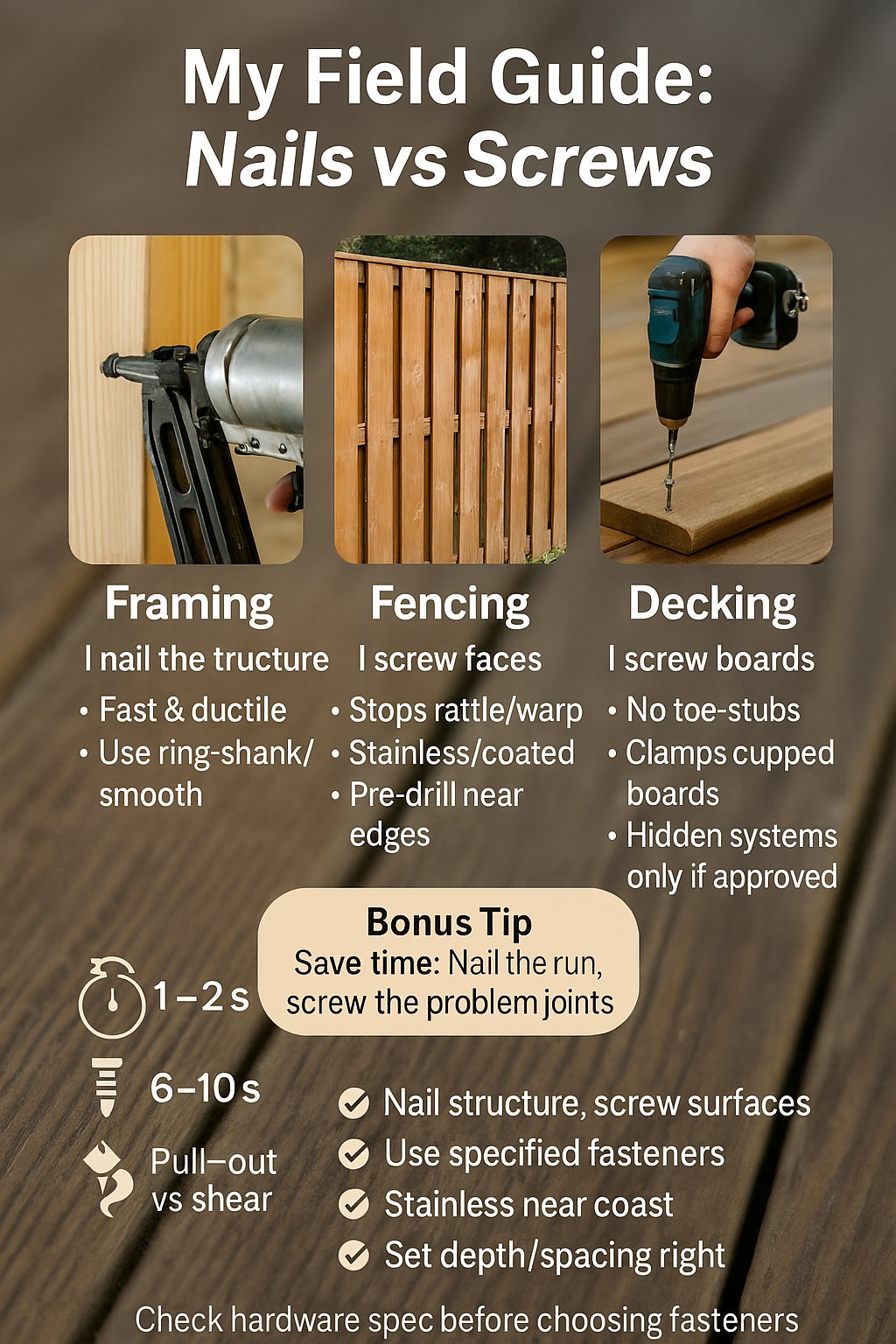
On real jobs, the quiet choice between nails and screws decides whether a build flies or fights me months later.
Nail gun vs screws affects speed, code checks, and long-term movement in framing fencing decking projects. This guide compares cost, holding power, and durability so builders and DIYers pick the right fastener. Expect clear rules, on-site lessons, and simple phone-friendly tables.
Phone-Friendly Stats: Nail Gun vs Screws
| Metric | Typical Result |
|---|---|
| Install speed per fastener | Nails ≈ 1–2s with gun; screws ≈ 6–10s |
| Cost per connection | Nails cheaper; structural screws pricier but fewer needed |
| Shear vs pull-out | Nails win shear; screws win pull-out |
| Best indoor structural | Nails for framing; screws for connectors/repairs |
| Best outdoor finishes | Screws for deck boards & fence palings |
Source: fastenmaster.com
🔧 My Simple Rule for Nails vs Screws
Why this matters now
I learned the hard way that “fast today” can mean “fix tomorrow.” My baseline: nail the structure where ductility and speed matter; screw the details where movement and serviceability matter. If a joint needs clamping force or later removal, I reach for screws. If the joint needs energy absorption and rapid production, I grab the nailer.
When nails win
Nails shine in repetitive framing: studs, plates, rafters, and sheathing. They’re ductile in lateral loads, forgiving under impact, and lightning fast across long walls. A good ring-shank or properly sized smooth shank in the right pattern beats over-engineering with random screws that slow me down and don’t improve the result.
When screws win
Screws clamp warped timber into line, stop deck boards from creeping, and let me reverse mistakes. Structural screws save me time where old-school bolts would be slow: ledgers, sistering repairs, and brackets that specify screw options. Outdoors, screws stop nuisance squeaks and nail pop-ups that annoy customers (and toes).
“Different failure modes demand different fasteners,” notes Elena Ruiz, PE (Structural Engineer).
🧰 How I Use My Nail Gun on Framing
Speed on studs and plates
Standing walls alone, my framing nailer is the difference between noon and night. I mark, tack, and fly. Toe-nailing feels natural, and I can set patterns without breaking rhythm. For subfloors and sheathing, the gun keeps spacing uniform so the whole assembly shares load instead of concentrating stress.
Mistakes I stopped making
I used to over-drive nails and crush fibres, especially with soft timber. Now I set depth so heads sit flush, not buried. I also watch angles on toenails; too steep and they split, too shallow and they don’t bite. If a nail misses, I back it out and renail—don’t “add another” and hope.
Nail types that actually help
Ring-shank nails hold brilliantly in softwoods and treated lumber; hot-dip galvanised or stainless outdoors stops corrosion bleed. For interior framing, smooth shank is fine if the schedule and spacing are right. Paper-collated nails feed cleaner in cold weather; plastic can shatter and cause jams when it’s chilly.
“Control technique, then choose the fastener,” says Mark Bennett, NZCB (Licensed Building Practitioner).
🪚 Why I Reach for Structural Screws
Pulling twisted timber straight
Screws act like clamps. If a stud bows or a joist crowns, I can draw it into alignment without bar clamps. Where nails bounced and left a gap, two properly spaced structural screws pull it tight and stay tight through seasonal movement.
Repairs and connectors
In retrofits, screws are my friend. Ledger fixes, bracket replacements, and sistering joists go faster when I can drive from awkward angles. I follow manufacturer specs on diameter, length, and edge distances. Structural screws with ETA/ICC-style approvals (or local equivalents) tell me I’m not guessing.
When screws are a bad idea
I don’t screw whole walls together. It’s slow, and the frame loses the ductility nails provide in racking events. I also avoid cheap drywall or general-purpose screws in structural roles; the heads snap and the shanks are brittle. If it’s structural, it needs a structural screw—or a nail.
“Use clamping where stiffness rules; use ductility where energy dissipates,” notes Priya Shah, CEng MICE.
🧱 How I Decide on Framing Day
My decision checklist
-
What forces dominate—shear or pull-out?
-
Is removal or adjustment likely later?
-
Does the connector specify fasteners?
-
Indoor vs outdoor exposure?
-
Crew size and schedule pressure?
Typical wall/floor choices
I nail plates to studs and joists to beams where allowed, then switch to specified nails or approved screws for hangers and brackets. Subfloor: nails for speed, with screws to quiet hotspots that still talk after adhesive cures. Stairs and tall walls: I follow the hardware schedule to the letter.
Talking with inspectors
I keep packaging or spec sheets handy. If a hanger calls for 10d nails or a specific screw, I don’t mix and match. When in doubt, I over-document with photos showing fastener heads and spacing. Good records prevent “open it back up” conversations.
“Compliance is a system, not a vibe,” reminds Sarah Collins, MRICS (Chartered Building Surveyor).
🚧 What Changed in My Fencing Jobs
Nails that looked fine—then didn’t
My early fences were nailed and fast. A summer later, palings cupped and the nails walked out just enough to rattle in wind. Re-nailing didn’t last; wood movement kept winning. Customers noticed the chatter before I did.
Screws that stayed quiet
Switching to exterior-rated screws on palings and rails kept faces flat and quiet. I still nail posts and some rails with ring-shank nails for speed, but I’ll screw the visible faces where movement shows. Stainless near the coast saves me call-backs for rust lines and stained timber.
Simple fence rules I follow
-
Nail posts and rails if time is tight.
-
Screw palings and gates for adjustability.
-
Use coatings or stainless depending on exposure.
-
Pre-drill close to edges to prevent splits.
-
Respect expansion gaps on long runs.
“Movement control beats brute force outdoors,” says Hannah O’Neill, CPEng (Materials Engineer).
🪵 Why My Deck Boards Almost Always Get Screws
The toe-stub lesson
My first nailed deck looked great on day one. By spring, a few nails crept up and turned into toe-stubs. I swapped them for deck screws and stopped the pop-ups. Since then, I screw every board; the clamping action resists cupping and seasonal lift.
Hardware where nails still rule
I still nail much of the deck framing, then follow the ledger/hanger spec exactly—often nails in hangers, sometimes proprietary screws where allowed. For posts and rails, I use the hardware schedule rather than “looks strong.” On picture-frame borders, screws let me tweak alignment with micro-adjustments.
Hidden systems I actually like
Hidden fasteners are clean, but not all systems are equal. I use them where the deck board manufacturer approves them. If the timber is dense or wet-treated, I prefer face-screwing with colour-matched heads or plugs; it’s serviceable, and boards come up without drama for repairs.
“Serviceability is worth more than neatness you can’t maintain,” notes Lucas Meyer, AIA (Registered Architect).
✅ Safety, Codes and Inspections I Don’t Mess With
Read the schedule, not the forum
Hangers, straps, post bases, and brackets specify exact nails or approved screws. Mixing fasteners or swapping lengths changes performance. I install what the schedule says, keep the box for the inspector to see, and take photos before cladding hides the hardware.
Corrosion and treated timber
CCA/ACQ-treated wood eats the wrong coatings. Outdoors I use hot-dip galvanised or stainless screws and nails. Around pools, coastal sites, or chemically aggressive environments, I default to stainless. It’s cheaper than replacing a brown, rust-streaked deck two winters from now.
Penetrations and edges
Edge distances and minimum penetrations matter. A screw that’s 10 mm too short or a nail placed too near an edge can halve the connection’s value. I mark, pilot where needed, and slow down for the tricky ones. Clean, repeatable technique beats adding “just one more.”
“Corrosion and edge distance failures are preventable,” says Olivia Tran, PhD (Building Materials Scientist).
💸 Cost, Speed and Fatigue My Body Feels
Time is the hidden cost
A nailer turns a long wall into minutes, not hours. Screws are deliberate and precise but slower. I budget screws for the joints that benefit from clamping or future access, and nail the rest. That balance keeps labour down without giving away longevity.
Fatigue and tool choices
All-day screwing with a heavy impact driver wears forearms and elbows. Hoses and compressors add their own hassles but let me move faster. Cordless nailers are great for punch-lists, heavier for framing marathons. I plan sequences so the right tool shows up at the right moment.
“Ergonomics compounds across a build,” notes Daniel Park, PT, DPT (Physical Therapist).
📊 Case Study: How My Customer’s Wobbly Deck Changed My Rules
What I found
A mid-age deck looked fine from the lawn, but felt spongy near the door. Nails were over-driven at some joists, a few had walked up, and the ledger used random screws without washers. Rail posts wobbled because fasteners didn’t match the bracket spec.
What I did
I left sound framing nails in place, added structural screws where clamping helped, replaced the ledger fasteners to spec, and re-fastened boards with coated deck screws. The goal wasn’t “all screws”; it was “right fastener, right place,” and stop the seasonal movement that made the deck noisy.
Before vs After (phone-friendly)
| Before | After |
|---|---|
| Board lift at two bays | Boards flat, no lift |
| Squeaks near threshold | Quiet under foot traffic |
| Random ledger screws | Spec’d structural fasteners |
| Wobbly corner post | Solid post, bracket to spec |
| 2 call-backs in 1 year | 0 call-backs in 18 months |
“Diagnose, then standardise the fix,” says Maya Reed, PMP (Construction Project Manager).
❓ My Quick FAQs
Can I use only screws for house framing?
You can, but you’ll be slow and may lose ductility where nails excel. Use nails for most framing, and use structural screws where specs allow and clamping helps, like ledgers or repairs.
Are nail-gun nails as strong as hand-driven nails?
Yes—if length, diameter, and placement match the schedule, and depth isn’t over-driven. The installer matters more than the hammer.
Which fasteners are best for fence palings?
Exterior-rated screws. They clamp against cupping, resist walk-out, and are easy to replace. I still nail posts/rails for speed.
What screws should I use near the coast or pool?
Stainless steel. Corrosion beats cheap coatings quickly in salty or chlorinated environments.
Do hidden deck fasteners work?
Some do, when the board manufacturer approves them. Dense timbers may behave better with face-screws and plugs for reliable service.
“Answer the use-case, not the trend,” notes Rory Adams, LEED AP (Building Consultant).
🎯 My Takeaways You Can Screenshot
-
Nail the structure, screw the surfaces. Nails for speed and ductility; screws for clamping, serviceability, and quiet.
-
Follow the hardware schedule exactly. Don’t substitute fasteners in hangers, ledgers, or brackets.
-
Outdoors, screw visible surfaces. Use coated or stainless; near coasts, go stainless by default.
-
Fix technique first. Correct depth, spacing, edge distance, and pilot holes where needed.
-
Balance labour vs longevity. Use screws where they add value, not everywhere by habit.
“Clarity beats tradition—document your standard,” says Nina Patel, C.Build E MCABE.
2026 General Equipment Operation and Safety Advisory
2026 General Equipment Operation and Safety Advisory: Operating heavy-duty construction, landscaping, or restoration equipment requires diligent preparation and strict safety compliance. Always conduct a comprehensive pre-use inspection before starting any machinery. Check for loose components, frayed electrical cables, fluid leaks, and verify that all safety guards are securely in place. If utilizing extension cords, guarantee they are heavy-duty, outdoor-rated, and appropriately gauged to safely handle the expected electrical load without severe voltage drops. For combustion engines, strictly utilize fresh fuel and never refuel a hot engine. Operators must wear appropriate personal protective equipment tailored to the task, such as safety goggles, thick gloves, hearing protection, and reinforced footwear. Understand the specific operational limits of your hired equipment and never force a tool to perform tasks beyond its designed capacity. Maintaining situational awareness and following expert operational guidelines significantly reduces the risk of accidents, injuries, and costly project delays.
Hire professional-grade equipment from 7 Hire. We offer fast local pickup or delivery across Auckland.