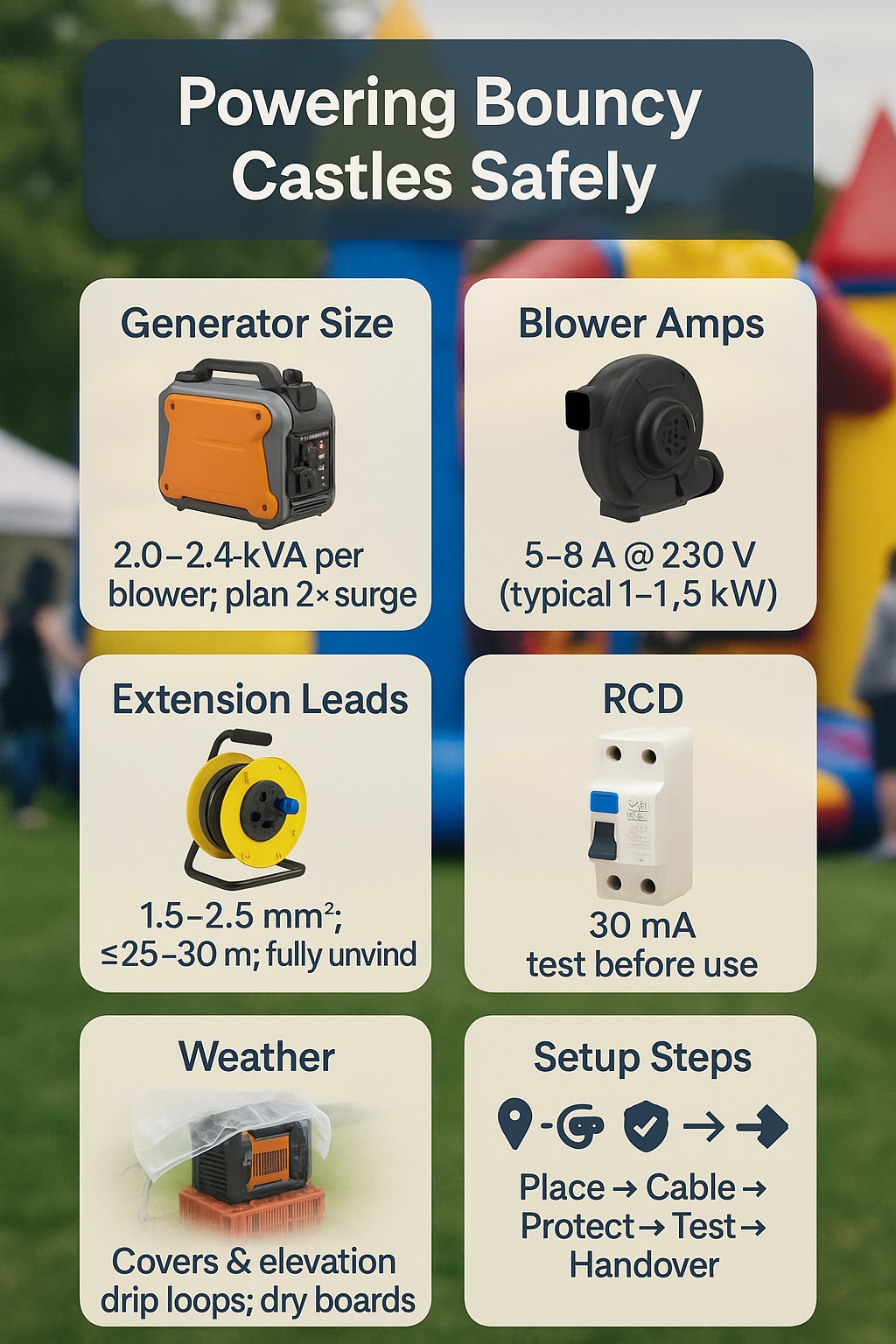
My Safe Power Plan for Bouncy Castles
Here’s how I power inflatables safely without drama.
Safe generator hire for bouncy castles depends on sizing, cabling, and protection. Typical 1–1.5 kW blowers draw 5–8 A at 230 V and can spike on startup. I plan for clean power, dry placement, and easy supervision, so the only “surprises” are happy kids and cake.
Plan capacity with headroom. I allow roughly 2.0–2.4 kVA per blower, account for 2× surge, and keep cables short and chunky. I prioritise generator hire with stable, low-THD output, confirm bouncy castle blower amps on the nameplate, and test RCD safety before guests arrive. The goal: steady pressure, zero trips, big smiles.
Quick Stats for Bouncy Castle Power
| Topic | Typical figure |
|---|---|
| Blower current (230 V) | 5–8 A per 1–1.5 kW blower |
| Startup surge | ≈ 2× running amps for 0.5–2 s |
| Recommended generator | 2.0–2.4 kVA per blower (pure sine preferred) |
| Extension lead spec | 1.5–2.5 mm², ≤ 25–30 m, fully unwound |
| RCD protection | 30 mA trip; test before use |
Source: worksafe.govt.nz
🔎 My Quick Safety Checklist
What I’ll cover:
-
Site scan and ground conditions
-
Power math (amps, surge, headroom)
-
Protection (RCDs, weather covers)
-
Proving the setup with live tests
Site scan and set-out
I walk the area first. I avoid puddles, slopes, and tight walkways, then place the castle with clear entry and exit. I mark a generator zone 7–10 m downwind, on dry ground, with exhaust pointing away from people. Cords run along fence lines or taped paths—no trip lines through the party.
Power math and proof test
I read blower plates (kW, A), convert to kVA, then add 20–30% headroom. I test the blower, then yank the RCD test button to confirm it trips and resets cleanly. If I’m adding lighting or a speaker, I check wattage and split loads so a nuisance trip doesn’t end the fun.
Dr. Lara Singh, CPEng (Engineering New Zealand), notes that a small diesel with AVR can outperform bigger sets if voltage regulation beats surge better under short cable runs.
🧮 I Size the Generator Right
What I’ll cover:
-
Nameplate-to-kVA method
-
Surge allowance and diversity
-
Headroom for heat and age
-
Mixed loads (lights, pumps, speakers)
Nameplate to kVA made easy
If the blower says 1.1 kW and 6.4 A at 230 V, I sanity-check both. kW ÷ power factor (≈0.9) gives kVA; amps × volts confirms the story. I choose an inverter or tightly regulated set for smooth output—especially if the castle vendor brings a modern variable-speed blower.
Surge and headroom that save the day
Blowers gulp current for a second then settle. I budget roughly 2× surge and 20–30% headroom so voltage won’t sag. With two blowers, I split across sockets/circuits. If loads are borderline, I step up one size; the quiet reliability pays for itself in zero trip-outs.
Alex Romero, CEng MIET, argues that oversizing by 40% can reduce thermal stress and extend generator life, even if it feels conservative on paper.
🔌 My Extension Lead Rules
What I’ll cover:
-
Cable gauge vs length
-
No daisy-chains
-
Drums fully unwound
-
Protection for walkways
Beat voltage drop with thicker, shorter leads
Long skinny cords are trip magnets for your RCD and your party. I use 1.5–2.5 mm² cables and keep runs to 25–30 m max. Short and chunky keeps voltage healthy and blowers happy. If I must go longer, I upsize the cable and avoid hot joints in the grass.
Drums, joins, and protection
Cable drums stay fully unwound—heat kills insulation. I keep joints off wet ground using hooks or stakes. Crossings get ramps or mats, not duct tape alone. If I see cable warmth or soft blower sound, I swap to a heavier lead before anyone notices.
Mei Tan, NEBOSH IGC, reminds that most “mystery” trips are heat and moisture at joins, not the generator—mitigate the environment and the electrics behave.
⚡ My RCD & Earthing Setup
What I’ll cover:
-
30 mA RCD as standard
-
Upstream placement and covers
-
Circuit separation
-
Routine test and reset
RCDs where they matter
I place a 30 mA RCD upstream of the leads and test it before kids arrive. Distribution boards sit on dry risers or crates, under covers with airflow. I never defeat RCDs to “keep things going.” Safety comes first; uptime follows when the basics are solid.
Separate circuits, calmer days
For two blowers, I split outlets so a nuisance trip doesn’t deflate everything. I label each lead, record a quick test, and show the host the test button. If rain is coming, I add drip loops, rubber covers, and a routine re-test mid-event.
Samir Patel, CMEngNZ, notes that in wet climates, IP-rated plugs and connectors offer more real-world stability than adding a second RCD in series.
🌦️ My Placement, Weather & Noise Plan
What I’ll cover:
-
Distance and wind
-
Rain strategy and covers
-
Noise control tricks
-
Public safety and barriers
Distance, direction, and dry underfoot
Generators live downwind, 7–10 m from crowds, on flat ground. Exhaust points away from faces and prams. I elevate boards on bricks or crates and keep a canopy above. The canopy isn’t a tent—it’s a shield with clear airflow so engines breathe and stay cool.
Noise respect without stress
Inverter sets help with hum. I angle acoustic screens so reflections face the fence, not neighbours. After setup, I walk the boundary and listen. If I can talk comfortably, I’m good. If not, I shift the screen or bump the set back a metre.
Hannah Brooks, MASNZ (Acoustical Society), says ground surface matters—grass absorbs highs, concrete reflects mids; a small shift can beat a bigger muffler.
➕ I Power Two (or More) Blowers Safely
What I’ll cover:
-
Honest amp totals
-
Surge stacking
-
Split circuits and boards
-
Redundancy options
The real total and the worst second
Two 1.5 kW blowers don’t always spike together, but I plan as if they might. I total running amps, add surge logic, then split across protected outlets. If the nameplates vary, I start the bigger motor first, then bring the second online after a five-second breather.
When redundancy is smart
If the site is remote or the schedule can’t slip, I bring a second set. Either it shares load or sits warmed-up as a spare. Fuel, cords, and boards scale accordingly. Parents don’t see the safety net—they just see the castle never sag.
Owen K., PMP (Project Management Institute), argues that redundancy is cheaper than refunds—one extra set beats a blown timeline every time.
⛽ My Fuel, Runtime & Refuelling Rules
What I’ll cover:
-
Runtime estimates
-
Approved storage
-
Safe cooldown refuelling
-
Contingencies if rain hits
Runtime that matches your schedule
I estimate litres per hour at the expected load, then add a spare hour. If the gala lasts six hours, I plan seven. I keep fuel in approved containers away from kids and heat. If the tank is marginal, I either upsize the set or add a timed refuel window.
Refuel procedure, no drama
I stop the set, let it cool, refuel carefully, wipe spills, then restart and test the RCD before reconnecting load. No refuelling with kids on the castle—period. If weather turns, I pause play, secure cords, and resume only when drip points are dry.
Rachel D., GradDipOHS, notes that a scheduled 10-minute refuel break can double as hydration and toilet time—risk management that looks like good hosting.
🧰 My On-Site Setup Flow
What I’ll cover:
-
Place → cable → protect
-
Solo test → joint test
-
Handover with rules
-
Proof via readings and photos
The sequence that keeps me calm
I place the generator and board first, lay cables along planned routes, then protect crossings. I power and run each blower solo, check voltage under load, and trip-test the RCD. Then I do a joint test with the vendor: inflate, settle, shake, and listen for motor tone.
Handover that hosts appreciate
I brief the host: “If it trips, press test/reset; call me if it repeats.” I point out the emergency stop and the no-go refuel zone. I log voltage, snap photos of placements, and leave a laminated do/don’t card by the board.
Gareth Lim, CHSE® (Certified Healthcare Simulation Educator), says checklists cut panic—aviation and medicine learned it; events can too.
🤝 My Vendor & Venue Coordination
What I’ll cover:
-
Getting specs early
-
Plug types and counts
-
Weather calls and timelines
-
Clear roles on the day
Ask early, arrive confident
A week out, I ask for blower specs, plug types, and extra loads. I confirm access windows, noise windows, and rain rules with the venue. If the vendor brings LED lights or a PA, I want wattage and plugs so I can predict the board layout.
Timing beats firefighting
Bump-in and bump-out need the same care as start time. I plan load-in parking, carry mats for muddy patches, and keep one spare heavy lead. If the venue has strict quiet hours, I set the generator farther back and screen the path properly.
Elena Moretti, CEM (Certified Exhibition Manager), says a five-minute pre-brief with all parties saves thirty minutes of “who’s doing what” later.
📄 My Insurance, Compliance & Paperwork
What I’ll cover:
-
Liability coverage
-
Test tags and records
-
Simple T&Cs
-
Learning after events
Records that speak for you
I keep service tags up to date and store pre-use checks with photos. If anything odd happens, I log it. When rain hits, I note what worked: cover angles, drip loops, and cord routes. Those notes become the next event’s time-savers.
T&Cs that prevent confusion
My terms say who supervises kids, who calls weather, and where generators can sit. They cover ground conditions, refuelling windows, and what “safe to continue” means. Simple, readable language beats legalese; hosts remember and comply.
Priya Shah, ANZIIF (Assoc) CIP, points out that documented pre-use tests reduce claim friction and speed up approvals when something outside your control occurs.
🛠️ My Troubleshooting Playbook
What I’ll cover:
-
Low voltage symptoms
-
Nuisance trips
-
Heat and cable drums
-
Smart swaps in sequence
When the blower sounds “soft”
If the blower tone droops, I check voltage under load, cable warmth, and joints. I swap to a shorter or heavier lead, then split circuits, then step up the set. I keep connectors off wet grass and redo the drip loops. Most issues vanish with these three moves.
If an RCD keeps tripping
Moisture is enemy number one. I dry connectors, elevate boards, replace wet leads, and re-test. If a blower is the culprit, I swap it first and inform the vendor. I only resume when trips stop and voltage holds steady with both blowers running.
Dmitri Ivanov, IEng (UK), reminds that a clamp meter and a spare 2.5 mm² lead fix 80% of event-day mysteries faster than any “bigger generator.”
📊 Case Study — How I Powered a School Gala
A rainy Saturday, two large inflatables, and a small PA for announcements. I pre-planned headroom, split circuits, used short 2.5 mm² leads, and elevated boards on crates. When showers arrived, our drip loops and covers kept everything dry. No trips. No sag. Kids bounced for six hours straight.
| Item | Detail |
|---|---|
| Event size | 300 people (2 inflatables + PA) |
| Blowers | 2 × 1.5 kW (≈ 6.5–7.0 A run; ~2× surge) |
| Generator plan | 2 × 3 kVA inverter sets, circuits split |
| Leads used | 2.5 mm², 20 m max, drums fully unwound |
| Outcome | 6-hour runtime, zero trips, dry distribution |
❓ FAQs
Can one generator run two blowers?
Yes, if it’s sized correctly and circuits are split. I total amps, allow for surge, and keep cables short. If headroom is thin, I step up the set or bring a second for redundancy.
What size generator do I need for a 1.5 kW blower?
Plan around 2.0–2.4 kVA per blower, assuming decent power factor and short, heavy leads. If the blower is older or the cable run is long, add extra headroom.
Do I need an RCD if the generator has breakers?
Yes. Breakers protect equipment; RCDs protect people. I run a 30 mA RCD upstream, test it, and keep distribution dry and elevated.
How long can my extension cord be?
I aim for ≤ 25–30 m using 1.5–2.5 mm² cable. Longer runs mean more voltage drop and warmer insulation. Shorter and thicker is safer and steadier.
Can I run in light rain?
Only with covers, elevation, IP-rated gear, and proper drip loops—then re-test RCDs. If water pools or connectors get damp, pause, dry, and resume when safe.
Why does the blower keep tripping the RCD?
Common causes: moisture in connectors, overheated drum, or a tired blower motor. Dry, shorten, and upsize the lead; split circuits; swap the blower if trips continue.
✅ My Final Takeaways for Stress-Free Parties
Measure amps honestly, allow for surge, and choose a generator with headroom. Keep leads short, heavy, and fully unwound. Test RCDs before kids jump, elevate boards, and protect from weather. Split circuits so one trip won’t end the fun. Bring a spare plan, not just spare fuel. That’s how I keep the castle bouncy and the day easy.
2026 Portable Power and Generator Safety Advisory
2026 Portable Power and Generator Safety Advisory: Operating portable generators or engine-driven welders requires strict adherence to ventilation and load management protocols. Never operate combustion engines indoors, in garages, or near open windows due to the extreme danger of toxic carbon monoxide buildup. Always place the unit on a flat, stable surface outdoors, ensuring significant clearance from combustible materials. Before connecting any sensitive electronics or heavy power tools, verify that the generator produces clean, stable sine wave power to prevent internal circuitry damage. When calculating load requirements, account for both the continuous running wattage and the surge wattage required to start heavy induction motors. Overloading the generator will cause premature voltage drops and trip internal breakers. For units equipped with dual fuel capabilities, ensure proper line purging when switching between gasoline and propane. Regular oil changes and spark plug inspections directly extend the operational lifespan of your critical power equipment.
Hire professional-grade equipment from 7 Hire. We offer fast local pickup or delivery across Auckland.