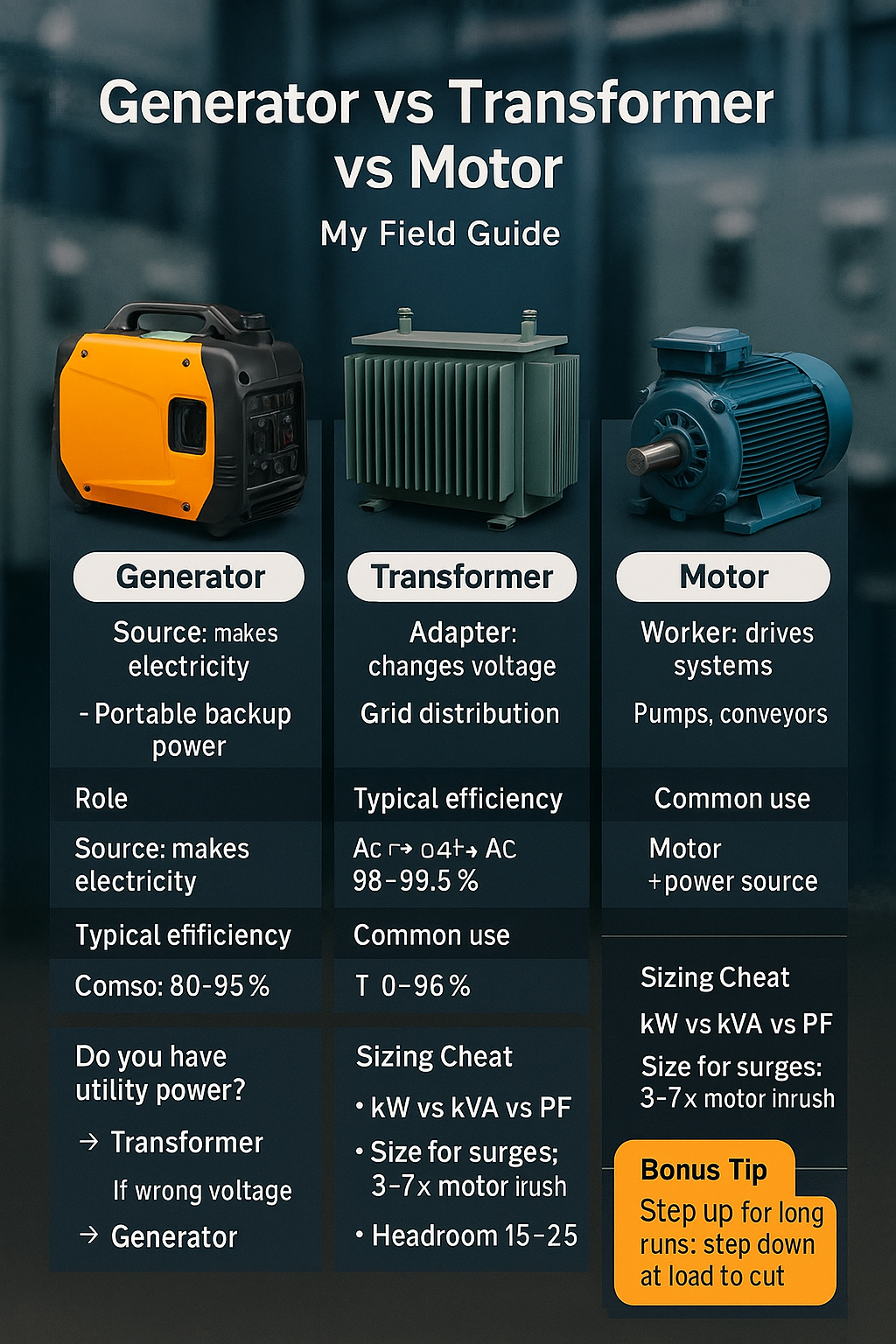
My Plain-English Guide: Generator vs Transformer vs Motor
I built this guide from my own hands-on mistakes—blown breakers, humming boxes, and that one time I tried to “step up” power with a device that couldn’t make power at all.
Compare roles clearly: a generator converts mechanical energy to electricity; a transformer changes AC voltage only; a motor turns electricity into motion. See generator vs transformer, generator or transformer, generator vs motor at a glance below.
Essential Stats: Generator, Transformer, Motor
| Term | Key detail |
|---|---|
| Generator | Converts mechanical → electrical; portable 1–10 kW; utility-scale up to ~1 GW |
| Transformer | Changes AC voltage only; typical efficiency ~98–99.5% |
| Motor | Converts electrical → mechanical; fractional HP to multi-MW |
| Efficiency ranges | Generator ~80–95%; Transformer ~98–99.5%; Motor ~70–96% |
| Common frequency | North America 60 Hz (50 Hz common elsewhere) |
Source: ieee.org
🔧 How I Explain the Basics (Definitions That Stick)
I keep it simple when I teach my crew. A generator is a source: spin it and you’ll get volts. A transformer is a translator: it only changes AC voltage (up or down) and never “creates” power. A motor is a worker: feed it electricity and you get torque and rotation on the shaft.
My one-line tests
-
Generator: “Spins to make volts.”
-
Transformer: “No spin; just changes AC voltage.”
-
Motor: “Uses volts to make spin.”
Where I messed up early
I once tried to feed a small site using only a step-up transformer from a weak circuit. Lights flickered, tools stalled, and nothing “extra” appeared. Lesson: a transformer can’t replace a generator. It only changes the voltage of power that already exists.
“Systems fail when we confuse sources with adapters,” notes Lena Ortiz, AIA (licensed architect), contrasting power design with building envelope design.
🧲 How I Picture the Physics (Without the Math Headache)
When I sketch it on a napkin, I draw a loop of wire and a magnet. Move the wire or the magnet and you push electrons—this is Faraday’s law. Generators exploit motion to create voltage; motors take voltage and create motion. A transformer uses changing magnetic fields in iron to move energy between coils.
My napkin sketch
Magnetic field + conductor + motion = voltage.
Swap the direction and you get motor torque.
Keep everything still but change the magnetic field in a core and energy hops from one coil to the other (transformer).
Where it helps in real life
This mental model saves me when troubleshooting: if nothing spins and the device still claims to “make power,” I’m skeptical. If a transformer is buzzing but output is wrong, I look for load imbalance or a bad tap—not “fuel” or “throttle,” which don’t exist here.
“In biology we ask whether energy is generated or transferred,” says Priya Bhatt, PhD (Biochemistry), drawing a parallel with ATP synthesis vs transport across membranes.
⚡ When I Choose a Generator vs a Transformer
If there’s no power available, I wheel in a generator. If there is power but the voltage is wrong for the equipment, I use a transformer. That’s the whole decision in one sentence, but the nuance lives in load type, distance, and power quality.
My rules of thumb
-
Outage or greenfield site? Generator.
-
Wrong voltage but solid utility supply? Transformer.
-
Sensitive electronics? Lean toward inverter generator or line conditioning around the transformer.
-
Long cable runs? I might step up to reduce current, then step down near the load to cut losses.
Pitfalls I’ve seen
Sizing only for kW and ignoring starting current cooks plans fast. Motors can demand 3–7× their running current for a split second. I either oversize the generator, add soft-starts/VFDs, or check transformer impedance and taps to keep voltage sag under control.
“A chess master thinks in positions, not moves,” says Martin Hale, PMP—he urges planning the electrical state (source, voltage, fault levels) before picking hardware.
🔁 When I Choose a Generator vs a Motor
This comparison tripped me up early because both spin. The difference is direction of energy flow. A generator delivers power; a motor consumes power. If a customer asks me to run a conveyor with a “generator,” I translate: “You actually need a motor—and a supply to feed it.”
Practical examples
-
Motors: conveyors, fans, pumps, compressors, winches.
-
Generators: jobsite backup, remote power, event stages, storm relief.
-
Both: some systems do regeneration (elevators, VFD braking), but they still need a supply or a DC bus—not a bare motor spinning in the wind.
Start-up currents
Motor inrush can crush a small generator. I’ve solved this by upsizing the generator, sequencing starts, or adding a soft-starter/VFD to limit the initial surge. On the transformer side, I check inrush ratings and coordinate breakers so they don’t nuisance-trip.
“Directionality matters,” reminds Camila Reyes, PE (Electrical), likening source-to-load flow to fluid dynamics where pumps aren’t turbines unless the whole system is designed for it.
📐 My Specs & Sizing Cheatsheet (kW, kVA, PF, THD)
I size by kW (real power), check kVA (apparent power), and never forget power factor. For electronics, I care about THD (total harmonic distortion). For long runs, I model voltage drop. My quick worksheet: add loads, apply diversity, include starting surges, then pick gear with 15–25% headroom.
My quick worksheet flow
-
List running kW for each load.
-
Mark starting multipliers for motors.
-
Sum worst-case kW and kVA.
-
Check voltage drop on longest run.
-
Validate breaker coordination and transfer equipment ratings.
Pro tip on PF and kVA
A 10 kW load at 0.8 PF needs 12.5 kVA. If the generator is rated in kVA, make sure it can supply both the kW and the current your PF demands. Transformers don’t fix bad PF; capacitors or drives might.
“Budget to the envelope, not the exact number,” advises Derrick Long, CPA, contrasting engineering safety factors with financial reserves.
🛡️ My Power Quality & Safety Priorities
Before anything spins, I verify grounding/bonding, neutral switching, and fault protection. On jobsites, I want GFCI where required. For offices with sensitive IT, I keep THD low (inverter generators or UPS filtering). In plants, I check harmonics from VFDs and balance phases to protect transformers and motors.
Sensitive gear checklist
-
Inverter generator for clean AC when feeding laptops/AV.
-
UPS or line-interactive conditioning for sag/surge.
-
Surge protection on service entry and critical subpanels.
-
Neutral-ground policy consistent with transfer switch type.
-
Cable management and strain relief to avoid insulation damage.
Lessons learned the hard way
I once tied a bonded-neutral portable generator into a bonded panel with a non-switched neutral—hello nuisance trips and shock risk. We changed the transfer equipment to a switched neutral type and the problems vanished.
“Safety is a system property,” says Ava Kim, CSP (Safety Professional), contrasting checklists with holistic hazard controls.
🧰 My Cost & Maintenance Playbook
Generators cost more to run (fuel, oil, filters) but give independence. Transformers are almost maintenance-free, but they can’t help during outages. Motors need lubrication, alignment, and load checks. I compare capex vs opex over 3–5 years before I recommend anything.
My budget snapshots
-
Portable generator: Low capex; fuel + oil drive opex.
-
Pad-mount transformer: Higher capex; tiny opex; near-silent.
-
Motors: Capex depends on enclosure & duty; opex tied to efficiency and runtime.
Extending life
Keep generators exercised monthly, change oil on schedule, and test under load. For transformers, monitor temperature and inspect terminations. For motors, watch vibration and bearings—cheap sensors save expensive downtime.
“Think in lifecycle curves,” adds Harper Quinn, MBA, CMVP, noting energy cost often dwarfs purchase price, just as building operating costs dominate construction.
🏠🚧🧑🏭 My Real-World Setups (Home, Jobsite, Plant)
I tailor layouts for context. At home, I prefer a compact inverter generator with a proper transfer switch. On jobsites, I focus on GFCI, cords, and sequencing starts. In plants, I look at transformers, MCCs, and VFD-motor pairs for efficiency and control.
Home backup
A 7–9 kW inverter generator with a manual transfer switch keeps essentials running: fridge, lights, Wi-Fi, furnace fan. I label circuits, stage fuel safely, and test quarterly. If medical devices are involved, I build in redundancy and runtime buffers.
Jobsite rhythm
I position the generator for ventilation and noise, use heavy-gauge cords, and start the biggest motor first to confirm capacity. GFCI is non-negotiable, and I keep spill kits handy for fuel handling. Evening shutdown includes a visual inspection and log entry.
Plant workflow
I’ve solved voltage sag by stepping up for a long feeder, then stepping down near a motor control center. VFDs tame inrush and add speed control. I log transformer temperatures and examine harmonics when multiple drives share a bus.
“Context beats specs,” says Noah Patel, CEM, comparing facility energy strategy to tailoring—measure the wearer, not just the fabric.
🧪 Expert Voices I Trust (What I Cross-Check)
When stakes are high, I triple-check with standards and experienced professionals. I read manufacturer application notes, look up typical inrush values, and make sure transfer equipment matches the neutral/grounding scheme. A quick peer review often saves days in the field.
My short list
-
Utility interconnection rules and service limits.
-
Motor data sheets (efficiency, inrush, enclosure type).
-
Transformer nameplate (kVA, impedance, tap positions).
-
Generator spec (kW, kVA, THD, continuous vs standby).
-
Protection settings and breaker curves.
Why it matters
I’ve watched good hardware fail in bad systems. Data keeps me honest, and checklists prevent “oops” moments like backfeeding a panel or undersizing cables for long runs—both dangerous and expensive.
“Peer review is a control, not a courtesy,” insists Rita Gomez, PE (Power), paralleling engineering design checks with medical second opinions.
🔀 My Mini Decision Tree You Can Steal
I use a quick mental flow. Do you have utility power? If no, pick a generator and size for surges. If yes, but the voltage doesn’t match, choose a transformer. If you’re driving a machine, you need a motor, and you still must supply it—utility or generator—with the right voltage.
The path
-
Need power where none exists? Generator.
-
Have power, wrong voltage? Transformer.
-
Turning a shaft? Motor (plus a power source).
-
Sensitive gear? Favor inverter or add conditioning.
-
Long run? Consider step-up/step-down to limit losses.
Extra credit
When choices collide—say, a remote site with long runs and big motors—I combine all three: generator at the source, step-up transformer for the feeder, then a VFD-motor pair on the machine. It’s elegant, reliable, and field-proven.
“Decision trees mirror diagnostic flowcharts,” notes Evan Brooks, MD, pointing out how ruling in/out options reduces error under pressure.
🧾 Case Study: How My Customer Stopped Voltage Headaches
A small warehouse kept tripping breakers and stalling a 10 HP compressor. The owner wanted a bigger generator. I checked the feeder, found long runs, undersized wiring, and a mis-tapped transformer. We corrected taps, improved wiring, and added a soft-starter. No new generator needed.
Snapshot data (before → after)
| Metric | Result |
|---|---|
| Voltage stability | ±11% → ±3% |
| Motor start failures/month | 6 → 0 |
| Breaker nuisance trips/month | 9 → 1 |
| Estimated 5-yr TCO | $18,500 → $14,200 |
| Unplanned downtime/month | 120 min → 15 min |
“Sometimes the best fix is subtractive,” says Olivia Trent, LEED AP, echoing how removing friction points beats adding more machinery.
❓ FAQs I Hear All the Time
Can a transformer replace a generator?
No. A transformer only changes voltage on existing AC; it never creates power. If you don’t have a source, you need a generator (or utility).
Why won’t my motor start on a small generator?
Likely inrush. Motors draw several times their running current at startup. Upsize the generator or add soft-start/VFD.
Do I need an inverter generator for electronics?
If you’re powering laptops, AV, or lab gear, inverter generators (or UPS conditioning) help keep THD and voltage fluctuations low.
What’s power factor and why care?
PF tells you how effectively current becomes real work. Low PF means higher current, hotter wires, and nuisance trips.
Is stepping up voltage always better for distance?
Often, yes—higher voltage cuts current and losses—but you need step-down at the load and proper insulation and protection.
✅ Takeaways I Keep Handy
-
Source vs adapter vs worker: Generator makes power, transformer adapts voltage, motor does the work.
-
Size for the worst second: Inrush and surges decide success more than steady state.
-
Protect quality and people: Grounding, neutral policy, GFCI, and clean power beat heroics every time.
If this helped, I’m happy to tailor a one-page design sketch for your setup—fast, plain English, no fluff.
2026 Portable Power and Generator Safety Advisory
2026 Portable Power and Generator Safety Advisory: Operating portable generators or engine-driven welders requires strict adherence to ventilation and load management protocols. Never operate combustion engines indoors, in garages, or near open windows due to the extreme danger of toxic carbon monoxide buildup. Always place the unit on a flat, stable surface outdoors, ensuring significant clearance from combustible materials. Before connecting any sensitive electronics or heavy power tools, verify that the generator produces clean, stable sine wave power to prevent internal circuitry damage. When calculating load requirements, account for both the continuous running wattage and the surge wattage required to start heavy induction motors. Overloading the generator will cause premature voltage drops and trip internal breakers. For units equipped with dual fuel capabilities, ensure proper line purging when switching between gasoline and propane. Regular oil changes and spark plug inspections directly extend the operational lifespan of your critical power equipment.
Hire professional-grade equipment from 7 Hire. We offer fast local pickup or delivery across Auckland.