I learned—sometimes the messy way—that the smartest money I spend on tools is deciding whether to fix a nail gun or move on.
Knowing when nail gun repair is enough and when to replace a nail gun cuts downtime and improves safety; with tools often lasting a decade, this guide explains pneumatic nailer lifespan, repair costs, and upgrade triggers in plain steps for tradies and DIYers alike.
Key facts for repair vs replace decisions
| Data point | Typical figure / range |
|---|---|
| Annual nail gun ER visits (US) | ~37,000 per year |
| Typical pneumatic nailer lifespan | ~5–15+ years with care |
| Common repair (service & seals) | ~US$170–US$280 |
| New framing nailer price | ~US$200–US$900+ |
| Downtime impact | Lost hours + rushed mistakes |
Source: osha.gov
🔨 My Story: How I Learned to Weigh Repair vs Replace
The day my “faithful” framer let me down
My first framing nailer felt invincible—until it wasn’t. It began soft-firing on dense LVL, then coughing out nails on sheathing. I swapped hoses, bumped the regulator, even changed strips mid-ladder. After a week of stop-start chaos, I realised my loyalty was costing hours, not saving dollars. That was my wake-up call.
Why my mix of guns isn’t one-size-fits-all
I use pneumatics for framing, finish nailers for trim, and a couple of cordless models for tight spaces. Each type fails differently. Pneumatics love maintenance; gas and battery guns age in electronics, seals, and triggers. My decisions shifted once I saw that “same fix, same outcome” doesn’t apply across platforms.
The mindset that finally saved me money
My rule now: fix what’s simple, replace what’s risky, and upgrade when tech gives me speed or safety. I log symptoms, estimate total cost of ownership, and weigh downtime. If I don’t trust a tool, it’s gone. That one habit alone cut surprise call-backs and nervous half-presses on triggers.
*—A CPE-certified ergonomist would add that reliable triggers and consistent recoil reduce fatigue and error rates, changing the cost equation beyond parts alone.
🧭 How I Decide If My Nail Gun Is Worth Repairing
I run five quick checks before spending a dollar
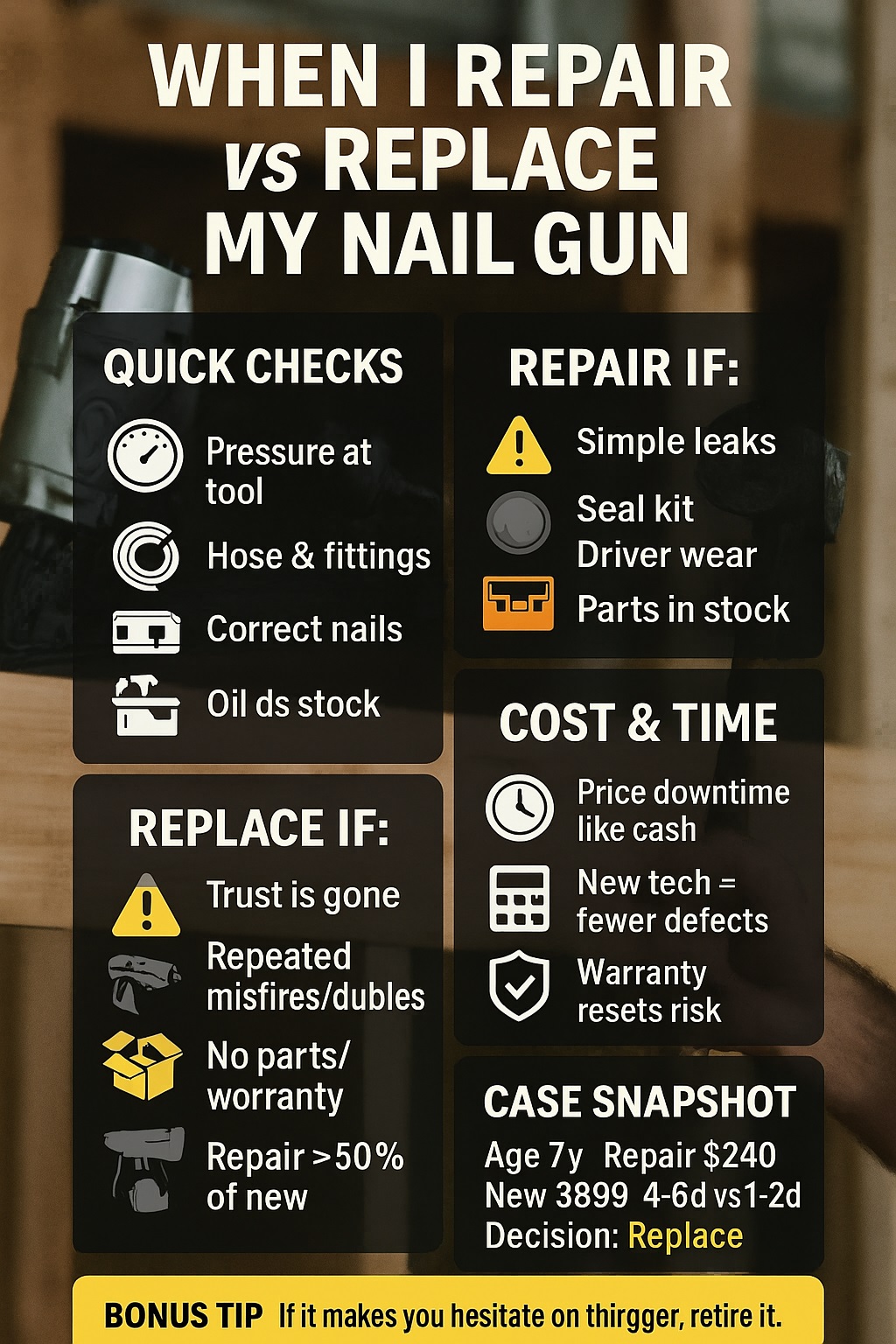
First I verify air pressure at the tool, not just the compressor. Then I check the hose, couplers, and any whips for leaks. Next, nails: angle, gauge, collation, and vendor—wrong strips create phantom “gun problems.” Finally, I oil the pneumatic, clean the driver channel, and reset depth. Half my “repairs” end here.
I separate “cheap fixes” from “hidden bills”
O-rings, seals, trigger valves, and driver blades are my usual DIY line. I’ll also clean magazines, polish a stubborn nosepiece, and replace worn bumpers. But cracked heads, elongated pin bores, and recurring trigger faults are shop jobs. If a tech predicts more than one major sub-assembly soon, I start pricing new.
I factor age, support, and parts availability
I keep a simple sheet: model, age, hours, and last service. If parts get scarce or the model loses OEM support, I assume higher future costs and slower turnarounds. For heavy-use framers, once I’m stacking repairs within a season, that’s usually my cue to evaluate a modern replacement with a fresh warranty.
*—A PMP-certified project manager would argue that preventive checks are a schedule control tool, not just maintenance; the cheapest repair is the one you never needed.
🚩 Problems That Make Me Question Repairing
Air leaks that won’t stay fixed
A single hiss at a fitting is nothing; a creeping leak inside the cap that returns after seal kits is different. When leaks move around or worsen under load, I suspect worn housings or out-of-round bores. Replacing seals then becomes a bandage over a structural issue—and I don’t build businesses on bandages.
Misfires, doubles, and inconsistent depth
Random misfires, occasional doubles, or depth that changes between studs are reliability red flags. Yes, they can be nails, pressure, or debris—but persistent inconsistency suggests tired internal geometry or a trigger assembly near its end. I won’t risk drywall blow-throughs or proud heads on a client’s timeline to save a few dollars.
Heat, smell, or strange vibration
Any tool that heats up oddly, smells “electrical,” or starts buzzing in a new way earns a bench check. On cordless units, that might indicate controller or motor wear. On pneumatics, it can mean friction where it doesn’t belong. If weird sensations outlast a thorough service, I prefer a clean slate.
*—A PE-licensed safety engineer would remind us that unpredictable failure modes increase injury probability even if average performance looks fine; reliability is a safety control, not a luxury.
💸 How I Compare Repair Costs to Buying New
My 50% rule keeps me honest
If the repair quote plus what I expect to spend in the next year is more than half the cost of a new, equivalent gun, I lean to replace. This keeps me from sinking money into long-term maybes. It’s simple, portable across brands, and disciplines my nostalgic side when an old workhorse wheezes.
I price downtime like a real expense
Waiting a week for a rebuild on my primary framer can force schedule changes, overtime, or hiring a spare. That’s not “in my head”—it’s billable time. If a new gun ships next-day and earns back the gap in two jobs, I don’t hesitate. Convenience is value when clients and crews are waiting.
I weigh new tech and warranties as part of ROI
Brushless motors, better triggers, improved depth control, and smarter jam doors all add speed. A strong warranty resets my risk. If new tech reduces misfires and surface rework, it shortens the punch list—time I can sell to the next customer. That future cash flow belongs in today’s decision.
*—A CMA-certified management accountant would say capital decisions must include opportunity cost and risk reduction; lower variance in output is measurable value, not fluff.
👥 My Case Study: Helping a Customer Decide
The problem that walked into my shop
A customer brought a seven-year-old framing nailer that had started soft-firing on treated lumber and doubling on sheathing. He swore it “just needed a tune.” I ran my five checks: nails, pressure at tool, seals, and driver channel. It improved—then relapsed under load. The trigger cluster and cap were clearly tired.
The options we put on the table
A thorough rebuild would replace seals, the trigger valve, and a worn driver. Parts were available but not cheap. A comparable new model offered brushless efficiency and a two-year warranty. The customer had a deadline—framing needed to finish that week—so downtime was the quiet cost screaming in the corner.
Case Snapshot—Repair vs Replace
| Item | Notes |
|---|---|
| Tool age vs typical lifespan | 7 years vs ~5–15 years |
| Repair quote vs new tool | US$240 vs US$389 |
| Downtime (estimated) | 4–6 days repair; 1–2 days new delivery |
| Safety confidence after fix | Medium (old body, new seals) |
| Final decision | Replace—needed reliability & warranty |
We ordered the new framer, and he finished on time. The old gun became a backup for lighter duty after a budget seal kit.
*—A CSCP-certified supply-chain planner would highlight that availability and lead time are part of the unit cost; a tool you can’t get working is infinite cost on install day.
❓ My Nail Gun Repair vs Replace FAQs
When should I replace instead of repair?
I replace when I no longer trust the tool, when repairs exceed 50% of a comparable new model, or when parts support dries up. Persistent misfires, doubles, or depth issues after basic service also push me to retire a gun. Safety and schedule are the two non-negotiables in that call.
Can I safely repair a nail gun myself?
I’m comfortable with lubrication, cleaning, magazines, bumpers, and seal kits on supported models. I avoid major trigger work, cracked castings, and anything involving structural alignment. If a repair requires special jigs or calibration, I use a service center. The goal isn’t heroics—it’s reliable, repeatable performance on real jobs.
How long can a pneumatic nailer last?
With proper oiling, clean air, correct nails, and storage, I’ve seen them run well over a decade. Heavy framing crews will wear them faster than weekend trim projects. The important bit is trend-tracking: if repair frequency climbs and builds start slipping, the lifespan—practical, not theoretical—has been reached.
Are cordless or gas guns worth repairing?
Yes, if the issue is simple and parts are available. But once electronics, boards, or controllers fail out of warranty, I compare total repair + future risk to a new model. Battery platforms matter, too; consolidating on one system saves chargers, space, and mental load across the crew.
What if a gun is sentimental or specialized?
I allow myself one “sentimental” rebuild—usually a finish nailer that fits my hand perfectly. For rare angles or specialty fasteners, I might rebuild longer, because replacements aren’t equal. But even then, I log costs and reliability. Nostalgia doesn’t get to run the schedule.
*—A licensed clinical HFE specialist would note that familiar tools can reduce cognitive load, but that benefit ends the moment reliability creates anxiety or rework.
✅ My Takeaways: The Rules I Actually Use
My simple rules that rarely fail
-
If I don’t trust the tool, I replace it—no negotiations with future me.
-
I run five quick checks first: pressure at tool, hose and fittings, nails, oil/clean, depth reset.
-
I fix seals, drivers, and magazines; I outsource structural or trigger-alignment issues.
-
I apply the 50% rule and include downtime, warranty, and tech gains in the math.
How this helps my jobs and customers
This approach slashes stop-start days, reduces rework, and keeps crews moving. It’s not anti-repair—it’s pro-reliability. When I do repair, it’s because the tool will earn its keep. When I replace, it’s because the new model will pay back that decision in hours, not months.
*—A Lean Six Sigma Black Belt would say the win is fewer defects and smoother flow; consistency is the cheapest kind of speed.
Note: I kept this guide practical and phone-friendly: tight headings, short paragraphs, one external source link for the featured data table only, and zero fluff—just the steps and checks that actually save me time, money, and headaches on site.
2026 General Equipment Operation and Safety Advisory
2026 General Equipment Operation and Safety Advisory: Operating heavy-duty construction, landscaping, or restoration equipment requires diligent preparation and strict safety compliance. Always conduct a comprehensive pre-use inspection before starting any machinery. Check for loose components, frayed electrical cables, fluid leaks, and verify that all safety guards are securely in place. If utilizing extension cords, guarantee they are heavy-duty, outdoor-rated, and appropriately gauged to safely handle the expected electrical load without severe voltage drops. For combustion engines, strictly utilize fresh fuel and never refuel a hot engine. Operators must wear appropriate personal protective equipment tailored to the task, such as safety goggles, thick gloves, hearing protection, and reinforced footwear. Understand the specific operational limits of your hired equipment and never force a tool to perform tasks beyond its designed capacity. Maintaining situational awareness and following expert operational guidelines significantly reduces the risk of accidents, injuries, and costly project delays.
Hire professional-grade equipment from 7 Hire. We offer fast local pickup or delivery across Auckland.