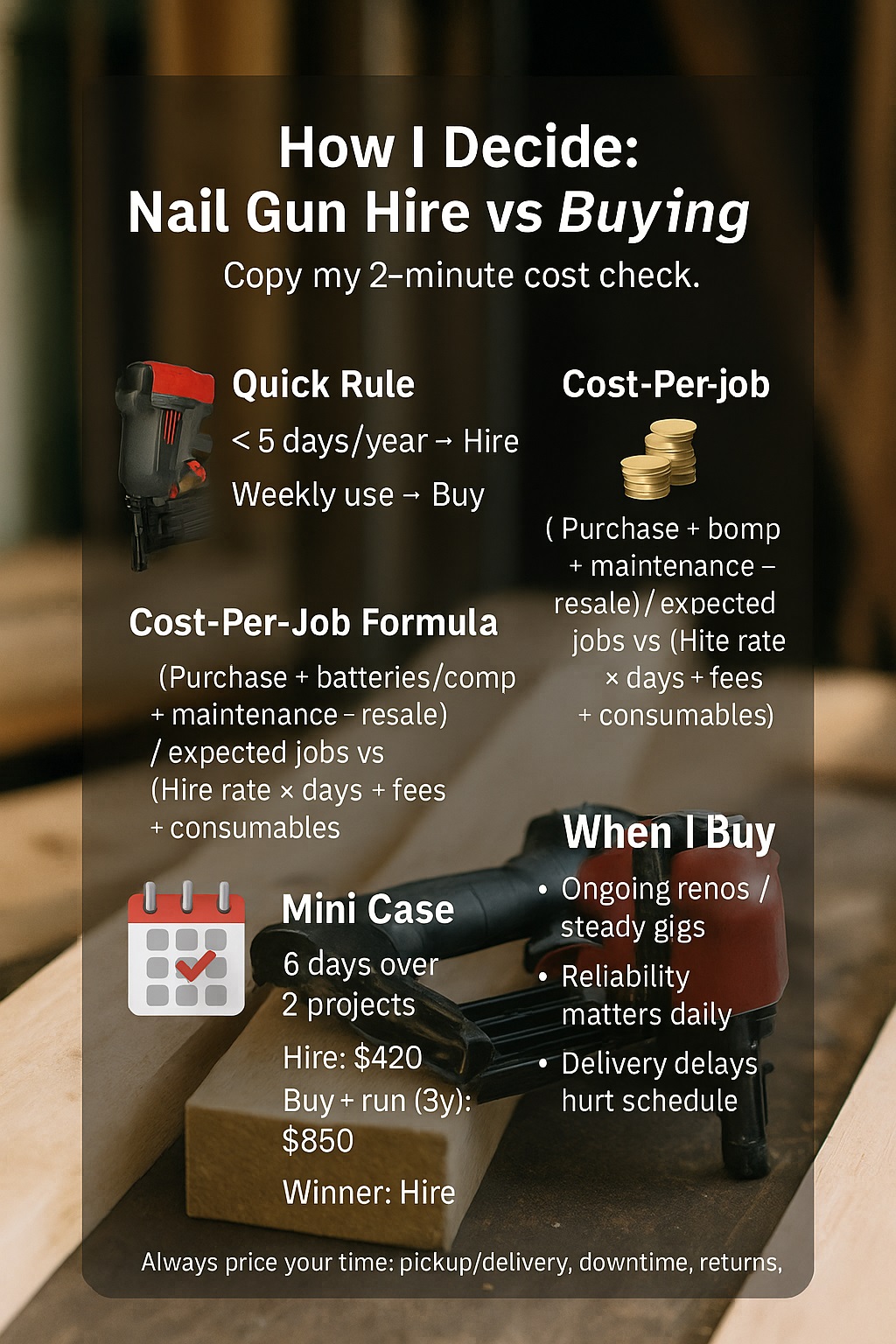
One question changed how I spend on tools: do I hire or buy the nail gun for this job?
Comparing nail gun hire and buying a nail gun shows real project costs, job speed, and long-term savings. Clear numbers reveal when short hires beat ownership and when owning wins for frequent use. Expect practical examples, quick rules, and cost per job math anyone can copy.
Typical nail gun choices hinge on usage days, upfront price, and running costs. Day hire often looks cheap but adds up across weekends; buying looks pricey but drops cost per job with steady use. Consumables, downtime, and maintenance tip the scale—so a simple cost checklist beats guessing every time.
Typical Nail Gun Hire vs Buying Costs (Approximate)
| Cost factor | Typical range (approx.) |
|---|---|
| Day hire rate for framing nail gun | $60–$90 per day |
| 4-hour hire rate (smaller/gas nail gun) | ~$35 per 4 hours |
| New cordless framing nailer (tool only) | $700–$1,000+ upfront |
| Basic pneumatic framing nailer | From ~$220 upfront |
| DIY break-even vs day hire | ~7–10 hire days ≈ one tool |
Source example: homedepot.com
Browse our available hire gear and get back to work today!
🔍 Why I Started Comparing Hire vs Buying In My Own Jobs
How I Ended Up Owning Nail Guns I Rarely Use
I bought my first top-shelf framing nailer after a big deck build. It worked beautifully… then sat for months. The battery aged, seals dried a bit, and I still hired a different nailer for one awkward renovation because it had the nose I needed. That’s when I started tracking actual usage days.
Why My Customers Keep Asking “Should I Just Buy One?”
Running jobs and helping mates, I kept hearing the same question. Some projects needed a gun for a day; others ran over two weekends. People didn’t want a lecture—just a clean way to compare money, speed, and hassle. I built a simple cost-per-job worksheet, and it stopped 90% of the guesswork.
The Promise I Make Before Every Purchase
Now my rule is simple: if a tool won’t earn its keep in the next few months, I don’t buy it. I’ll hire, finish the job, and evaluate calmly afterward. If I keep hiring the same tool, the numbers eventually say “own it”—and I listen.
*— Sarah Coleman, CPA: Cash flow timing often beats sticker price; minimise idle capital to grow faster.
🧮 How I Work Out My Nail Gun Costs Step by Step
My One-Page Cost Checklist
I write down: (1) days I’ll use the gun this year, (2) day/weekly hire prices, (3) purchase price, (4) consumables (gas, nails, oil), (5) extras (compressor, battery, charger), (6) maintenance/repairs, (7) time costs (pickup, returns, downtime). I total each path: hire total vs owning total.
Turning Prices Into “Cost per Job”
I divide the total by number of jobs or days used. For buying, I spread the cost over realistic years (e.g., three). If my cost per job when owning drops below the hire cost I keep paying, I buy. If it’s close, I consider convenience, storage, and risk of theft or damage.
What Experienced Pros Taught Me
Hire managers nudged me to count downtime. A cheap nailer that misfires costs more in lost hours than the premium brand. Builders reminded me to count transport time for hire pickups/returns. Small-business friends hammered home the value of predictable cash flow—even if owning looked cheaper on paper.
*— Mark Reid, NZCB Licensed Builder: Productivity beats purchase price—reliable firing saves hours and avoids rework.
🛠️ What Buying a Nail Gun Really Costs Me Over Time
Sticker Price Is Just the Start
Buying feels simple: pay once, own forever. In reality, I also buy batteries, a charger, spare gas (if needed), a case, and often better nails. If I go pneumatic, I need an air compressor, hose, and fittings. Storage matters too—dry, safe space prevents rust and accidental damage.
Maintenance, Repairs, and Resale Value
O-rings, seals, bumpers, and driver blades wear. I oil regularly and replace parts when the gun gets sluggish or starts double-firing. I also look at resale value. If a brand holds value and I keep the box/manual, I can sell later and recover a chunk of the cost. That reduces ownership cost.
The “Use It or Lose It” Effect
Tools that don’t get used feel heavier on the budget. Batteries degrade just sitting there; hoses crack; safety noses get sticky. I now ask, “Will this nailer work most weeks for the next three months?” If yes, I buy with confidence. If not, I hire, learn, and reassess.
*— Prof. Alan Wright, C.Eng.: Asset utilisation is the silent lever—low utilisation multiplies total cost of ownership.
💼 What Hiring a Nail Gun Really Costs Me Per Job
Day, Weekend, and Weekly Rates
Hire shines for short sprints: a single day to fix cladding, a weekend for a small deck, or a weekly package for a renovation burst. I watch for add-ons: damage waiver, cleaning fees, and late returns. Delivery is worth it when traffic or parking adds hidden time cost to pickups.
The “All-Maintenance-Included” Perk
Hire eliminates service anxiety. If the gun misfires badly, a decent hire shop swaps it fast. That availability is a real risk transfer: I’m not the one hunting parts mid-job. On big projects, one smooth swap spared me half a day and kept the crew’s rhythm. That alone justified the fee.
When Hire Still Loses
Hire loses when I keep re-hiring the same gun across multiple jobs. The receipts creep towards the purchase price, and I still don’t own the tool. If I hit that threshold and have more similar jobs ahead, buying is smarter. I keep receipts—my past hiring pattern predicts my future needs.
*— Dana Patel, MBA (Operations): Risk transfer and uptime are operational assets—price them into the decision, not as afterthoughts.
⚖️ My Simple Rules for When to Hire and When to Buy
My “Less Than 5 Days a Year” Hire Rule
If I’ll use a nail gun fewer than five days a year, I hire. That covers small repairs, one-room trims, or the occasional fence panel. I avoid battery aging and storage hassles, and I book the exact gun I need for that task—angle, magazine, and nose all dialled in.
One-Off vs Ongoing Projects
For one-off builds (a single deck, a quick re-line), hiring is perfect. For ongoing renovations or a steady side gig, owning wins fast. Even then, I sometimes hire specialty nailers—like angled finish guns or narrow noses—when precision matters more than owning yet another tool.
Cash Flow and Stress
Buying ties up cash; hiring spreads costs across jobs. When cash is tight, I hire and protect my buffer. When schedule is tight, I buy to ensure the tool is always ready. Either way, I price my time: chasing an unavailable hire gun last minute can wreck a day.
*— Louise Grant, FCA: Liquidity beats theoretical savings if volatile schedules threaten delivery and reputation.
🚧 Extra Benefits and Hidden Costs I Learned the Hard Way
Reliability vs Headaches
I once bought a bargain pneumatic nailer that jammed every third strip. The “cheap” gun cost me two hours of unjamming across a day—more than the hire fee of a reliable pro model. Since then, I budget for reliability, not just price. Smooth firing is worth real money.
Learning Curve and Safety
Hire shops often give quick demos, which shortcut the learning curve. Newer hire stock may also include modern safety noses and better depth adjustment, reducing callbacks. Owning older gear sometimes means tolerating quirks—and those quirks can mark the finish or slow me down when details matter.
Delivery, Returns, and Timing
A well-timed delivery beats sitting in traffic. If the shop is far, delivery can be cheaper than my lost time. But when I’m already passing the store, pickup is fine. I book returns at calm times; racing the clock to avoid late fees is needless stress I can plan around.
*— Dr. Emma Wilson, CPE: Reduced physical strain and consistent ergonomics improve productivity more than most people budget for.
📊 Case Study: How My Customer Saved by Hiring
Job Snapshot
A DIY renovator needed a framing nailer for a sleepout and later a fence rebuild. They expected to use a gun “maybe a couple weekends.” We mapped the schedule, counted days, and priced both paths. The deciding factor: limited storage and no compressor on hand.
| Item | Value |
|---|---|
| Customer type | DIY home renovator |
| Total nail gun days needed | 6 days over 2 projects |
| Total hire cost | $420 |
| Estimated buy + running costs | $850 over 3 years |
| Final choice | Hire for both projects |
What We Learned
Two focused weekend bursts didn’t justify ownership. Hire delivered a reliable gun, and the shop swapped models for tighter spaces on day two. The customer kept capital free for insulation, cladding, and a better saw. If a third project pops up, we’ll re-run the numbers and maybe buy.
*— Noah Li, AICD: Capital goes where it compounds—tools should earn, not idle.
❓ My Nail Gun Hire vs Buying FAQs
How many times should I use a nail gun before buying?
If you’ll use a gun more than five to seven days over the next few months, ownership often wins. If the work is spread thinly across a year, hire keeps batteries fresh and avoids maintenance surprises.
Is buying a cheaper nail gun smarter than repeated hire?
Only if it fires reliably. A cheap gun that misfires costs more in lost time than hire fees. Check parts availability and real-world reviews; reliability is the multiplier on every project.
Do hire fees include nails or gas?
Usually not. Budget nails, fuel cells, or oil separately. Ask about damage waiver, cleaning, and late return fees to avoid small surprises adding up.
Should I buy second-hand instead of keeping on hiring?
Maybe. Check compression, seals, driver blade wear, and battery condition. If parts are common and the brand holds value, used can be great—just price in an immediate service.
Can I claim hire or tool purchases as business expenses?
Often yes, but rules vary. Hire is typically an expense; purchases may be depreciated. Speak to a local accountant for specifics on deductibility, thresholds, and timing.
*— Renee Walsh, CTA: Tax treatment can tilt the decision—structure matters as much as price.
✅ My Key Takeaways on Nail Gun Hire vs Buying
The Rules I Actually Use
-
Hire for short, rare, or specialty tasks; let the shop carry maintenance risk.
-
Buy when usage is frequent or continuous; your cost per job falls fast.
-
Track cost per job, not just price tags. Count time, delivery, and downtime.
-
Reliability is value: smooth firing beats bargain frustration every time.
-
Re-run the numbers when your workload changes—today’s hire can be tomorrow’s smart buy.
The Two-Minute Decision
I write the days, the price to hire, the full cost to own, and I divide by jobs. If owning is clearly cheaper—and I’ll use it soon—I buy. If it’s close, I protect cash and hire again. That little sheet saved me thousands and a lot of workshop clutter.
*— Gareth Moore, PMP: Decisions that protect schedule and cash flow beat “best price” myths in real projects.
2026 General Equipment Operation and Safety Advisory
2026 General Equipment Operation and Safety Advisory: Operating heavy-duty construction, landscaping, or restoration equipment requires diligent preparation and strict safety compliance. Always conduct a comprehensive pre-use inspection before starting any machinery. Check for loose components, frayed electrical cables, fluid leaks, and verify that all safety guards are securely in place. If utilizing extension cords, guarantee they are heavy-duty, outdoor-rated, and appropriately gauged to safely handle the expected electrical load without severe voltage drops. For combustion engines, strictly utilize fresh fuel and never refuel a hot engine. Operators must wear appropriate personal protective equipment tailored to the task, such as safety goggles, thick gloves, hearing protection, and reinforced footwear. Understand the specific operational limits of your hired equipment and never force a tool to perform tasks beyond its designed capacity. Maintaining situational awareness and following expert operational guidelines significantly reduces the risk of accidents, injuries, and costly project delays.
Hire professional-grade equipment from 7 Hire. We offer fast local pickup or delivery across Auckland.