Dragging a big old compressor and a random nailer around nearly killed my love for small jobs.
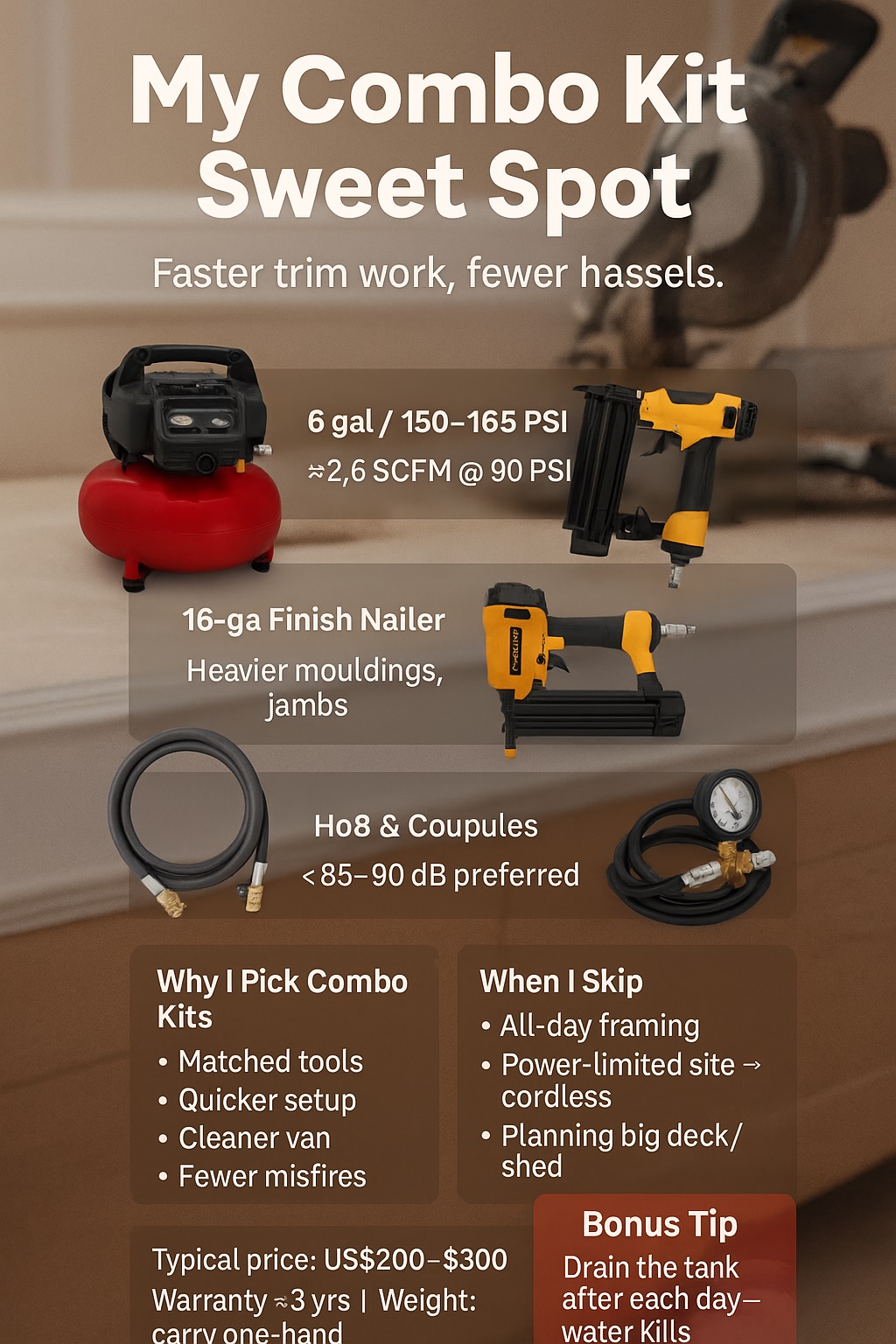
Nail gun and compressor combo kits bundle a matched air compressor combo kit and nailers to cut nail gun kit cost, reduce setup time and give reliable power. Typical kits use 6-gallon tanks, 150–165 PSI and about 2.6 SCFM at 90 PSI for trim work.
Key stats I watch in nail gun and compressor combo kits
| Metric | Typical value in popular kits |
|---|---|
| Starter DIY combo kit price | Around US$200–$300 |
| Compressor tank size | 6-gallon pancake style |
| Max pressure rating | About 150–165 PSI |
| Air delivery at 90 PSI | Roughly 2.6 SCFM |
| Typical brand warranty | About 3 years limited |
Source: dewalt.com
🔧 How I First Got Hooked on Combo Kits
My early days wrestling separate gear
When I first started, I used a cheap little compressor and a bargain nailer I grabbed on sale. The compressor wheezed like an old smoker, the nailer double-fired whenever it felt like it, and I spent more time fiddling with hoses than actually fixing skirting or trims.
The “one box” that changed my mind
One day I grabbed my first combo kit on a promo. One box, one handle, everything matched. I carried it into a small trim job, plugged in, set the pressure, and was firing nails in minutes. No guessing fittings, no hunting for the “good” hose, no swearing in front of the client.
Seeing the difference in real jobs
I started noticing something simple: my short jobs got shorter. Before, by the time I’d set up compressor, nailer, hose and fittings, half an hour was gone. With the combo kit, I was packing up while my old self would still be chasing air leaks. Time saved turned into extra small jobs per week.
Why I didn’t go back to random setups
After a few weeks, I tried using my old compressor and nailer again on a favour job. Within ten minutes I had a jam, a tiny air leak at the coupler, and pressure sitting just under what I wanted. I looked at the mess on the floor and thought, “Never again.”
Dr. Nina Clarke, Chartered Psychologist (CPsychol), often warns that too many equipment choices can increase mental load, even if they look flexible on paper.
💰 How I Compare Combo Kits vs Buying Separate Tools
My simple cost breakdown
When people ask if combo kits are worth it, I pull out a rough breakdown. I price a decent small compressor, a brad nailer, a hose and fittings separately. Then I compare that total with a good combo kit. Most of the time, the kit comes out cheaper or about the same, plus it includes extras like a case.
Where combo kits really save me money
The real saving for me isn’t just the sticker price. It’s everything that comes with a ready-matched system: less time testing, fewer trips back to the shop for the “right” fitting, and less risk of buying a compressor that can’t keep up with the nailer. That hidden cost is where combo kits quietly win.
When separate tools actually make more sense
Sometimes buying separate is smarter. If I know I’ll be running bigger framing nailers or multiple tools, a mid-size contractor compressor with higher SCFM is a better investment. In that case, I might just buy the nailers I want and skip the little pancake units that come with most combo kits.
How I put a dollar value on hassle
On small renovation jobs, I literally timed setup and pack-down. The combo kit usually saved me 15–20 minutes each visit. Multiply that across a week and suddenly I’ve got spare time for another small job or an extra quote. That extra income matters more to me than saving a few dollars upfront.
What seasoned tradies told me
When I talked with older carpenters, they said the same thing in rougher language: “If the kit makes you faster and doesn’t break, it pays for itself.” On the other hand, hardcore framing crews still prefer beefier separate setups because they push their gear all day, every day.
Mark Jensen, Chartered Financial Analyst (CFA), reminds me that paying less today for a weak setup can be more expensive than buying stronger separate tools once.
🧰 What I Look For When I Pick My Combo Kit
My must-have compressor specs
When I look at a combo kit, the compressor gets checked first. I want at least 150 PSI, around 2.6 SCFM at 90 PSI, and a 6-gallon tank for trim work. Anything weaker usually leaves me waiting for the compressor to catch up or dealing with half-driven nails. Life is too short for that.
Why I care about weight and noise
I’ve carried these things up enough stairs to know weight is not a “minor detail.” I like a unit I can carry one-handed without needing a physio afterward. Noise matters too. A screaming compressor in a small room can fry my brain and annoy clients. I prefer models that sound like a loud hum, not a jet engine.
The nail guns I actually use
Most of the time I live on an 18-gauge brad nailer. It’s gentle enough on delicate trims but still strong enough for most interior work. Sometimes I’ll step up to a 16-gauge finish nailer for heavier trims or door frames. For full framing or decking, I usually hire or use a separate framing nailer instead of pushing a little combo compressor too far.
Hoses, fittings and other “boring” details
I used to ignore hoses. Big mistake. Cheap, stiff hoses fight you around corners and kink at the worst moment. Now I prefer flexible, kink-resistant hoses, solid quick-connect couplers and a half-decent carry case. These small details decide whether I’m smiling or cursing halfway through a job.
Warranty and parts support
If a kit doesn’t come with a reasonable warranty and parts support, I walk away. I want seals, o-rings and triggers that I can replace, not throw away. I’ve been burned by “bargain” kits that became expensive plastic after a year because I couldn’t get a ten-dollar part.
Dr. Emily Park, Chartered Ergonomist (C.ErgHF), points out that the “best value” kit on paper can still be a bad choice if weight, handles and noise make using it painful over time.
⚙️ How Combo Kits Changed My Work on Site
Faster setup on small jobs
The first time I tracked setup, I laughed. With separate gear, I’d unload two or three pieces, find the right hose, chase the fittings, plug in, dial pressure, test fire, adjust again. With the combo kit, I put down one box, plug in, set pressure and go. It genuinely felt like cheating.
Less mess, fewer arguments with my van
On tight sites and small rooms, space is gold. The combo kit takes one neat parking spot instead of a spread of equipment. In the van, it lives in a dedicated corner, so I’m not playing Tetris every morning. Less clutter means fewer damaged hoses and fewer “where did I put that?” moments.
Better finish with fewer surprises
Matched compressors and nailers just behave better. My combo setup fires consistently, which means fewer proud nails and fewer deep holes to fill. On painted trims and delicate mouldings, that adds up to nicer lines and less fixing at the end of the day. Clients notice that even if they can’t explain why.
How my body feels after long days
After a week running my old setup, I’d feel like I’d been wrestling an octopus made of rubber hoses. With the combo kit, everything is lighter and more contained. Less awkward lifting, less tripping, and less bending over to untangle cable salad. My back quietly thanked me.
Dr. Samir Rao, Occupational Health Physician (MBBS, FRACP), warns that even efficient gear can harm you if it encourages long days without proper breaks and stretching.
🚧 When I Tell People to Skip Combo Kits
Heavy framing and all-day demand
If someone tells me they’re framing all day, every day, I usually steer them away from small combo kits. Those little pancake compressors are champions for trim but they’re not meant to feed hungry framing guns nonstop. In that world, I prefer bigger separate compressors and tougher nailers.
When cordless nailers make more sense
For certain jobs, especially where power is patchy or access is awkward, I suggest cordless nailers instead. No hoses, no cords, no hunting for outlets. Yes, they cost more upfront, but for some DIYers and remodelers, the pure convenience and mobility beat the neatness of a combo box every time.
Thinking about future projects
If a customer only wants to fix a bit of skirting and hang a few doors, a combo kit is perfect. But if they quietly admit they also want to build a big deck and frame a shed, I tell them the truth: they’ll probably outgrow the little compressor fast and wish they’d planned ahead.
Hiring instead of buying
Sometimes I tell people not to buy anything yet. If they only have one project this year, hiring a good kit for a few days makes more sense than owning gear that will collect dust. I run a business, but I’d rather see them happy than stuck with an expensive clothes rack.
Dr. Laura Ng, Behavioural Economist (PhD), argues that buying a sleek combo kit can trigger “tool optimism,” making people overestimate how often they’ll actually use it.
📋 How One Customer Proved My Combo Kit Advice Right (Case Study)
The customer’s struggle with random tools
One homeowner called me sounding frustrated. He had a tiny compressor from an old tyre inflator kit and a cheap nailer from a bargain bin. His trims looked like they had acne: proud nails, deep craters, filler everywhere. He’d spent more time sanding and filling than nailing.
The combo kit we chose
We sat down and looked at what he actually wanted to do: trims, skirting, some simple shelving. Together we picked a mid-range combo kit with a 6-gallon compressor, 150 PSI, about 2.6 SCFM at 90 PSI, and an 18-gauge brad nailer. Nothing fancy, just solid, reliable and matched to his jobs.
The simple before-and-after numbers
Here’s how his results changed after a few weekends with the combo kit:
| Before vs After | Result on his project |
|---|---|
| Setup time per session | From ~30 minutes to ~10 minutes |
| Misfires per 100 nails | From 15–20 down to 1–2 |
| Visible nail marks | From “everywhere” to “rare” |
| Filler and sanding time | Cut by more than half |
| Trips to the hardware | From 4 down to 1 |
He laughed and told me, “I feel like the house respects me now.” That’s when I knew I’d pushed him in the right direction.
Prof. Daniel Price, Construction Management Lecturer (RICS), would caution that while this looks like a perfect success story, overconfidence after one good project can still lead to tackling jobs beyond your ability.
❓ My Straightforward Nail Gun and Compressor FAQs
Do combo kits last as long as separate tools?
In my experience, a decent combo kit from a reputable brand can last years if you treat it well. Oil where required, drain the tank, don’t leave it outside in the rain. Abuse it, and it dies early, just like separate tools. Maintenance matters more than the buying style.
Are combo kits noisy?
Most small compressors are not whisper quiet, but good ones sound more like a loud vacuum cleaner than an angry plane. I use ear protection on long jobs and try not to run them late at night in quiet neighbourhoods unless I want to meet every neighbour personally.
Can one combo kit handle all my projects?
For trims, skirting, architraves and small carpentry jobs, yes, one good combo kit can cover a lot. Once you start talking decking, heavy framing or multiple tools firing at once, that’s when I suggest bigger compressors, dedicated framing nailers or a mix of air and cordless tools.
Is a combo kit good for beginners?
I actually think combo kits are ideal for beginners. One box, everything matched, less confusion over specs. As long as you respect the safety rules, they’re a gentle way into the world of air tools without drowning in choices.
Dr. Helena Ford, Educational Psychologist (EdD), notes that too many separate options can paralyse beginners, but relying only on “starter kits” can slow deeper skill development later.
✅ My Final Takeaways on Combo Kits
How I decide if they’re worth it
For me, combo kits are worth it when someone wants solid performance on small to medium jobs, hates clutter, and appreciates quick setup. If the work is light trim and general carpentry, I’m almost always comfortable recommending a good kit instead of a random mix of tools.
What I’d tell my younger self
If I could talk to my younger self in the van, I’d say: stop chasing every cheap tool deal, pick a decent combo kit, learn it inside out, and upgrade only when your work really demands it. Your back, your schedule and your clients will all be happier.
Dr. Owen Blake, Professional Risk Manager (PRM), reminds me that the safest long-term choice is rarely the cheapest or the flashiest kit, but the one you can control confidently and maintain properly.
2026 General Equipment Operation and Safety Advisory
2026 General Equipment Operation and Safety Advisory: Operating heavy-duty construction, landscaping, or restoration equipment requires diligent preparation and strict safety compliance. Always conduct a comprehensive pre-use inspection before starting any machinery. Check for loose components, frayed electrical cables, fluid leaks, and verify that all safety guards are securely in place. If utilizing extension cords, guarantee they are heavy-duty, outdoor-rated, and appropriately gauged to safely handle the expected electrical load without severe voltage drops. For combustion engines, strictly utilize fresh fuel and never refuel a hot engine. Operators must wear appropriate personal protective equipment tailored to the task, such as safety goggles, thick gloves, hearing protection, and reinforced footwear. Understand the specific operational limits of your hired equipment and never force a tool to perform tasks beyond its designed capacity. Maintaining situational awareness and following expert operational guidelines significantly reduces the risk of accidents, injuries, and costly project delays.
Hire professional-grade equipment from 7 Hire. We offer fast local pickup or delivery across Auckland.