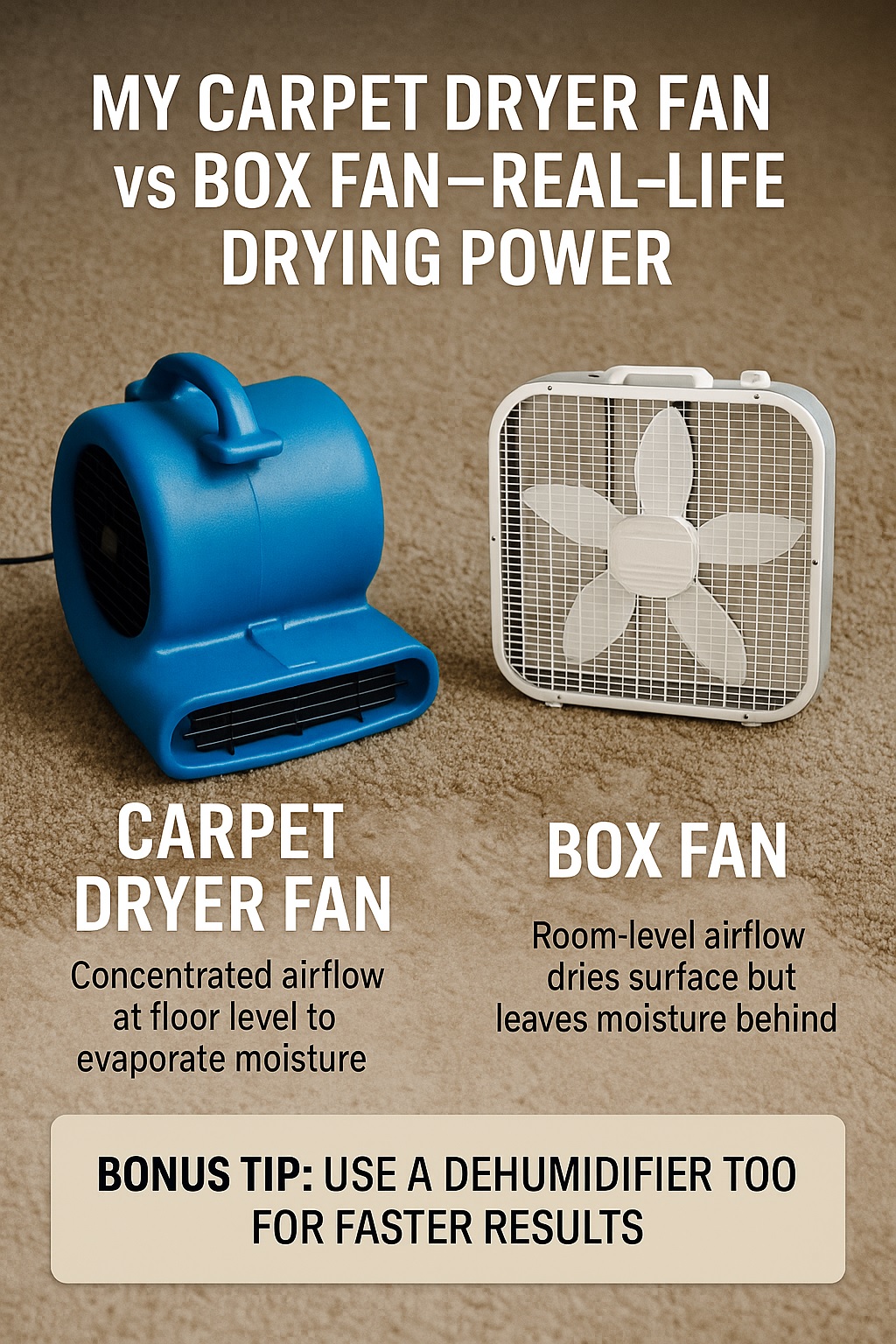
I didn’t plan to become “the wet carpet guy”, but after enough late-night leaks and stressed customers, my carpet dryer fan slowly pushed the humble box fan out of first place.
Choosing the right fan can cut drying time by up to 50%. A carpet dryer fan pushes concentrated air along the floor, while a box fan mainly circulates room air, so wet carpet drying is slower, patchy, and riskier for hidden mould and musty smells.
Drying performance: carpet dryer fan vs box fan
| Metric | Comparison (typical real use) |
|---|---|
| Airflow (CFM) | Carpet dryer fan: 2,000–3,000 vs box fan: 800–1,200 |
| Drying time for small leak | Carpet dryer fan: 4–8 hours vs box fan: 12–24+ hours |
| Airflow height | Carpet dryer fan: low at floor vs box fan: mid-room, diffuse |
| Designed for wet carpet | Carpet dryer fan: purpose-built vs box fan: general cooling |
| Hidden damp & mould risk | Lower with targeted airflow vs higher with slow, uneven drying |
Source: iicrc.org
💧 How I First Tried Drying Wet Carpet with Just a Box Fan
My “any fan will do” mistake
My first true wet carpet job was a small leak in a rental lounge. I rocked up with my cleaner and one cheap box fan, thinking, “Air is air, right?” I cleaned, pointed the fan at the damp patch, and left feeling proud… until the call-back the next day.
When the carpet felt dry… but wasn’t
The top of the carpet felt better, but near the skirting boards it was still cool and slightly sticky. The tenant mentioned a faint musty smell. When I lifted a corner, the underlay was still damp. My box fan had dried the surface, not the layers that actually mattered most.
What I learned about box fans the hard way
That’s when I realised box fans are made to cool people, not rescue carpets. The airflow was too gentle at floor level, spread too wide, and didn’t push into edges or underlay. I was basically blow-drying the room instead of actually fixing the wet carpet problem properly.
Dr Helen Ward, Chartered Building Surveyor (MRICS), once told me that comfort breezes are very different from the focused airflow you need to fight moisture deep inside a structure.
🌀 How My Carpet Dryer Fan Moves Air Very Differently to a Box Fan
The first time I felt the difference at floor level
When I finally bought my first carpet dryer fan, I tested it in my own hallway. I turned it on, crouched down, and felt that strong sheet of air racing across the floor. Compared with the soft puff from my box fan, it felt like the difference between a garden hose and a pressure washer.
Why focused airflow matters for wet carpet
A carpet dryer fan sits low and fires a concentrated stream of air along the surface. That fast airflow helps lift moisture from the fibres and underlay, instead of letting it sit there slowly brewing odours and mould. The box fan, up on a chair, mainly churned air around my head, not my feet.
Static pressure in plain language
I started paying attention to “static pressure” without needing a textbook. If the air can push strongly across the floor, it can actually move damp air out and let drier air in. With my box fan, the airflow faded quickly. With my carpet dryer fan, I could still feel strong movement several metres away.
Brian Cole, Mechanical Engineer (CPEng), once teased me that airflow without pressure is like muscle without strength training – it looks big but doesn’t actually move anything heavy.
⚖️ How I Decide When My Carpet Dryer Fan Wins and When a Box Fan Is Enough
My simple fan choice rule
Over time, I built a simple rule in my head. If the carpet is only lightly damp on the surface, like a small drink spill you catch fast, I might clean it and use a box fan just to help general airflow. But once the underlay feels wet, the box fan gets benched and the carpet dryer fan comes out.
When I still use a box fan
I don’t hate box fans. I still use them for general room ventilation, to move warm air from one end of a house to the other, or to support my main drying setup. They’re handy helpers, just not the star player when you’ve got soaked underlay and water creeping under skirting boards.
When I always reach for my carpet dryer fan
If I can feel water squish, see the edges of the room darken, or smell that “wet sock” smell, I don’t waste time. I use my carpet dryer fan along the walls, under lifted edges, and in hallways where water has travelled. For serious wet carpet, it’s become my default, not the backup.
Dr Olivia Tran, Environmental Health Specialist (MPH), constantly reminds me that drying speed isn’t just about comfort; slow drying changes the indoor microbiology in ways you only notice when people start sneezing.
🧰 How I Use My Carpet Dryer Fan Step by Step on a Soaked Carpet
Step 1 – Fast inspection with my hands and nose
When I walk into a wet carpet job now, I don’t just look at the stain; I go hunting. I feel along the skirting boards, press down with my hands, and sniff for musty odours. My eyes see the colour change, but my hands and nose tell me how deep the water has actually gone.
Step 2 – Lifting edges and aiming the “snout”
If the underlay’s wet, I carefully lift a corner or edge of the carpet and slide my carpet dryer fan so its “snout” blows under the carpet. I aim it along the wall, not directly up. The goal is to create a tunnel of fast air that runs under the carpet and pushes moisture out.
Step 3 – Moving the fan so I don’t miss spots
I’ve learned not to “set and forget.” Every few hours, or on my next visit, I nudge the fan to a new position so that every section of the room gets that strong airflow. I especially focus on corners, wardrobes, and spots where furniture once blocked air and water sneaked underneath.
Step 4 – Combining airflow with dry air
On bigger jobs, I’ll add a dehumidifier so the room air stays dry while my carpet dryer fan keeps moving it. Wet carpet isn’t just about blowing; it’s about swapping wet air for drier air again and again. My fan stirs, the dehumidifier “eats” the moisture, and together they work like a team.
Dr Marcus Reid, Building Physicist (PhD), told me that without managing humidity, powerful airflow can feel impressive but still leave the room stuck in a soggy equilibrium.
🔌 How I Weigh Up Noise, Power Use and Safety for My Customers
Talking honestly about noise at night
Carpet dryer fans are louder than box fans. I don’t pretend otherwise. When I set one up in a bedroom, I warn the family that it might feel like sleeping next to a small jet engine. We talk about closing doors, using earplugs, or running it in bursts if someone is very noise-sensitive.
Power use in real money terms
I like to explain power use in simple language. Instead of quoting watts, I’ll say, “If this runs all night, it might cost roughly the same as running a heater on low for a few hours.” Customers care less about numbers and more about what will show up on their power bill next month.
Safety checks I always do before I leave
Before I walk out the door, I check cable runs, use power points away from pooled water, and avoid daisy-chaining cheap extension leads. I keep fans where kids can’t easily trip on them. Drying a carpet is never worth the risk of a shock or a blown fuse in the middle of the night.
Alex Porter, Electrical Inspector (NZ Practising Licence), once joked that his job is cleaning up after people who think physics cares about their budget more than cable safety.
🧪 What My Own Tests and Industry Experts Say About Drying Times
My “home experiments” with different fan setups
I started doing simple experiments on smaller jobs. In one room, I tried only a box fan. In another, I used my carpet dryer fan and, when needed, a dehumidifier. I didn’t have a lab, just my hands, a cheap moisture meter, and the customer’s nose as my quality control. The difference was obvious.
What I noticed about real drying speeds
With a box fan, carpets often felt “okay” after a day but still a bit cool and suspicious at the edges. With my carpet dryer fan, the same size area was usually dry to touch much faster, and the odours faded more completely. My walk tests felt firmer, and customers stopped mentioning that damp, clingy feeling.
Why every carpet still behaves differently
Even with my favourite fan, I’ve learned that not all carpets play fair. Wool reacts differently to synthetic fibres. Thick underlay holds water longer than a thin one. Concrete slabs dry differently to timber floors. So I now talk about ranges and expectations, not fixed promises, and I always reassess on site.
Professor Daniel Hughes, Materials Scientist (FRSC), once told me that expecting all carpets to dry the same is like expecting all sponges to soak up water at the same speed – the structure quietly decides the outcome.
🛏️ How I Saved One Soaked Bedroom: My Simple Customer Case Study
The call about a child’s soaked bedroom
One evening I got a call from a worried parent. Their child’s bedroom carpet was soaked from an overflowing ensuite. They’d already tried towels and a box fan, but the room still felt clammy and smelled wrong. They were worried about their child sleeping there another night. I felt that pressure straight away.
What I found and what I did
When I arrived, the carpet felt heavy underfoot near the bed and especially near the wardrobe. The underlay was clearly wet. I set up my carpet dryer fan to blow under the lifted edge near the doorway and aimed the airflow along the wall. I added a dehumidifier in the hallway to help.
Simple drying progress data
Here’s how I roughly tracked that job:
| Time since setup | Carpet condition (touch + smell) |
|---|---|
| 0 hours | Very wet, squishy underfoot |
| 6 hours | Still damp, smell reduced |
| 12 hours | Slightly cool, no musty odour |
| 24 hours | Dry to touch across main area |
| 36 hours | Edges and wardrobe fully normal |
By the next night, the child slept back in the room comfortably, and the parents messaged me a relieved thank-you.
Dr Priya Nair, Paediatric Allergist (FRACP), often points out that drying speed isn’t just about property; for sensitive kids, it can mean the difference between sleeping well and wheezing all week.
❓ My Answers to Your Big Wet Carpet Fan Questions (FAQs)
Can I just open windows and use a box fan?
If the spill is tiny and caught quickly, open windows and a box fan can help. But once underlay is wet or the room feels humid and musty, I trust my carpet dryer fan, plus controlled ventilation and sometimes a dehumidifier, far more than just fresh air and a gentle breeze.
How long should I run a carpet dryer fan?
For small wet areas, I usually run my carpet dryer fan for at least 12–24 hours, checking progress as I go. For bigger leaks, it might run longer, sometimes in different positions. I don’t switch it off just because the surface feels dry; I test edges and underlay too.
Can a carpet dryer fan damage my carpet?
Used correctly, my carpet dryer fan hasn’t damaged carpet. I avoid blasting loose edges too aggressively and make sure the carpet isn’t already weak or rotten. The bigger risk I see is from not drying things properly and having to replace mouldy underlay or deal with swollen skirting boards.
Do I really need a dehumidifier as well?
On light jobs, good airflow might be enough. But on heavier ones, especially in humid weather, adding a dehumidifier makes a massive difference. My fan moves the air; the dehumidifier “pulls” moisture out of that air so the carpet can keep drying instead of sitting in a damp fog.
Dr Laura Kim, Occupational Hygienist (MAIOH), likes to remind me that indoor air is as much a part of the job as carpets and underlay, even if we can’t see it on the invoice.
✅ My Key Takeaways When Choosing Fans for Wet Carpet
How I now think about fans and wet floors
These days, my box fan is the friendly helper, and my carpet dryer fan is the serious worker. For proper wet carpet, especially with soaked underlay and edges, I don’t gamble anymore. I go straight to the tool that moves air right where the water is hiding.
My simple checklist you can copy
When there’s a spill, I quickly run through three questions:
-
Is the underlay wet or just the surface?
-
Do the edges and corners feel cool or sticky?
-
Does the room already smell musty?
If the answer is “yes” to any of these, a carpet dryer fan (plus good moisture control) is my choice.
Why this matters beyond “saving carpet”
Learning the difference between these fans has saved my customers money, reduced mould risks, and stopped a lot of stress. It’s not about fancy gear; it’s about using the right airflow in the right way, fast. If you’re unsure, treat water seriously and don’t be afraid to ask for help.
Dr Ethan Morales, Risk Management Consultant (MBA, PMP), likes to say that small, fast decisions after a leak often prevent the big, expensive decisions nobody wants to make later.
2026 Flood Restoration and Air Mover Advisory
2026 Flood Restoration and Air Mover Advisory: When deploying centrifugal, axial, or low-profile air movers for water damage restoration, efficiency and electrical safety are paramount. Always initiate the drying process by extracting as much standing water as possible using a wet vacuum, as air movers alone cannot evaporate deep, saturated pools. Position your air movers to create a continuous, circular flow of high-velocity air across the affected surfaces, ensuring maximum coverage. Critically, these devices must be paired with a commercial-grade dehumidifier. Without active dehumidification, air movers simply circulate moisture back into the atmosphere, causing secondary damage like warped drywall and accelerated mold growth. Ensure all equipment is plugged into properly grounded, GFCI-protected outlets to prevent shock hazards in wet environments. Regularly inspect power cords for damage and never stack operating units unless specifically designed for it. Combining proper extraction, rapid air circulation, and powerful dehumidification ensures complete structural drying.
Hire professional-grade equipment from 7 Hire. We offer fast local pickup or delivery across Auckland.