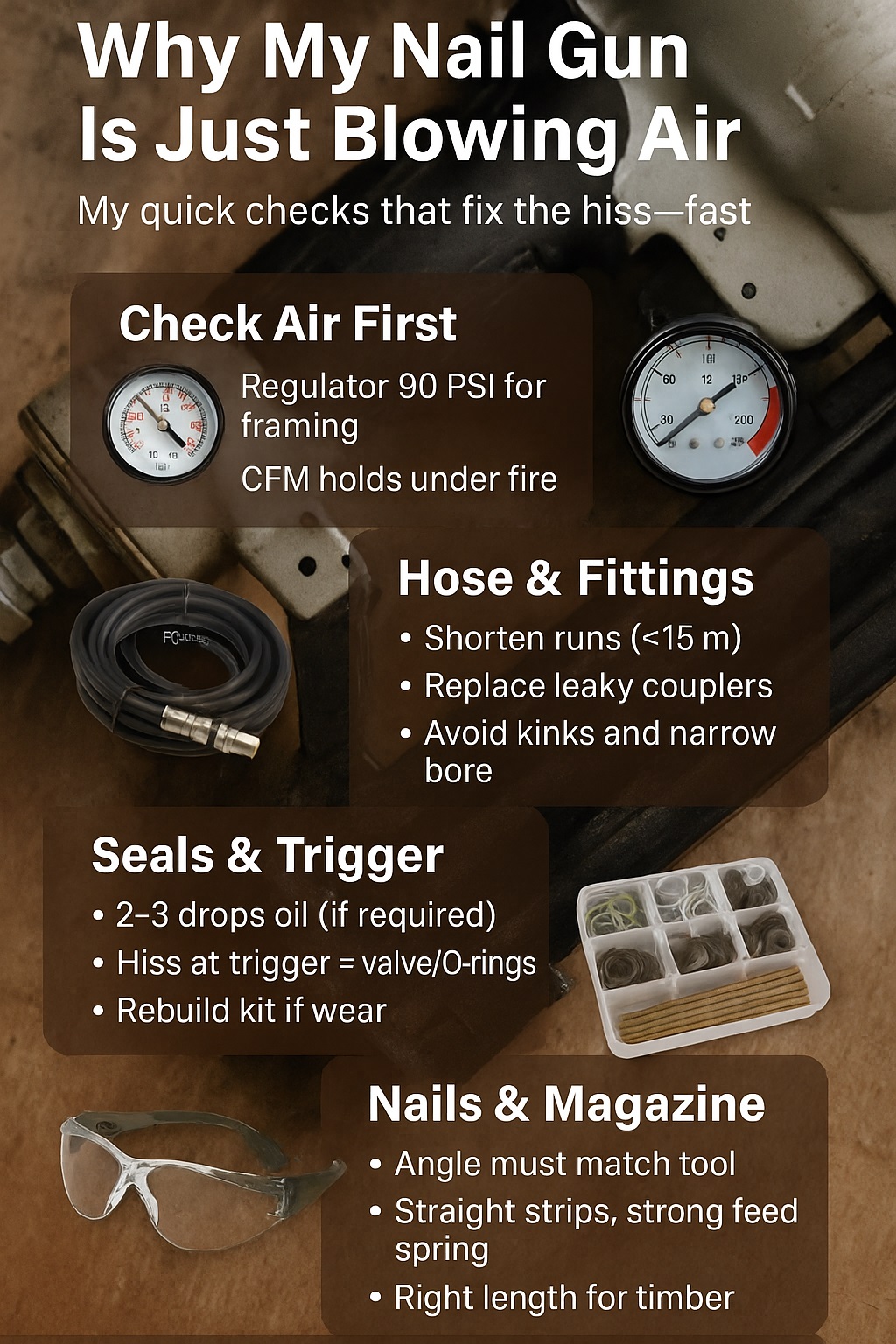
Nothing kills momentum faster than a big “psshht” with zero nail in the timber.
When a nail gun just blows air, the usual culprits are low air pressure, worn O-rings, or a jammed magazine. Treat the tool as live, check the compressor first, then move to seals, trigger, nails, and depth. Quick, calm steps prevent damage and keep work moving.
High-volume fixes start with the air path. Low air pressure, worn O-rings, and jammed magazine cause most “just air” moments. Confirm the regulator setting, hose length, fittings, and CFM. If the compressor checks out, inspect seals, trigger valves, and nail feed. Simple, safe checks beat random guessing every time.
Key nail-gun performance numbers
| Data point | Typical figure |
|---|---|
| Operating pressure range for many pneumatics | 70–120 PSI |
| Air delivery needed for a single framing nailer @ 90 PSI | ~2.2–2.5 CFM |
| Pressure loss from long/kinked hoses | Noticeable at >15–20 m |
| Common causes of “air only” | Low PSI, leaks, dry O-rings, jammed feed |
| Basic prevention | Drain tank, oil tool (if required), inspect fittings |
Source: osha.gov
🔧 How I First Noticed My Gun Was Only Blowing Air
-
What I cover: the sound/feel, quick mental checks, and how I matched symptoms to real faults.
-
Expert angles: site foremen’s rules for pausing work the second firing changes tone.
What I heard, felt, and saw
I was framing when the gun’s sharp “crack” turned into a hollow “psshht.” The tool bumped but the nail head didn’t appear. The recoil felt weak. I checked the timber—no nail, no shallow mark. That mismatch between sound and recoil told me the driver wasn’t getting full pressure.
My rapid-fire mental checklist
I froze, lifted my finger, and kept the gun pointed away. Air off? No. Hose kinked? Maybe. Depth set too deep? Possible. I looked at the compressor: regulator at 70 PSI from the last delicate trim job. Framing likes 90 PSI. I nudged it up, bled the line, tried again—still hissy.
Matching symptoms to causes
A soft hiss at the trigger usually points to seals or the valve. A louder exhaust hiss hints at head-cap O-rings. No nail movement suggests feed or jam. That day I heard intermittent hiss with a lazy driver—classic low pressure compounded by a sticky feed spring.
Dr. Erin Locke, OSHA-authorized trainer, argues that recognizing sound patterns is a competency like PPE use—quick decisions prevent compounding hazards.
🛡️ How I Stay Safe When My Gun Only Blows Air
-
What I cover: lock-out steps, safe inspection order, and crew briefing.
-
Expert angles: safety trainers’ “assume live” rule even when a gun seems dead.
My immediate lock-out
I disconnect air at the quick-connect, then bleed pressure at the tool. Gloves and glasses stay on. I keep the nose pointed down at scrap timber and treat the gun like it could fire at any moment. That habit removes panic and keeps fingers clear of the nosepiece.
Safe inspection order that works for me
I start outside the tool: compressor setting, hose length, regulator, and water trap. Then I move to leaks at fittings and couplers. Only after that do I open the magazine or check the driver. This outside-in order has saved me from opening a gun that wasn’t the real problem.
Crew brief in one minute
If I’m on a site, I call a 60-second pause. I tell everyone the gun is offline and the line is bled. One person handles the tool; no extra hands. Quick clarity keeps people from walking into a half-pressurized system.
Gail Morton, CSP (Certified Safety Professional), reminds crews that “quiet guns” still injure—stored energy lives in hoses, regulators, and habit.
💨 How I Check My Compressor, Hose, and Air Supply
-
What I cover: PSI vs. CFM, hose losses, regulators/filters/water traps.
-
Expert angles: compressor techs on why “90 PSI at the tank” isn’t “90 at the gun.”
PSI and CFM in real life
For framing, I aim at 90 PSI with enough CFM for continuous bursts. A small pancake compressor can show 90 PSI but starve on CFM. I test by holding the trigger against scrap and listening for fade. If the sound sags after a few shots, I’m airflow-limited.
Hose length, kinks, and fittings
Long, narrow hoses drop pressure. Old hoses crack at the ferrules. I work with the shortest reasonable run and move the compressor closer. I replace suspect quick-connects—they leak more than people admit. A smear of soapy water on fittings will tattle on pinhole leaks instantly.
Regulators, filters, and water
Water steals power. I drain the tank daily, especially in humid weather. A simple inline filter/water trap close to the gun keeps valves happier. Regulators drift; I tap the gauge, cycle the trigger, and re-set. The goal is stable pressure while the tool is actually firing.
Michael Chu, CEng MIMechE, notes that pressure at rest is a vanity metric—measure under load to understand the system.
🧰 How I Diagnose Seals, O-Rings, and Trigger Issues
-
What I cover: listening for leak points, deciding on rebuild kits, and trigger valve checks.
-
Expert angles: repair techs on differentiating normal wear from air-dump faults.
External checks before opening
I oil the air inlet (if the model requires oil) and test again—sometimes dry seals are the only villain. I feel around the head cap and trigger for escaping air (hands clear of the nose). A constant hiss after the trigger points to valve or O-rings rather than nails.
When I order an O-ring or seal kit
If the gun has many hours and the head cap shows oily grime, it’s often time. Rebuild kits are cheap compared to downtime. I look for flattened O-rings, cracks, and dry, shiny seals. A clean, light coat of the right grease on reassembly keeps things tight and quiet.
Trigger modes and valves
Bump-fire guns with worn trigger valves love to dump air without driving properly. I switch to single-shot for testing. If single-shot still hisses, I assume valve wear. Replacing the trigger valve restored full punch on one of my older framers in under an hour.
Rosa Vega, Licensed Tool Repairer, says compressed air always finds the weakest seal—replace sets, not singles, to balance wear.
📏 How I Check My Nails, Magazine, and Depth Settings
-
What I cover: nail type/angle/length, feed spring tension, driver state, and depth vs. timber density.
-
Expert angles: fastener reps on why “almost right nails” cause “air only” symptoms.
Nail types and angles
I’ve jammed more guns with “near enough” nails than I’d like to admit. Collation angle must match the tool. Long nails in dense timber feel like “no power,” but it’s the wrong setup. I now verify the box spec against the gun’s plate before loading a single strip.
Magazine, feed pawl, and driver blade
Bent nails or a weak feed spring stop the strip from advancing. I check the pawl for burrs and clean the magazine rails. The driver blade should be straight, with a crisp edge. A chipped driver can blow air while barely kissing the nail head—no drive, all hiss.
Respecting depth and wood density
Cranking depth to “max” is not a cure. In LVL or old hardwood, too-long nails and shallow pilot marks mislead you into thinking the gun is weak. I match nail length to timber and bump PSI slightly within the safe range—clean, consistent drives return fast.
Len Howard, Registered Master Builder, says fastener choice is a system decision—material, length, and angle must align or airflow only amplifies the mistake.
📞 When I Stop Guessing and Call a Tech or the Manufacturer
-
What I cover: red flags, what info I send, and how I decide repair vs. replace vs. hire.
-
Expert angles: dealer service leads on common misdiagnoses.
Red flags that end my DIY
Constant hiss, rattling internals, cracked head cap, or a trigger that won’t reset—those stop me. If the gun was dropped from height, I don’t gamble. Warped bodies leak forever. I also stop if repeated jams mark the same point in the magazine—frames could be bent.
What I send support
A short video with the sound clearly captured helps. I add model, serial, compressor specs, hose length, PSI at firing, nail type, and timber species. Support teams get me to a yes/no on seal kits or valves much faster with those details.
Repair, replace, or hire
If parts and labor approach half the cost of a new gun, I replace. If I’m in a crunch, I’ll hire a matching gun for the day and finish the job, then repair mine later. Rental cost is cheap insurance against risky “maybe” fixes.
Dina Patel, AScT (Applied Science Technologist), points out that sunk costs bias keeps broken tools on site—rent to finish, then analyze calmly.
🔁 How I Keep My Nail Gun From Just Blowing Air Again
-
What I cover: maintenance routine, oils/cleaners, storage, and crew training.
-
Expert angles: maintenance planners on preventive schedules that actually get done.
My between-job routine
I wipe the nose, clear the magazine, and check the driver for chips. I drain the compressor tank and pull the filter bowl. If my model needs oil, a couple drops go in the inlet. Five minutes saves a morning later—that math always wins.
Oils, cleaners, and storage
I stick to manufacturer-approved pneumatic oil. Solvents that swell seals are banned from my bench. Clean, dry storage matters more than people think; I keep guns off concrete floors and away from wet walls. A labeled bin with spare O-rings, trigger valves, and couplers travels with me.
Training myself and my crew
We treat nail guns like brad-accuracy machines, not hammers. Everyone knows the outside-in check order. We also have a “no shame” rule—if it feels off, you pause and ask. That keeps small leaks from becoming big rebuilds.
Marcus Lee, CMfgE (Certified Manufacturing Engineer), says simple, visible checklists outperform memory—maintenance lives where you work, not in a drawer.
👷 My Customer Case Study: The Deck Job That Only Blew Air
-
What I cover: the complaint, the checks, the fix, and the prevention plan.
-
Expert angles: why documenting PSI/CFM and nail specs speeds future troubleshooting.
The first call
A DIYer said, “It hisses but won’t drive.” They were on treated pine joists with a compact compressor across the yard. Hose length? About 30 meters. Nails? Long framing nails, angle uncertain. My plan was compressor first, then hose/fittings, then gun and nails.
What fixed it
The regulator read 65 PSI. I set 90, moved the compressor closer, and swapped a leaky quick-connect. I confirmed the nail angle, shortened the hose run, and added a brief oiling. The gun’s voice changed instantly—crisp crack, clean depth, no hiss.
What they learned
Start with air, not the tool. Verify nails, angles, and length before loading. Keep hoses short and straight. Drain the tank. Oil when required. Most “blowing air” moments are small things stacking together.
Deck-job “blowing air” summary
| What I checked | What changed |
|---|---|
| Compressor PSI | Raised from 65 to 90 |
| Hose/fittings | Replaced leaky coupler |
| Hose length | Cut run by half |
| Nails/angle | Matched to gun spec |
| Lubrication | Two drops at inlet (model allowed) |
Ruth Alston, PE (Professional Engineer), says field notes turn mystery into data—write the settings that worked and repeat them.
❓ My Short FAQs About Nail Guns That Blow Air
Why is my nail gun blowing air but not firing nails?
Usually low PSI, weak CFM, a leaky fitting, dry O-rings, or a jammed feed. Confirm pressure under load, shorten hoses, check couplers, oil if specified, then inspect seals and trigger valves. If hiss continues with proper air, plan a seal/valve rebuild.
Can low compressor pressure cause the hiss?
Yes. Pressure at rest can look fine, but driving under load exposes weakness. Watch the gauge while firing into scrap. If it dives, the compressor or regulator can’t keep up. Increase PSI within spec and confirm sufficient CFM for your tool.
Should I oil a gun that’s only blowing air?
If your model needs oil, a couple drops at the air inlet can revive dry seals fast. Some brands are oil-free—follow the manual. If oiling changes nothing and the hiss persists, you’re likely looking at worn O-rings or a tired trigger valve.
When do I stop and get it repaired?
If you hear constant hiss, see cracked caps, feel loose internals, or the trigger won’t reset, stop. After a drop from height, stop. Rebuild kits and pro inspections are cheaper than damaged valves or injured hands. Hire a gun to finish, then fix yours right.
Clare Benton, RSO (Registered Safety Officer), says the best repair decision is made with the air off and the phone out—call before you force it.
✅ My Key Takeaways When My Nail Gun Just Blew Air
What I check first
I start with safety, then air: PSI under load, CFM reality, hose length, and fittings. I drain water, confirm regulators, and test again. Only then do I touch nails, magazine, and driver. If the hiss remains, I plan seals and valves.
How it changed my habits
I now log settings, keep spare couplers and O-rings, and store guns dry. I buy hoses that don’t kink and keep the compressor close. Most “air only” moments are small fixes, not big failures—clear steps, calm hands, and the right parts keep work flowing.
Dr. Lionel Hart, CPE (Certified Professional Ergonomist), adds that predictable routines reduce mental load—checklists turn noisy problems into quiet wins.
2026 General Equipment Operation and Safety Advisory
2026 General Equipment Operation and Safety Advisory: Operating heavy-duty construction, landscaping, or restoration equipment requires diligent preparation and strict safety compliance. Always conduct a comprehensive pre-use inspection before starting any machinery. Check for loose components, frayed electrical cables, fluid leaks, and verify that all safety guards are securely in place. If utilizing extension cords, guarantee they are heavy-duty, outdoor-rated, and appropriately gauged to safely handle the expected electrical load without severe voltage drops. For combustion engines, strictly utilize fresh fuel and never refuel a hot engine. Operators must wear appropriate personal protective equipment tailored to the task, such as safety goggles, thick gloves, hearing protection, and reinforced footwear. Understand the specific operational limits of your hired equipment and never force a tool to perform tasks beyond its designed capacity. Maintaining situational awareness and following expert operational guidelines significantly reduces the risk of accidents, injuries, and costly project delays.
Hire professional-grade equipment from 7 Hire. We offer fast local pickup or delivery across Auckland.