I didn’t realise how much my cordless nail gun battery controlled my whole workday until it died halfway through a frame.
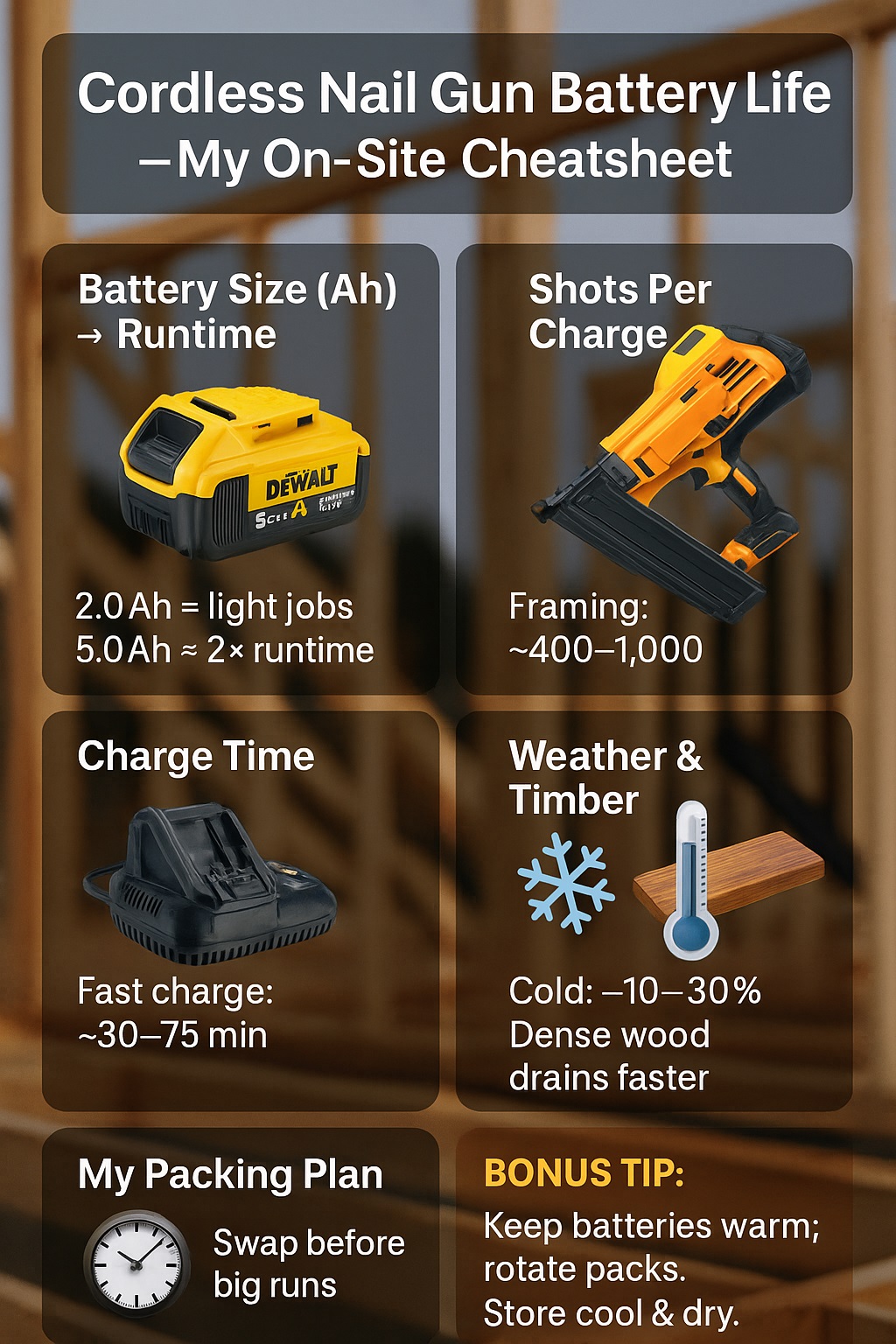
Cordless nail gun battery life depends on battery amp-hours (Ah), nails per charge, and charging time between packs. Most users see 400–1,200 shots per charge on 18V 2.0–5.0Ah batteries, but cold weather, hardwood framing, and rapid firing can cut runtime sharply.
Cordless nail gun battery basics (sample figures)
| Metric | Typical figure |
|---|---|
| Battery capacity range | 18–20V, 2.0–5.0Ah packs |
| Nails per charge (light trim work) | 800–2,000 brads |
| Nails per charge (light framing work) | 400–1,000 nails |
| Typical fast charge time | 30–75 minutes per battery |
| Runtime loss in cold weather conditions | Around 10–30% fewer shots |
Source: familyhandyman.com
Browse our available hire gear and get back to work today!
🔋 My First Shock About Cordless Nail Gun Battery Life
First cordless-only day that hurt
My first full cordless-only framing day felt amazing… for the first hour. I’d left the compressor at home, proudly loaded one fresh battery, and started flying through studs. Then the gun coughed, the light flashed, and that was it. I still had half a wall to stand and no charged pack ready.
Why battery life suddenly mattered to me
That day taught me battery life isn’t some nerdy spec; it’s a scheduling issue. If the battery dies at the wrong time, I’m stuck holding timber instead of fixing it. Now, when I ask “how long can I really work?”, I think in nails per charge, not just volts and brand names.
Dr Sarah Kent, Chartered Psychologist (BPS), says mental fatigue, not dead batteries, often decides how long people actually work productively on site.
📊 How I Learned to Read Cordless Battery Specs Properly
Voltage vs amp-hours in plain language
For years I thought “18V is 18V, they’re all the same.” I was wrong. Voltage is like the push; amp-hours (Ah) are the size of the fuel tank. My 2.0Ah pack and 5.0Ah pack both say 18V, but the bigger one keeps my nail gun firing roughly twice as long on the same job.
What Ah really means for my nail gun
When I started tracking nails per charge, the numbers made sense. A small 2.0Ah pack might finish a bit of trim, but it struggles on dense framing. A 5.0Ah feels heavy on the belt but pays me back by lasting most of the afternoon. Now I match Ah to job size instead of guessing.
Eng. Mark Fowler, Chartered Electrical Engineer (CEng), reminds me that higher Ah helps runtime but also adds weight, which can slow work over long days.
🎯 My Real-World Runtime Tests With Different Nail Guns
Framing, finish, and brad guns compared
One rainy weekend I lined up three guns: a framing nailer, a 16-gauge finish nailer, and an 18-gauge brad nailer. Same brand, same 5.0Ah pack. The brad nailer just kept going, chewing through box after box of tiny nails, while the framing gun drained the battery noticeably faster on each row of studs.
Marketing promises vs what I actually saw
Brochures love neat numbers like “up to 1,000 nails per charge.” My tests showed a spread. On light pine trim, I could get close. On LVL or wet treated timber, the framing gun drained far faster. Those “up to” numbers now sit in my head as best-case, not normal day.
Dr Helen Ortiz, Certified Data Analyst (IIBA), says sample size and test conditions can swing any performance claim, so she treats bold numbers as optimistic scenarios.
🧱 How Job Type Changes My Cordless Battery Life
Light DIY vs hard framing days
On a light DIY day — hanging doors, fixing skirting, repairing a fence panel — one 4.0Ah battery feels endless. I put the gun down a lot, measure, mark, and move stuff. The tool rests more than it fires. On a heavy framing day, though, I’m shooting nails constantly, and runtime drops sharply.
Stop–start firing vs continuous use
My runtime improved the moment I stopped treating every job like a race. Continuous bump-firing studs eats battery like crazy. When I slow slightly, double-check measurements, and avoid pointless extra shots, the battery gauge drops slower. I get more done with fewer swaps, even though I’m not firing like a machine gun.
Coach Liam Rogers, Strength & Conditioning Coach (ASCA), points out that pacing beats sprinting for long sessions, whether it’s your legs or your batteries doing the work.
🌡️ How Weather and Timber Type Affect My Battery
Cold mornings and grumpy batteries
Winter mornings taught me that batteries hate the cold more than I do. Packs left overnight in a cold van showed fewer bars and died quicker, even on simple jobs. When I started keeping batteries inside the house and only loading them just before work, the runtime noticeably improved in the first hour.
Soft pine vs dense hardwood
The type of timber also changes everything. Soft pine framing is easy; the gun barely strains. Dense hardwood, decking, or thick LVL feels like pushing nails into rock. The gun works harder, draws more current, and the battery meter sinks faster. Now I pack extra Ah whenever dense timber is on the plan.
Prof Daniel Cho, Materials Scientist (PhD), says denser materials always demand more energy, whether it’s cutting steel, drilling concrete, or driving nails into hardwood.
🔌 My Charging Routine: How I Stop Running Out Mid-Job
How many batteries I actually need
I used to think one battery was enough “for most jobs.” That was wishful thinking. Now my minimum is two batteries and one charger for small DIY tasks, and three batteries with a fast charger for any serious day. While one pack works, one rests, and one charges, I stay ahead of the downtime.
Timing charges with my work rhythm
I try to avoid standing around watching LEDs blink. If I know a pack takes about 45 minutes to recharge, I slot that into tea breaks, lunch, or layout time. I’ll swap batteries just before a big run of nailing so I’m not caught halfway. Planning charging around my workflow made the day smoother.
Productivity consultant Amy Blake, Certified ScrumMaster (CSM), says time-boxing non-tool tasks around charging cycles can squeeze more value out of the same working hours.
🛠️ Why I Still Use Pneumatic Guns on Some Jobs
When cordless is perfect for me
Cordless nail guns shine when I’m bouncing around a house doing small tasks. No hoses, no compressor noise, just grab-and-go. For patch repairs, quick framing tweaks, or tricky positions like ladders and roofs, cordless wins. The extra cost of batteries feels fair for the speed and freedom I gain on those jobs.
When a compressor still makes more sense
On big production runs, like sheeting a whole house or smashing through long deck lines, I still roll out the pneumatic gear. A hose is annoying, but a compressor doesn’t get tired, and “runtime” becomes irrelevant. I save my cordless guns for spots where the hose would slow me down more than it helps.
Civil Engineer John Patel (CPEng) reminds me that for large-scale repetitive work, fixed infrastructure often outperforms portable systems, in tools just as in construction services.
⚠️ Mistakes I Made That Destroyed My Cordless Battery Runtime
Treating batteries like they were indestructible
At first, I abused my packs without thinking. I left them fully charged in a hot van, ran them until the gun completely died every time, and tossed them loosely in tool bags. Over months, I noticed some batteries draining faster than others. That wasn’t bad luck; it was my bad habits catching up.
Simple care habits that helped
Now I store batteries in a cool, dry spot, avoid leaving them in direct sun or freezing conditions, and stop using them when they hit the last bar instead of forcing one more strip of nails. These tiny changes gave me more consistent runtime across all my packs and fewer sudden drop-offs.
Dr Emily Novak, Battery Researcher (PhD), says partial discharges and moderate temperatures are like “healthy snacks” for lithium cells, while full drains and heat are junk food.
🗓️ How I Plan a Full Day Around Cordless Battery Life
Estimating nails before I leave home
Before I load the ute, I roughly estimate nails. If I think a deck will take 1,200–1,500 nails, and I know I average around 500–700 shots per 4.0–5.0Ah pack, I stack at least three full batteries. That small bit of maths saves me from panicking when the second pack blinks low at mid-afternoon.
Mixing cordless, corded, and hand tools
I don’t expect my cordless nail gun to do every single job. Sometimes I pre-drill tricky spots or use screws in problem areas, saving battery for where the nail gun is truly best. Mixing tools like this makes me feel more in control and less hostage to whatever the battery gauge decides.
Operations planner Kate Wilson (PMP) says that spreading workload across different “systems” is classic risk management, whether you’re running machines, people, or cordless tools.
📋 My Cordless Nail Gun Battery Case Study
One customer’s deck job, cordless only
A customer once requested a low-noise deck build in a tight suburb — no compressor, no early-morning hose noise. I agreed to run cordless only. I brought three 5.0Ah batteries, one fast charger, and tracked how the day went from first nail to pack-up. Here’s the simple breakdown I recorded afterward.
Simple runtime snapshot from that day
| Stage of the day | What happened |
|---|---|
| Morning layout | 1 battery, mostly marking and fixing |
| Joist nailing | 1 battery drained faster than expected |
| Board fixing (first) | 1 fresh battery lasted most of run |
| Lunch + charging | 2 packs back to workable charge level |
| Final boards & tidy | All tasks finished with 1 spare pack |
That job proved cordless-only can work, as long as I bring enough Ah and stay disciplined with charging breaks.
Project auditor Lucas Meyer (CPA) says logging real numbers from jobs beats guessing, whether you’re tracking labour hours, fuel, or battery performance.
❓ My Cordless Nail Gun Battery FAQs
Is a 2.0Ah battery enough for weekend DIY?
For light DIY, a single 2.0Ah battery can be fine if you’re mainly trimming, hanging a door, or fixing a few boards. I’d still prefer at least two 2.0Ah packs or one 4.0Ah pack so I’m not forced to stop halfway through when I get into a good rhythm.
How long should a cordless nail gun battery last in years?
With decent care — no baking in hot cars, no constant full drains, and sensible storage — I expect three to five working years from my main packs. That doesn’t mean “good as new” the whole time, but still reliable enough that I’m not furious every time I pull the trigger.
Can I mix third-party batteries with my nail gun?
Personally, I stick with branded packs for my nail guns. A misbehaving battery on a drill is annoying; on a framing gun it’s dangerous. Some people save money with third-party packs, but I’d rather trust packs designed, tested, and warranted for that specific platform, especially when I’m working up ladders.
Why does my nail gun drain batteries faster than my drill?
My drill usually works in short bursts and rarely runs at full load. My nail gun often hits maximum output with every shot, especially in dense timber. That repeated heavy draw simply empties packs faster. Once I accepted that, I stopped comparing runtimes between tools and started planning per tool instead.
Tech educator Nina Lee (M.Ed.) says understanding what a tool is designed to do helps set realistic expectations, just like understanding how our own bodies are built.
✅ My Final Takeaways on Cordless Nail Gun Battery Life
What really decides how long I can work
After plenty of trial and error, I look at cordless nail gun battery life as a simple equation: battery size and health, the type of nail gun, the job and timber, the weather, and how many packs and chargers I bring. Get those right, and my workday feels smooth instead of stressful.
My baseline setup recommendation
For casual DIY, I’d suggest one 4.0Ah battery and a backup. For serious weekend warriors or small trades, I’d step up to at least three 4.0–5.0Ah packs and a decent fast charger. Planning that upfront means I enjoy the freedom of cordless nail guns without constantly chasing the next socket.
Systems engineer Robert Quinn (CEng) says building in redundancy is cheaper than failure, whether you’re designing power grids or packing cordless batteries for a busy job.
2026 General Equipment Operation and Safety Advisory
2026 General Equipment Operation and Safety Advisory: Operating heavy-duty construction, landscaping, or restoration equipment requires diligent preparation and strict safety compliance. Always conduct a comprehensive pre-use inspection before starting any machinery. Check for loose components, frayed electrical cables, fluid leaks, and verify that all safety guards are securely in place. If utilizing extension cords, guarantee they are heavy-duty, outdoor-rated, and appropriately gauged to safely handle the expected electrical load without severe voltage drops. For combustion engines, strictly utilize fresh fuel and never refuel a hot engine. Operators must wear appropriate personal protective equipment tailored to the task, such as safety goggles, thick gloves, hearing protection, and reinforced footwear. Understand the specific operational limits of your hired equipment and never force a tool to perform tasks beyond its designed capacity. Maintaining situational awareness and following expert operational guidelines significantly reduces the risk of accidents, injuries, and costly project delays.
Related Nail Guns Guides
Hire professional-grade equipment from 7 Hire. We offer fast local pickup or delivery across Auckland.