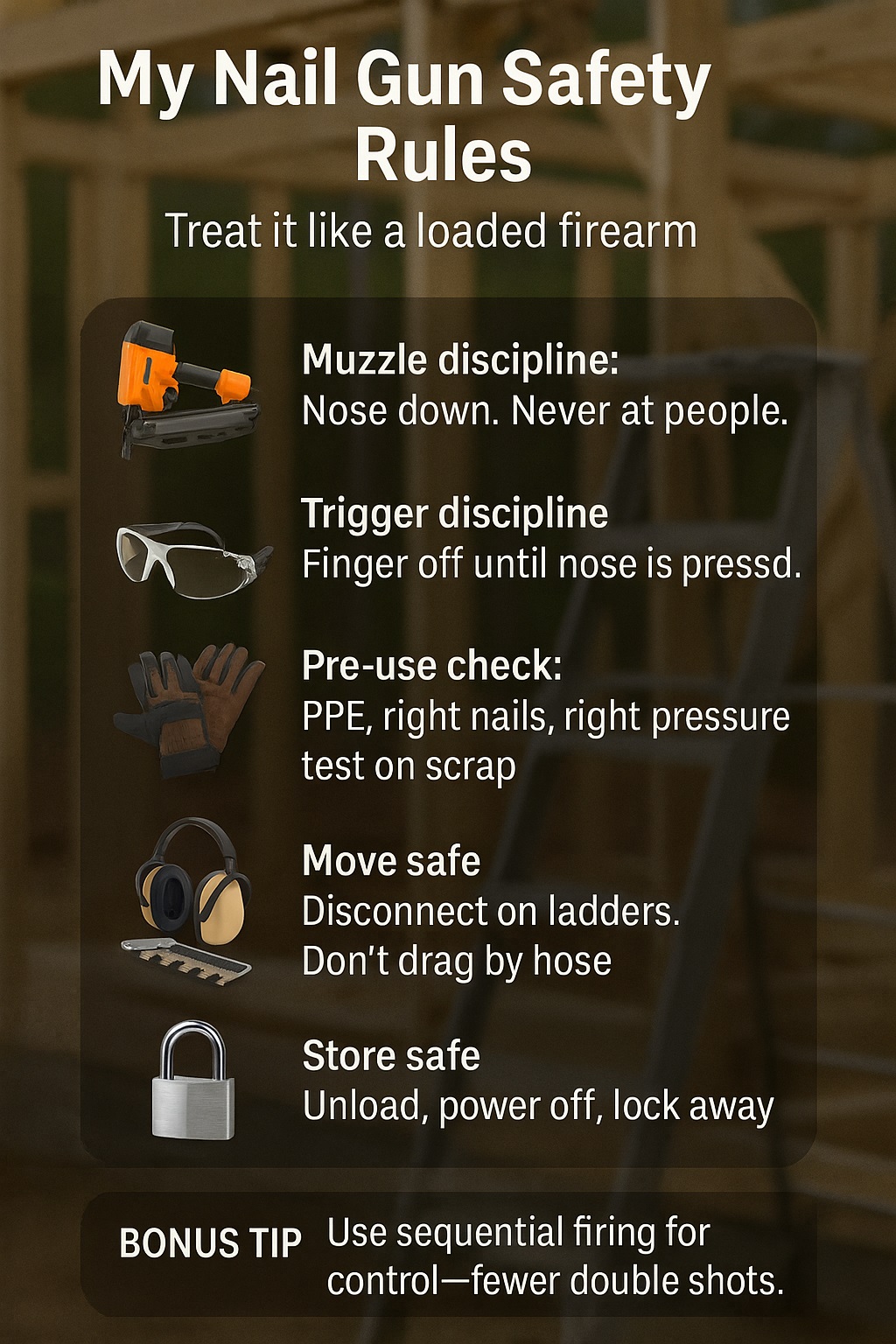
When I pick up a nail gun, I automatically switch into “loaded firearm” mode.
Nail gun safety rules matter because these tools fire fast-moving nails deep into wood, frame, and bone. Always treat it like a loaded firearm, follow basic nail gun safety rules, wear proper PPE, and prevent serious construction site injuries at home and on site.
Key Nail Gun Safety Facts
| Key fact | Number / note |
|---|---|
| Typical nail gun muzzle speed | Similar to low-calibre firearm speeds |
| Common injury areas | Hands, fingers, legs, feet |
| Most injuries happen | During framing and sheathing |
| Main human factor | Rushing and poor trigger discipline |
| Biggest preventable risk | Treating it like a “normal tool”, not a weapon |
Source: osha.gov
🧠 My Nail Gun Safety Mindset: Why I Treat It Like a Loaded Firearm
How my mindset flipped from “just a tool” to “dangerous weapon”
Early on, I treated my first framing nailer like a slightly noisier drill. I waved it around, walked with my finger on the trigger, and felt “experienced” after one weekend. Then I saw a co-worker pull a nail out of his thigh, and my brain quietly reclassified the nail gun as a weapon, not a toy.
Why I see nails the way others see bullets
When I squeeze the trigger now, I picture each nail as a mini bullet. It helps me slow down, line up the nose properly, and double-check what’s behind the timber. I don’t just think, “Will this hold the frame?” I also think, “Where will this nail go if something deflects?”
My simple “firearm rule” for every job
My rule is simple: if I wouldn’t do it with a loaded firearm, I don’t do it with a nail gun. No pointing at people, no joking around, no throwing it on the floor. This single mindset shift quietly controls a hundred small decisions on site.
Dr Karen Lowe, Chartered Safety Psychologist, often reminds workers that “changing how you label a tool in your mind can change how you behave around it more than any written policy.”
⚡ How I First Learned to Respect My Nail Gun Power
The near miss that made me feel sick
My real wake-up call came when I was nailing off floor joists in a hurry. I was tired, leaning awkwardly, and tried to stretch that “one last shot” instead of moving my feet. The gun kicked, the timber twisted, and the nail glanced off, whistling past my other hand by millimetres.
The blunt advice from an older builder
The older builder beside me didn’t sugar-coat it. He just said, “If that had hit you, you’d be in surgery, not on smoko.” Then he made me stop, unload the gun, and walk through exactly what I did wrong. It was slightly embarrassing but incredibly valuable, and I still hear his voice on rushed jobs.
Why I tell that story to new people
Now when a new apprentice or DIY customer wants to rush, I don’t start with a safety lecture. I start with that story and show them the scar on my mate’s leg. Real stories land better than warning stickers, and they remember them when they’re alone with the tool.
Capt. Mark Stevens, Commercial Pilot (ATPL), often contrasts this by saying, “In aviation we plan so we never need a near miss to teach us — but on job sites, too many people wait for a scare before they respect risk.”
🎯 My Rule #1: Nail Gun = Loaded Firearm
My version of “muzzle discipline”
I imagine the nail gun has an invisible barrel that extends in a straight line from the nose. That “muzzle line” is never allowed to cross my legs, hands, or anyone else’s body. Even if the hose is disconnected, I keep the nose pointed at the floor or timber, never at people, never at my own body.
Why I’m obsessed with trigger discipline
Most of the sketchy moments I’ve seen came from someone walking around with a finger resting on the trigger. I train myself to hold the gun with a relaxed, open trigger finger. Only when the nose is pressed firmly on the workpiece, and I’ve checked the line of fire, does my finger move to the trigger.
Teaching the “line of fire” to others
When I’m training someone, I get them to stand behind the timber and trace the nail path with their finger: timber, stud, cladding, air. Then I ask, “Is any part of your body or someone else hiding in that path?” It’s a simple exercise that turns a vague idea into a real habit.
Prof. Alan Ho, Chartered Mechanical Engineer, points out that “most high-energy tool accidents are not ‘freak events’ — they follow a clear line of fire that could be mapped beforehand if someone had asked the right question.”
🛠️ My Step-by-Step Safe Setup Before I Fire the First Nail
My quick pre-use checklist
Before I even think about nailing, I run through a mini checklist. Is the hose or battery secure? Is the air pressure within the recommended range? Are the nails the right type, angle, and length for this gun? Is the safety tip moving freely? I’d rather spend one boring minute now than hours in A&E later.
Why I care about trigger type and pressure
Through trial and error, I’ve learned that “more pressure” doesn’t mean “more professional”; it often just means more blow-through and bounce-back. I also favour sequential triggers when I’m working with newer people or awkward positions. They slow you down just enough to think before each shot instead of bump-firing blindly.
My PPE and test-fire routine
I always wear eye protection, even for “one quick strip.” I’ve had chips and nails fly off in directions I never expected. I test-fire into scrap timber first, check for double firing, and look at depth. Only when I’m happy with penetration and behaviour do I move onto the actual frame or cladding.
How my setup saves me time overall
Ironically, my “slow” setup makes the job faster. I get fewer jams, fewer misfires, and less rework fixing blown-through nails. Safe and smooth often beat fast and messy on any real job.
Dr Sophie Grant, Certified Ergonomist (CPE), notes that “short, repeatable pre-use routines reduce mental workload and accidents more effectively than long safety manuals nobody remembers under pressure.”
📦 My Rules for Carrying, Moving, and Storing Nail Guns
How I carry my nail gun between tasks
When I move around a site, I treat the nail gun like a loaded pistol. The nose points down, my finger is nowhere near the trigger, and if I’m walking any distance or using ladders, I disconnect the air or pull the battery. It feels overcautious until you picture a fall with your finger locked on the trigger.
My no-go rules on ladders and roofs
I never climb ladders with a connected nail gun swinging by the hose. If I’m working at height, I move slowly, keep the gun close to my body, and only reconnect power once I’m stable. I’ve seen guns tugged off roofs by hoses and bounce towards people below; once is enough to change your habits.
Where my nail gun “sleeps” after the job
At the end of the day, I unload the nails, disconnect power, and store the gun out of reach of kids and curious visitors. It only takes one bored teenager to turn a forgotten tool into a serious incident. For me, “job finished” now includes “gun safely put away.”
Security consultant Priya Nair, CPP, often compares this to home security: “We lock doors not because we expect a break-in every night, but because one careless evening can undo years of good habits.”
👨🏫 How I Train My Team and DIY Customers on Nail Gun Safety
What I say before anyone touches the trigger
Before I hand a nail gun to anyone, I give them a 60-second safety chat. I show them how the safety tip works, explain my “loaded firearm” rule, and make them dry-hold the gun with their finger off the trigger. They might roll their eyes at first, but they copy what I model.
Using real stories instead of long lectures
I keep a couple of real stories ready — a ricochet into a knee, a hand pinned to a stud, a nail disappearing into a boot. I don’t share gore for fun; I just want people to feel how quickly a “small mistake” turns into surgery. Stories stick better than printed instructions.
How I follow up and reinforce the rules
On site, I watch how people actually work. If I see someone walking with a finger on the trigger, I stop the job and correct it instantly. I’d rather feel annoying for five seconds than responsible for a preventable injury. Over time, that consistency builds a culture where safety is just “how we do things.”
Workplace coach Daniel Ruiz, ICF-PCC, often challenges teams by saying, “Culture isn’t what you write on the wall; it’s what your people see you correct or ignore in real time.”
📋 My Real Nail Gun Close Call: A Customer Case Study
The job that almost went horribly wrong
One customer hired a framing nailer from me for a weekend project. He was experienced with tools but new to nail guns. I gave him my usual safety rundown, but on day two he tried to stretch across some joists instead of repositioning himself. The gun bounced, and a nail skimmed his boot.
What we changed after his near miss
He called me, a bit shaken, and we went through what happened step by step. We pinpointed the key mistake: awkward body position plus contact-style firing. After that, I tightened my hire checklist and started pushing sequential trigger mode harder for first-time users.
Simple Case Study Summary
| Detail | Notes |
|---|---|
| Project type | DIY floor framing in a garage |
| User experience | Handy DIYer, first time with framing nailer |
| Trigger mode | Contact firing, no switch to sequential |
| Main mistake | Reaching too far, poor body position |
| Safety change | Stronger briefing and default to sequential trigger for beginners |
Risk analyst Dr Emily Shaw, CFA, contrasts this approach by saying, “In finance we study near misses like plane crashes — but on sites, small escapes are often laughed off instead of being treated as free training.”
❓ My Straight-Talking Nail Gun Safety FAQs
Do I really need eye protection for a quick job?
Yes. I’ve seen nails glance off metal straps and disappear sideways at eye level. Even one rogue chip can end your weekend. Safety glasses take seconds to put on; eye surgery takes a lot longer and costs far more than any job is worth.
Is a battery nail gun safer than an air nailer?
Battery nailers often feel friendlier because there’s no hose, but they can still drive a nail through timber and into bone. The same rules apply: muzzle discipline, trigger discipline, and proper PPE. The power source changes; the injury potential stays very real.
Can I let my teenager use a nail gun if I supervise?
If I wouldn’t let them handle a loaded firearm, I don’t let them handle a nail gun. If you do involve them, keep it short, heavily supervised, and on simple, stable tasks. Personally, I’d rather they learn with drills and hand tools first.
Is contact firing really that risky?
Contact firing is faster, but it also makes it easier to double fire or shoot unexpectedly when the gun bounces. I use it only when I’m in full control and good body position. For beginners, sequential firing keeps the pace steady and the risk down.
What should I do if I nail myself or someone else?
Don’t pull the nail out. Stabilise the area, keep the person calm, and get medical help quickly. A nail can hit joints, nerves, and arteries that you can’t see. I’d rather feel silly turning up early at a clinic than clever trying to be my own surgeon.
Emergency physician Dr Leo Chan, FACEM, notes, “The patients who worry me most are the ones who tried to fix a deep penetrating injury themselves before coming in.”
✅ My Final Takeaways: One Simple Rule to Remember
My 5 rules I want you to steal
If you remember nothing else from my story, remember this short list:
-
Treat every nail gun like a loaded firearm.
-
Keep the “muzzle” off people, including yourself.
-
Keep your finger off the trigger until you’re ready to fire.
-
Do a quick setup and test-fire every time.
-
Store the gun unloaded and disconnected.
When I follow these five, jobs run smoother, tools last longer, and everyone goes home with the same number of holes they arrived with. That’s the real definition of a good day on site for me.
Behavioural economist Dr Nadia Wells, PhD, points out that “simple, memorable checklists change behaviour far more reliably than long, complicated rulebooks people never read twice.”
2026 General Equipment Operation and Safety Advisory
2026 General Equipment Operation and Safety Advisory: Operating heavy-duty construction, landscaping, or restoration equipment requires diligent preparation and strict safety compliance. Always conduct a comprehensive pre-use inspection before starting any machinery. Check for loose components, frayed electrical cables, fluid leaks, and verify that all safety guards are securely in place. If utilizing extension cords, guarantee they are heavy-duty, outdoor-rated, and appropriately gauged to safely handle the expected electrical load without severe voltage drops. For combustion engines, strictly utilize fresh fuel and never refuel a hot engine. Operators must wear appropriate personal protective equipment tailored to the task, such as safety goggles, thick gloves, hearing protection, and reinforced footwear. Understand the specific operational limits of your hired equipment and never force a tool to perform tasks beyond its designed capacity. Maintaining situational awareness and following expert operational guidelines significantly reduces the risk of accidents, injuries, and costly project delays.
Hire professional-grade equipment from 7 Hire. We offer fast local pickup or delivery across Auckland.