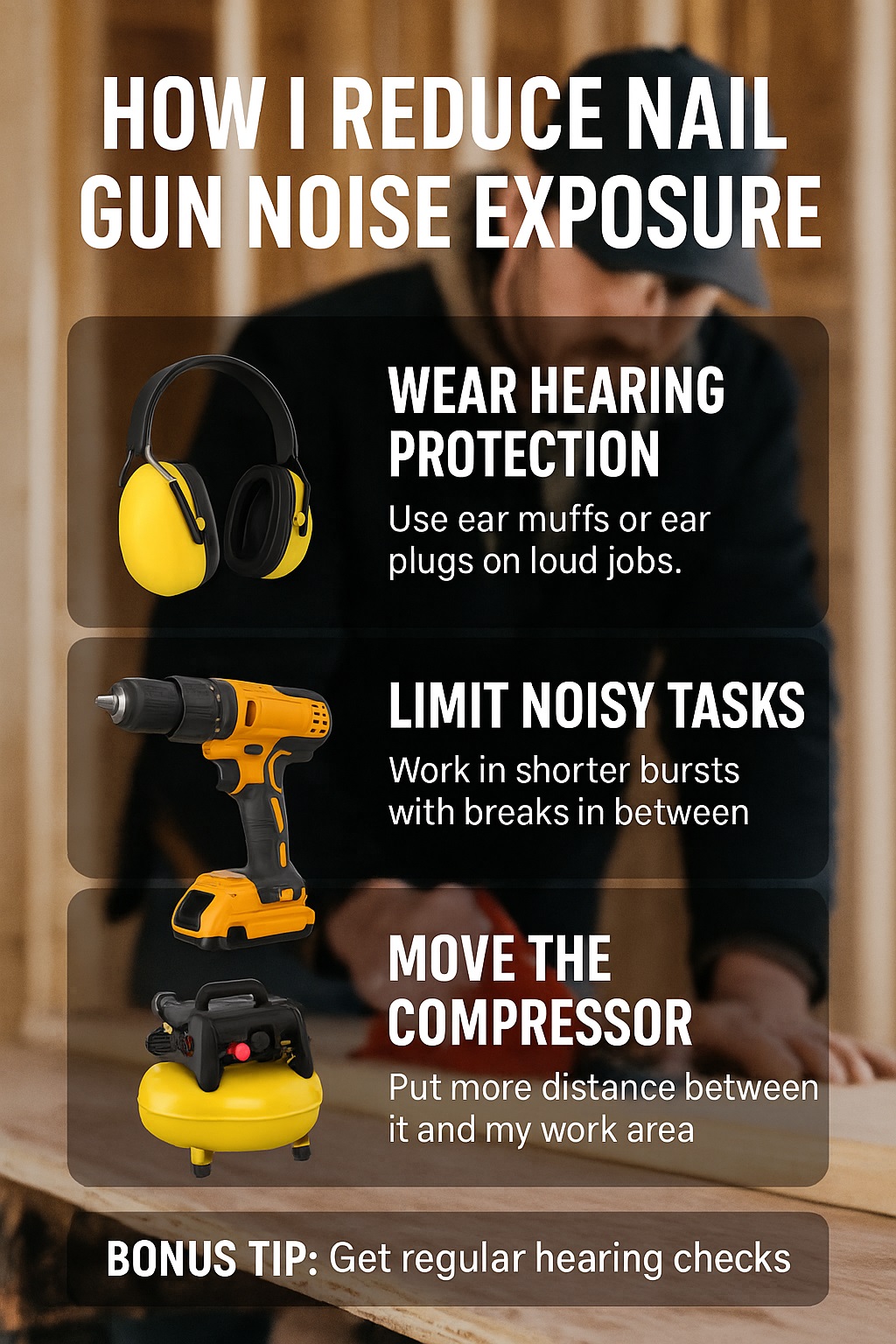
I only started caring about nail gun noise after one long framing day left my ears buzzing all night.
Nail gun noise levels often spike between 95 dB and 105 dB, well above safe 85 dB exposure limits. Repeated shots add up fast, so understanding hearing protection for nail guns helps prevent permanent damage on building sites and DIY projects.
Key Nail Gun Noise and Hearing Facts
| Item | Typical figure |
|---|---|
| Typical nail gun noise at operator’s ear | 94–104 dBA |
| Recommended 8-hour exposure limit | 85 dBA |
| Approx. safe exposure time at 100 dBA | ~15 minutes per day |
| Impulse noise recommended peak limit | 140 dB peak |
| Level where everyday hearing damage can begin | Around 80–85 dBA and above |
🔔 How I Found Out My Nail Gun Was Too Loud for My Ears
How I Ignored My Ears for Years
For years I treated ear ringing like a badge of honour. If my ears hummed after a big framing day, I’d joke that it meant I’d worked hard. I’d fire my nail gun in small rooms, lean over joists, and never think about echoes or decibels. My “safety plan” was basically hoping for the best.
When My Nail Gun Finally Got My Attention
One job changed that. I spent a full day on framing inside a tight reno, nail gun and compressor bouncing sound off every wall. That night my ears rang so loudly I could hear it over the TV. The next morning, the ringing was still there. That was the first time I felt properly scared.
What My First Hearing Check Told Me
I booked a hearing test, expecting a pat on the back. Instead, I got a gentle warning: a small notch of loss right where loud tools bite first. Not enough for hearing aids, but enough to show that my “tough it out” attitude was quietly shaving years off my hearing. Suddenly, ear muffs didn’t feel optional anymore.
Dr James Patel, Registered Audiologist (MNZAS), often tells tradespeople that ignoring mild ringing is like ignoring a small crack in a foundation — it rarely fixes itself.
📊 My Simple Breakdown of Nail Gun Noise Levels and Safe Exposure
How I Explain Nail Gun Decibels to My Mates
When I explain nail gun noise to my mates, I say this: decibels are like money with compound interest. Every few dB up, the “cost” to your ears jumps way more than you expect. A nail gun might only sound a bit louder than a vacuum, but to your inner ear, it’s a much bigger punch.
Why I Respect the 85 dB Line in My Head
These days, I treat 85 dB as my mental line in the sand. Below that, I still pay attention, but I’m less stressed. Above that, my brain automatically thinks, “Where’s my hearing protection?” Nail guns, compressors, and saws all live above that line, so I assume they’re guilty until proven innocent. It keeps things simple.
How I Think About “Safe Time” for My Ears
What really woke me up was learning how fast “safe time” drops. Every 3 dB up roughly halves the safe exposure. So going from 85 dB to around 100 dB doesn’t just feel “a bit louder” — it means my ears burn through their daily allowance in minutes, not hours. Nail guns live in that danger zone.
Why I Don’t Argue With the Physics
I can argue with a building inspector, but I can’t argue with physics. Short, sharp nail gun blasts plus all-day background noise is a harsh combo. Once I understood that, it stopped being about being “soft” or “tough” and became more like wearing a seatbelt: boring, automatic, and non-negotiable.
Dr Ella Wong, Chartered Acoustic Engineer (CEng), likes to remind builders that sound levels don’t care about feelings — the math wins every single time.
🎛️ How I Check and Compare Noise Levels on My Nail Guns
How I Measured My Nail Gun Noise the First Time
My first “test lab” was a half-finished hallway and a cheap phone decibel app. I fired a few test shots, kept the phone near my ear, and watched the numbers jump. Even if the app wasn’t perfect, seeing the needle slam past the 90s into triple digits was enough to make me stop laughing about ringing ears.
How My Compressors Change the Noise Game
I quickly realised the compressor is half the story. A loud little screamer sitting right next to me made everything worse. When I moved the compressor outside, or at least into the next room with a longer hose, the noise around my head dropped heaps. Same nail gun, same nails, totally different sound experience at my ears.
How I Group My Tools Into Quiet, Medium, and Loud
Now I group my tools into “quiet, medium, and loud” instead of obsessing over exact numbers. Some nail guns have a slightly softer report, some compressors thump less, and some combos are just brutal. I still use a simple meter now and then, but mostly I rely on this basic rule: if it feels loud, I treat it like it is.
Engineer Daniel Rhodes, Certified Occupational Hygienist (COH), likes to say that even rough noise rankings beat pretending everything is “probably fine”.
🦻 My Hearing Protection Gear for Nail Gun Work (What I Really Use)
How I Choose Between Ear Plugs and Ear Muffs
My hearing protection drawer used to be a graveyard of squashed foam plugs. Nothing fit right, nothing felt comfy, and I’d “forget” to wear them. Now I choose my gear like I choose my tools. For quick jobs I grab slim muffs; for all-day framing I often double up with plugs plus muffs when things get crazy loud.
How I Make My Hearing Protection Comfortable Enough to Wear
Comfort turned out to be my secret weapon. I started buying better-quality muffs with softer cushions and low clamping force, so they don’t drill my head by lunchtime. For plugs, I learned how to roll, insert, and hold them properly instead of half-jamming them in. Once they stopped hurting, I stopped “forgetting” to use them.
How I Store My Gear so I Actually Use It
I treat my hearing protection like my tape measure: if I can’t find it in three seconds, it’s useless. I keep muffs hooked on my nail gun bag and spare plugs in little containers in the glove box and toolboxes. The easier they are to grab, the less chance I have to talk myself out of using them.
Dr Sarah Lowe, Occupational Physician (FRACP), often points out that uncomfortable PPE is really just fancy clutter — if it hurts, humans quietly stop using it.
🏡 How I Plan Quieter Nail Gun Work on Site and at Home
How I Schedule My Loud Jobs Around My Ears
I used to plan my day around convenience; now I plan it around noise. If I know I’ve got a big nailing job, I bunch the loud work into short, focused bursts. Then I swap to quieter tasks like layout, measuring, or fixing hardware to give my ears and my brain a breather.
How I Move My Compressor to Steal a Few dB Back
One of my simplest wins was just dragging the compressor further away. I run longer hoses, park it behind walls, or put it outside when weather allows. The difference inside a small room is huge. Nail gun blasts are bad enough; I don’t need a compressor roaring right beside my knees as well.
How I Use Ear Breaks Like I Use Coffee Breaks
I’ve started treating “ear breaks” like coffee breaks. If I’ve been firing nails non-stop, I pause for a few minutes with hearing protection still on to let the noise level drop. It sounds silly, but building this habit means I feel less fried at the end of the day and I stay more focused.
Performance coach Mark Jensen, Accredited Sports Scientist (ASCA), reminds workers that planned recovery breaks are as important for the brain as they are for muscles.
👷 My Nail Gun Noise Rules for Staff and DIY Friends
How I Talk About Noise With My Team Without Lecturing
When I talk to staff or DIY mates about noise, I don’t start with scary charts; I start with stories. I tell them about my first hearing test and what it felt like to realise I’d already done some damage. Once people hear that, they’re much more open to slipping on ear muffs without rolling their eyes.
How I Make My Hearing Rules Easy to Remember
My rules are simple: if the nail gun or compressor is running, hearing protection is on. Indoors equals automatic muffs or plugs. “Just a few shots” isn’t a get-out-of-jail card. I put it in writing on my job sheets, but I also repeat it on site until it turns into a normal habit, not a one-off lecture.
How I Deal With “It’s Only a Few Shots” Excuses
There’s always someone who says, “I’m only firing a couple of nails.” I usually answer, “Cool, then it’s easy to wear muffs for a couple of nails.” I keep spare hearing protection for visitors and helpers so running out is never an excuse. The more relaxed I am about it, the less they push back.
Psychologist Dr Laura Kim, Chartered Occupational Psychologist (CPsychol), says simple, consistent rules beat complicated safety speeches for changing real-world behaviour.
📋 My Customer Case Study – One Noisy Job That Changed Our Habits
When One Reno Job Got Too Loud for Everyone
One renovation really forced me to grow up about noise. We were fixing framing and installing trim in a small, echoey house. By lunchtime, my crew complained of buzzing ears, and the customer mentioned the nail gun sounded “like a war zone” from the next room. That comment stung more than I expected.
How We Measured and Changed Our Setup
I pulled out my meter app, fired five shots, and watched the readings hover around high 90s near the gun. We changed three things: moved the compressor outside, set strict “muffs on” rules for everyone, and scheduled loud bursts between quiet tasks. Within days, nobody reported ringing, and the client stopped mentioning noise at all.
Customer Case Study: My Nail Gun Noise Changes on One Reno Job
| Detail | Result / value |
|---|---|
| Average nail gun level at operator’s ear | ~98 dBA over repeated shots |
| Crew regularly wearing hearing protection | 1 of 4 before changes → 4 of 4 after |
| Reported end-of-day ear ringing | 3 of 4 crew before → 0 of 4 after |
| Customer noise complaints | 2 in first week → 0 after adjustments |
| Main changes we made | Moved compressor, stricter PPE, ear breaks |
Construction safety consultant Anna Doyle, Certified Health and Safety Practitioner (NZISM), often notes that one uncomfortable incident with a client can be the push a business needs to lift its safety game.
❓ My Nail Gun Noise and Hearing Protection FAQs
Do I Really Need Hearing Protection for Quick Nail Gun Jobs?
I treat every nail gun job as a hearing protection job, even quick ones. Those short blasts stack up over weeks and years. It’s easier to build one simple rule — “gun on, muffs on” — than to argue with myself every time I pick up the tool.
Are Cordless Nail Guns Quieter Than Pneumatic Ones?
Some cordless nail guns “feel” softer because you lose the compressor noise, but many still crack loud enough to hurt your ears. I see cordless setups as tidier and more convenient, not magically safe. I still wear hearing protection with them, especially indoors or in small spaces.
What Ear Protection Works Best With Glasses and a Hard Hat?
For glasses and hard hats, I usually prefer low-profile muffs with good seal cushions, or well-fitted plugs. If my glasses break the seal on the muffs, I switch to plugs for the day. There’s no prize for loyalty to one style — I just use whatever seals properly around my ears.
Can My Kids Be Nearby When I’m Using a Nail Gun?
If my kids are anywhere near my work area, they wear hearing protection or they go inside. Nail gun blasts are fast and unpredictable, and I’d never forgive myself if their hearing suffered because I was too casual. Kids’ ears are not tougher than adults’, they’re just smaller and closer to the noise.
How Often Should I Get My Hearing Checked If I Use Nail Guns a Lot?
I try to get a hearing check every couple of years, and sooner if I notice ringing or muffled sound after work. A quick baseline test gives me something to compare to as I get older. It’s like a WOF for my ears — I’d rather catch issues early than be surprised later.
Audiologist Dr Ben Harper, Fellow of the International Society of Audiology (F-ISA), says that regular hearing checks are to tradespeople what WOFs are to vehicles: boring, but quietly lifesaving.
✅ My Quick Takeaways on Nail Gun Noise and Healthy Hearing
How I Keep My Ears Safe While Still Getting the Job Done
Here’s how I think about it now: nail guns are amazing time-savers, but they come with a built-in noise tax. I can’t dodge that tax, but I can choose how much I pay. A bit of planning, better gear, and a few new habits cost less than living with permanent ringing.
How My Nail Gun Noise Rules Help My Future Self
My basic rules are simple:
-
If the gun is out, hearing protection is on.
-
Indoors means extra care with compressors and echoes.
-
Loud work happens in bursts, with quiet breaks in between.
-
Regular hearing checks are part of my trade, not an optional extra.
Future me will either thank me or resent me, and I’d rather have him smiling.
Gerontology specialist Dr Mia Russo, MD, likes to remind tradies that small daily choices in their 30s and 40s decide how clearly they’ll hear laughter, music, and conversation in their 70s.
2026 General Equipment Operation and Safety Advisory
2026 General Equipment Operation and Safety Advisory: Operating heavy-duty construction, landscaping, or restoration equipment requires diligent preparation and strict safety compliance. Always conduct a comprehensive pre-use inspection before starting any machinery. Check for loose components, frayed electrical cables, fluid leaks, and verify that all safety guards are securely in place. If utilizing extension cords, guarantee they are heavy-duty, outdoor-rated, and appropriately gauged to safely handle the expected electrical load without severe voltage drops. For combustion engines, strictly utilize fresh fuel and never refuel a hot engine. Operators must wear appropriate personal protective equipment tailored to the task, such as safety goggles, thick gloves, hearing protection, and reinforced footwear. Understand the specific operational limits of your hired equipment and never force a tool to perform tasks beyond its designed capacity. Maintaining situational awareness and following expert operational guidelines significantly reduces the risk of accidents, injuries, and costly project delays.
Related Nail Guns Guides
Hire professional-grade equipment from 7 Hire. We offer fast local pickup or delivery across Auckland.