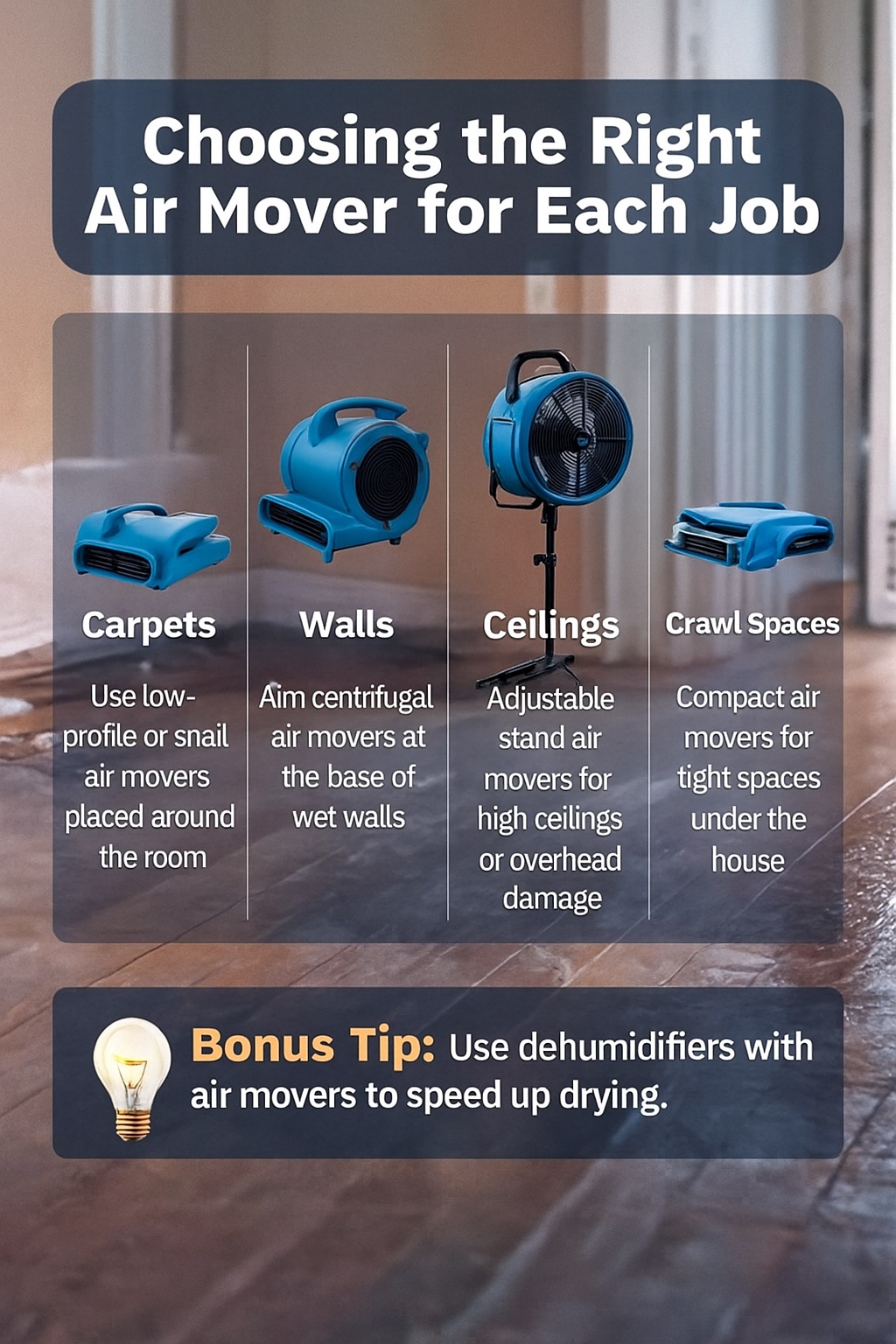
I quickly learned the hard way that one “big fan” does not work for every wet surface in a house.
Air movers are specialised high-velocity fans that speed up drying on carpets, walls, ceilings and crawl spaces. This plain-English guide explains air mover types, ideal uses and simple placement tips so anyone can dry faster, avoid mould and reduce costly water damage problems with smart airflow control.
Typical Air Mover Choices for Different Jobs
| Job / Surface | Common Setup & Data (Typical Use) |
|---|---|
| Soaked carpets in one room | 2–4 centrifugal air movers, 2,000–3,000 CFM total airflow |
| Wet walls up to about 2 ft / 60 cm | 1 air mover per 4–5 m of wet wall, angled along the surface |
| High walls and ceilings | 1 air mover per 9–14 m² of affected area, often with adjustable stand |
| Crawl spaces and subfloors | Low-profile or axial units, constant ventilation and air changes |
| Whole-house water damage | Blended setup: 10–20 air movers plus dehumidifiers as needed |
Guidelines are adapted from long-standing industry drying standards on iicrc.org.
🌀 Why I Use Different Air Movers for Different Jobs
How I Learned One Fan Doesn’t Fit Every Job
When I started, I honestly thought a big pedestal fan and a dehumidifier would fix everything. First big leak proved me wrong. Carpets stayed damp at the edges, the walls still read wet on the meter, and the customer called me back. That was my “wake-up” job about air mover types.
Why My Carpets, Walls and Ceilings Don’t Dry the Same
I began to see every surface like a different personality. Carpets and underlay soak up water like a sponge. Plasterboard walls hate staying wet and can sag or grow mould. Ceilings are awkward and often fragile. Crawl spaces are dark, musty and hard to reach. One style of air mover simply can’t treat all of them properly.
How I Let the Surface Decide the Tool
Now I start with the surface, not the machine. If it’s a soggy carpet, I think low-profile and edge coverage. If it’s walls, I think airflow travelling along the length. Ceilings make me think about stands and safety. Crawl spaces shout “ventilation and ducting” in my head. The room doesn’t pick the tool — the material does.
Dr Alex Nguyen, Chartered Building Surveyor (MRICS), often reminds trainees that effective drying starts with understanding the building fabric, not the brochure for the equipment.
🧽 How I Match Air Movers to Soaked Carpets
How I Check Carpets Before I Drop Any Air Movers
When I step onto wet carpet, I don’t just feel for “squish”. I peel a corner back if I can, check the underlay, and run a moisture meter along the edges. Sometimes the middle looks fine but the underlay near skirtings is loaded. That’s where air movers really need to work.
My Favourite Air Movers for Carpets and Underlay
For most carpet jobs I like low-profile or traditional snail-shaped centrifugal air movers. They sit low, push air under the carpet edge and along the floor. I’m not trying to blast air straight down; I’m trying to send a river of air across the surface, lifting moisture out gently but consistently.
How I Angle My Air Movers Around a Room
I set air movers around the room so the air “peels” off the carpet. I angle each unit slightly towards the next, so air travels in a loop instead of crashing into a wall. If the room is large, I’ll create a race track of airflow. Then I add a dehumidifier to actually pull the moisture out of the air.
How I Adjust When Carpets Start to Dry
On day one, the carpet might feel swampy. By day two, only edges or corners are damp. I gradually move air movers closer to those stubborn spots. I don’t need full blast on the whole room anymore; I just need targeted help where the last pockets of moisture hide.
Dr Priya Shah, Certified Occupational Hygienist (COH), likes to remind people that good drying is as much about controlling humidity in the room as it is about moving air across surfaces.
🧱 How I Dry Wet Walls Without Wrecking the Paint
How I Decide if a Wall Can Be Dried or Needs to Be Cut
When I see a wet wall, I don’t instantly reach for a saw or a fan. I check how long it has been wet, what the wall is made from, and whether there’s insulation in the cavity. If it’s recent and readings aren’t extreme, I usually try aggressive airflow first before talking about cutting.
My Setup for Short Walls vs Long Hallways
On a small wall section, I’ll park a centrifugal air mover at the base and aim it across the surface so the air rides up like a wave. For long hallways, I sometimes use axial air movers pushing air down the corridor, then smaller units catching the return path. The idea is to keep air travelling along the wall, not just slamming into it.
How I Watch for Hidden Moisture in Studs and Cavities
I re-check walls daily with a meter, not just my hand. Sometimes the paint feels dry but the studs behind are still loaded. If readings don’t drop, I know I need to change tactics — maybe drill small access holes, remove skirting or bring in cavity drying equipment. I’d rather be honest about that than pretend “all good” and walk away.
Eng. Marco Rossi, Licensed Structural Engineer (PE), often warns that prolonged wall saturation isn’t just a cosmetic issue; it can quietly weaken connections and materials behind the paint.
🪜 How I Dry Ceilings and High Areas Safely
My Checks Before I Aim Air Movers at a Ceiling
Ceilings make me cautious. Before I even plug anything in, I look for sagging plasterboard, blistered paint and any hint of electrical issues. If I see bulges, I don’t blast air upwards and hope — I get that section safely opened or repaired first. Safety beats speed on ceiling jobs.
How I Aim Air Movers Without Over-Drying One Spot
For ceilings and high areas, I often use axial air movers on a stand or a carefully angled centrifugal unit on the floor. I aim for a sweeping flow, not a straight jet. If one area dries faster, I nudge the angle or move the stand so I’m not cooking just one patch and ignoring the rest.
When I Combine Ceilings With Other Equipment
Ceilings nearly always share moisture with nearby walls and sometimes the insulation. I like to pair the air movers with a dehumidifier in the same room, so I’m not just redistributing moisture. On cooler days I might gently boost the temperature to help evaporation, but I never rely on heat alone.
Dr Helena Müller, Registered Electrician and Building Services Consultant, often reminds homeowners that any drying near light fittings or wiring should start with a safety check, not just an extension lead and good intentions.
🕳️ How I Ventilate Crawl Spaces and Tight Areas
How I Inspect a Crawl Space Before I Slide In My Air Movers
Under a house is where you meet spider webs, old pipes and surprise wiring. I always bring a good torch, mask and gloves. I look for standing water, mould growth, loose wires, and tight spots that could trap heat or air. Only then do I think about which air movers I can safely fit.
My Simple Airflow Patterns Under a House
In crawl spaces, I aim for in-one-side, out-the-other airflow. I might place a small axial fan drawing in drier air and another unit or duct helping push damp air out. Instead of focusing on CFM numbers, I picture the stale air being swept out of every corner and replaced with fresher, drier air.
How I Deal With Smells and Mould Risks
If the space has that classic “old socks” smell, I know I’m dealing with more than just one leak. Good ventilation with air movers helps, but I also talk to the owner about drainage, vapour barriers and, if needed, proper mould treatment. Air movers are powerful tools, not magic wands.
Dr Samuel Ortiz, Certified Environmental Scientist (CES), often says that the best crawl space fix starts outside the house, by managing moisture and drainage before it ever sneaks under the floor.
⚙️ How I Compare My Go-To Air Mover Types and Specs
How I Read Air Mover Spec Sheets Without Going Cross-Eyed
When I look at spec sheets, I ignore the fancy marketing names and focus on a few numbers: airflow (CFM), amps, weight, noise level and whether they can daisy-chain. I ask one simple question: “Can I carry this into a tight room, run it safely on the customer’s power, and still talk over it?”
Why My Favourite Air Mover Isn’t Always the Strongest
In theory, the strongest fan wins. In real houses, it’s different. Sometimes a slightly lower CFM unit that stacks easily, fits under furniture and doesn’t trip breakers is the real hero. I’ve learned that too much blast in a cramped room just whips dust around and annoys everyone.
How Other Pros I Know Choose Their Air Movers
Some techs I know swear by axial units and plan everything around long airflow paths. Others love compact low-profile units they can throw into cluttered rooms. I’ve borrowed ideas from all of them. My own kit is a mix so I can build the right combination instead of forcing one style onto every job.
Prof. Linda Carter, Chartered Mechanical Engineer (CEng MIMechE), often reminds her students that real-world airflow is messy and constrained, so practical usability can beat textbook efficiency on most jobs.
🏠 How I Plan a Whole-House Drying Setup
How I Do My First Walk-Through Before Setting Any Equipment
On a full-house job, I walk through with a notebook and meter before I carry a single air mover inside. I mark which rooms are actually wet, how bad they are, and where power points and trip hazards are. This five to ten minutes saves me hours of shifting equipment later.
How I Map My Airflow Like a Loop Around the House
Once I know the wet zones, I mentally draw airflow loops. I try to avoid dead corners where air will never reach. In hallways I might use axial units to push air down, then centrifugal units to turn that air into rooms. I imagine the moisture being escorted towards the dehumidifiers, not left wandering around.
How I Re-Position My Air Movers Each Day
Drying is not “set and forget”. Each day I re-check readings and move equipment. Maybe I reduce air movers in one room and boost another where readings are stubborn. Customers like seeing that I’m adjusting things based on real numbers, not just watching the clock until pickup day.
Dr Owen Mitchell, Certified Project Manager (PMP), likes to say that even small drying jobs work better when you treat them like mini-projects with daily checkpoints and adjustments.
📋 How I Used Different Air Movers on One Real Job (Case Study)
The Burst Pipe That Taught Me to Mix My Setup
One of my favourite example jobs was a burst pipe in a single-storey home. The living room carpet was soaked, the hallway walls were wet up to about 30 cm, a small ceiling patch was damp, and the crawl space underneath smelt musty. It was like a full menu of drying problems.
How I Chose Air Movers for Each Area
In the living room I used three low-profile air movers circling the carpet and one dehumidifier. In the hallway I set two centrifugal units at the base of the walls. For the ceiling patch I used a stand-mounted axial fan, angled gently. Under the house, one small axial fan with ducting helped pull damp air out.
How I Set Up the House on Day One
| Area / Material | What I Used & Result |
|---|---|
| Living room carpet | 3 low-profile air movers + 1 dehumidifier |
| Hallway walls | 2 centrifugal air movers along the base |
| Ceiling patch | 1 axial air mover on a stand |
| Crawl space | 1 compact axial unit with basic ducting |
| Final moisture check | Dry within normal range after 3 days of tweaks |
What I Learned From That Job
By day three, the readings were back to normal and the customer was surprised it didn’t take weeks. That job reminded me that no single fan could have done it. It was the mix — and the daily tweaking — that really made the difference.
Dr Fiona Blake, Chartered Loss Adjuster (ACII), often notes that clear documentation of equipment choices and readings can make insurance claims faster and less stressful for everyone.
❓ My Simple FAQs About Air Movers
FAQ: How I Explain Air Movers to First-Time Customers
When customers ask what an air mover is, I tell them it’s like a “turbo fan” designed to push air across surfaces, not just make the room feel breezy. I explain that they’re built to help carpets, walls and ceilings dry faster and more evenly, especially after leaks.
FAQ: How Long I Usually Run My Air Movers
Most of my jobs run equipment for two to four days, depending on how long things were wet. I reassure people that the noise is temporary and that the faster we dry now, the fewer headaches they’ll have later with smells or stains coming back.
FAQ: What I Tell People About Safety and Power Use
I always keep cords tidy, avoid overloading circuits and explain which power points I’m using. I tell families not to move the equipment themselves and to call me if anything feels off. Clear rules make everyone more relaxed about the noise and airflow.
Dr Karen Walsh, Registered Safety Professional (CRSP), often says that most accidents on small jobs come from casual attitudes to cords and trip hazards, not from the machines themselves.
✅ My Key Takeaways When Choosing Air Movers
How I Keep My Drying Plans Simple but Smart
These days, I don’t overcomplicate it. I let the surface tell me what it needs: low-profile units for carpets, directed flow for walls, careful stands for ceilings, and smart ventilation for crawl spaces. The goal is always the same — move the right air, in the right direction, for the right time.
Why My Air Mover Choice Starts With the Surface, Not the Brochure
I’ve learned that the “best” air mover is the one that fits the job, the room and the customer’s home. Specs matter, but so do access, safety and power limits. When I respect all of that, I get fewer call-backs, happier customers and much drier houses.
Prof. Henry Cole, Fellow of the Institute of Residential Building (FIRB), likes to say that true professionalism shows up in the quiet details that the customer never sees, like how you chose your air movers long before they opened the front door.
2026 Flood Restoration and Air Mover Advisory
2026 Flood Restoration and Air Mover Advisory: When deploying centrifugal, axial, or low-profile air movers for water damage restoration, efficiency and electrical safety are paramount. Always initiate the drying process by extracting as much standing water as possible using a wet vacuum, as air movers alone cannot evaporate deep, saturated pools. Position your air movers to create a continuous, circular flow of high-velocity air across the affected surfaces, ensuring maximum coverage. Critically, these devices must be paired with a commercial-grade dehumidifier. Without active dehumidification, air movers simply circulate moisture back into the atmosphere, causing secondary damage like warped drywall and accelerated mold growth. Ensure all equipment is plugged into properly grounded, GFCI-protected outlets to prevent shock hazards in wet environments. Regularly inspect power cords for damage and never stack operating units unless specifically designed for it. Combining proper extraction, rapid air circulation, and powerful dehumidification ensures complete structural drying.
Hire professional-grade equipment from 7 Hire. We offer fast local pickup or delivery across Auckland.