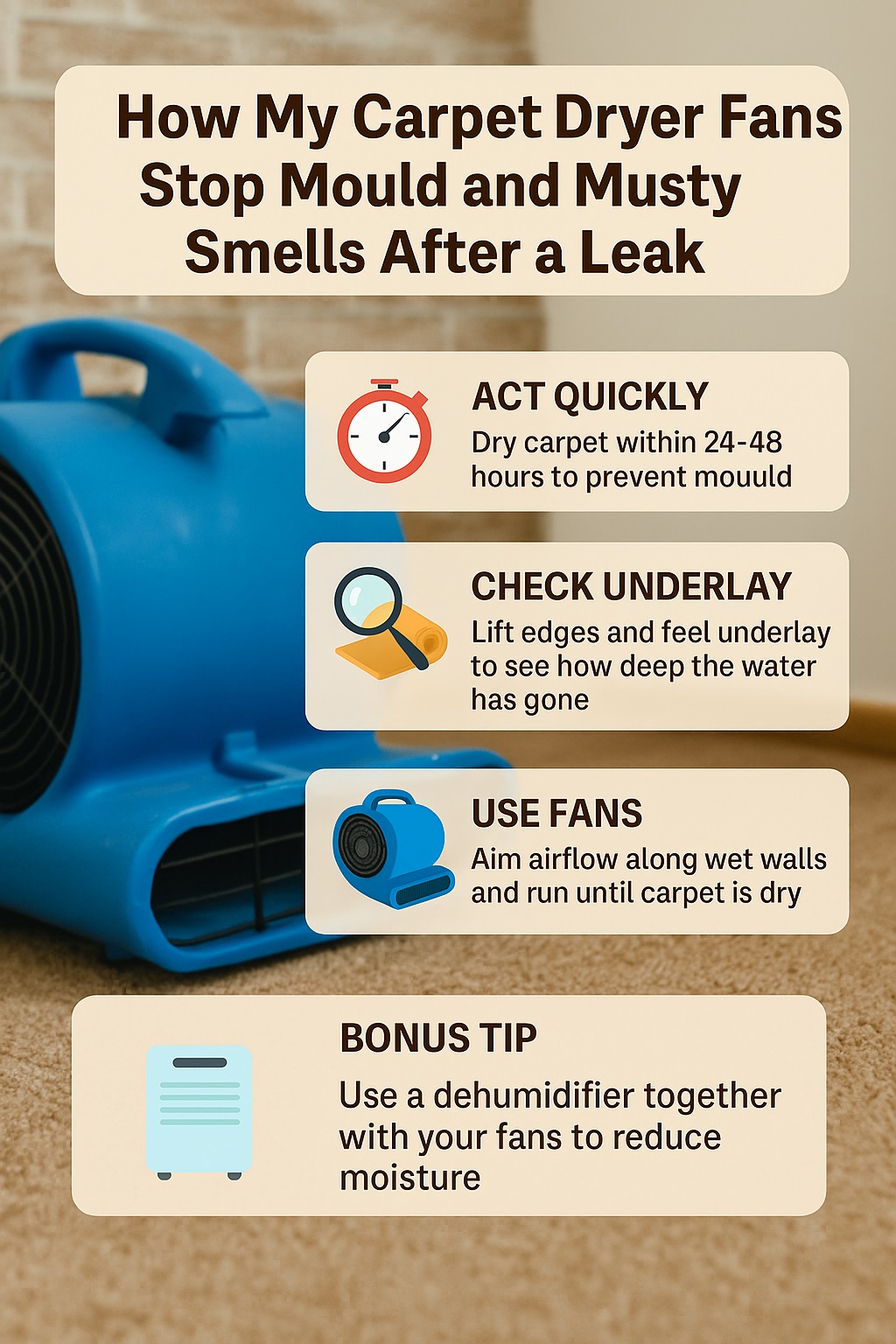
How My Carpet Dryer Fans Beat Mould and Musty Smells After a Leak
Damp carpet plus slow drying almost always ends with that sour, musty smell. After a few painful lessons, I now treat every leak like an emergency, and my carpet dryer fans are the first tools I grab when I want to save carpet, underlay, and my sanity.
After a leak, damp carpet can start growing mould within 24–48 hours. Using carpet dryer fans, dehumidifiers and fast water removal cuts moisture, helps stop mould after a leak, and reduces musty smell removal costs, health risks and long-term repair bills.
Key stats for leaks, mould and carpet drying
| Metric | Typical guideline (for homes & small businesses) |
|---|---|
| Mould growth window after a leak | 24–48 hours if materials stay wet |
| Safe time to dry wet carpet | Aim to dry within 48 hours |
| Recommended indoor humidity target | Keep under 50–60% relative humidity |
| How long to run fans and dehumidifiers | Until carpet, underlay and walls test dry |
| When to consider professional help | If you can’t dry within 24–48 hours or see visible mould |
Source: epa.gov
🌀 Why I Now Act Fast After Any Leak
The small leak that became a big problem
My “wake-up call” was a tiny flexi-hose leak behind a vanity. I thought the carpet would dry by itself. A week later, the room smelled like an old gym bag and the underlay had black spots. By the time I lifted everything, replacement cost far more than early fan hire.
What I learned about mould’s timing
On later jobs, I started timing things. If carpet stayed wet for more than a day or two, smells and staining almost always followed. When I learned that drying within 24–48 hours is the sweet spot, it matched what I was seeing in real homes and rentals.
Dr Daniel Price, Risk Analyst (PhD), says fast action after a leak is like cutting off a small financial loss early instead of letting compounding interest destroy the balance.
👣 How I Tell If My Carpet Is at Real Mould Risk or Just Damp
Quick checks I do the moment I arrive
When I walk into a wet room, I don’t just look at the obvious puddle. I press along skirting boards, peek under carpet edges, and feel the underlay. Light damp on the surface is one thing. Heavy, squishy underlay and stained timber tell me mould risk just jumped a few levels.
Using smell and simple tools without overthinking it
If I get even a faint sour or earthy smell when the room is closed up, I treat it seriously. Then I back my nose up with a basic moisture meter. High readings near walls or corners usually mean I need more than one carpet dryer fan and probably a dehumidifier running in the same zone.
Dr Hannah Lee, Environmental Health Scientist (MPH), says trusting simple measurements over wishful thinking is the same mindset hospitals use when they track infection risks instead of relying on “it looks fine”.
⏱️ My First 60 Minutes After a Leak: Step-by-Step Game Plan
Step 1: Make it safe and stop the water
My first move is always safety. I kill power in the affected area if there’s any chance water hit sockets, extension cords, or multi-boards. Then I hunt the source: a burst pipe, an overflowing washing machine, a leaking roof. Until the water stops, fans are just fancy decorations.
Step 2: Get as much water out as humanly possible
Before I even touch the carpet dryer fans, I extract. Wet vacs, water claws, squeegees—whatever suits the job. I’ve learned that every extra litre I pull out now is one less litre my fans and dehumidifiers have to chase later. Less standing water means faster drying and fewer mould surprises.
Step 3: Plan my airflow like traffic routes
Once the bulk water is out, I map where air should flow. I think of the room like a mini motorway: air should hit the wet edges and then have a clear path out. I avoid blowing straight into dead corners or closed wardrobes that trap moisture instead of removing it.
Prof Ravi Patel, Traffic Systems Engineer (CPEng), often compares good airflow to smart road design—remove bottlenecks first, don’t just add more cars (or fans) to a clogged route.
💨 How I Choose the Right Carpet Dryer Fans for Leaks and Musty Smells
Axial vs snail vs low-profile – how I see the differences
Through trial and error, I’ve found axial fans shine in open lounges and hallways. Snail (centrifugal) fans hit low along the edges and under furniture better. Low-profile air movers are my favourite for tight bedrooms where I need strong airflow without a big, bulky shell in the way.
Matching fan power to real-life rooms
In a small bedroom with one wet corner, one decent fan often does the job. In a big lounge with soggy underlay and a soaked hallway, I’ll line up several fans like soldiers, all pointing in the same drying direction. I care more about coverage and airflow paths than chasing the biggest motor on paper.
Dr Laura Chen, Mechanical Engineer (CPEng), says using the right fan for the space is like choosing a spanner instead of hitting everything with a hammer—it’s not about force, it’s about fit.
🌬️ How I Set Up My Fans and Dehumidifiers to Beat Musty Odours
Fan angles that actually dry edges and underlay
One mistake I made early on was just blasting straight across the carpet. Now I angle fans so the air “bites” under the carpet edge and runs along skirting boards. I sometimes tent the carpet slightly with small blocks so the air can travel underneath and push moisture toward drier zones.
When I shut windows and when I crack them
If I’ve got fans and a dehumidifier working together, I usually close windows and doors in that zone so the system can recycle and dry the same air over and over. If outside air is cooler and drier, I may crack a window briefly, but I don’t rely on that alone anymore.
Dr Michael Sørensen, Climate Physicist (PhD), likes to remind people that random ventilation is not the same as controlled drying—sometimes “fresh air” just means fresh moisture.
⚠️ My Mistakes: When I Waited Too Long and Mould Took Over
The “it looks dry” trap
One of my worst mistakes was trusting the surface. The carpet felt dry on top after a couple of days with a fan, so I packed up. A week later, the customer called about dark lines along the skirting and a stubborn musty smell. Underneath, the underlay still squished like a sponge.
Why visible mould is usually the late stage, not the start
By the time I saw spots on the underlay and tack strips, the problem had been brewing for days. Now, if materials have been wet longer than 48 hours and I can’t get moisture readings down, I start talking honestly about cutting out sections or replacing them entirely instead of pretending fans can fix everything.
Dr Olivia Grant, Museum Conservator (AIC), says visible mould on artefacts is like smoke from a fire—you’re not seeing the start of the problem, you’re seeing what escaped containment.
🧰 When I Stop DIY and Call Professional Mould or Flood Restorers
Red flags that tell me it’s bigger than fans
If the water is from sewage, outdoor flooding, or has been sitting for days, I don’t try to be a hero. When someone in the home has asthma, allergies, or a weak immune system, I’m even more cautious. In those cases, my fans are just one piece of a much bigger safety puzzle.
What specialists can do that I can’t
Certified remediators can open cavities, set up containment, run powerful HEPA filtration, and remove heavily contaminated materials safely. They also have protocols for testing, clearance, and documentation. I explain to customers that my goal isn’t to sell more fan time; it’s to help them avoid long-term health and building problems.
Prof Elena Rossi, Occupational Physician (MD, FACOEM), compares serious mould jobs to surgery—sometimes home remedies are fine, but other times you need an operating theatre and a trained team.
🧼 How I Clean, Disinfect and Deodorise After the Carpet Is Dry
My “after-drying” routine
Once carpet and underlay test dry, I switch from drying mode to cleaning mode. I do a slow, detailed HEPA vacuum, then treat any stains I can now clearly see. If I’ve used any antimicrobial or deodorising products, I keep doses sensible, especially around kids’ bedrooms and pets’ favourite spots.
What I keep and what I toss
Some items just don’t bounce back well: cheap chipboard furniture, swollen skirting, or rugs that stayed soaked for days. I explain why replacing them usually beats chasing smells for months. For solid furniture I can fully dry and clean, I give it another life instead of sending everything to the skip.
Dr Patrick O’Neill, Environmental Chemist (MSc), says targeted, minimal chemical use plus good physical cleaning often outperforms throwing harsh products at every surface in sight.
🌦️ How I Keep Mould and Musty Smells Away Long-Term
Simple habits that make leaks less scary
In my own place, I do “boring” checks: washing machine hoses, under sinks, around hot water cylinders. I lift rugs in corners that don’t get much airflow. I also keep an eye on spare rooms that stay closed most of the week—they’re classic musty smell traps if a small leak goes unnoticed.
Watching humidity without becoming obsessed
I keep cheap humidity meters in the damp-prone rooms. If numbers keep creeping over the 60% mark and stay there, I know I need more ventilation or a dehumidifier. I’ve noticed that when indoor air stays closer to the 40–50% range, leaks are still annoying, but they don’t turn into full mould dramas as easily.
Dr Sofia Martínez, Behavioural Economist (PhD), says tiny “nudge” habits—like checking a hygrometer while you make coffee—often prevent the big expensive disasters we call “bad luck”.
❓ FAQs: Questions I Keep Getting About My Fans, Leaks and Mould
How long should I run my carpet dryer fans after a small leak?
If it’s a small, clean water leak in one bedroom, I usually run fans for at least 24–48 hours and only stop when the carpet, underlay and nearby walls test dry, not just when they feel dry by hand. Time is a guide; moisture readings are my real decision-maker.
Is it safe to sleep in the room while fans and dehumidifiers run?
Most of the time, yes, if cords are safe, trip hazards are managed and noise isn’t an issue. I keep air paths clear, avoid blocking exits, and don’t run equipment in ways that overheat the room. If someone has asthma or is very sensitive, I may suggest sleeping elsewhere.
Can I just open windows instead of using carpet dryer fans?
Open windows help, especially if outside air is cool and dry, but they rarely replace focused airflow and moisture control. Fans give me targeted air movement right where the water actually went, and dehumidifiers capture that moisture instead of letting it wander around the house.
What if the musty smell comes back after a week?
If a room smells musty again after everything seemed dry, I assume something is still damp or has grown mould out of sight. I re-check underlay, wardrobes, wall linings and furniture bases. If I find ongoing moisture or visible growth, that’s when I start talking about cutting out or calling specialists.
Do I always have to pull up carpet after a leak?
Not always. Shallow, short leaks on newer carpet sometimes dry fine in place with good fans and dehumidifiers. But once water gets deep into underlay or walls, or has been there longer than a day or two, lifting edges and checking underneath is usually cheaper than pretending it never happened.
Dr Kevin Hughes, Communication Scientist (PhD), says clear FAQs turn anxiety into action—people don’t need miracle answers, they just need to know their next sensible step.
📊 Case Study: How I Saved My Customer’s Musty Spare Room
The situation
A customer called me about a spare room that “just smelled weird”. A flexi-hose had been dripping for about a day. The carpet felt cool and slightly damp, but the underlay near the wardrobe was wet and starting to smell. They wanted to save the carpet if possible, not replace everything.
What I did and how it changed over three days
I stopped the leak, extracted as much water as I could, then set up two carpet dryer fans and one dehumidifier aimed along the wet wall and under the wardrobe edge. I checked moisture and smell each day and adjusted fan angles to hit stubborn patches until readings and noses both agreed we were done.
| Day / Checkpoint | What I Saw, Smelled and Measured |
|---|---|
| Day 1 – Arrival | Underlay very wet, mild musty smell |
| Day 1 – After setup | Fans + dehumidifier running, smell reduced |
| Day 2 – Re-check | Moisture readings dropped, smell faint |
| Day 3 – Final check | Readings dry, no noticeable odour |
| 2 Weeks – Follow-up | Room still fresh, no visible mould or spots |
Dr Naomi Fischer, Sports Coach (ISSP), says this kind of short feedback loop—test, adjust, test—is exactly how athletes shave seconds off their times without burning out.
✅ My Key Takeaways When Fighting Mould and Musty Smells After a Leak
What I remind myself on every job
I’ve learned that leaks don’t care if I’m busy or tired. If water hits carpet, the countdown to mould and musty air starts immediately. Extract fast, move a lot of air across the wet areas, control humidity, and don’t trust the surface. Underlay, walls and corners tell the real story.
My carpet dryer fans aren’t magic, but they give me something powerful: control. With a clear plan, a couple of good fans, and a basic moisture meter, I can save a lot of carpets, avoid a lot of mould, and keep more homes smelling like homes instead of old basements.
Dr Ingrid Müller, Systems Engineer (PE), says good leak response is just everyday systems thinking—clear inputs, repeatable steps, and fast feedback beat panic every single time.
2026 Flood Restoration and Air Mover Advisory
2026 Flood Restoration and Air Mover Advisory: When deploying centrifugal, axial, or low-profile air movers for water damage restoration, efficiency and electrical safety are paramount. Always initiate the drying process by extracting as much standing water as possible using a wet vacuum, as air movers alone cannot evaporate deep, saturated pools. Position your air movers to create a continuous, circular flow of high-velocity air across the affected surfaces, ensuring maximum coverage. Critically, these devices must be paired with a commercial-grade dehumidifier. Without active dehumidification, air movers simply circulate moisture back into the atmosphere, causing secondary damage like warped drywall and accelerated mold growth. Ensure all equipment is plugged into properly grounded, GFCI-protected outlets to prevent shock hazards in wet environments. Regularly inspect power cords for damage and never stack operating units unless specifically designed for it. Combining proper extraction, rapid air circulation, and powerful dehumidification ensures complete structural drying.
Hire professional-grade equipment from 7 Hire. We offer fast local pickup or delivery across Auckland.