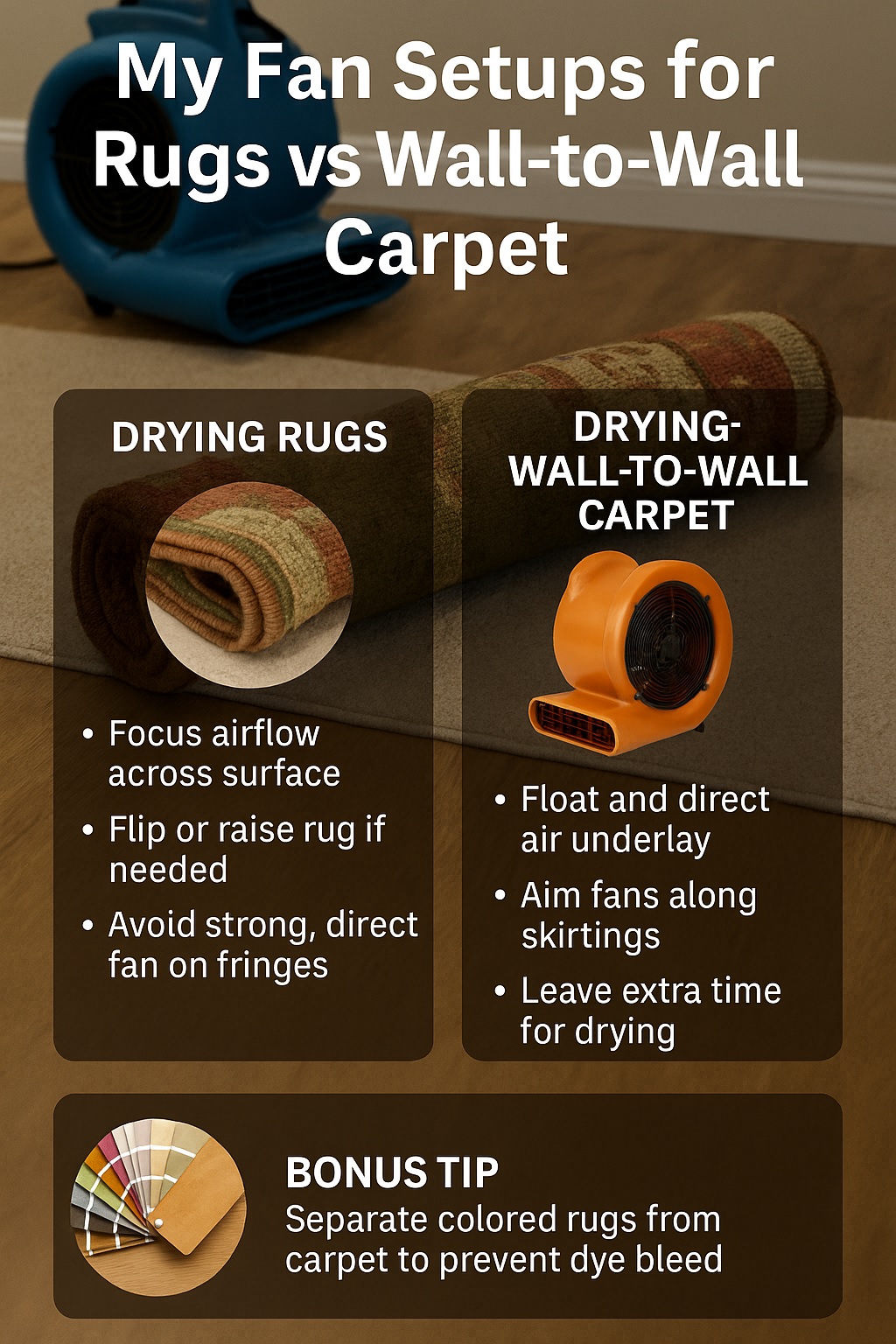
When I see wet floors, I never treat a loose rug the same way I treat wall-to-wall carpet.
Drying rugs and wall-to-wall carpet needs different fan setups. Correct airflow direction, carpet drying time planning and moisture monitoring cut mould, odour and damage. Learn how to protect floors, underlay and colours after leaks, spills or cleaning jobs.
Key Differences When I Dry Rugs vs Wall-to-Wall Carpet
| Factor | Typical Rug vs Carpet Value |
|---|---|
| Average surface drying time (fans) | Rugs: 8–24 hours / Carpet: 24–72 hours |
| Safe damp time before mould risk | Best kept under 24–48 hours |
| Airflow from a carpet dryer fan | Often 2,000–3,000 CFM |
| Typical pile / fibre thickness | Rugs: 5–15 mm / Carpet: 8–20 mm |
| Water damage jobs involving carpet | Around 70–80% of residential water losses |
Source: iicrc.org
💡 Why I Treat My Rugs and Wall-to-Wall Carpet So Differently
When I walk into a wet room, I always ask two questions first: is this a loose rug or wall-to-wall carpet, and what’s under it? My fan plan changes completely depending on those two answers. My goal is simple: dry fast enough to beat mould without wrecking the fibres or the floor.
With rugs, I think in “layers.” The rug is one piece. The floor underneath is another. I can usually move the rug, flip it, raise it or even take it outside. With wall-to-wall carpet, I’m dealing with carpet, underlay, gripper and subfloor, all fixed in place. My fans have to push air through that whole sandwich.
I learnt the hard way that if I treat installed carpet like a big rug and just blow air across the top, I can “polish” the surface dry while the underlay quietly stays wet. That’s when musty smells show up days later and customers call saying, “It’s wet again.” It isn’t. It just never dried underneath.
Dr Emma Tan, Building Scientist (CPEng), once told me that water in floors behaves more like smoke than a puddle, so my fan strategy must follow where it hides, not where it shines.
🧺 How I Use Fans on My Loose Rugs
How I Look at My Rugs Before I Even Plug in a Fan
When I pick up a wet rug, I don’t rush straight for the fan switch. I flip the rug, feel the backing, and look for tags or labels. I want to know if it’s wool, synthetic, or a mystery blend. Dark reds and blues get extra respect from me because I’ve seen them bleed onto light floors.
I’ve also learnt to check existing damage before I touch anything. If the backing is already flaky or the edges are unravelled, strong airflow can make it worse. Now I take quick photos before I start. That way, I know what was there first and what happened during drying. It keeps me honest and reassures customers.
If I’m unsure about colour stability, I do a quick test in a corner with a slightly damp white cloth. A tiny bit of transfer is manageable with careful drying. Heavy transfer means I treat that rug like a drama queen: gentle airflow, extra checks and zero shortcuts. That test has saved more than one pale carpet underneath.
Textile conservator James Lau, AIC Member, once told me that a rug can survive slow drying, but rushed airflow on unstable dyes is like putting a fragile painting in a wind tunnel.
How I Position My Fans Around My Rugs
For most rugs, I like to dry them flat on a non-absorbent surface first. I keep my fans low and angled so the air “skims” across the rug instead of making it flap. If the rug starts lifting and slapping, I know I’m pushing too hard or too close, so I back off the angle or distance.
On thicker or fringed rugs, I sometimes raise one edge slightly using small blocks or tiles, then aim a fan along the length. That little air channel speeds up drying without sending the whole rug flying. If I need more power, I add a second fan from the opposite side rather than just turning one fan to hurricane mode.
For small or delicate rugs, I like drying them over a mesh rack or table with airflow underneath. That way, moisture escapes from both sides. I still keep a fan across the face, but I avoid blasting straight into fringes. If fringe dries too fast compared to the body, it can curl or twist in strange ways.
Sports physiotherapist Mark O’Connor, MSPNZ, once compared my rug airflow to stretching: “Gentle and even works; aggressive and uneven gives you weird, painful results.”
How I Stop My Rugs from Bleeding Colour or Shrinking
I’ve seen rugs that looked perfectly fine when wet but turned into colour-bomb disasters when dried too hot or too fast. These days, I avoid hot air on sensitive dyes. I use room-temperature airflow and, if I can, keep the room humidity under control with a dehumidifier instead of heat. Slow and steady wins here.
If a rug feels loose-weave or hand-woven, I’m extra careful about shrinkage. I don’t let one end dry hard while the other end is still dripping. I move my fans around during the job so the whole rug dries as evenly as possible. I’d rather spend ten more minutes repositioning fans than return to fix a warped rug.
On higher-value rugs, I sometimes stop early and do a quick “check-in” with the owner. I’ll show them the progress and explain why I’m not forcing extra speed. Most people are relieved when they see I care more about their rug surviving than about racing the clock. That trust is worth more than any shortcut.
Architectural designer Lydia Chan, NZIA, once told me that materials rarely fail from being too respected; they fail when we rush them to match our schedule, not their limits.
💨 How I Dry My Wall-to-Wall Carpet After Leaks and Spills
How I Decide When to “Float” My Carpet
Floating carpet looks dramatic: edges lifted, fans shooting air underneath like a big balloon. I don’t do it just to look busy. I only float when the underlay is soaked and there’s a good chance of saving it. If the underlay is crumbly or smelly, I skip straight to removal instead.
Before I float, I check the carpet construction. If the backing already feels weak or I see signs of delamination, I avoid lifting big areas. I might instead lift small sections at the worst spots and direct fans underneath. That way I still move air under the carpet without tearing it away from the backing glue.
I also think about safety. Floating a hallway that everyone needs to walk through is asking for tripping and angry toes. In those cases, I dry from the sides, using fans along skirting boards and doorways, and lean more on dehumidifiers. Not as dramatic, but much kinder on ankles and insurance excess.
Civil engineer Daniel Fox, CEng, once joked that water damage jobs fail more from poor traffic planning than poor physics, and I’ve found that strangely accurate.
How I Aim My Fans Along My Walls and Hallways
In long hallways, I almost always start fan placement at the driest end and aim towards the wettest area. It sounds backwards, but it pushes drier air into the damp zone instead of dragging wet air through the whole corridor. I line my fans like dominoes so the airflow overlaps, not collides.
Around skirtings and corners, I sit low-profile fans right against the wall and angle them slightly so the air washes along the edge. I’ve seen tiny strips of damp under skirting boards cause big musty smells a week later. Now I treat those edges like priority zones, not leftovers.
If I’m drying a room with windows on one side, I sometimes angle fans so air runs across the floor and “curves” up the wall towards that side. Then my dehumidifier sits where the air naturally gathers. It’s like giving the room a one-way air highway instead of a messy roundabout.
Indoor air consultant Dr Priya Menon, CIH, tells me that predictable airflow patterns make moisture removal more efficient, just like predictable ventilation makes pollutants easier to control.
How I Work With Underlay and Subfloors
Underlay is the secret troublemaker. Customers rarely see it, but I spend half my thinking time on it. If the underlay squelches when I press down, I assume it’s storing water like a sponge. Light, modern foams sometimes dry well; old crumbly underlay usually doesn’t and just collapses after a soaking.
When timber subfloors are involved, I’m careful with moisture meters and patience. The surface might hit a “dry” reading while deeper layers still sit above safe levels. In those cases, I keep at least one fan and one dehumidifier running longer, even when the carpet feels fine to bare feet. My nose and meters have to agree.
Concrete slabs are different again. They release moisture slowly, so I’m realistic with timelines. I’ve learnt not to promise “dry tomorrow” on concrete. Instead, I explain that I’m chasing numbers, not feelings, and show the readings as we go. People relax when they can see progress, not just hear me say “almost there.”
Construction project manager Olivia Reid, PMP, often reminds me that hidden layers decide the schedule, not the diary, and water-damaged floors are a textbook example of that truth.
🛠️ How I Choose the Right Fans for My Rugs and Carpets
Why My Air Movers Are My Main Workhorses
My low-profile air movers are the first tools I grab for carpets. They sit low, push a strong sheet of air across the floor and slide neatly under bed frames and desks. I’d rather use three smaller air movers on low speed than one big noisy unit blasting like a jet engine.
I also think about power and noise. In small flats, I don’t want the neighbours thinking a helicopter has landed in the lounge. Running several fans on medium speed often keeps the overall volume down while still moving plenty of air. Customers are more likely to leave equipment running if it doesn’t drive them crazy.
Acoustic engineer Ben Fraser, MIOA, once told me that if people turn machines off to escape noise, the design has failed, no matter how powerful the specs look on paper.
When I Use Axial Fans Instead of Snail-Style Fans
Axial fans are my “big room” tools. When I walk into an open-plan lounge with soaked carpet, one axial placed well can set the whole room’s air in motion. I normally angle it slightly across the floor rather than straight down the middle, then back it up with smaller air movers in trouble spots.
For large rugs, axials are handy too. I can stand one fan at the end of a rug and let the airflow travel down the length. If the rug starts fluttering, I adjust the angle or move the fan back. I’d rather trim airflow than tape the rug down and risk pulling fibres when I remove the tape later.
Industrial process engineer Carla Nguyen, CPEng, once pointed out that big fans are like fire hoses: great for coverage, but you still need small nozzles to handle the details.
How I Keep Things Quiet for My Customers
Night-time bedrooms are a different game. I’ve dried plenty of kids’ rooms where parents still needed sleep. In those cases, I pick my quietest fans, run them on lower speed and position them so the air still moves but the sound is pointed away from the bed.
I also tidy cables like I’m setting up a small stage. I hate the idea of someone tripping on my gear at 2 a.m. A simple cable route along skirting boards or under a bed edge makes a big difference. Happy, well-rested customers are far more forgiving about how long the drying takes.
Human factors specialist Dr Alan Price, HFES, says most safety incidents come from messy layouts, not bad intentions, and I see that every time I tidy a drying setup.
🪑 How I Protect My Floors, Furniture and Coloured Rugs While I Dry
How I Stop Stains and Colour Transfer
One of my early mistakes was leaving a damp red rug on a pale carpet “just for an hour” while I set up fans. That carpet wore a faint pink shadow for months. Now, as soon as I see high-risk colours on top of lighter flooring, I separate them before I even think about airflow.
If I have to dry a rug on top of something, I use plastic sheets, tiles or thick towels as a barrier. I also keep checking the underside during drying. If I see any hint of colour movement, I change the setup immediately. It takes seconds and saves awkward conversations later.
Textile scientist Dr Hannah Boyd, CText ATI, once told me that dyes are like teenagers: most behave, but the tricky ones need space and supervision.
How I Shield Timber, Vinyl and Tiles from My Setup
Wet rugs and carpets aren’t the only problem; my equipment can mark floors too. I’ve seen plastic fan feet leave faint rings on soft timber when the floor stayed damp for too long. Now I pop coasters, rags or plastic under fan feet any time I’m on sensitive surfaces.
On polished timber, I never leave soaked rugs sitting in place. Timber can cup, warp or darken faster than most people expect. I’d rather move the rug, explain why to the owner and show them the boards underneath. Once people see the risk, they usually thank me for being fussy.
Timber flooring inspector Peter Hall, ATFA Member, told me that most floor failures come from “harmless” moisture that hung around just a bit too long.
How I Move Furniture Without Making Things Worse
I’ve seen rusty chair legs and stained sofa feet turn a simple drying job into a restoration headache. These days, when I move furniture, I don’t just slide it onto the next damp patch. I lift it onto foam blocks or plastic cups so it can sit safely above the moisture while fans run.
Heavy items get special treatment. I plan their new resting spots before I move them, so I’m not dragging them back and forth across wet carpet. My back and the carpet both appreciate that. It looks slow from the outside, but it saves time overall because I’m not fixing extra damage.
Ergonomist Lisa Ford, CPE, says that good lifting and layout planning prevent half the injuries people blame on “hard work,” and I’ve found that true in water jobs too.
📊 How I Use Moisture Meters and My Nose to Check Drying
How I Take Moisture Readings in Rugs and Carpets
I trust my eyes and hands, but I don’t trust them alone. I use moisture meters on carpets, underlay and subfloors whenever I can. I like taking readings in both obvious wet spots and “boring” corners. Water loves to hide along edges and under furniture, not just in the big puddle area.
On rugs, I check both the face and the backing. If the face feels dry but the backing still reads high, I keep airflow going and avoid rolling or storing the rug yet. I’ve seen “dry” rugs grow a faint musty smell inside cupboards because the backing was still holding moisture.
Building diagnostics consultant Sofia Marin, RICS, once told me that instruments don’t replace common sense, but they expose the lies our eyes want to believe.
How I Decide When to Move or Switch Off My Fans
I don’t switch off fans just because a room “feels” dry. I look at trends. If readings are steadily dropping and the smell is fresh, I might reduce the number of fans but keep at least one running in the worst area. I step down in stages instead of going from full blast to zero.
When carpets on concrete are involved, I know readings can bounce around a bit as deep moisture releases. In those jobs, I focus on overall progress rather than chasing a perfect number in one spot. I’d rather leave gear one extra day than get a phone call about a smell next week.
Risk analyst Jonathan Lee, PRMIA, says that people underestimate slow, creeping risks, and subfloor moisture is one of my favourite real-life examples.
How I Use Smell and Touch as a Backup
Meters are great, but my nose is still one of my best tools. Fresh drying work smells clean and a bit like laundry day. If I catch even the hint of a musty smell while fans are running, I know I’ve missed a pocket of moisture somewhere or I’m not exchanging enough air.
Touch matters too. I walk the carpet slowly, feeling for cool, slightly sticky patches. Those spots often sit just above a wet underlay or cold concrete slab. Once I find them, I shift fans and sometimes lift edges again to check underneath. It’s a bit like detective work, but for water.
Clinical microbiologist Dr Ravi Patel, FASM, reminds me that mould doesn’t care about excuses, only moisture and time, so my senses are my early warning system.
⚠️ Problems I’ve Seen When People Dry Rugs and Carpets the Same Way
When a Rug Bleeds Onto a Carpet Underneath
I once walked into a lounge where a bright red rug had been left on a cream carpet after a leak. The owner had put a fan on top and walked away. The rug dried. The carpet underneath looked like someone had sprayed pink mist in a perfect rectangle.
Fixing that meant extra cleaning, stain treatments and one very stressed owner. If that rug had been lifted first, or at least moved onto tiles, none of that drama would have happened. Now, whenever I see that combination, I automatically separate the layers before I start anything else.
Colour chemist Dr Alison Moore, FRSC, joked that dyes are loyal to nothing; they move wherever physics pushes them, no matter how much we like the original design.
When Carpet Delaminates or Lifts Off the Backing
Another common issue I see is carpet delamination. People crank up heaters, point fans at one corner and hope for the best. The surface dries quickly, but the glue between layers suffers. Later, the carpet starts rippling or lifting when people vacuum or move furniture.
In my jobs, if I suspect heavy or long-term saturation, I focus less on speed and more on even drying. I’d rather remove and replace damaged underlay and re-stretch carpet than pretend it’s fine and leave someone with permanent waves. My reputation isn’t worth a rushed shortcut.
Flooring consultant Greg Walters, NICF, says that backing systems hate extremes, and I’ve watched that come true in more than one overheated lounge.
When Mould Starts Under a “Dry” Carpet
Hidden mould is the sneakiest problem. A carpet can feel completely dry on top while underlay quietly grows a science experiment underneath. A few weeks later, the room smells earthy, and sometimes people start sneezing more when they spend time there. The carpet wasn’t re-wet; it was never fully dry.
To avoid that, I combine airflow, dehumidification and proper checks. I lift edges, I measure, I sniff, and I explain to customers why I’m being so picky. Once they understand that “feels dry” isn’t the same as “is safe,” they become partners in the process instead of rushing me to unplug everything.
Environmental health officer Karen Doyle, MPH, says that indoor air complaints often start with hidden moisture, not visible mess, and my jobs back that up again and again.
📘 My Case Study: How I Saved a Customer’s Rug and Carpet After a Leak
A family called me after their washing machine hose popped off and flooded part of their lounge. A bold patterned rug sat on top of a light carpet right in the splash zone. By the time I arrived, everything squelched, and they were worried the rug would ruin the carpet forever.
The first thing I did was remove the rug to a separate drying area and block the furniture. Then I extracted as much water as I could from the carpet and underlay. Next came fans along the skirtings, one axial across the room and a dehumidifier to control humidity. Moisture readings told me where to focus.
Here’s how I tracked that job:
| What I Measured | Result From This Job |
|---|---|
| Water source and duration | Washing machine leak, ran about 20–30 minutes |
| Worst moisture reading (carpet) | Around 90–95% in skirting and corner areas |
| Fans and dehumidifiers used | 3 air movers and 1 medium dehumidifier |
| Time to reach dry standard | Roughly 36 hours to acceptable readings |
| Final outcome | No dye bleed, no musty odour, no visible damage |
The family kept both their rug and their carpet, and the room smelled normal again. Jobs like that remind me why the “rug equals carpet” shortcut is so dangerous and why my separate plan for each one matters.
Operations researcher Dr Leo Chang, INFORMS, likes to say that small decisions at the start of a job decide ninety percent of the outcome, and this case proved that to me.
❓ My Quick FAQs About Drying Rugs vs Wall-to-Wall Carpet
Why can’t I dry my rug and carpet the exact same way with one fan?
I wish it were that simple. Rugs and wall-to-wall carpet have different backings, thickness and movement. One fan angle that’s perfect for a rug can leave underlay wet. I treat them as separate jobs so I don’t win the surface and lose the layers underneath.
How long do I usually run my fans on rugs vs carpet?
For rugs, I often see 8–24 hours with good airflow and humidity. For wall-to-wall carpet, especially over underlay, 24–72 hours is much more realistic. I don’t go by the clock alone. I go by moisture readings, smell and how the floor feels underfoot.
Can I sleep with fans running in my bedroom?
Most of my customers do. I choose quieter settings and tidy cables so no one trips in the dark. I also avoid blocking doorways completely. If the noise is too much, we sometimes move the bed or shuffle the setup. Comfort matters as much as drying.
When should I call in a professional instead of DIY?
If you see widespread flooding, repeated leaks, visible mould or stained skirtings, I’d strongly consider professional help. Once water reaches underlay, timber or wall cavities, the job gets bigger than a single fan and a towel. Calling early usually costs less than repairing later.
Do I always need a dehumidifier as well as fans?
Not always. Small spills on good ventilation days can sometimes dry with just fans. But if humidity is high, or if the room feels sticky and warm, I bring in a dehumidifier. Fans move moisture into the air; dehumidifiers pull it back out so the room can actually recover.
Consumer behaviour expert Dr Mia Roberts, PhD, once told me that people love simple yes-or-no rules, but homes rarely cooperate, and water damage is a prime example.
✅ My Takeaways When I Dry Rugs and Wall-to-Wall Carpet
My short version is this: my rugs are travellers, my wall-to-wall carpets are foundations. I move and protect the travellers; I stabilise and rebuild the foundations. That mindset shapes every fan angle, every edge I lift and every extra day I leave a dehumidifier humming in the corner.
Over time, my rules have become simple: separate layers before drying, protect floors and furniture, use more gentle fans instead of one angry one, and never trust “feels dry” without checking underneath. Those habits came from my own mistakes, long evenings of callbacks and a lot of quiet learning on real jobs.
I hope my stories help you avoid the common traps I’ve seen when people treat rugs and carpet as the same thing. Use my tips where they fit your home, and if the water gets bigger than your comfort level, don’t be shy about asking a local professional to step in.
Business coach Aaron Blake, CPA, says that systems are just lessons written down, and this is simply my drying system, shared so you don’t have to learn everything the hard way.
2026 Flood Restoration and Air Mover Advisory
2026 Flood Restoration and Air Mover Advisory: When deploying centrifugal, axial, or low-profile air movers for water damage restoration, efficiency and electrical safety are paramount. Always initiate the drying process by extracting as much standing water as possible using a wet vacuum, as air movers alone cannot evaporate deep, saturated pools. Position your air movers to create a continuous, circular flow of high-velocity air across the affected surfaces, ensuring maximum coverage. Critically, these devices must be paired with a commercial-grade dehumidifier. Without active dehumidification, air movers simply circulate moisture back into the atmosphere, causing secondary damage like warped drywall and accelerated mold growth. Ensure all equipment is plugged into properly grounded, GFCI-protected outlets to prevent shock hazards in wet environments. Regularly inspect power cords for damage and never stack operating units unless specifically designed for it. Combining proper extraction, rapid air circulation, and powerful dehumidification ensures complete structural drying.
Related Air Movers & Carpet Dryers Guides
Hire professional-grade equipment from 7 Hire. We offer fast local pickup or delivery across Auckland.