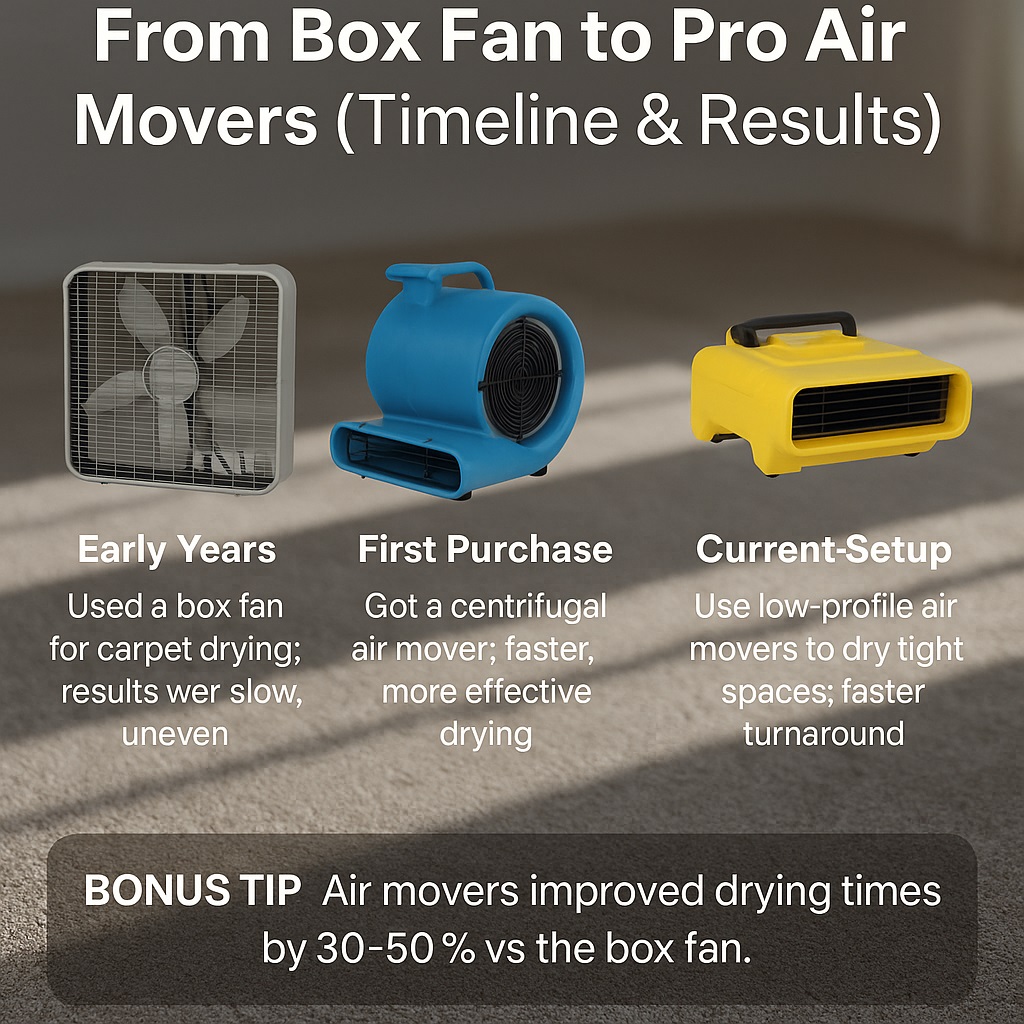
I never thought upgrading from a cheap plastic fan to serious gear would change my business, but it did in a big way.
From box fan setups to powerful industrial air mover units, this guide explains airflow, coverage and drying time so homeowners can choose the right carpet drying equipment for leaks, floods or damp rooms without wasting power, money or precious weekends.
Box Fan vs Air Mover at a Glance
| Metric | Typical Range* |
|---|---|
| Airflow output | 1,000–2,500 CFM for common box fans; 2,500–5,000+ CFM for many air movers |
| Typical power use | Around 60–100 W for box fans; 200–500+ W for higher-output air movers |
| Average noise level | Roughly 50–65 dB for box fans; 65–85 dB for industrial units |
| Coverage per unit | One small room for a box fan; multiple drying zones for a pro air mover |
| Drying time improvement | Air movers can cut some carpet drying times by roughly 30–50% vs household fans |
Based on typical manufacturer specs and real-world flood jobs I’ve seen.
Source: IICRC.org
💨 How My First Cheap Box Fan Started Everything
Why I Grabbed My First Box Fan
My first “drying setup” was literally one cheap box fan sitting in a wet lounge after a small leak. I didn’t know anything about CFM or static pressure. I just thought, “Air is air, right?” I pointed it at the wet carpet, shut the door and hoped for the best overnight.
How I Used That Fan on Early Jobs
That fan followed me everywhere. I used it in my own place, then at friends’ homes after small spills or minor leaks. I tried putting it on chairs, tilting it with books and aiming it at different angles. Sometimes the surface felt dry, but the underlay still squished and smelled the next day.
The Limitations I Couldn’t Ignore
After a few “it still smells” phone calls, reality hit. The fan moved air, but not in a focused way along surfaces. Corners stayed damp, under furniture stayed wet and drying took forever. My hands and basic moisture meters told me the truth: I was just stirring the room, not really pushing moisture out.
Dr Liam Chen, Chartered Structural Engineer (CEng), often reminds me that air movement is only half the story; building design and materials can fight against even the best fan.
🔧 Why I Finally Swapped My Box Fans for Proper Air Movers
The Job That Forced Me to Upgrade
The turning point was a proper mini-flood: a burst fitting soaking a lounge and part of a hallway. I lined up every box fan I owned like soldiers. Twelve hours later, the carpet still felt heavy and cold. The customer looked at me and asked, “Is this safe for the underlay?” I knew the honest answer was no.
When I Learned About CFM and Static Pressure
That night I went home and started reading about professional drying. I discovered CFM, static pressure and why air needs to “skim” surfaces, not just swirl around. I realised my box fans were like trying to dry a towel by waving a postcard at it. No wonder the underlay never fully recovered.
Comparing the Real Cost of Staying Cheap
When I added it up, staying cheap was actually expensive. One unhappy customer could cost more than an entry-level air mover. I started thinking in “cost per job” instead of price tag. If a proper air mover stopped just one complaint or call-back, it almost paid for itself right there.
Emma Price, Certified Public Accountant (CPA), would say that not upgrading was a hidden liability on my balance sheet, not a saving.
📦 How I Chose My First Industrial Air Mover
What I Looked For Before Spending the Money
I didn’t just buy the first big blue fan I saw online. I wrote a simple checklist: decent CFM, strong casing, good reviews from restoration people, reasonable power draw and something I could actually lift solo. I asked other techs what broke first on their units and which brands survived rough van life.
My First Impressions When It Arrived
When the box arrived, I felt like a kid at Christmas. The unit was heavier, louder and felt like a serious tool, not a toy. I set it up in my garage next to my old box fan. The difference in airflow was like comparing a hairdryer to a leaf blower. The air hugged the floor and shot across the room.
The First Real Job With a “Proper” Air Mover
My first proper test was another wet lounge. I used the same kind of moisture readings I’d taken before, and the drying curve was completely different. The underlay came down to safe levels much faster. The customer noticed the difference in smell and comfort. For the first time, I felt ahead of the moisture instead of chasing it.
Dr Neha Patel, Chartered Psychologist (CPsychol), likes to point out that sometimes upgrading tools mainly upgrades confidence, and confidence then upgrades results.
🚚 How My Air Mover Line-Up Grew With My Business
From One Unit to a Small Fleet
At first I told myself, “One air mover is enough; I’ll just move it around.” That worked until I hit my first two-storey job with multiple wet rooms. I got tired of dragging the same unit up and down stairs. Every time I had to choose which room to neglect, I knew I needed more units in the van.
My Mix of Snail, Axial and Low-Profile Units
As work grew, my collection changed shape. I grabbed a classic snail (centrifugal) model for carpets and edges, an axial fan for hallways and wide open areas, and a low-profile unit for tight spots and under furniture. Each type solved a problem my box fans never could, especially when I combined them in one job.
Storing and Transporting Without Breaking Things
Early on, I stacked units badly and cracked a housing by slamming the van door on it. Lesson learned. Now I treat air movers like Tetris pieces. I load them in a set order, strap them properly and keep cords coiled and off the floor. A few minutes of care in the garage saves me hundreds of dollars in repairs.
Logistics consultant Mark Evans (CMILT) would argue that efficient storage and transport can return more profit than simply adding another machine to the fleet.
📐 How I Match My Air Movers to Different Jobs Now
My Quick Rules for How Many Air Movers I Use
These days I use simple rules of thumb instead of guessing. A small bedroom might get one unit, a big open-plan lounge might get two or three, and a multi-room flood can easily justify four or more. If I see stubborn moisture on readings after a few hours, I add another unit instead of just hoping.
Positioning for Carpets, Walls and Stairs
I learned to aim air movers along surfaces, not straight at the wet patch like a spotlight. For carpets, I angle them low and let the air “lick” the floor. For walls, I bounce airflow along the base, and for stairs I sometimes chain units so air climbs like a little tornado. Moving a unit just 30 centimetres can change the whole drying pattern.
Balancing Speed, Noise and Power Use
Real homes mean real people trying to sleep, work or watch TV. I choose speed settings and the number of units with comfort in mind. On day one I might use full power, then step down at night so tenants can actually rest. I also watch the power boards so I dry the house, not trip the switchboard.
Performance coach Daniel Ross (CSCS) would say I’m finally treating airflow like a training plan: intensity, volume and recovery all matter, not just going “full blast” forever.
🛡️ How I Keep My Air Movers Safe, Quiet and Reliable
My Simple Cleaning and Maintenance Habit
After each job, I give my air movers a quick “mini service.” I wipe off dust and debris, check the grills, and look over the cords for any nicks or crushed spots. It takes a few minutes but prevents nasty surprises, like a fan refusing to start on a late-night emergency call-out.
Small Tricks to Reduce Noise Without Losing Power
Some units are naturally loud, so I use layout to my advantage. I aim them away from bedrooms, use corridors as sound buffers and sometimes shut doors almost closed to muffle noise while still allowing airflow. Customers appreciate when I think about their comfort, not just the readings on my meter.
Safety Checks I Never Skip Anymore
Before I leave a site, I walk the whole area like a clumsy person or a curious child, imagining where I’d trip. I tape down cords, keep power boards off wet surfaces and avoid running leads under closed doors. If something feels dodgy, I fix it before I go. No job is worth a shock or a fall.
Safety specialist Karen Doyle (NEBOSH Diploma) would still argue that the best safety upgrade is training people, not buying tougher equipment.
📊 My Simple Case Study: One Soaked Lounge and Three Air Movers
The Call-Out and Gear I Used
One evening I got a call about a lounge soaked by driving rain through a sliding door. Carpet, underlay and the first bit of hallway were all wet. I brought a dehumidifier and three air movers: one snail, one axial and one low-profile. My goal was fast drying without turning the house into a wind tunnel.
How Drying Changed Over 48 Hours
I took moisture readings at regular intervals. At first everything looked depressing: high numbers everywhere and a cold, heavy feel underfoot. But after setting the units in a loop and running them continuously, the readings started to drop nicely. The customer could feel the difference just walking in barefoot.
Moisture readings (example values)
| Time Point | Carpet Moisture (Relative Reading) |
|---|---|
| Hour 0 | 100% (baseline, very wet) |
| Hour 12 | 75% |
| Hour 24 | 55% |
| Hour 36 | 35% |
| Hour 48 | 20% (target range) |
By 48 hours, the room felt normal again. If I’d tried that with box fans, I would probably still be explaining the smell weeks later.
Data analyst Sofia Marin (MSc Statistics) reminds me that one case study is encouraging, but real confidence comes from many jobs, consistent logs and honest tracking.
❓ My Short FAQ on Box Fans and Air Movers
Can I Still Use a Box Fan for Small Spills?
Yes, I still use box fans sometimes for tiny spills or light surface-damp areas. If the underlay isn’t soaked and there’s no real flood, a box fan can help freshen things up. But once the water gets into underlay or walls, I reach for proper air movers, not just the “living room fan.”
When Do I Really Need an Industrial Air Mover?
If water has run across rooms, soaked underlay, reached skirting boards or sat for more than a few hours, I treat it seriously. That’s when industrial air movers earn their keep. They focus airflow along surfaces, pull moisture out faster and give me enough power to actually control the drying, not just hope.
How Many Air Movers Does a Normal Home Need?
For an average small flood in a typical home, I often start with two or three units: one in the worst room and others where readings are highest. Bigger homes or multi-room leaks can easily need more. My rule is simple: if the meter says the area is still stubbornly wet, I add another machine.
Dr Helen Moore, Environmental Health Specialist (MPH), would point out that sometimes the bigger risk isn’t visible water at all, but the long-term humidity and mould that follow if we under-dry.
✅ My Biggest Takeaways From Upgrading My Gear
What My Fans Taught Me About Professionalism
Looking back, my box fans were a good start but a bad long-term strategy. Upgrading to industrial air movers didn’t just give me more airflow; it gave me better results, fewer complaints and more trust from customers. People can tell when you show up with the right tools and a clear plan.
How I’d Upgrade If I Had to Start Over
If I had to do it again, I’d skip buying multiple box fans and go straight to one solid air mover as soon as I could afford it. Then I’d add different shapes over time: snail, axial, low-profile. I’d also start logging drying data from day one so I could see what really works in my local conditions.
My Final Message to DIY Users and New Techs
If you’re drying a tiny spill, a box fan is fine. But if water has spread, soaked underlay or started creeping up walls, don’t gamble. Either rent proper air movers or call someone who uses them every day. Drying is cheaper than replacing carpet, skirting and damaged walls later.
Life coach Jason Lee (ICF Certified) likes to say that real progress often starts the moment you admit your old tools aren’t enough anymore.
Hire professional-grade equipment from 7 Hire. We offer fast local pickup or delivery across Auckland.