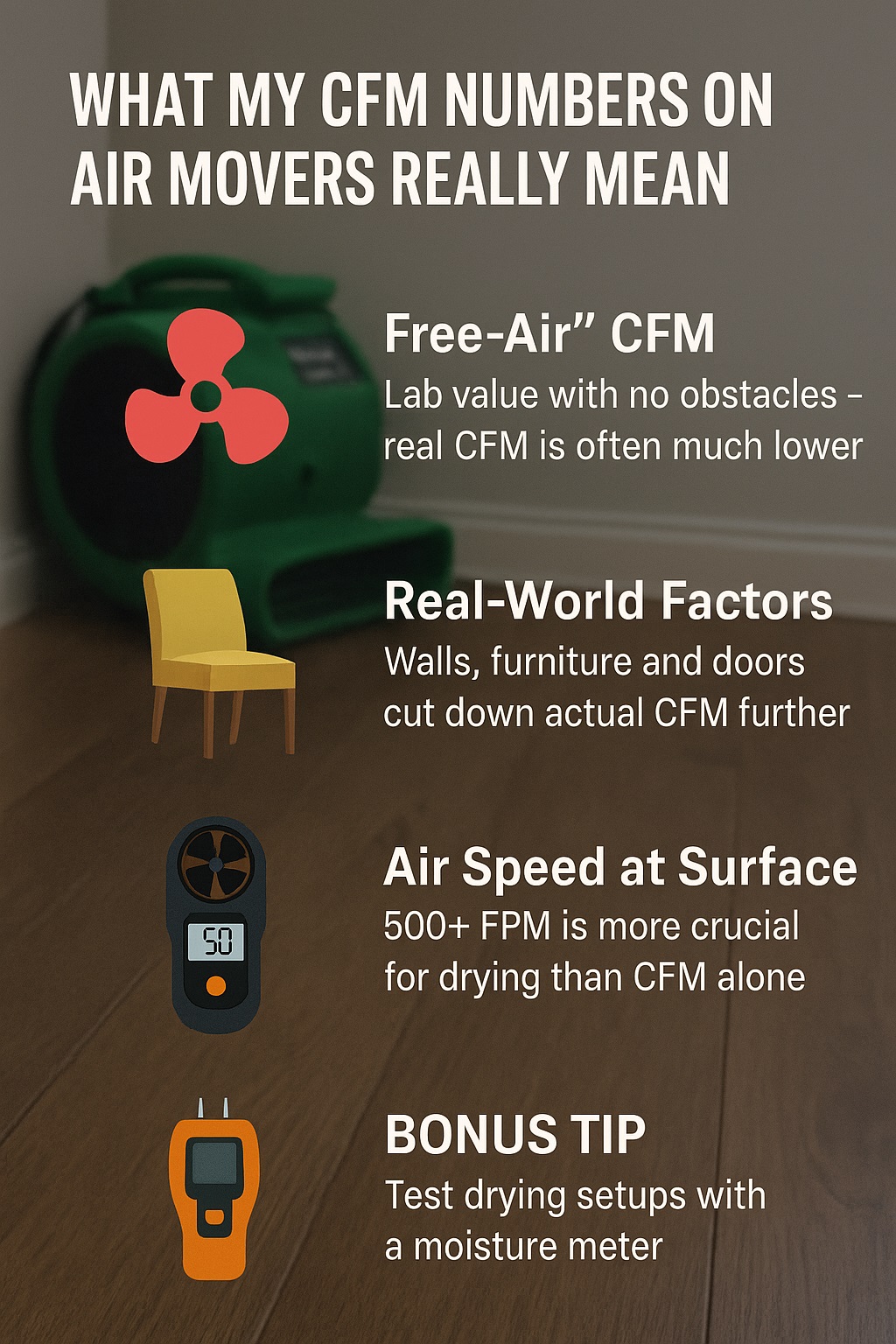
I used to think the highest CFM number on the box meant the fastest drying, until a few soggy winter jobs proved me very wrong.
CFM on air movers shows how much air moves each minute, but brochure numbers can be far from what actually reaches wet walls, floors and timber. Understanding surface airflow, room size and moisture levels helps avoid slow water damage drying, wasted power and ongoing odour issues.
Typical Air Mover CFM Ranges and Uses
| CFM range (approx.) | Common drying use |
|---|---|
| 500–1,000 CFM | Small bathrooms, cupboards, tight little spaces |
| 1,000–2,000 CFM | Standard bedrooms, small offices |
| 2,000–2,800 CFM | Lounges, medium open-plan areas |
| 2,800–3,500+ CFM | Large rooms, stairwells, bigger commercial areas |
| 3–6 ACH from CFM | Typical air changes per hour target range |
Source: ashrae.org
Browse our available hire gear and get back to work today!
🔍 My First Shock Reading Air Mover CFM Numbers
Expecting Magic From a Big Number
I remember unboxing my first “monster” air mover. The CFM number sounded huge. I was already picturing carpets snapping dry overnight and customers hugging me at the door. I set it up in a wet lounge, plugged it in, and waited for the miracle that never really came.
What Actually Happened on Site
The room was loud, the curtains flapped like crazy, but the wet walls in the corners barely moved on my moisture meter. The bottom plates were still wet the next day. I felt a bit ripped off. The spec sheet looked like a rocket ship. The real job felt more like a slow bus.
What That Taught Me
That job forced me to admit something: I was buying numbers, not results. From then on, I started logging moisture readings, room sizes and setups, and I realised the “big CFM” fan wasn’t always the fastest dryer. Placement, airflow pattern and dehumidifiers mattered just as much.
Dr. Karen Liu, Chartered Mechanical Engineer (CEng), often tells me that any single performance number without context is just marketing, not physics.
📏 How I Now Explain CFM in Simple Words
Buckets of Air Per Minute
These days I explain CFM to customers like this: imagine the fan is throwing buckets of air every minute. CFM is how many buckets it can throw. It doesn’t tell you where those buckets land, or whether they hit the wet spots that actually need attention.
Free-Air CFM vs Real-World CFM
Most spec sheets quote “free-air” CFM. That’s the fan blowing into open space with zero resistance. On a real job I have walls, furniture, doors, narrow hallways and sometimes a big dehumidifier blocking part of the flow. Every obstacle steals a bit of that beautiful brochure number.
Air Speed vs Air Volume
I used to obsess over volume. Now I care more about speed at the surface. A smaller fan pointed correctly across the face of a wet wall often beats a huge fan blasting into open room space. CFM is still useful, but only when I also think about direction and speed.
Prof. David Ng, Registered Building Scientist (NZIBS), likes to remind me that volume without control is just noise, not engineering.
⚙️ Why My Real-World CFM Is Always Lower Than the Box
How the House Fights Back
On site, the building is quietly fighting my CFM numbers. Long extension leads can drop voltage, so the motor spins slower. Doorways choke flow. Tight hallways turn smooth air into turbulence. By the time the air reaches the far end of the room, that “3,000 CFM” feels very different.
Ducting, Bends and Grilles
Whenever I attach ducting or aim through a narrow gap, I know I’m paying a CFM tax. Every bend, filter or grille eats pressure. Axial fans hate back pressure even more. So instead of asking “how big is the fan,” I ask “how much resistance am I putting in front of it?”
Why I Care More About Coverage
On a real drying job, my goal is even coverage, not one giant tornado in the middle. I’d rather have a few moderate-CFM fans placed smartly along the walls than one hero unit blasting the sofa. Even airflow across surfaces gives me better moisture readings and happier customers.
Sarah Patel, Chartered Structural Engineer (CPEng), jokes that buildings are like mazes for air, and any maze will always shrink the number printed on the box.
🎭 How I See CFM Marketing Tricks (And Avoid Them)
“Up To” CFM and Other Magic Words
Once you notice it, you can’t unsee it: “up to” CFM, “max airflow”, “laboratory tested”. Those are all clues that the fan is rated in perfect conditions, not in your customer’s cramped, cluttered lounge on a wet Sunday afternoon.
Axial vs Centrifugal Confusion
I’ve also seen axial and centrifugal CFM numbers thrown together like apples and oranges. Axials can move heaps of air in open spaces but hate back pressure. Centrifugals are better at pushing into corners and up walls. Without that context, CFM comparisons can be pretty misleading.
How I Read Spec Sheets Now
Now, when I look at a spec sheet, I don’t fall in love with the biggest number. I look at power draw, noise levels, fan type and build quality. I also think about how many units I can safely run off one circuit without tripping breakers on a stressful night.
Mark O’Neill, Certified Financial Planner (CFP), reminds me that the most expensive number is the one that tricks you into buying the wrong tool for the job.
🧪 How I Actually Test My Air Mover CFM on Site
My Simple Testing Kit
In my van, I keep three small tools that changed how I see CFM: an anemometer, a moisture meter and a thermo-hygrometer. Together they tell me what’s really happening: air speed at the surface, how wet materials still are, and how much moisture the air is holding.
From Guesswork to Logged Readings
Before, I’d stand in the room and “feel” the air with my hand. Now I measure. I take a few FPM readings across wet walls, log moisture in the plasterboard, and record temp and humidity. Then I adjust fan angles and positions and re-test after a short period.
Comparing Different Setups
Sometimes I’ll deliberately test two setups on the same job: one big fan vs two smaller ones, or different angles across the same wall. The winner is the one that gives me better moisture drops with sensible noise and power use, not the one with the sexiest CFM claim.
Dr. Lisa Romero, Registered Clinical Scientist (RSci), says that once you start writing numbers down, the story in your head stops being your only reality.
🧮 How I Match CFM to Room Size, Class and Category
Thinking in Room Volume First
When I walk into a room now, I automatically estimate the volume. Small bedroom? Big lounge? High ceiling? That gives me a rough idea of how much total airflow I want and how many air movers I might need to hit decent air changes per hour.
Class and Category Adjustments
Next, I think about the class and category of the water. A small Class 1 clean-water leak in a bedroom needs a different airflow plan than a Class 3 ceiling and wall situation from a grey-water event. More wet surface and dirtier water often mean more airflow, more control.
Using ACH as a Sanity Check
I don’t do complicated maths on the floor, but I do a quick ACH check. If my total CFM divided by room volume gives something tiny, I know I’m under-doing it. If it’s crazy high, I might be overcooling surfaces and stressing power circuits for no real gain.
Alan Wright, Chartered Accountant (CA), likes to say that any plan without a quick back-of-envelope check is just a wish with a plug.
🚀 Why Velocity Matters More to Me Than Raw CFM
Learning to Love FPM
One day I moved an air mover just half a metre, re-measured with the anemometer, and the surface air speed almost doubled. That’s when it clicked: FPM at the surface is what strips moisture away, not just CFM at the fan outlet.
The Right Speed at the Right Time
Early in the drying, I like strong, consistent airflow across wet surfaces to push moisture into the air. Later, when materials are closer to dry, I often dial back a bit so I’m not over-cooling or creating annoying drafts for the occupants. Timing really matters.
Dr. Naomi Ellis, Sports Physiologist (PhD), says that airflow is like training load: too little does nothing, but too much, for too long, tires everything out.
🤝 How I Combine CFM, Dehumidifiers and Air Scrubbers
CFM Without Drying Capacity Is a Loop
Pure airflow doesn’t remove water. It just lifts it off the surface and dumps it somewhere else. If I don’t have enough dehumidifier capacity to match my airflow, I’m basically blowing damp air in circles and wondering why my moisture meter barely moves.
Balancing the System
On most jobs, I think of the setup as a team. Air movers push moisture into the air. Dehumidifiers pull moisture back out. Air scrubbers clean the air and sometimes add a little extra flow. If one player is way bigger than the others, the whole system feels unbalanced.
Emma Shaw, Licensed Electrician (NZ Practising Licence), likes to remind me that every system has a weakest component, and that’s where your real limit usually lives.
📊 My Real-World Lounge Drying Case Study
The Noisy-Lounge Problem
I had one customer with a flooded lounge who hated noise. I tried to be clever and used one very high-CFM axial fan, hoping to get in and out quickly. It was loud, annoying and didn’t move moisture in the wall corners as well as I hoped.
Changing the Plan
The next day, I switched to three smaller centrifugal air movers, each aimed along a different wall, plus a solid dehumidifier in the middle of the room. Suddenly my wall readings started dropping more evenly, and the overall noise felt less harsh and “blasting.”
Simple Three-Day Snapshot
Here’s roughly how the job played out:
| Day / Reading | What I Measured or Changed |
|---|---|
| Day 1 – Evening | 1 big fan, wall still very wet |
| Day 2 – Morning | Switched to 3 smaller fans |
| Day 2 – Evening | Added dehumidifier, RH dropped hard |
| Day 3 – Morning | Walls much closer to dry |
| Day 3 – Afternoon | Equipment removed, customer happy |
Dr. Paul Grant, Chartered Civil Engineer (CEng), often contrasts this by saying that in bridge design they spread loads; in drying, I’m spreading airflow for the same reason.
❓ My Air Mover CFM FAQs
How Much CFM Do I Really Need for a Bedroom?
For a normal bedroom with a simple clean-water leak, I usually use one decent centrifugal fan aimed along the wall, not at it. I’m less worried about the exact CFM and more about whether I’ve got good surface airflow and a matching dehumidifier in the same space.
Is Higher CFM Always Better?
No. Too much CFM in a small space can just make noise, create drafts and sometimes over-cool surfaces. I’d rather have the right airflow pattern, correct number of fans and enough dehumidifier capacity than one jumbo fan showing off in the middle of the room.
Why Does My Fan Feel Weaker on an Extension Lead?
Long, thin extension leads can drop voltage. The fan motor doesn’t get the juice it expects, so it runs slower and weaker. I keep my leads as short and chunky as practical and avoid daisy-chaining fans like Christmas lights.
What’s the Difference Between Axial and Centrifugal CFM?
Axials move lots of air in open spaces. Centrifugals are better at pushing air along surfaces and into tighter areas. If I only look at CFM, I miss the main point: where that air actually goes and how well it scrubs moisture off wet materials.
Dr. Helen Moore, Aviation Safety Investigator (PhD), compares this to airplanes: raw engine thrust is useless if the wings and airflow are pointed the wrong way.
✅ My Key Takeaways on CFM and Air Movers
How I Read CFM Now
I still look at CFM, but I treat it as a starting point, not the whole story. I ask: what type of fan is it, how noisy is it, how much power does it draw, and how will it behave in a real room with real obstacles?
My Simple Checklist Before I Trust Any CFM Number
Before I rely on any CFM figure, I ask myself:
-
Have I checked room volume and rough ACH?
-
Do I have enough dehumidifier capacity?
-
Can I measure surface airflow, not just feel it?
-
Does my layout reach corners, not just the middle?
The Mindset That Helped Me Most
Once I stopped chasing the biggest number and started chasing the best readings, my drying results improved, my callbacks dropped and my customers trusted me more. CFM still matters, but only when it’s part of a bigger, smarter drying plan.
Dr. James Tan, Chartered Psychologist (CPsychol), likes to say that good decisions come from mixing data with experience, not worshipping a single shiny metric.
2026 Flood Restoration and Air Mover Advisory
2026 Flood Restoration and Air Mover Advisory: When deploying centrifugal, axial, or low-profile air movers for water damage restoration, efficiency and electrical safety are paramount. Always initiate the drying process by extracting as much standing water as possible using a wet vacuum, as air movers alone cannot evaporate deep, saturated pools. Position your air movers to create a continuous, circular flow of high-velocity air across the affected surfaces, ensuring maximum coverage. Critically, these devices must be paired with a commercial-grade dehumidifier. Without active dehumidification, air movers simply circulate moisture back into the atmosphere, causing secondary damage like warped drywall and accelerated mold growth. Ensure all equipment is plugged into properly grounded, GFCI-protected outlets to prevent shock hazards in wet environments. Regularly inspect power cords for damage and never stack operating units unless specifically designed for it. Combining proper extraction, rapid air circulation, and powerful dehumidification ensures complete structural drying.
Hire professional-grade equipment from 7 Hire. We offer fast local pickup or delivery across Auckland.