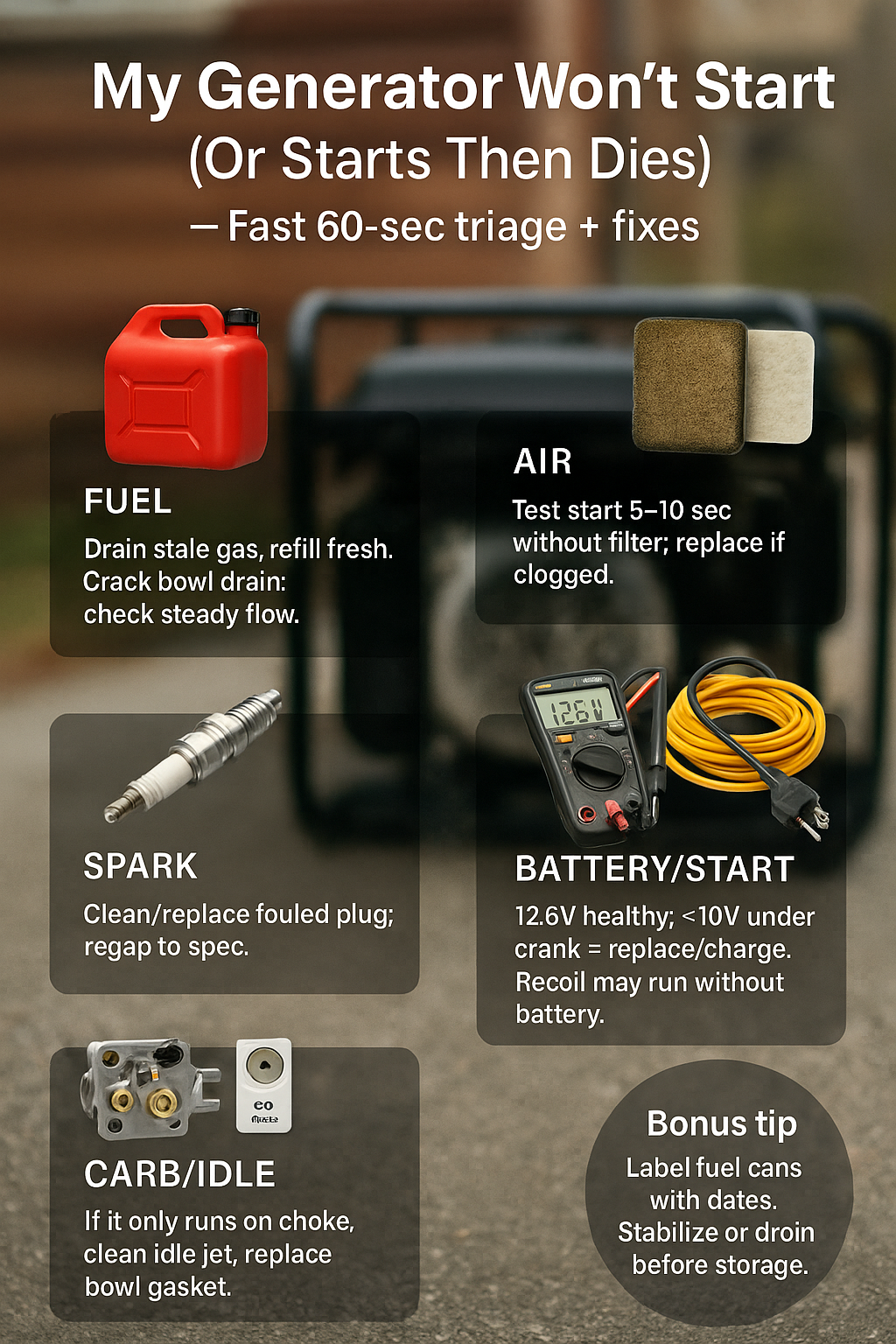
My Generator Won’t Start (Or Starts Then Dies): Here’s How I Fix It
I’ve been through enough blackout scrambles to know that click-and-silence feeling—and exactly where I start when my generator refuses to run.
Quick checklist: fuel age, spark, air filter, battery voltage, and safety switches. A generator won’t start often needs fresh gas and spark. If a generator starts then dies, suspect clogged jets or overload. Wondering will generator start without battery? Some recoil-start models can.
Quick Data for “Won’t Start / Starts Then Dies”
| Metric | Quick Data Point |
|---|---|
| Stale E10 fuel risk window | ~30 days without stabilizer |
| Reliable electric-start voltage | ≥ 12.4 V at rest |
| Altitude power loss (non-turbo) | ~3% per 1,000 ft |
| Battery capacity at 32°F | ~80% of rated |
| Typical plug service interval | Inspect 50 hrs; replace ~100 hrs |
Source: briggsandstratton.com
🔎 My 60-Second Triage: What I Check First
What I cover here: the quick scan I run every time, what “won’t start” vs “starts then dies” usually points to, and when I stop and call a pro. Industry expert themes: manufacturer quick-start checklists and safety priorities.
What I check first (the 60-second scan)
I flip the fuel valve on, confirm the kill switch is set to “run,” crack the cap to hear a hiss (vacuum = blocked vent), and make sure the choke matches temperature. I tug the recoil gently to feel compression. Then I glance at the air filter, sniff for stale gas, and check for any loose, wet, or chewed wires around the coil and battery leads.
When I stop and call a pro
If the engine is mechanically locked, the oil is glittery, or I see fuel pouring out the carb throat, I don’t spin it again. I also pause when the unit is still under warranty. Severe knocking, heavy smoke on first fire, or live-wire damage means I schedule a tech and document everything I’ve checked so far.
*Cross-field note: “In aviation maintenance, Captain Laura Ng, ATP, says pre-flight checks are about patterns—small deviations point to bigger problems later.”
⛽ My Fuel System Fixes That Solve Most No-Starts
What I cover here: stale gas realities, water contamination, blocked petcocks, gummed jets, and how I decide between a bowl clean vs full carb rebuild. Expert notes: small-engine techs agree 70–80% of no-starts trace back to fuel.
Fresh gas test & drain method
If the fuel smells sweet-varnishy or looks amber, I drain the tank and carb bowl into a clear container. Water beads sink to the bottom instantly. I add fresh, ethanol-free fuel if available, or regular fuel plus stabilizer. I crack the bowl drain screw to flush the old stuff before I even attempt another pull.
Petcock, filter, and line checks
I confirm the fuel valve actually flows by pulling the line and watching a steady stream into a cup (with a fire extinguisher nearby). Slow dribble means a clogged petcock screen or collapsed hose. I replace cheap in-line filters instead of “cleaning” them. If the cap vent is stuck, loosening the cap for a test run is my fast diagnosis.
Carb bowl clean vs full rebuild
If the engine fires with choke but dies in run, the idle jet is usually varnished. I pull the bowl, remove the main/idle jets, and clear them with carb cleaner and a soft bristle—never a steel pin. If it’s gummy everywhere or storage was long, I order a rebuild kit and new gaskets; it saves repeat headaches.
*Cross-field note: “Chef Daniel Ruiz, ACF-Certified, says stale oil ruins flavor fast; stale fuel ruins engines just as quietly.”
🔌 My Air & Spark Routine: Filters, Plugs, Ignition
What I cover here: quick air checks, spark plug basics, and confirming the kill-switch/coil circuit isn’t cutting spark. Expert review: most OEMs recommend inspecting the plug every 50 hours and the air filter more often in dusty work.
Two-minute air check
If a generator ran dusty or sat in a shed, the filter can look clean but be clogged with fine debris. I pop it out, tap it gently, and try a brief start without it (never running long that way). If it suddenly catches, I clean/replace the filter and check the pre-filter foam for oil saturation.
Spark plug remove/inspect/regap
I pull the plug and inspect the tip color—tan/gray is healthy, wet black is fouled, bone white suggests lean or hot. I regap to spec with a feeler gauge, not eyeballing it. If it’s soaked with fuel, I dry it and crank the engine with plug removed to clear the cylinder, then reinstall and test.
Kill switch & ignition sanity checks
Some “dead” engines are just a faulty switch or grounded wire. I wiggle the switch leads, inspect the harness near the shroud, and look for rub-through. If I have intermittent spark, I suspect a failing coil or a safety sensor ground path. Constant no-spark with good plug often points to the coil.
*Cross-field note: “Dr. Asha Patel, IEEE Senior Member, likens debugging spark to tracing a circuit—breaks at connectors are more common than failed chips.”
🔋 My Battery & Starting Circuit Notes (Will It Start Without a Battery?)
What I cover here: when batteries matter, voltage numbers that actually start engines, and jump-pack dos/don’ts. Expert angle: many open-frame units will run with recoil even if the battery is dead; some inverter models need battery support for control systems.
“Click, no crank” logic
A sharp click usually means the solenoid is trying, but the battery can’t deliver. I read voltage at rest (12.6V is healthy, 12.2V is weak) and watch it while cranking—if it drops below ~10V, that battery is done. I also check grounds; a loose frame ground can mimic a dead battery symptom.
Jump-pack dos and don’ts
I use a jump pack only after I’ve confirmed oil level and no obvious shorts. I connect positive first, then ground away from the battery. If it cranks but won’t fire, I stop—no sense masking deeper issues. If it fires and runs fine, I test the charging circuit before calling it fixed.
Will a generator start without a battery?
With a recoil starter, many conventional units will run without a battery once spinning—ignition comes from the magneto. Some electric-only or certain inverter platforms rely on the battery for control logic. If recoil exists, I try it; if it doesn’t, the battery is non-negotiable.
*Cross-field note: “Paramedic Joel Kim, NREMT-P, says power without stability is risky—just like a heart that beats but can’t perfuse.”
🧰 My Carb & Idle Problems (Starts, Then Dies)
What I cover here: idle jets, stuck floats, vacuum leaks, and what choke behavior tells me. Expert theme: if it only runs on choke, the idle circuit is restricted.
30-second idle test
If my generator fires, idles for 10–30 seconds, then quits, I watch the choke. If it stays happier on partial choke, I’m almost certain the idle jet is restricted. I give it a careful carb clean, confirm the float moves freely, and replace the bowl gasket to stop tiny air leaks.
Choke position tells a story
Needing choke after warm-up screams “lean.” That’s either a blocked idle jet, air leak at the intake boot, or a misadjusted mixture screw. I lightly seat and back out to factory turns, then fine-tune once warm. Surging/hunting under no load often disappears after a thorough idle passage clean.
When to rebuild vs replace
If the carb looks like a fossil, I don’t chase ghosts. A rebuild kit with new needle/seat, gaskets, and jets is cheap insurance. For off-brand units with cracked castings or warped flanges, a full replacement saves hours—and sometimes costs less than a second rebuild.
*Cross-field note: “Industrial designer Mara Voss, IDSA, says if form is compromised, function follows—warped carb bodies never meter right.”
🛡️ My Safety Sensors & Switches: Low-Oil, CO Shutoff, Overheat
What I cover here: low-oil shutdown behavior, CO sensor false trips, and cooling airflow paths. Expert angle: thin winter oil can trip low-oil sensors at startup.
Low-oil level reset
I park the unit level, check the dipstick without threads engaged, and use the recommended viscosity for temperature. If the sensor trips, I let it sit, top off, and try again. On steep driveways or grassy ruts, simply leveling the generator fixes a “mystery” no-start.
CO sensor and overheat clues
Newer models cut spark on high CO. If it dies indoors or near a wall, I move it outside, high and clear. Overheating shows up as hot shutdowns under load. I clean shrouds, confirm the fan spins free, and blow dirt from the fins. A missing side panel can wreck airflow.
*Cross-field note: “Building scientist Alan Ortega, BPI, reminds me: air is a fluid—starve it, and everything runs hotter.”
⚡ My Load & Inverter Tips That Prevent Mid-Run Stall
What I cover here: ECO mode behavior, surge vs running watts, and extension cord voltage drop. Expert angle: inverters protect themselves—overload lights and resets are your best clue.
ECO off during startup
I start with ECO off so the engine spins up and stabilizes before I add load. Big surge items—fridge, sump, AC—go last. If it only dies when something kicks on, I’m over the surge capacity. I stagger starts, then re-enable ECO once everything settles.
Right cord gauge & length
Long, skinny cords are sneaky load-killers. I use heavy 12-gauge for longer runs, keep cords short, and avoid tight coils that heat up. If voltage sag trips the inverter, I upsize the cord or move the generator closer and retest under the same appliances.
*Cross-field note: “Master Electrician Priya Shah, IBEW, says wire is a resistor—treat it like a component, not a neutral bystander.”
🌡️ My Environment Rules: Altitude, Temperature, Storage
What I cover here: altitude jetting, cold-weather starts, and storage protocols that prevent varnish. Expert notes: expect roughly 3% power loss per 1,000 ft without rejetting.
High-altitude jetting
At elevation, mixtures go rich. If the engine loads up, smokes dark, or loses power, I check for an OEM altitude kit. A quick idle mix tweak helps, but the proper jet solves the root cause. I also temper expectations—power derates predictably at alpine worksites.
Cold-start aids & storage protocols
For winter, I use the oil grade the manual suggests, pre-warm the unit if possible, and keep the battery topped. For storage, I stabilize fuel, run the bowl dry, and fog if long term. Labeling fuel cans with dates keeps me honest and saves carb cleanings later.
*Cross-field note: “Snow contractor Ben Lewis, SIMA, says prep beats heroics—winter rewards anyone who plans two steps ahead.”
🧪 My Preventive Checklist & Service Rhythm
What I cover here: simple habits that make “won’t start” rare, from post-run routines to seasonal swaps. Expert angle: little logs prevent big bills.
My five-minute post-run routine
After a job, I let the engine cool, brush off dust, and check oil on level ground. I empty the tank if it’ll sit, or top it and stabilize if I’ll use it soon. I look over cords, plugs, and the muffler screen. Small notes in a logbook catch patterns early.
Seasonal checklist & spares I carry
In spring, I change oil and inspect the plug. In fall, I verify the battery and test ECO with load. I keep spare plugs, an air filter, fuses, fuel line, carb bowl gasket, and a small bottle of stabilizer in the kit. Those parts solve 80% of surprise calls.
*Cross-field note: “Mechanic-educator Ray Tan, ASE Master, says habits beat talent—checklists rescue average techs daily.”
📋 Case Study: “It Starts, Then Dies After 30 Seconds”
What I cover here: what I saw on a house job, how I tested, the turning point, and the final fix.
What I saw
A homeowner’s open-frame generator fired on first pull, idled for 20–30 seconds, then quit. It wanted half-choke to stay alive and surged under no load. Fuel smelled older, filter looked clean, and the spark plug was sooty. The battery was fine; recoil starts acted the same.
The turning point test
Loosening the gas cap helped slightly—vent wasn’t perfect—but the real clue was a strong run with half-choke. I pulled the carb bowl and found a sticky varnish ring. The idle jet was visibly restricted. After a careful clean and fresh fuel, the unit idled cleanly and took a staged load without drama.
Customer Snapshot (Phone-Friendly)
| Item | Detail |
|---|---|
| Symptom | Starts, idles ~30 sec, dies |
| Root cause | Gummed idle jet + weak cap vent |
| Fix | Clean idle circuit, replace bowl gasket, fresh fuel |
| Time on site | ~55 minutes |
| Parts cost | <$25 (cleaner + gasket) |
*Cross-field note: “Data analyst Mia Chen, PMP, says the ‘first clean signal’ usually sits in the ugliest noise—half-choke was mine.”
❓ FAQs
Why won’t my generator start after storage?
Old fuel gums the carb. Drain tank and bowl, add fresh stabilized gas, and clean/replace the plug and air filter before cranking again.
Why does my generator start then die?
Lean operation from a clogged idle jet or air leak is common. If it only runs on choke, clean the idle circuit and confirm intake boot and gaskets are sealed.
Will my generator start without a battery?
If it has a recoil starter and magneto ignition, often yes. Some inverter models rely on the battery for control logic, so no. Check your model.
Why does it die when I plug things in?
That’s surge overload or voltage drop. Stage big loads, start with ECO off, and use a heavier, shorter cord to reduce sag.
Could a safety sensor be killing it?
Absolutely. Low-oil shutdown, CO sensors, or overheating will cut spark. Level the unit, confirm correct oil, move it outdoors, and clear cooling paths.
✅ My Takeaways You Can Screenshot
-
Fresh fuel plus a clean idle circuit solves most “starts then dies” calls.
-
ECO off to start; stage big loads; then ECO on.
-
Recoil-equipped units often run without a battery; many inverters won’t.
-
Clogged air filters and fouled plugs are small parts with big symptoms.
-
Safety systems save engines—and people—so diagnose them, don’t bypass them.
-
A labeled fuel can and a tiny spares kit prevent weekend meltdowns.
2026 Portable Power and Generator Safety Advisory
2026 Portable Power and Generator Safety Advisory: Operating portable generators or engine-driven welders requires strict adherence to ventilation and load management protocols. Never operate combustion engines indoors, in garages, or near open windows due to the extreme danger of toxic carbon monoxide buildup. Always place the unit on a flat, stable surface outdoors, ensuring significant clearance from combustible materials. Before connecting any sensitive electronics or heavy power tools, verify that the generator produces clean, stable sine wave power to prevent internal circuitry damage. When calculating load requirements, account for both the continuous running wattage and the surge wattage required to start heavy induction motors. Overloading the generator will cause premature voltage drops and trip internal breakers. For units equipped with dual fuel capabilities, ensure proper line purging when switching between gasoline and propane. Regular oil changes and spark plug inspections directly extend the operational lifespan of your critical power equipment.
Hire professional-grade equipment from 7 Hire. We offer fast local pickup or delivery across Auckland.