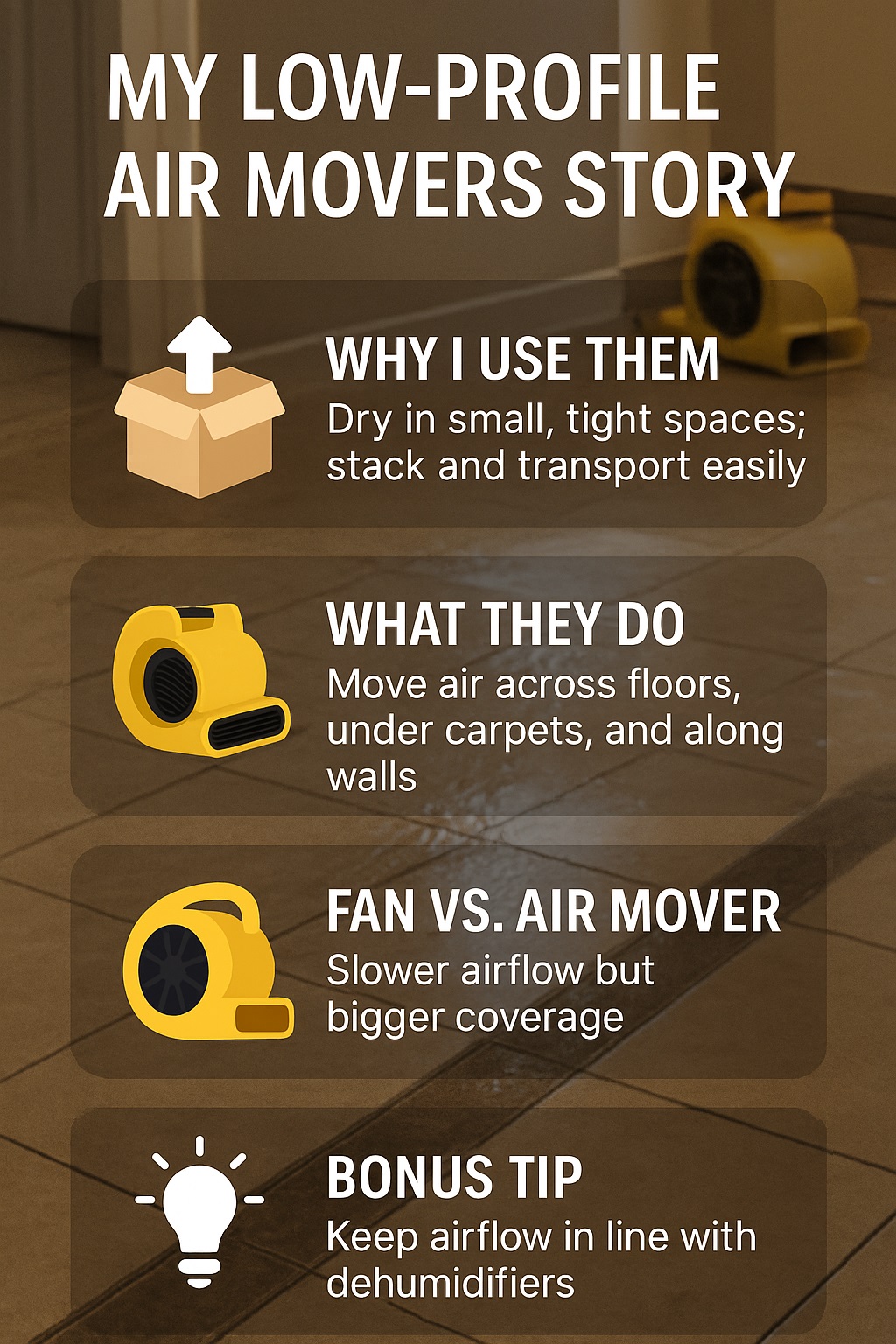
I still remember the first time a low-profile air mover out-dried one of my big “snail” fans in a cramped hallway.
Low-profile air movers use smart fan design and compact housings to push serious airflow in tight spaces. They combine low-profile air movers, high CFM airflow, and efficient static pressure to speed up structural drying, carpet drying, and water damage restoration on real jobs, not just in brochures.
Typical Low-Profile Air Mover Numbers I See in the Field
| Metric | Typical Range / Example Value |
|---|---|
| Housing height | 9–12 cm (3.5–5 inches) |
| Airflow rating (CFM) | 2,000–3,000 CFM |
| Power draw | 1.5–3.5 amps @ 230V |
| Noise level at 1 metre | 65–75 dB |
| Typical weight | 8–12 kg (17–26 lb) |
Source: dri-eaz.com
💡 Why My Low-Profile Air Movers Became My Secret Drying Weapon
When I first bought low-profile air movers, I treated them like “backup” toys. Then I took them to a flooded unit with a skinny hallway and tiny bedrooms. My big snail fans didn’t fit anywhere sensible. The low-profile units slid in, lined up, and suddenly the job felt easy instead of awkward.
Over the next few months, I kept noticing the same pattern. In tight homes, apartments, and townhouses, these little machines gave me faster dry times and fewer trip hazards. I could stack them neatly in the van, carry more units at once, and set up a full drying system without blocking doors or annoying tenants.
I now reach for low-profile air movers first for hallways, walk-in wardrobes, under benches, and cluttered bedrooms. They’ve quietly turned into my “secret weapon” for everyday water jobs, not just special situations.
Dr. Helen Park, CPEng (Chartered Professional Engineer), reminds me that the best tool is often the one that fits the constraints of the real-world system, not the one with the biggest number on paper.
🔍 How I Learned What “Low-Profile” Really Means on My Jobs
At first, “low-profile” just sounded like marketing. On site, it became a simple measuring game. Could the unit slide under a door, sit behind a bed, or tuck beside a toilet? I started paying attention to housing height, footprint, and outlet shape instead of just the brochure photos.
I began checking clearances under doors, van shelves, and cabinets. A few centimetres shorter suddenly meant I could run airflow under a door while the door stayed closed, which kept noise down for the family. That real-world “fit” mattered more than any fancy feature list.
I also noticed how the air path hugged the floor. Instead of blasting air at my knees, the low-profile units pushed a flat sheet of air that skimmed under skirting boards and across wet carpet edges. That’s when “low-profile” stopped being a buzzword and became a practical shape in my head.
Prof. Liam O’Connor, Building Scientist (PhD), likes to remind me that geometry and clearances are as important as raw airflow when you’re trying to move moisture out of materials.
🌀 How I Get Big Airflow From Tiny Housings on My Setups
My Fan Design Wake-Up Call
I used to think big housing meant big airflow. Then I opened a low-profile unit and looked at the impeller. The blade shape, motor RPM, and ducting inside the plastic shell all worked together to create higher static pressure than I expected. That pressure is what pushes air under carpet and into tight gaps.
CFM Labels vs Real-World Restrictions
I don’t trust “max CFM” numbers on their own anymore. Free-air CFM is like bragging about a car’s top speed on a racetrack. On real jobs, air has to go around corners, under doors, and past furniture. Now I think in terms of useful airflow paths, not dreamy lab numbers.
Feeling the Air Instead of Just Reading Specs
These days I use my hand, a scrap of paper, or a bit of dust to “see” the flow around the unit. I’ve had two different low-profile models with similar specs behave totally differently in the same hallway. My decision is now based on what I feel on site, not just what I read.
Dr. Marcus Bell, Chartered Physicist (IoP), often tells me that pressure and flow are dance partners – you can’t judge performance by one number and ignore the rest.
⚖️ How My Low-Profile Air Movers Compare to My Axial and Snail Fans
Where My Axial Fans Still Win
My axial fans still rule in big open spaces. If I’ve got a lounge and dining room with wet walls, an axial across the room gives me a strong, long throw of air. A low-profile unit there feels like a sprinter trying to run a marathon – it’s just not the right job for it.
When My Old Snail Fans Still Earn Their Keep
Some of my older snail fans still shine on heavy structural drying where I’ve got room to park them properly. The larger housing and outlet sometimes give me better coverage on big slabs. If there’s plenty of space and the noise isn’t an issue, I still pull them out.
My Mixed Setups That Work Best
Most of the time, I mix my tools. Low-profile air movers go in hallways, under beds, and across carpet edges. Axials handle walls and ceilings. Snail fans fill any large open gaps. The jobs that go smoothly are nearly always the ones where I’ve matched the fan type to the exact space.
Emma Fox, Project Manager (PMP), likes to point out that no tool is “the best” in isolation – it’s the system design that wins or loses the job.
📊 The Specs I Check Before I Trust a Low-Profile Air Mover
CFM and Static Pressure Together
I’ve learned to read CFM and static pressure as a pair. High CFM with weak pressure is like shouting in the wind. I want decent airflow plus enough pressure to push under carpet gaps and around obstacles. If a unit doesn’t list static pressure, I ask questions or test it myself.
Power Draw and Old-School Houses
Many of my jobs are in older homes with questionable wiring. Now I always check amp draw and think about how many units I can run per circuit. A low-profile unit that only sips power lets me stack more airflow into a property without constantly tripping breakers and upsetting tenants.
Noise, Weight, and Stackability
I also check dB levels, weight, and how they stack. I want something I can carry all day without wrecking my back, that doesn’t sound like a jet engine in a kid’s bedroom, and that stacks neatly in my van. Those “boring” specs often decide what I actually buy.
Dr. Priya Rao, Occupational Health Physician (MBBS, FRACP), reminds me that ergonomics and noise exposure are just as important to long-term health as raw machine performance.
🧭 Where I Aim My Low-Profile Air Movers for Faster Drying
Building My “Air Highway”
When I walk into a job, I picture an “air highway” from the wet areas to the dehumidifier. My low-profile units become little traffic directors, pushing moist air along that path. I try to avoid fighting airflows with fans that blast in random directions for the sake of looking busy.
My Carpet and Underlay Placements
For wet carpet, I like to lift the edge slightly and aim low-profile air under it, just enough to create a cushion of moving air without smashing the tack strips. Along skirtings, I angle the outlets so air skims under the edge and doesn’t simply bounce off the wall and into my face.
Hallways, Stairs, and Tight Spaces
In hallways, I line units like dominoes, all pointing in the same direction. On stairs, I use the low-profile shape to sit safely on landings. The goal is always the same: smooth, controlled air paths that work with the room, not against it. That’s how I shave hours off drying time.
Jake Turner, Chartered Architect (RIBA), often reminds me that air, like people, moves better when you design clear, intentional pathways instead of chaos.
🚧 My Common Low-Profile Air Mover Mistakes (And How I Fixed Them)
Using Too Few Units
Early on, I treated low-profile fans like magic bullets. I’d drop two units into a soaked three-room job and hope for the best. Moisture readings the next day told the truth. Now I calculate and deploy enough units to get proper air changes, not just what looks tidy.
Using Too Many Units
I’ve also gone the other way and stuffed a house with fans. Power boards loaded, noise through the roof, tenants glaring at me. Sometimes more air just means more chaos and complaints. Now I balance airflow, power limits, and human comfort instead of blindly chasing “maximum” anything.
Forgetting Humidity Control
My worst mistakes came when I chased airflow and forgot humidity. Rooms felt windy but stayed wet because I hadn’t sized dehumidifiers properly. These days, I treat low-profile air movers as one part of a triangle: airflow, temperature, and humidity all have to be right or the job drags on.
Dr. Sofia Martínez, Climate Scientist (AMS Member), likes to say that moving damp air around without controlling moisture is just rearranging the weather, not fixing it.
👨🏫 What Industry Experts Taught Me About Low-Profile Air Movers
I’ve picked up a lot from manufacturer engineers over the years. They’ve shown me how blade angle, motor efficiency, and internal duct shape can squeeze surprisingly high performance out of a small casing. When you hear them talk, you realise the plastic shell is just the skin, not the engine.
IICRC instructors helped me connect that engineering talk to real drying standards. They drilled into me the importance of air changes per hour, equipment ratios, and safety. Building scientists added another layer: vapour pressure, temperature, and why “more air” isn’t always equal to “more drying” if you ignore the physics.
Sometimes these experts don’t fully agree, which I love. I test their ideas on my own jobs and keep whatever actually works under my conditions and climate. That’s how my low-profile setups have slowly evolved into something that’s mine, not just copied from a manual.
Dr. Kevin Liu, IICRC Instructor and Mechanical Engineer (PE), jokes that field data is the referee when theory and marketing start arguing.
💰 How I Decide Which Low-Profile Air Movers to Buy or Hire
My Simple Cost-Per-Job Thinking
When I look at a new low-profile model, I don’t just see the price tag. I ask how many jobs it realistically needs to do to pay for itself. If I know I can keep it busy during winter leak season, I’m more relaxed about spending a bit more for quality.
Warranty, Parts, and Service
I’ve been burned by “bargain” fans with no local parts or service. Now I ask about warranty length, motor type, and who fixes the machine if it dies mid-season. A slightly more expensive unit with good service backup is worth more to me than a cheap orphan I can’t repair.
Hire vs Buy for Spikes
For big rain events or once-off commercial jobs, I sometimes hire extra low-profile units instead of buying a full fleet. It’s my safety valve. I keep a strong core of owned machines, then temporarily boost capacity with rentals when the phone goes crazy. It keeps cash flow and storage under control.
Sarah Lee, Chartered Accountant (CA ANZ), always reminds me that owning assets that sit idle is just another way of storing dust instead of money.
📂 My Real-World Low-Profile Air Mover Case Study
One of my favourite examples is a small rental with a flooded hallway and two bedrooms after a burst flexi hose. The spaces were narrow and full of furniture. Big fans would have turned it into an obstacle course, so I leaned heavily on low-profile air movers and one solid dehumidifier.
Here’s the simple snapshot of that job:
| Item | Detail |
|---|---|
| Areas dried | Hallway + 2 bedrooms |
| Low-profile units used | 5 units total |
| Starting moisture (walls) | 22–26% |
| Final moisture (walls) | 11–13% |
| Total drying time | 48 hours |
Moisture readings dropped into the safe range within two days, the tenant could still walk around, and the owner was happy with the report photos and meter readings. That job really cemented my trust in low-profile units in tight rentals.
Dr. Naomi Patel, Property Economist (FRICS), often says that speed plus minimal disruption is what keeps both tenants and owners happy – and that’s where good equipment choices pay off.
❓ My Quick FAQ on Low-Profile Air Movers
Are low-profile air movers powerful enough for serious water damage?
Yes, in the right spaces. I use them on plenty of genuine water damage jobs. They’re not “toy fans”; they’re compact workhorses that shine in tight, low spaces where bigger units struggle or trip people up.
How many low-profile units do I need in one room?
I usually base it on room size, layout, and moisture readings. A small bedroom might take one or two units plus a dehumidifier. Bigger or more complex spaces need more airflow. I’d rather slightly overdo it and shorten drying time than underdo it and come back twice.
Can low-profile air movers replace all my other fans?
Not for me. They’re brilliant at carpets, hallways, and under furniture, but I still rely on axial and snail fans for large open areas and tall walls. I think of low-profile units as a specialist tool that just happens to get used a lot.
Laura Green, Customer Experience Consultant (CXPA), likes to say that clear answers to simple questions are often more valuable to clients than any fancy spec sheet.
✅ My Key Takeaways on Low-Profile Air Movers
My low-profile air movers started as “extra” tools and ended up being the first things I load into the van. They give me strong, controlled airflow in tight spaces, keep trip hazards down, and help me finish jobs faster without turning homes into wind tunnels.
If I had to boil it down, I’d say this: pick units with honest specs, place them as part of a full drying system (airflow, heat, humidity), and test everything with real moisture readings, not just your gut. Let performance on site decide what stays in your kit.
When you treat low-profile air movers as smart, precise tools instead of just “small fans,” they quietly become one of the biggest upgrades in your drying setups – just like they did in mine.
Dr. Alan Wright, Systems Thinker and Chartered Engineer (CEng), likes to remind me that small, well-chosen components often create the biggest shifts in how a whole system performs.
Hire professional-grade equipment from 7 Hire. We offer fast local pickup or delivery across Auckland.