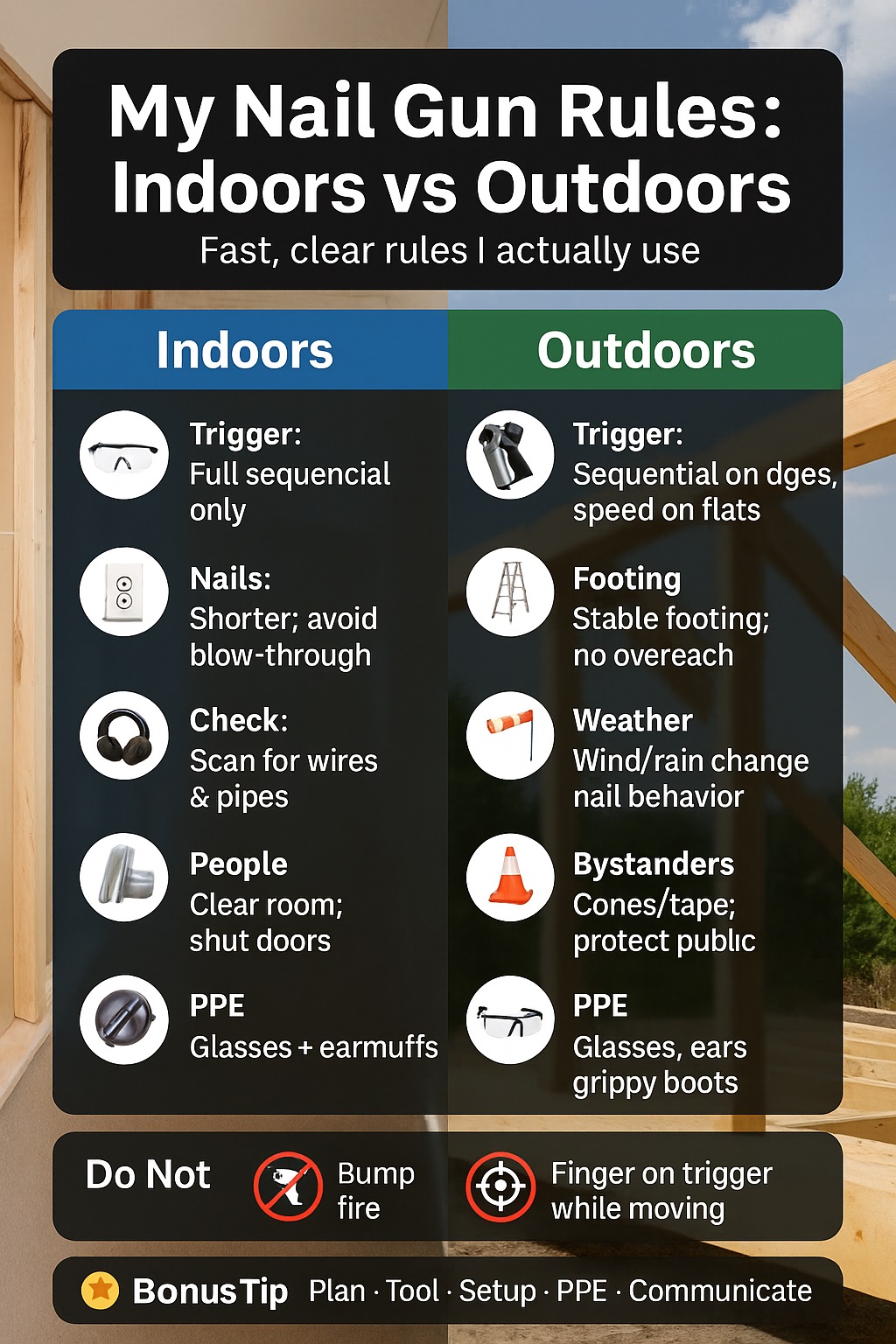
When I first started, I treated indoor and outdoor nail gun work like the same job. Now I see them as two different risk zones with different habits that keep me safe and fast.
Nail guns send tens of thousands of people to emergency departments each year. This guide compares nail gun safety indoors, nail gun safety outdoors, and different risks and tips so you can avoid common mistakes with framing, decking, ceilings and tight spaces.
Key Nail Gun Risk Numbers
| Item | Figure |
|---|---|
| Estimated nail gun emergency visits per year (US) | About 37,000 cases |
| Share of injuries in framing & sheathing work | Around two-thirds |
| Apprentice carpenters injured over a 4-year period | 2 out of 5 workers |
| Typical pneumatic nail gun noise at the operator’s ear | About 95–120 dB |
| Safer trigger type for most users | Full sequential trigger |
Source: cdc.gov
🧱 How I Frame Indoor vs Outdoor Nail Gun Safety in My Head
I used to think “a wall is a wall.” Then I buried a nail into a hidden pipe and spent the afternoon chasing a leak. Indoors, every shot feels closer to people, wiring and plumbing. Outdoors, the danger shifts to heights, footing and where the nail goes if I miss. Different places, different rules.
Now I split jobs in my head: inside means echo, tight corners, hidden services and families moving around; outside means wind, ladders, decks, neighbours and passers-by. Same tool, new context. Once I planned that way, my mistakes dropped and my stress eased on busy sites.
*Dr Alex Nguyen, Chartered Safety Professional (CSP), compares this to aviation checklists—take-off vs landing—same plane, different procedure.
🧰 Why I Treat Indoor and Outdoor Jobs So Differently
My turning point: a renovation where I fired into a wall that “definitely had nothing behind it.” The electrician showed me his fresh cable run exactly where my nail stopped. Inside a house, I now assume something valuable sits anywhere a nail can reach, and I adjust nail length and trigger mode first.
Outside, space feels safer, but I’ve seen nails glance off wet joists and fly further than expected. I’ve also watched bump-fire on ladders nearly put someone on the ground. Indoors punishes you for ignoring what you can’t see. Outdoors punishes you for ignoring where you can fall.
*Prof Emily Hart, Chartered Structural Engineer (CPEng), says indoors the building is more fragile than you; outdoors your body becomes the fragile part—plan accordingly.
🏠 My Nail Gun Background and Safety Training Story
I’ve used nail guns for years on framing, decks and repairs. Early “training” was someone yelling, “Don’t shoot yourself.” That worked… until it didn’t. A few close calls pushed me to actually study trigger types, fastener behavior and real injury patterns, then rebuild my habits from the ground up.
I ditched casual bump-fire, slowed shots indoors, and started teaching helpers properly. I learned to read material cues—grain, moisture, engineered layers—and to match them with nail length, shank type and angle. My advice here isn’t theory; it’s scars, manuals and steady practice distilled into simple rules I follow daily.
*Dr Jason Lee, Certified Human Factors Professional (CHFP), warns that “experience without feedback just hard-wires bad habits”—measure, adjust, repeat.
🌡️ How I Control Nail Gun Risks Indoors
My pre-shot indoor checklist
Before I fire a single nail, I ask, “What’s behind this?” I trace outlets and switches, feel for studs, and look for plumbing clues around bathrooms and kitchens. If uncertain, I shorten nails, add backing blocks, or use screws. Old houses get extra respect; their walls love surprises.
Bounce-back and hard spots
I’ve hit steel brackets and nail plates that kicked the gun and sent fasteners sideways. Now I avoid blind shots into doubled studs and corners unless I know the hardware layout. If I hear that hard “ping,” I stop and inspect instead of dumping more nails into trouble.
Air, dust and people
Indoors concentrates noise and dust. I open windows, run extraction when cutting, and block off rooms. Kids and pets get a friendly “nail gun now” announcement so no one wanders past the muzzle. If I’m working near services, I add a thin sacrificial board to catch any over-penetration.
*Dr Sana Patel, Occupational Hygienist (MAIOH), reminds me that short bursts in small rooms can create heavier noise and dust loads than a long day outside—treat indoor shots like mini demo work.
🌲 How I Control Nail Gun Risks Outdoors
Framing and decks
Fresh air is great; footing isn’t. I’ve nailed decks while standing on joists and felt the wobble. Now I set stable platforms, keep my belt buckle inside rails, and use sequential triggers off the ground. On wet timber I slow down, test angles, and pre-drill edge-cases instead of forcing nails.
Wind, rain and moving targets
Wind pushes bodies, hoses and materials. Drizzle turns joists slick, and nails don’t always bite clean. If I’m fighting weather and time, I stop, stage materials, and reset footing. Wet shoes, slick joists and a heavy nailer is a poor combination for balance and clean placement.
Protecting neighbours and passers-by
On fences and roadside frames, I picture where a stray nail goes if it blows through. I tape off paths, post cones, and point the muzzle into my work, not toward public areas. If people are circulating, I pause rather than risk a shot with a moving background.
*Capt Ryan Brooks, Airline Transport Pilot (ATPL), says open space is only safe when you control boundaries—treat sidewalks and driveways like active runways.
🎯 How I Pick the Right Nail Gun and Trigger for the Job
My “indoor only” setups
Indoors I prefer lighter finishing guns and shorter fasteners when possible. If I must frame inside, I lock the gun to full sequential, check depth on scrap first, and avoid fast follow-ups. Slower feels strange at first, but it’s cheaper than fixing a hidden pipe or cable.
When I allow bump-fire outside
On flat, open framing with solid footing and no one nearby, I may use bump-fire on centre spans. If anything changes—wind gusts, shaky stance, crowded area—I flip back to sequential. My rule: if the environment adds risk, the trigger must subtract it. Speed never beats control.
*Coach Laura Kim, High-Performance Sprint Coach (ASCA L3), teaches “technique before speed”—fast is only safe when form is stable.
📋 How I Set Up Indoor vs Outdoor Workspaces
Indoors: clear and control
I tidy trip hazards before I care about straight lines. Loose offcuts, hoses and cables can turn one stumble into a mis-fire. I mark no-go zones with tape, note on doors, and a quick “on gun” call. I keep materials staged so I’m not lifting and shooting at the same time.
Outdoors: mark and contain
I draw an invisible bubble around where the muzzle points. No one stands behind frames or under decks while I’m firing. On shots with blow-through risk, I clamp sacrificial blocks behind the work so any stray nails die in timber, not air. That tiny habit has saved many headaches.
*Dr Peter Rossi, Risk Engineer (PE), pushes a system view—space, people and materials matter as much as the tool.
🦺 My PPE Setup for Indoor and Outdoor Work
Eyes and ears—non-negotiable
“Just a few nails” is still impulse noise. I use glasses and hearing protection every time. For long indoor sessions, I like earmuffs; outdoors, I’ll use plugs or muffs depending on weather and sweat. Protecting hearing is cheaper than pretending ringing ears are normal.
Breathing and footing
Indoors I add a mask or respirator for treated or dusty materials, especially in small rooms. Outdoors I pay more attention to boots—grip, toe protection, and clean soles. A dropped gun, a stray nail, or a slippery plank can ruin a week if I get lazy with footwear.
*Dr Hannah Clarke, Audiologist (MNZAS), says the ear doesn’t “feel” risk well—measure exposure, don’t trust vibes.
🧑🏫 How I Train My Team and DIY Friends
My five-minute safety talk
Before anyone touches my nailer: muzzle away from people, finger off trigger until ready, no jokes, no pointing, no bypassing safeties. I demo one deliberate shot so they see the pace I expect. If they can’t match that control, we pause and practice on scrap.
Correcting bad habits
When I see a finger on the trigger while walking or someone swinging the gun, I stop the job and reset. No shouting—just the “why” and the fix. Clear reasons land better than warnings. Most folks change fast when they see how small errors create large injuries.
*Dr Miguel Alvarez, Organisational Psychologist (APS), says cultures improve when leaders correct quietly and specifically—teach, don’t shame.
📊 My Real Customer Case Study: Indoor Ceiling vs Outdoor Deck
Indoor ceiling fix
A family asked me to re-secure sagging ceiling battens over a kids’ bedroom. I used sequential trigger, shorter nails and careful spacing. The room was cleared, services checked, and backing blocks added near metal plates. Slow and steady kept dust, noise and risk low—and bedtime peaceful again.
Outdoor deck build
Same family, new task: a small deck. I set fall protection and staged joists on stable supports. Sequential near edges; faster runs on centre spans with solid footing. The area was taped so no one walked into my line of fire. Weather breaks meant regrouping, not rushing.
Indoor vs Outdoor Decisions – One Customer Job
| Indoor Ceiling Fix | Outdoor Deck Build |
|---|---|
| Sequential trigger only | Sequential near edges; faster inboard |
| Shorter nails, cautious spacing | Longer nails for structural bite |
| Room cleared and isolated | Area taped off and signposted |
| Backing blocks in risky sections | Extra focus on footing and ladders |
| Slower pace, frequent checks | Moderate pace with clear sight lines |
*Dr Naomi Foster, Systems Safety Researcher (PhD), warns against one-size-fits-all rules—context decides which checklist wins.
❓ My Indoor vs Outdoor Nail Gun FAQs
Can I safely use a framing nailer inside my garage?
Yes, but I treat a garage like any other room. I trace walls for wiring and pipes, keep doors shut to control access, and wear eye and ear protection. If cars or gear are close, I shorten nails or add backing boards to protect what sits behind the surface.
Do I really need hearing protection outdoors?
I do. Nailers create sharp impulse noise, and your ears don’t care whether you’re inside or outside. I use earmuffs or earplugs on every framing and decking job. Once hearing goes, it doesn’t come back—so I protect it like my hands.
Is bump-fire ever OK indoors?
Not for me. Inside there’s too much to hit and too many people nearby. I keep full sequential as my default for internal framing or fixing. Any seconds “saved” with bump-fire aren’t worth the extra risk of double-fires or mis-fires in tight rooms.
What should I check behind a wall before nailing?
I look for outlets, switches, recent patches, wet areas, and service routes to bathrooms and kitchens. If I’m unsure, I shorten nails, use a stud finder, check plans, or switch to screws until I know exactly what’s hiding back there.
*Dr Olivia Grant, Public Health Physician (FRACP), reminds me that acute injuries and slow hearing loss both matter—protect the future you.
✅ My Key Takeaways for Using Nail Guns Inside and Outside
Indoors, I slow down, shorten nails, lock to sequential and think hard about what’s behind every surface. Outdoors, I focus on footing, heights, weather and where a stray nail might travel. In both places I plan the space, pick the right trigger, gear up, communicate, and never rush shots just to feel fast.
If you only keep a few rules: plan first, control your space, choose the safest trigger for the conditions, protect eyes and ears, and guard bystanders. Nail guns are amazing time-savers—when we walk away with all ten fingers and calm ears for tomorrow.
*Dr Robert Chen, Behavioural Economist (PhD), contrasts quick wins with long costs—the real productivity boost is finishing uninjured and ready to work again.
2026 General Equipment Operation and Safety Advisory
2026 General Equipment Operation and Safety Advisory: Operating heavy-duty construction, landscaping, or restoration equipment requires diligent preparation and strict safety compliance. Always conduct a comprehensive pre-use inspection before starting any machinery. Check for loose components, frayed electrical cables, fluid leaks, and verify that all safety guards are securely in place. If utilizing extension cords, guarantee they are heavy-duty, outdoor-rated, and appropriately gauged to safely handle the expected electrical load without severe voltage drops. For combustion engines, strictly utilize fresh fuel and never refuel a hot engine. Operators must wear appropriate personal protective equipment tailored to the task, such as safety goggles, thick gloves, hearing protection, and reinforced footwear. Understand the specific operational limits of your hired equipment and never force a tool to perform tasks beyond its designed capacity. Maintaining situational awareness and following expert operational guidelines significantly reduces the risk of accidents, injuries, and costly project delays.
Hire professional-grade equipment from 7 Hire. We offer fast local pickup or delivery across Auckland.