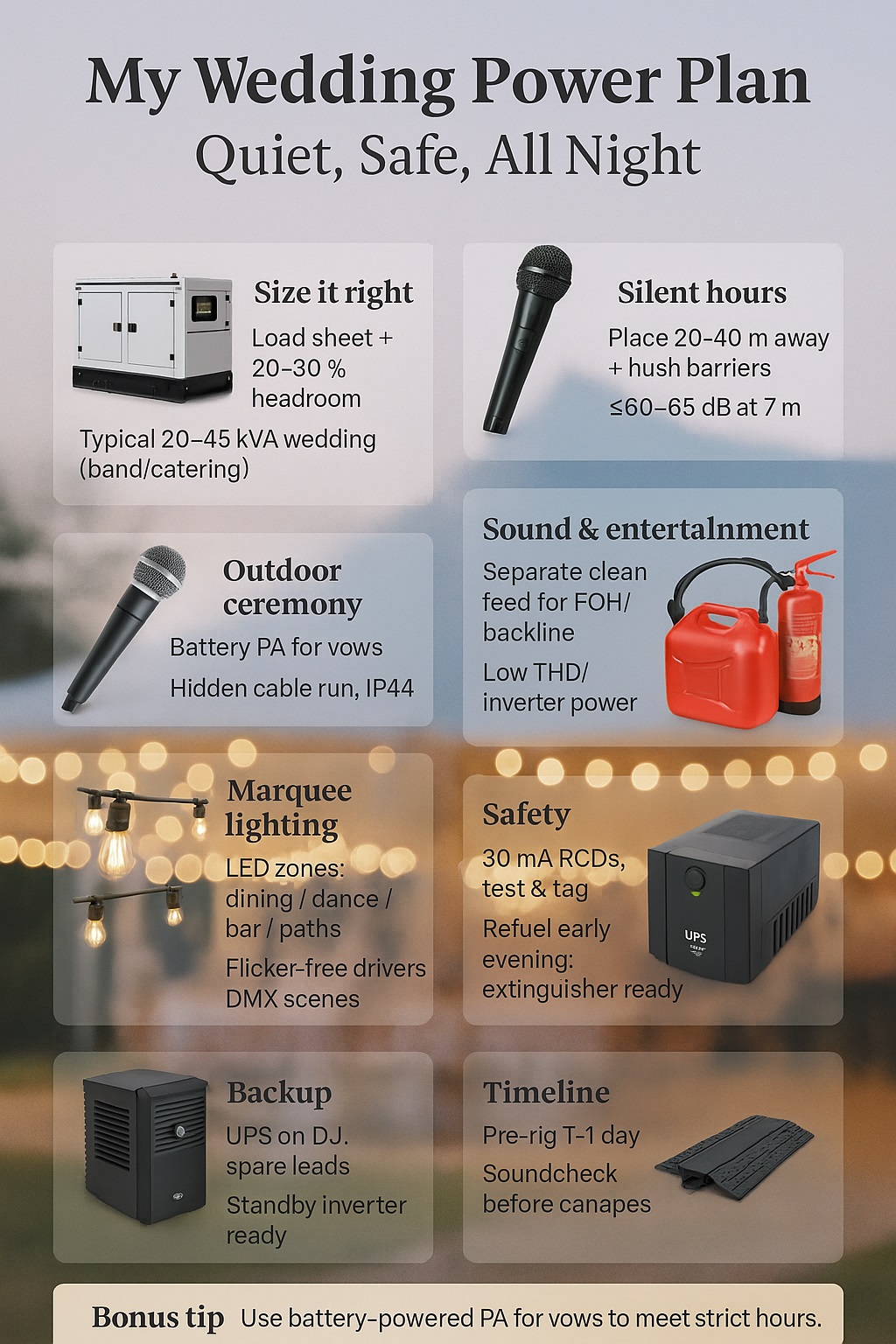
My Wedding Generator Plan: Quiet, Safe Power All Night
I learned the hard way that wedding power is only noticed when it fails—so I design it to disappear.
Plan reliable generator hire for weddings with right kVA, low-noise sets, and RCD protection. Size for catering, band, and marquee lighting. Place away from guests, manage fuel safely, and follow venue silent hours so speeches, vows, and dance floor stay smooth.
Wedding Generator Quick Specs
| Item | Typical Value |
|---|---|
| Recommended size (kVA) | 6–20 (DJ) / 40–60 (band + catering) |
| Noise at 7 m | ≤60–65 dB(A) super-silent canopy |
| Fuel use per hour | 0.8–3.5 L/hr at light–moderate loads |
| Runtime target | 8–12 hr with 20% contingency |
| Protection | 30 mA RCD/GFCI, IP44+ distro |
Source: cummins.com
🎯 My Big-Day Power Snapshot (Read This First)
Every outdoor wedding I power gets the same backbone: a quiet, right-sized generator, a tidy distro with RCD protection, and clearly labeled circuits for lighting, sound, and catering. I keep audio and lighting separate to avoid hum, and I run cable routes along edges with ramps so dresses, prams, and heels glide safely.
My Non-Negotiables
-
Super-silent canopy set, properly serviced and load-tested
-
30 mA RCDs on all outlets, earth checked, test tags current
-
Weatherproof cabling (IP44+), raised off wet ground
-
Cable plan with distance, barriers, and ramps
My Core Loads
-
Ceremony PA and mics
-
Marquee lighting, festoon strings, dimmable uplights
-
Catering gear, fridges, hot-hold, coffee
-
DJ or band, plus a few “unknowns” from vendors
*As Dr. Sarah Lin, CEng MIET, likes to say: “Invisible power is the loudest success metric at an event.”
🔌 My Power Needs: How I Count Every Watt
My first job is a realistic load sheet. I don’t just add nameplate watts; I separate continuous draw (lights, fridges) from peak demand (coffee machines, amplifiers). Then I add 20–30% headroom so vocals don’t dip when a bain-marie cycles or the espresso pulls during speeches.
My “No Blackout” Buffer
Musicians hate power dips. I give entertainment its own circuit and, where possible, its own small inverter set or clean feed from the distro. I note inrush currents: amps and compressors can spike 2–3× briefly. I stage lighting zones so ambience stays while the dance floor pumps without tripping breakers.
My Calculator Rules
I keep conversions simple on site: W ÷ 230 ≈ A (single-phase). For three-phase: kW ÷ (√3 × 400 × pf) ≈ A per phase. I also label connectors—10A/16A/32A—so vendor gear lands in the right place. The goal is boring reliability that feels like mains power, without the noise or drama.
*Audio engineer Leo Duarte, AES, told me: “Treat inrush like a guest who always arrives early—plan them a seat.”
🤫 My Quiet Setup: Beating Silent Hours
Some venues impose strict decibel limits and curfews. I start by placing the generator as far from the marquee as cable lengths and voltage drop allow. I use the canopy, face the exhaust away from guests, and build a “hush corner” with barriers or hay bales that break line-of-sight to the sound source.
My Acoustic Tricks
Distance is my cheapest decibel reducer. Every doubling of distance typically drops perceived loudness. I avoid hard reflective walls and pick soft ground. If wind carries sound toward the ceremony, I rotate or move the set. Late night, I switch ceremony or speech reinforcement to battery PA to glide under curfew.
*Environmental health officer Ava Carter, CEnvH, reminds me: “dB compliance is a design decision, not a hope.”
💍 My Outdoor Ceremony Plan: No Hum in the Vows
For the vows, I prefer battery-powered speakers and a lavalier mic on the celebrant. No hiss, no generator hum, and no trip hazards. If I must power the ceremony, I run an ultra-quiet inverter set just for the PA, parked behind trees, with a short, tidy cable run masked by décor.
My Weather Moves
I plan for drizzle and glare. IP-rated covers guard connections, mats lift cables off damp grass, and I keep a dedicated umbrella for the celebrant’s mic receiver. Before guests arrive, I test every RCD and do a slow walk listening for buzz. A quiet ceremony feels magical and effortless.
*Wedding celebrant Mia Thompson, VCANZ, tells couples: “Silence is part of the script—plan it.”
💡 My Marquee Lighting Map: Ambience vs Amps
Lighting is where mood meets math. I split my marquee into zones—dining, dance floor, bar, and paths—so the ambience can shift through the night. LED fixtures keep current low, but dimmers and drivers can be fussy. I choose flicker-free gear and avoid mixing heavy dimming with sensitive audio on the same feed.
My Cable & Dimming Plan
I run a 32A feed to a distro inside the marquee, then branch 16A to each zone. DMX gives me simple scenes: dinner warm, speeches clean, dance electric. I label returns and avoid daisy-chains that turn tidy exits into spaghetti at pack-down. Soft light, soft shadows, and soft power draw.
*Marquee pro Hugo Patel, MUTA, says it best: “Rig for romance, wire for rain.”
🎵 My Sound & Entertainment: Band, DJ, AV
Entertainment deserves clean, separate power. I give FOH (mixer, processors) its own circuit and stage backline another. If there’s video or a projector, that gets its own. I look for low THD on the generator or use an inverter set so the DJ controller and laptop don’t complain mid-chorus.
My Changeover Moments
Transitions are where power plans fail. I keep small UPS bricks for DJ gear and the router so walk-on music and card payments never drop. When a band takes over, dance floor lighting stays up on its own circuit. The vibe should never flicker, literally or figuratively.
My Stage Layout
I pre-drop outlets left, right, and center to avoid long, messy runs. I tape and ramp any crossings. Spare channels are ready for the sax that shows up unannounced. If a subwoofer wants more, I keep headroom free so the limiter isn’t the party pooper.
*Live sound tech Renee Doyle, PLASA, always warns: “Hum is a system problem, not a cable problem—split your feeds.”
🧯 My Fuel, Safety & Compliance: The Boring Bits I Love
Safety is romance insurance. I store fuel in approved containers, away from the crowd, and keep a 2A:40B:E extinguisher nearby. Refueling happens early evening—not midnight—so there’s no torchlight drama. I check voltage at the far end of the marquee and confirm earth continuity with a tester, not a shrug.
My Standards Snapshot
Temporary power isn’t guesswork. I work to the relevant local standard for temporary supplies (e.g., AS/NZS 3002, BS 7909, or NEC Article 525). That means documented RCD tests, correct cable sizing, and proper earthing stakes where required. I test, tag, and photograph the setup before guests arrive.
My Wet-Weather & Heat Plan
Generators need fresh air. I keep clearances around the canopy, never box in the exhaust, and watch wind direction. In hot weather, I derate expectations a touch and keep ventilation free. CO monitors sit near any semi-enclosed spaces. Safety talks don’t kill the mood—sirens do.
*Electrical inspector Daniel Kaur, REI (NZ), reminds me: “If it isn’t tested, it’s a story, not a system.”
🔁 My Backup Plan: Redundancy That Lets Me Sleep
I love backup like photographers love spare batteries. For key weddings, I’ll bring a second small inverter set as standby. At minimum, the DJ feed rides on a UPS that gives me time to reset a breaker without silence on the floor. Spare distro, spare leads, spare everything that ends nights early.
My Spares Box
My kit has the usual suspects: spare breakers, 10A–32A adapters, tape, cable ties, headlamps, and a labeled bag of fuses. I also carry a clean power bar for the band’s pedalboards and a ground loop isolator for the “mystery buzz” that shows up with a new keyboard.
*Critical-power consultant Imogen Wells, CPEng, frames it well: “Redundancy is cheaper than regret.”
📦 My Delivery, Setup & Pack-Down Timeline
Timelines keep tempers low. I like a T-1 day pre-rig: drop genny, run mains to the marquee, and rough-in lighting. On the morning, I set the distro and test RCDs zone by zone. Soundcheck happens before canapés, not during. At handoff, the MC knows who to call for what.
My Roles on the Day
I assign names, not hopes: I’m on power; the electrician signs tests; the planner controls timeline; the caterer owns heat loads; the bandleader owns backline. At pack-down, I coil and label as I go so nothing gets lost in the dark. Future me sends present me a thank-you.
*Project manager Noah Reed, PMP, says: “A timeline without names is a wish list.”
💰 My Budget: What I Really Pay & Save
Weddings run on numbers. I price the generator (daily or weekend), delivery, setup, fuel, and a technician window for soundcheck and early-evening checks. Super-silent sets cost more but buy me decibels I can spend on ambience. Right-sizing lowers fuel burn and noise and avoids running a big set at a sulky idle.
My Save-or-Spend Choices
I spend on silence and safety—the audience hears both. I save by keeping lighting LED and zoning smartly. A second tiny inverter for the DJ can be cheaper than a giant set lugging everything. I always add a contingency line; surprises happen, and weddings deserve Plan B without a phone-call poll.
*Chartered accountant Priya Shah, CA ANZ, often notes: “Your cheapest watt is the one you don’t waste.”
📚 My Case Study: How I Powered a Vineyard Wedding
A 120-guest vineyard wedding had three spots: hilltop ceremony, lawn canapés, and a marquee dinner with a band. I placed a 45 kVA super-silent set behind rows, fed the marquee via a 32A distro, and used a battery PA for the ceremony. We kept the generator out of photos and well under curfew.
Vineyard Wedding Data (Phone-Friendly)
| Item | Data |
|---|---|
| Guest count → Peak kW | 120 → ~12 kW peak (band hit) |
| Generator size → Runtime | 45 kVA → ~10.5 hours |
| Lighting zones → Circuits | Dining 1, Dance 2, Bar 1, Paths 1 |
| Entertainment → Feeds | FOH 1, Backline 1, DJ fallback 1 |
| Fuel used → Cost | ~24 L → budgeted in hire |
My Lessons Learned
Two smaller circuits for audio beat one “everything” line. Battery PA for the vows gave total silence and freedom for photos. A spare UPS saved the DJ when a breaker tripped during a high-energy sax solo. The band never noticed; the dance floor didn’t either.
*Event planner Lucy Grant, CMP, sums it up: “If guests remember the power, something else went wrong.”
❓ My FAQs: The Things I Answer Every Week
How many kVA do I need for 100 guests?
Most weddings land between 20–45 kVA depending on catering and entertainment. I size from a load sheet, then add headroom so peaks never dim the lights.
Can I meet silent hours and still run a band?
Yes. Place the generator well, use a super-silent canopy, and zone lighting. Battery PA helps for late speeches.
Do I need three-phase for a marquee?
Often not, but big bands, large catering, or extensive lighting may benefit. I decide after the load sheet.
How far from guests should the generator be?
As far as cabling and voltage drop allow—often 20–40 meters—with a hush barrier and the exhaust facing away.
What if it rains?
Waterproof connections, raised runs, mats, and IP-rated gear. I test RCDs before guests arrive and keep a weather eye all night.
Who is responsible for safety testing?
I arrange a qualified person to test and tag; I keep the records with the site map and timeline.
✅ My Takeaways: The Quick Checklist I Hand to Couples
-
Make a load sheet. Add 20–30% headroom.
-
Separate sound from lighting and catering.
-
Place the generator far, face exhaust away, and build a hush corner.
-
Use RCDs, test tags, mats, ramps, and CO awareness.
-
Plan for refuelling, rain, and curfew.
-
Keep a small UPS on entertainment.
-
Give every task a name and time.
When the power plan is boring, the wedding feels effortless—that’s the romance I protect.
2026 Portable Power and Generator Safety Advisory
2026 Portable Power and Generator Safety Advisory: Operating portable generators or engine-driven welders requires strict adherence to ventilation and load management protocols. Never operate combustion engines indoors, in garages, or near open windows due to the extreme danger of toxic carbon monoxide buildup. Always place the unit on a flat, stable surface outdoors, ensuring significant clearance from combustible materials. Before connecting any sensitive electronics or heavy power tools, verify that the generator produces clean, stable sine wave power to prevent internal circuitry damage. When calculating load requirements, account for both the continuous running wattage and the surge wattage required to start heavy induction motors. Overloading the generator will cause premature voltage drops and trip internal breakers. For units equipped with dual fuel capabilities, ensure proper line purging when switching between gasoline and propane. Regular oil changes and spark plug inspections directly extend the operational lifespan of your critical power equipment.
Hire professional-grade equipment from 7 Hire. We offer fast local pickup or delivery across Auckland.