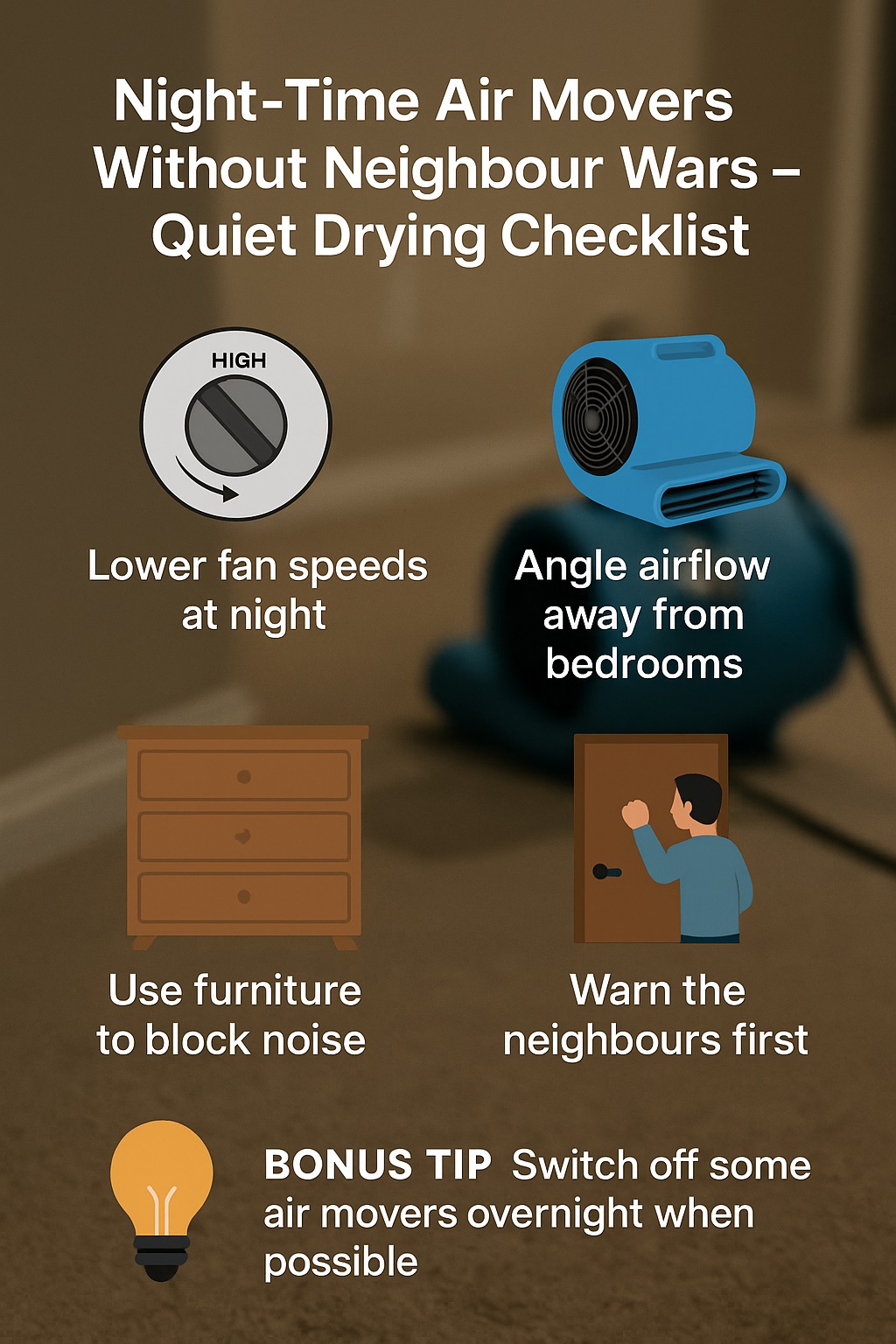
When I run my air movers at night, I’m not just drying carpet – I’m trying not to start World War III with the neighbours.
Air mover noise during night-time drying can disturb neighbours, affect sleep, and trigger complaints. This guide explains how to set up neighbour-friendly drying, balance noise with mould risk, and keep homes safe and dry without upsetting the whole street.
Typical Night-Time Air Mover Noise Data
| Metric | Typical value / range |
|---|---|
| Air mover noise at 1 m | About 60–70 dB |
| Recommended bedroom noise at night | Around 30 dB or lower |
| Outdoor night noise to protect sleep | Under about 40 dB on average |
| “Safe” long-term daily noise exposure | At or below about 70 dB |
| Vacuum cleaner / loud fan comparison | Often around 60–70 dB |
Source: who.int World Health Organization+4World Health Organization+4Quality Planning+4
🔊 My Night-Time Drying Reality: What I Hear On Real Jobs
The late-night fan roar I’ll never forget
The first time I left a full line of air movers running overnight in a small townhouse, I honestly thought, “Sweet, this will dry fast.” By 11pm, my phone was buzzing with texts about humming walls and vibrating pillows. That was my wake-up call about real-world noise, not just airflow.
How different air movers actually sound in real rooms
On paper, two fans can both say “65 dB”. In a bedroom with hard floors and bare walls, that can feel like a plane taxiing. In a lounge full of curtains and sofas, it feels more like a strong bathroom fan. Axial air movers have a smoother “whoosh”, while some compact snails have a sharper, more annoying pitch. kironmotor.com+1
Why I sometimes “waste” speed to save sanity
My old mindset was simple: maximum speed, shortest drying time. Now I think: maximum sustainable speed. If the noise level makes people furious or exhausted, they’ll switch the gear off at midnight and not tell me. A slightly slower, neighbour-friendly setup usually dries better than a setup that gets unplugged in secret.
Dr Karen Li, Chartered Occupational Psychologist (CPsychol), often reminds her clients that performance you can stick with usually beats any “perfect” plan that people abandon overnight.
🧾 How I Explain Air Mover Noise To My Customers
My quick “decibel talk” in plain English
When I walk into a job, I don’t start with physics. I say, “These fans will sound a bit like a loud bathroom fan or a quieter vacuum cleaner. They’re safe for hearing in the short term, but they can be annoying at night if we don’t plan properly.” That one sentence calms people down fast. NIDCD+1
Setting expectations before the first complaint
If I know the gear might run past 9–10pm, I say upfront, “Tonight is likely the noisiest; we’ll try to turn some units down when humidity drops.” I show them how to close specific doors, which rooms will be loudest, and where people might want to sleep instead. It feels basic, but it prevents so many angry next-day calls.
Backing my story with health and standards
I’ll often say, “Noise at night matters because the World Health Organization suggests bedrooms should be around library-quiet for proper sleep, and councils set their own night limits too.” I don’t drown people in numbers; I just show that I’m not making it up – health agencies and standards people care about this as well. Far North District Council+4World Health Organization+4Quality Planning+4
Acoustic consultant Mark Reynolds, CPEng (Acoustics), likes to remind builders that “what people feel about noise often matters more than what the meter says.”
📜 How I Work With Local Noise Rules And Quiet Hours
Why I bother checking local noise rules
I’m not a lawyer, but I don’t want my gear to be the star of a council complaint. Many residential rules aim for around 40 dB or so at night at the property boundary. That’s much quieter than a fan in a wet room, so I think in terms of reducing what “leaks” through walls and windows. unitaryplan.aucklandcouncil.govt.nz+1
Balancing council rules and water damage
Some nights I look at the house and think, “If I only run one fan, this place could grow mould.” Other times, it’s safe to switch some units off and rely more on dehumidifiers overnight. I explain this trade-off to customers: obeying noise rules while still protecting the building is a balancing act, not a switch. World Health Organization+1
When I split the job into extra days
On tight townhouses or apartments, I often go for “loud days, quiet nights.” I hammer the airflow during daytime, run fewer units at night, and simply extend the job by a day. Yes, it’s slightly more cost and time, but customers prefer that over a furious neighbour banging on the door at 1am.
Environmental planner Rachel Moore, MNZPI, often points out that “a legal limit is the floor, not the target; good neighbours usually aim lower.”
🛠️ The Ways I Make My Air Movers Quieter At Night
Using fan speed like a volume knob
My simplest trick: full power while everyone’s at work, lower speeds once kids go to bed. Airflow drops a bit, but the noise and annoyance drop a lot. It’s like dimming the lights. I also stagger start-up times so there isn’t one big “whoomp” of noise when all units fire up together. kironmotor.com+1
Aiming airflow away from thin walls
On one job, I had an axial fan pointing straight at a paper-thin shared wall. The neighbour could feel the vibration through their headboard. I turned the fan ninety degrees so it blew along the room instead of into the wall, added a dehumidifier, and the complaint disappeared while the drying stayed on track.
Letting furniture and doors act as sound shields
I’ve learned to use heavy furniture as accidental acoustic panels. A bookcase or wardrobe between a fan and a bedroom wall can soften the noise surprisingly well. I’ll also close some doors fully, leave others slightly open, and create an “airflow path” that doesn’t blast sound straight down the hallway into sleeping rooms.
Dehumidifier-heavy nights, fan-heavy days
If humidity is already dropping nicely, I’m happy to let dehumidifiers do more of the work overnight. They’re not silent, but in many homes they’re less sharp and annoying than several high-speed air movers. Then, next morning, I crank the fans again while everyone is dressed, awake, and less sensitive to noise. Daikin Internet+1
Mechanical engineer Dr Liam Carter, CPEng, jokes that “every fan is also a musical instrument – you can’t mute it, but you can tune how people hear it.”
🚪 How I Talk To Neighbours Before And During Night Drying
My simple neighbour intro script
If I know noise might be an issue, I knock on the neighbour’s door before the fans go on blast. I say something like, “Hi, I’m helping your neighbour with water damage. We’ll have drying fans running; they might sound like a strong bathroom fan through the wall for a couple of nights.” That one minute saves hours of drama.
Giving neighbours control and a direct line
I hand over my card and say, “If the noise feels too much, please text or call me before you call council. Often I can turn a fan or two down or move something.” People feel heard when they know there’s a face and a phone number, not just a mystery hum in the dark. Quality Planning+1
Owning my mistakes when it goes wrong
I’ve had nights where I didn’t warn anyone because I thought, “It’ll be fine.” Spoiler: it wasn’t. Now, if I get a complaint, I apologise first, then explain the drying risk, then offer solutions – reduced fan count, different layout, earlier switch-off times. Being defensive never works; being practical usually does.
Clinical psychologist Dr Amy Hughes, PhD, likes to say “a thirty-second apology can lower stress more than a five-decibel noise reduction.”
📊 Case Study: How My Customer And I Solved A Night-Time Noise Complaint
The townhouse that almost became a feud
One of my most memorable jobs was a two-storey townhouse with soaked carpet on the ground floor and bedrooms sharing party walls. I set up three air movers and a dehumidifier, left them overnight, and by 10:45pm the neighbour was messaging the customer about a “constant freight train” sound. Not ideal.
We got on a three-way call. I drove back, re-angled the fans, dropped one speed, moved a unit further from the shared wall, and agreed on earlier switch-off hours. We still kept enough airflow to dry safely, but the neighbour reported a “big improvement” the very next night. Here’s the rough data I tracked:
Customer Night Noise Case Data
| Item | Value |
|---|---|
| Number of air movers (before/after) | 3 → 2 |
| Approx. noise at neighbour’s wall | ~65 dB → ~55 dB |
| Overnight run time | 10pm–7am → 9pm–6am |
| Moisture reading day 1 → day 3 | 28% → 14% |
| Formal complaints received | 1 → 0 after changes |
Urban planner James O’Donnell, MNZPI, often notes that “small changes in timing and layout can transform a nuisance into something a community quietly accepts.”
❓ FAQs About My Air Movers, Noise And Night-Time Drying
Is this noise level dangerous for hearing?
In most homes, air movers sit roughly in the loud-fan or quiet vacuum range. That’s generally below the levels linked with immediate hearing damage but can become tiring if you’re exposed for hours, especially at night. I treat comfort and sleep as seriously as strict “hearing safety” numbers. NIDCD+2Noise Awareness Day+2
Can I switch some fans off at night?
Sometimes, yes. If moisture readings are improving and humidity is under control, I’m comfortable turning the “least important” units off for sleep and relying on dehumidifiers plus a few key fans. I always explain which units are okay to touch and which ones must stay on no matter what.
How long should air movers run overnight?
On a typical residential job, I aim for a continuous 24/7 run in the first day or two, but I adjust night settings to be more neighbour-friendly. If sleep is totally wrecked, people will start turning things off randomly, which is riskier than a planned “quiet mode” schedule.
What’s a normal noise level for professional air movers?
Many spec sheets put them around 60–70 dB at close range – about like a normal conversation to a vacuum cleaner, depending on the model and room. In small echoey bedrooms, it’ll feel louder than in a big furnished lounge. That’s why I always test noise in the actual rooms, not just trust the brochure. kironmotor.com+1
When should I call my restorer if neighbours complain?
If neighbours are losing sleep, don’t wait. Message or call me straight away. Usually I can shift a fan, change speeds, or tweak timings and still keep the drying plan on track. Waiting until everyone is furious just makes the whole job harder for you, me, and them.
Audiologist Dr Nina Patel, MNZAS, often tells patients that “most damage from everyday noise isn’t from one huge blast – it’s from stress and tiredness building up over time.”
✅ Takeaways: How I Dry Fast And Still Stay Friends With The Street
My simple rules for night-time drying
Over the years, I’ve learned to treat noise management as part of the restoration job, not an optional extra. I plan loud days and quieter nights, explain things clearly, test noise in the real rooms, and give customers and neighbours a direct line if something feels too intense. It’s part drying, part diplomacy.
If a setup looks great on paper but ruins everyone’s sleep, it’s not a good setup. I’d rather add an extra day, adjust the gear, and finish with dry carpets and neighbours who don’t hate the sound of my van. That way, the next time there’s a leak on that street, they’re happy to see me again.
Risk analyst Prof Michael Turner, FRM, likes to say “a fix that creates a new problem isn’t a fix – it’s just a different crisis on a delay.”
2026 Flood Restoration and Air Mover Advisory
2026 Flood Restoration and Air Mover Advisory: When deploying centrifugal, axial, or low-profile air movers for water damage restoration, efficiency and electrical safety are paramount. Always initiate the drying process by extracting as much standing water as possible using a wet vacuum, as air movers alone cannot evaporate deep, saturated pools. Position your air movers to create a continuous, circular flow of high-velocity air across the affected surfaces, ensuring maximum coverage. Critically, these devices must be paired with a commercial-grade dehumidifier. Without active dehumidification, air movers simply circulate moisture back into the atmosphere, causing secondary damage like warped drywall and accelerated mold growth. Ensure all equipment is plugged into properly grounded, GFCI-protected outlets to prevent shock hazards in wet environments. Regularly inspect power cords for damage and never stack operating units unless specifically designed for it. Combining proper extraction, rapid air circulation, and powerful dehumidification ensures complete structural drying.
Hire professional-grade equipment from 7 Hire. We offer fast local pickup or delivery across Auckland.