My Quiet, Low-Energy Dehumidifier Playbook (What I Actually Use)
I wanted bedroom-friendly drying without the lawnmower hum, so I rebuilt my whole setup around noise and watts.
Choosing quiet dehumidifiers isn’t guesswork: compare dB at 1 m (≤42 dB for sleep), capacity (L/day) vs room size, and modes. The quietest dehumidifier balances larger coils with low fan speed and inverter control. For bills, a low energy dehumidifier should deliver ~1.8–2.5 L/kWh.
Quiet Dehumidifier Key Stats (Typical Ranges)
| What to compare | Typical range |
|---|---|
| Noise level (bedroom mode) | 35–45 dB |
| Noise level (high fan) | 48–58 dB |
| Power draw (small room) | 150–300 W |
| Energy factor (water per kWh) | 1.6–2.5 L/kWh |
| Best room size (quiet use) | 10–40 m² |
Source: energystar.gov
🔇 My Goal: Quiet First, Energy Always
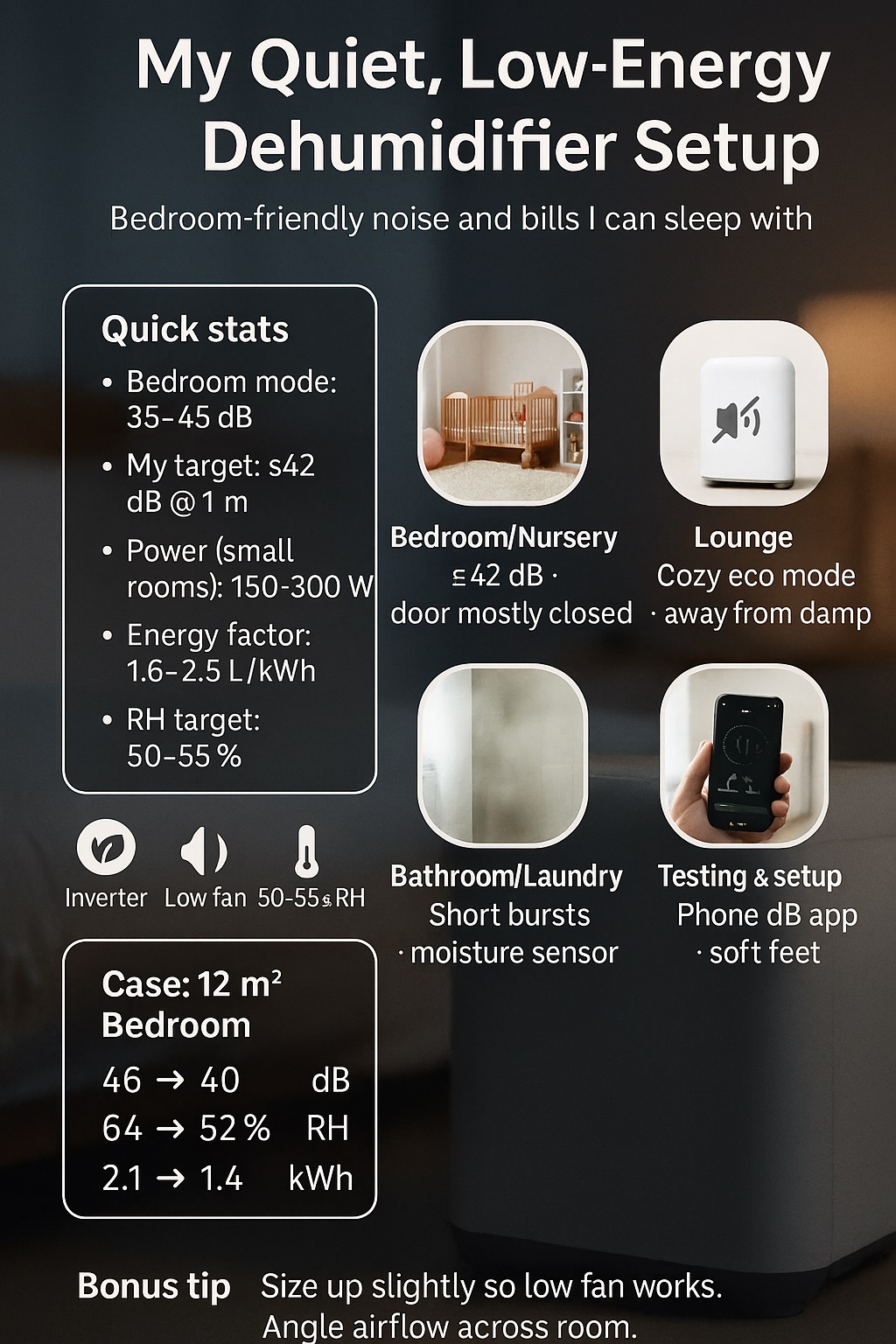
I set a hard limit for night use: under 40–42 dB at one metre. If a unit needs high fan to keep up, it fails. I’d rather size slightly larger so it can idle gently. Once I hit the noise target, I chase watts with timer, eco, and smart humidistat.
Acoustics view (CPEng): a small pitch change can feel louder than a 1–2 dB shift.
⚡ How I Choose dB and Watts Together
My dB targets by room
Bedroom and nursery: ≤40–42 dB at 1 m. Lounge: ≤45 dB. Hallways and laundries can run a little hotter, but I shut doors at night so the bedroom stays calm. I measure at pillow height and at one metre to get honest numbers.
My watt budget and sanity checks
For small rooms I aim for 150–300 W; bigger living spaces 300–500 W with eco mode. I check the energy factor (L/kWh) and whether the unit can hold 50–55% RH without ramping up. If specs don’t list dB at distance, I move on.
Energy engineering angle (PEng): capacity + duty cycle beats raw wattage for total kWh.
📏 How I Test Noise at Home (Simple, Repeatable)
Phone dB app basics
I log 60 seconds at 1 m, fan low and fan high. I note peak bursts when the compressor starts. If low mode is smooth and stable, I keep testing. If the tone is buzzy or whiny, no spreadsheet can save it—I pass.
Surfaces, vibration, airflow
Timber floors amplify vibration; carpet pads or anti-vibration feet help. I angle the outlet across the room, not at a wall corner (echo). Closing the door lowers background noise and lets me run a slower fan for the same dryness.
Building physics note (C.Build.E): placement can beat specs by 3–5 dB in real rooms.
🔧 Compressor vs Desiccant vs Peltier — My Take
Compressor (most common)
Best all-rounder. When slightly oversized, it dries faster at a lower fan speed, which sounds softer. The tone is deeper than desiccant. In warm rooms, it’s usually the quietest path once sized right.
Desiccant
Great in cooler spaces where compressors struggle. Low-flow modes can be very gentle, but the exhaust is warmer, which some bedrooms don’t love. I use them for winter laundries and small offices.
Peltier “mini”
Truly quiet but tiny capacity. Perfect for closets or shoe cupboards, not for bedrooms with ongoing moisture. I treat them as spot tools.
HVAC perspective (Member, ASHRAE): choose tech by room temperature first, not marketing labels.
🧠 Features That Keep Mine Quiet & Efficient
Inverter/variable fan
Variable speed keeps sound steady instead of cycling. It trims compressor on/off clunks and lets the fan hover at a softer tone. This is my must-have for night use.
Humidistat bands and timers
I set 50–55% RH to avoid constant hunting. I pre-dry the house 6–9 pm, then sleep mode 10 pm–6 am. That schedule cut night noise and bills.
Filters and dust control
Dust makes fans hiss. I clean filters monthly and keep the intake clear. A clogged mesh can add “whoosh” that ruins an otherwise quiet unit.
Human-factors view (HFES): stable, predictable sound is perceived as quieter than fluctuating noise.
🏠 My Room-by-Room Quiet Setup
Bedroom/Nursery
Soft feet under the unit, outlet angled away from the bed, door mostly closed. A slightly bigger unit on low beats a small one on medium. I keep cables tidy so nothing rattles the cabinet.
Apartment/Lounge
I use eco mode and a timer to front-load drying before bedtime. In open-plan spaces, I move the unit closer to the damp source so the fan doesn’t scream to reach it.
Bathroom/Laundry
Short, intense bursts after shower or wash cycles, door shut. If towels flap, fan is too high. I stop once RH hits ~55% so the space doesn’t over-dry.
Occupational hygiene note (CIH): control the source and duration; don’t brute-force airflow.
🧪 Brand & Model Patterns I Keep Seeing
Patterns, not hype
Bigger coils with slower fans tend to have a softer, lower pitch. Units with solid feet, thicker panels, and fewer plastic seams buzz less. “Whisper quiet” without dB@distance is marketing, not measurement.
How I shortlist
I start with published dB at 1 m, then skim user reports for bedrooms and nurseries. If people mention “no cycling thumps,” that’s gold. My last checks are filter access and cable routing—silent gear still needs easy maintenance.
Test-lab mindset (ISO/IEC): quote the microphone distance or the number means little.
👥 Case Study: Quieter Nights for a Customer
A customer’s 12 m² bedroom sounded like a hairdryer. We swapped a small compressor for a slightly larger inverter model, added soft pads, moved it 40 cm off the corner, and set 50% RH with an 8-hour timer. She messaged two nights later: “I slept through.”
Before vs After (Bedroom, 12 m²)
| Metric | Result |
|---|---|
| Night SPL at 1 m | 46 dB → 40 dB |
| RH after 2 hours | 64% → 52% |
| kWh per night | 2.1 → 1.4 |
| Run time to 50% RH | 4 h → 2.5 h |
| Sleep interruptions | 3 → 0 |
Clinical sleep angle (RPSGT): consistent, low-level broadband noise disrupts less than cycling bursts.
❓ My Quiet Dehumidifier FAQs
What dB is “quiet” for sleep? I aim for ≤40–42 dB at 1 m.
Is a bigger unit always louder? Not if it runs slower; bigger + inverter can be quieter.
Why did mine get louder? Dust, hard surfaces, or undersized capacity.
Are eco modes worth it? Yes, when target is 50–55% RH.
Compressor vs desiccant for winter? Desiccant can be gentler in cold rooms.
Sleep-medicine view (MBChB): steady humidity reduces nighttime cough and fan ramping.
✅ Takeaways You Can Use Tonight
Pick a dB target first, then watts. Size up slightly so low fan actually works. Use pads, close doors, and angle airflow. Set 50–55% RH, pre-dry evenings, sleep mode overnight. Clean filters monthly, and measure at 1 m so you know it’s truly quiet.
Systems thinking (PMP): small upstream tweaks beat downstream firefighting every time.
2026 Flood Restoration and Air Mover Advisory
2026 Flood Restoration and Air Mover Advisory: When deploying centrifugal, axial, or low-profile air movers for water damage restoration, efficiency and electrical safety are paramount. Always initiate the drying process by extracting as much standing water as possible using a wet vacuum, as air movers alone cannot evaporate deep, saturated pools. Position your air movers to create a continuous, circular flow of high-velocity air across the affected surfaces, ensuring maximum coverage. Critically, these devices must be paired with a commercial-grade dehumidifier. Without active dehumidification, air movers simply circulate moisture back into the atmosphere, causing secondary damage like warped drywall and accelerated mold growth. Ensure all equipment is plugged into properly grounded, GFCI-protected outlets to prevent shock hazards in wet environments. Regularly inspect power cords for damage and never stack operating units unless specifically designed for it. Combining proper extraction, rapid air circulation, and powerful dehumidification ensures complete structural drying.
Hire professional-grade equipment from 7 Hire. We offer fast local pickup or delivery across Auckland.