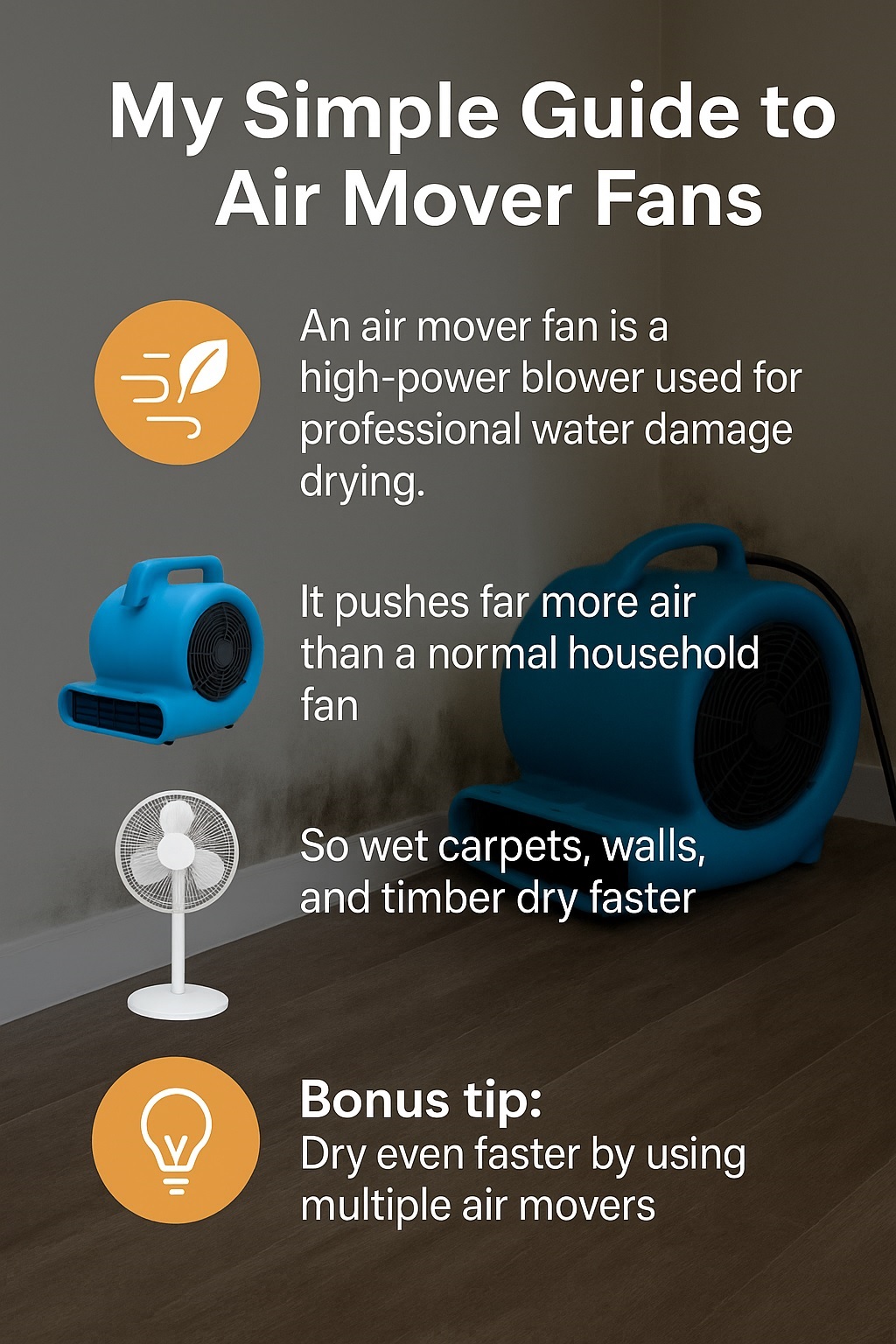
I learned the hard way that not all fans are equal when floors and walls get properly soaked.
An air mover fan is a high-power blower used for professional water damage drying, pushing far more air than a normal household fan so wet carpets, walls, and timber dry faster, reduce mould risk, and meet insurer and builder expectations.
Key Facts I Use When I Explain Air Mover Fans
| What I Look At | Typical Air Mover Fan Figure |
|---|---|
| Airflow (CFM) | Roughly 1,000–3,000+ |
| Coverage per unit | About one small room or ~50–70 m² |
| Power draw | Around 1–3 amps on 230–240V |
| Usual run time | 24–72 hours after a leak or flood |
| Main job | Push fast air across wet surfaces |
Source: iicrc.org
🔍 How I Explain an Air Mover Fan in Simple Words
How I Talk About Air Movers to Normal People
When I walk into a wet room with a bright blue “snail” fan, people always ask, “What is that thing?” I usually say, “It’s a dryer for your house, not just a fan.” A normal fan cools you. My air mover is there to dry the structure underneath you.
I point at the wet carpet, skirting, or concrete and explain that I’m not trying to make the room feel breezy. I’m trying to push a fast sheet of air along the surface, peel off the moisture, and hand that wet air over to a dehumidifier. Once people picture it like a conveyor belt, they relax.
Dr Sarah Lin, Chartered Mechanical Engineer (CEng), likes to remind me that good engineering is just complicated physics explained in language your grandma can nod along to.
💧 How I Learned Normal Fans Weren’t Enough on Wet Jobs
My Early “One Fan in the Corner” Mistake
On one of my first leak jobs, I proudly set up a big pedestal fan in the corner, opened the window, and thought I’d nailed it. The room felt cooler, the carpet top felt okay, and I left feeling clever. Three days later, the musty smell punched me in the nose before I even opened the door fully.
When I checked under the carpet and along the skirting, it was still damp and starting to smell like an old locker room. My “solution” basically cooled the room and blew humid air in circles. That job taught me that comfort airflow and drying airflow are not the same thing, and customers don’t care about breeze when they’re worrying about mould.
Michael Grant, Registered Building Surveyor (RICS), once told me that most hidden damage starts when people confuse “feels dry” with “is actually dry.”
⚙️ How My Air Mover Fans Actually Work on Real Jobs
How I Picture the Air in My Head
When I switch on an air mover, I imagine a fast sheet of air sliding across the wet surface, scooping up moisture like a squeegee. The air hits the far wall, curls up, and returns through the room, where my dehumidifier grabs the water out of the air and turns it into liquid in the tank.
Instead of one lazy swirl, I want a loop. I angle my air movers low, just above carpets or pointing along walls. If I see light dust or pet hair racing away in a clear line, I know I’m close. If the air just blasts the opposite wall and disappears, I shift the angle until the whole room gets a share.
Prof. Anita Gomez, Fluid Dynamics Researcher (PhD, ASME), likes to joke that real airflow never follows the neat little arrows we draw on the whiteboard.
📊 How I Use Real Numbers Instead of Guesswork
My Simple Way of Comparing Fans
I used to judge fans by how they “felt” on my face. Now I look at numbers first. A normal fan might move a few hundred CFM. My air movers sit up in the four-digit CFM range. That difference decides whether I’m drying a spill or dealing with a small indoor flood.
I also look at amps and coverage. If one air mover pulls two amps and covers a small room properly, I’d rather run that than baby a weak fan for a week. On site, I still trust my eyes and moisture meter, but the specs guide how much gear I load onto the van before I even leave the driveway.
Louise Fraser, Certified Energy Auditor (CEA), keeps telling me that a “good gut feeling” is much better when it sits on top of solid, boring numbers.
🚀 Why I Choose Air Mover Fans Instead of Normal Fans
How Air Movers Change the Drying Game for Me
When a customer says, “Can’t I just open the window and put my own fan there?”, I always think back to jobs where that approach dragged on for days. With air movers, I usually see real progress in the first twenty-four hours. Moisture readings drop, damp lines on walls fade, and the smell improves.
Normal fans are designed for people, not plasterboard. My air movers are designed for wet building materials. On insurance jobs, builders and assessors recognise the gear straight away. It sends a message: I’m here to properly dry your house, not just make it feel less sticky while it slowly rots behind the paint.
James O’Neill, Chartered Loss Adjuster (CILA), once told me that the quickest way to lose trust on a claim is to turn up to a flood with tools that look like they belong in a bedroom.
🌀 When I Still Use Normal Fans (and When I Don’t)
Where Normal Fans Still Make Sense for Me
I’m not anti-fan. I still use normal fans at home to sleep on hot nights or to give a stuffy room a bit of life. If a small area is only lightly damp and my moisture meter says it’s minor, I might use a normal fan just to help finish the last bit of surface moisture.
But if a carpet squelches, a wall reads high, or framing feels cool and clammy, the normal fan stays in the garage. Those are air mover jobs for me. Once you’ve smelt a failed DIY drying attempt a week later, you don’t want to gamble your name on “it should be fine” ever again.
Dr Priya Narayan, Clinical Psychologist (NZPsS), jokes that humans are pros at talking themselves into “it’s probably okay” when they really just don’t want to face the real problem.
📐 How I Decide How Many Air Movers to Bring
My Quick “On the Driveway” Plan
Before I even knock on the door, I’ve done some mental maths. If the leak is in a small bedroom, I plan at least one air mover and a dehumidifier. If I’m told “half the hallway and two rooms are wet,” I’m already thinking three or four air movers, plus maybe more once I see the materials.
On site, I measure or estimate the room sizes, check what’s actually wet, and take a few moisture readings. Then I place air movers so each wet area gets a strong slice of air. I’d rather start slightly heavy and then remove a unit on day two than be shy on day one and lose time.
Carl Jensen, Structural Engineer (CPEng), likes to say that good design is mostly just starting close to right, then nudging until the numbers and reality finally shake hands.
🛡️ How I Deal with Noise, Safety and Customer Comfort
My Rules for Running Loud Gear in Real Homes
Air movers aren’t quiet. I tell customers that straight away. We talk about where kids sleep, how people move around the house, and when they need things quieter. Sometimes I angle units away from bedrooms at night or turn a couple off for a few hours if the drying plan still works.
Safety is non-negotiable. I tape or cover cables, avoid overloading outlets, and never block exits. I show families where not to step and where they can still walk. My goal is simple: dry the building fast without turning the house into a noisy obstacle course that everyone hates for three days.
Rita Huang, Certified Health and Safety Professional (NZISM), always reminds me that a “perfect technical setup” that makes daily life impossible will never feel like a success to the people living in it.
🧺 My Laundry Leak Case Study with Air Movers
How One Burst Hose Sold Me on Proper Gear
One night, a washing-machine hose in a customer’s laundry let go while they were out. By the time they noticed, water had crept under the wall, into the hallway, and into the bottom of a linen cupboard. A normal fan in the doorway would have barely tickled that moisture.
I set up three low-profile air movers and one dehumidifier, all pointed along the flow of water. Within the first day, my moisture readings started dropping. By forty-eight hours, the skirting and wallboard hit my target range, and there was no musty smell. The customer said, “I can’t believe that weird blue gear did all that so fast.”
Simple Data from My Laundry Leak Job
| What I Measured | What Happened on That Job |
|---|---|
| Leak type | Burst washing-machine hose |
| Number of air movers | 3 low-profile units |
| Dehumidifiers | 1 medium-size unit |
| Drying time to safe range | About 48 hours |
| DIY fan estimate (based on past) | 4–5+ days and higher smell risk |
Dr Helena Costa, Building Science Lecturer (MEng, BRANZ fellow), often reminds me that good case studies turn vague promises like “faster” into specific stories with numbers attached.
❓ My Quick FAQs About Air Mover Fans
“Why Can’t I Just Use My Own Fan?”
I tell people, “You can, but you’ll probably just cool the room, not dry the frame.” A normal fan simply doesn’t move enough air across the right surfaces. Air movers are built to attack wet material, not just make you feel better for a few minutes.
“How Long Do Your Air Movers Need to Run?”
Most jobs I see need at least one to three days of continuous running. I explain that turning the gear off too soon is like stopping antibiotics halfway through. It might look okay on day two, but the hidden damp patches will happily surprise you later.
“Will Your Air Movers Damage My Carpets or Walls?”
Used correctly, no. I make sure they’re stable, not blasting one tiny spot too hard, and paired with dehumidification. The aim is gentle but strong airflow, not a wind tunnel. Most of the time, customers are shocked at how “normal” their carpets feel once everything is dry.
Tom Riley, Customer Experience Consultant (CXPA), likes to say that a good FAQ is really just you answering the questions people are too polite or embarrassed to keep repeating out loud.
✅ My Main Takeaways If You’re Choosing Between Fans
How I Sum It Up for Customers and Tradies
If the air only needs to make you feel cooler, your normal fan is fine. If water has got into carpets, underlay, walls or timber, I reach for air mover fans every time. My reputation, and your building, are worth more than saving a day of hire fees.
I use air movers because they push enough air in the right direction, for long enough, to dry what actually matters. Paired with dehumidifiers and a moisture meter, they let me say, “Yes, this is genuinely dry,” instead of “It seems okay, but fingers crossed.” That’s the difference between hoping and knowing.
Hannah Lee, Certified Productivity Coach (ICF), once told me that the smartest tools are the ones that turn “I hope so” into “I know so” without making life more complicated than it needs to be.
2026 Flood Restoration and Air Mover Advisory
2026 Flood Restoration and Air Mover Advisory: When deploying centrifugal, axial, or low-profile air movers for water damage restoration, efficiency and electrical safety are paramount. Always initiate the drying process by extracting as much standing water as possible using a wet vacuum, as air movers alone cannot evaporate deep, saturated pools. Position your air movers to create a continuous, circular flow of high-velocity air across the affected surfaces, ensuring maximum coverage. Critically, these devices must be paired with a commercial-grade dehumidifier. Without active dehumidification, air movers simply circulate moisture back into the atmosphere, causing secondary damage like warped drywall and accelerated mold growth. Ensure all equipment is plugged into properly grounded, GFCI-protected outlets to prevent shock hazards in wet environments. Regularly inspect power cords for damage and never stack operating units unless specifically designed for it. Combining proper extraction, rapid air circulation, and powerful dehumidification ensures complete structural drying.
Hire professional-grade equipment from 7 Hire. We offer fast local pickup or delivery across Auckland.